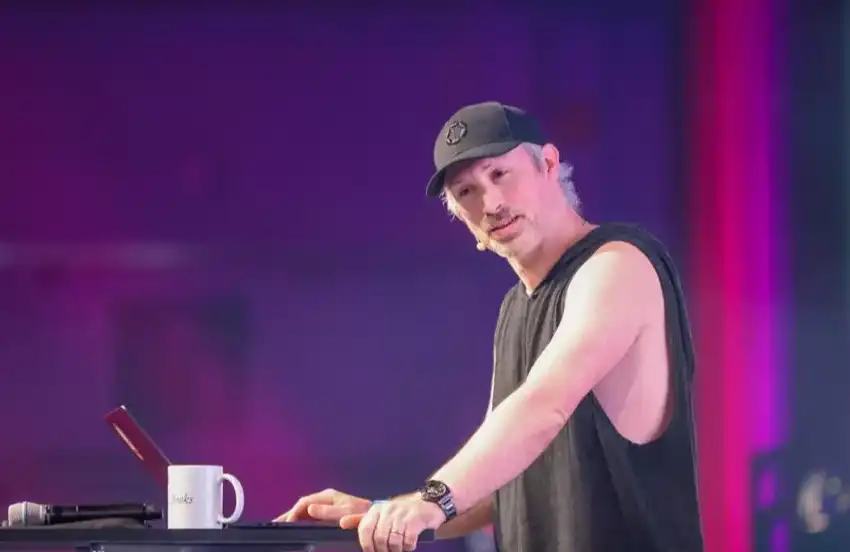
Gavin Wood: Polkadot wants to "make the blockchain great again"
Original title: "Gavin Wood: Polkadot wants to "make the blockchain great again""
Original source: PolkaWorld
At the first Polkadot community meeting Polkadot Decoded on December 3, Polkadot founder Gavin Wood and host Laura Shin has a fireside chat.
The following are some dry goods that PolkaWorld summarized from Gavin’s sharing, This article is the first half of the sharing, mainly including Polkadot’s vision, Polkadot’s abstraction, parachain slot auction, the difference between PLO and ICO, etc. The second half will be published on the PolkaWorld official account soon.
Create What is Polkadot's vision? What problems is Polkadot trying to solve?
Polkadot hopes to create more general and abstract model to solve some problems in the blockchain industry.
Bitcoin has opened the basic scripting language, and Ethereum has extended more There are many ways of financial transactions, and Polkadot hopes to create a more general model. On this basis, we also hope to solve some basic scalability issues, such as how to reach more transactions and how to handle a lot of work on the network. So these two topics are symbiotic, that is, versatility and scalability.
Our vision is to make "blockchain great again ( Make blockchain great again), leading the blockchain to take a step forward, we want to solve the existing problems we know. In fact, if we can travel back to four or five years ago, we will find that people were also talking about "how to process different transactions on multiple nodes" and "we really need to become more generalized". These are actually Polkadot's attempts to solved problem.
specific What is generic and abstract? You said that Polkadot is a meta-protocol, can you explain what this means?
The "meta" of the meta agreement means to go beyond , "Meta-protocol" refers to the protocol that manages other protocols. You can build other protocols on the basis of it. It is the protocol of the protocol. I mention the meta-protocol here because it is a more low-level, basic, and simple protocol, and we will build those protocols that we generally think of on the basis of it.
For example, the Bitcoin protocol is to distribute blocks , when you execute and interpret a block, the transactions in the block are like some scripts, but the meaning is to send some bitcoins to a certain address, this is a protocol, through which the nodes of the bitcoin network know how to To explain these blocks, it is essentially a language. But once you determine the agreement, it is like engraved in stone, it is difficult to change, improve, add new functions, fix bugs, it is very rigid. The meta-protocol is the lower layer of the protocol and defines the protocol. The advantage is that because the protocol is built on the basis of the meta-protocol, you can easily adjust it, just follow the rules of the meta-protocol, and the main protocol can adapt, evolve and iterate over time.
Then the next question is protocol?". The idea is that we make it as simple and abstract as possible. We choose an existing and proven technology. Many smart people and stakeholders have discussed and concluded that "this may be the best way to do meta-agreement." So we chose WebAssembly because WebAssembly is pretty much the industry standard, it has been iterated. In the beginning there were actually two separate technologies, one built by Mozilla and one by Google, which came together to form WebAssembly. Because it has gone through many iterations, we are unlikely to need to change it, so it is a good foundation, we can build something on top of this meta-protocol, and define everything else based on it. This is the meta-protocol. source of agreement.
So the Polkadot protocol, like parachain, governance, balance, Dot Protocols, staking, etc., these things are constantly changing, but the underlying meta-protocol is the same, which is why we chose a tested technology like WebAssembly. The meta-protocol is indeed mainly about flexibility and abstraction, because the Polkadot protocol is not very abstract on top of it, it has specific sharding, expansion logic, etc., it is still a collection of many viewpoints, and WebAssembly does not have any viewpoints at all, It's not even our point of view.
"Meta-protocol + protocol" is a binary structure. The same goes for Bitcoin to Ethereum and then to Polkadot. Bitcoin is basically unprogrammable, while Ethereum is programmable, but the computing model is very limited, such as gas, dynamic gas price, dynamic resource calculation, limited storage, etc. Polkadot has completely changed this model, because we have a parachain, which is more abstract and general. It is not just a small piece of code like a smart contract, but a whole parachain, which can do any block you can imagine Chains can do things that are much more abstract.
Why is it more abstract? You can implement a smart contract in the blockchain, Edgeware and Moonbeam are already doing this, but you can't build a blockchain in the smart contract in reverse, smart contracts don't have that much computing power, like You can't put shoes in your feet. So we say that Polkadot's model is more general than the smart contract model. Although this does not mean that parachains are more useful than smart contracts at any time, but anything you can do with smart contracts can be done with parachains, and not vice versa.
wave The card has a parachain, can you define a parachain, and the difference between it and a parathread?
Parallel chains are card slots one by one, It is limited, just like the core of a computer, some computers now have 6 cores, 8 cores or even more cores, and these cores can handle calculations for specific applications. For example, if you open a lot of windows, one core may be processing video, another core may be processing email, and another core may be playing music. They can do different workloads, and the same is true for parachains, but in the blockchain, one of the parachains may be doing smart contract transactions, another may be doing transfer transactions, another is doing governance, and the other is doing Staking is optimized, so multiple parallel chains can work at the same time in each time period. We use blocks to measure time, so we can do so many things at the same time in a specific block.
Parallel threads are when an application does not need to When transactions are processed in a block, it may need to be processed every 10 blocks, that is, a transaction is processed every 1 minute instead of 6 seconds. But this time is also reasonable. After all, Bitcoin transactions sometimes take 1 hour, so 1 minute is enough for some applications. Parathreads are more suitable for these applications.
Can you give an example, which applications are more suitable for using parathreads instead of parachains?
One example is Oracle, Some scenarios are uploading data from the outside world to the chain. For some types of data, uploading every 6 seconds seems too much. For example, weather data may be uploaded once a day or hour, and it does not need to be very accurate. to upload at some point. This scenario is very suitable for parallel threads.
Another example is some traditional applications, such as a business mainly in the United States Generally speaking, insurance companies do not process insurance claims at 4 o'clock in the morning, and usually process them during working hours during the day. So this type of business is also more suitable for parallel threads, because 60% of the time does not need to process transactions.
parallel The chain card slot is limited, so what if the application built on those parachains, such as an oracle machine, wants to run forever?
If you asked me this question a few years ago If so, there may not be a good solution yet, but we came up with parathreads about a year and a half ago. A parathread is a pay-as-you-go parachain. It doesn’t work normally, it only works when you pay, but you only pay for one block at a time.
If your blockchain is useless, it will be difficult to Raise funds to renew the slot, but (lose the slot) does not happen overnight, you have 18 months to convince others that your chain is useful, make your token valuable, and then renew the lease. You have 18 months to secure the next 6 month lease.
Even if you can’t renew your lease in the end, you don’t become A puff of smoke disappears, your chain is still there, applications on it can use passive data migration, and still use parathreads in a pay-as-you-go manner to continue running. It's like you bought a mobile phone number, the package fee is 50 dollars a month, if one day you don't want to use the package, you can keep the number, but change to pay by the call time, how much you pay.
This The question is that many people on Twitter are concerned about, when will the parachain slot auction be held, and when will you develop it?
Before we know when the parachain will go live , will not go to the auction, because everyone needs to lock their DOT. It is not good if everyone does not know how long their coins will be locked.
So the auction of the parachain has to wait for us to go online Let’s talk about the parallel chain test on the chain (such as Kusama/Polkadot).
You The concept of PLO (Parallel Chain Leasing Issue) is proposed. What is the difference between it and ICO (Initial Coin Offering)? How does it circumvent the regulatory issues ICOs face in the US?
We call the lease of the parachain " Crowd-loaning”, which is similar to crowd-funding, but you don’t really have to hand over your hard-earned money in exchange for tokens, it’s just a loan, you lock your DOT in a specific After a period of time, you can get your DOT back after unlocking.
The important thing is that the locking process happens on the Polkadot relay chain , You don’t have to transfer the money to the project party, so you don’t have to worry about the project party running away. The Polkadot protocol itself guarantees that these coins will return to your hands after the lock-up period ends. This lock does not involve transfers, so this may not be an issue for regulators.
Original link
Welcome to join the official BlockBeats community:
Telegram Subscription Group: https://t.me/theblockbeats
Telegram Discussion Group: https://t.me/BlockBeats_App
Official Twitter Account: https://twitter.com/BlockBeatsAsia
 Related Articles