Silicon Valley has no loyalty.
Original title: "Silicon Valley Has No Loyalty"
Original author: Dongcha Beating
On September 30, 2026, two top partners at the same established investment firm tore into each other on social media.
The two are Vinod Khosla and Keith Rabois, both at Khosla Ventures.
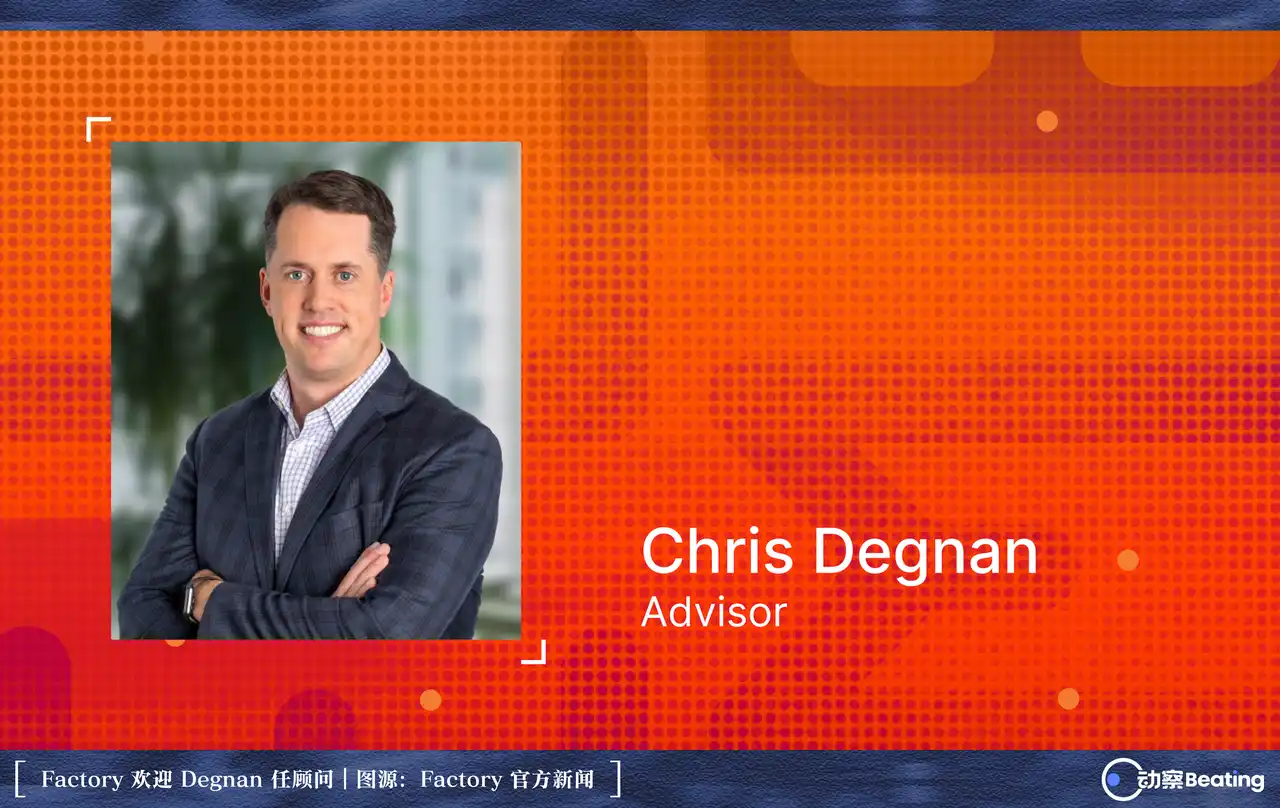
The incident began with a job change that should have been commonplace in Silicon Valley. Chris Degnan, a board observer and strategic advisor at AI coding unicorn Factory, was leaving to become CRO at its direct competitor, Cognition.
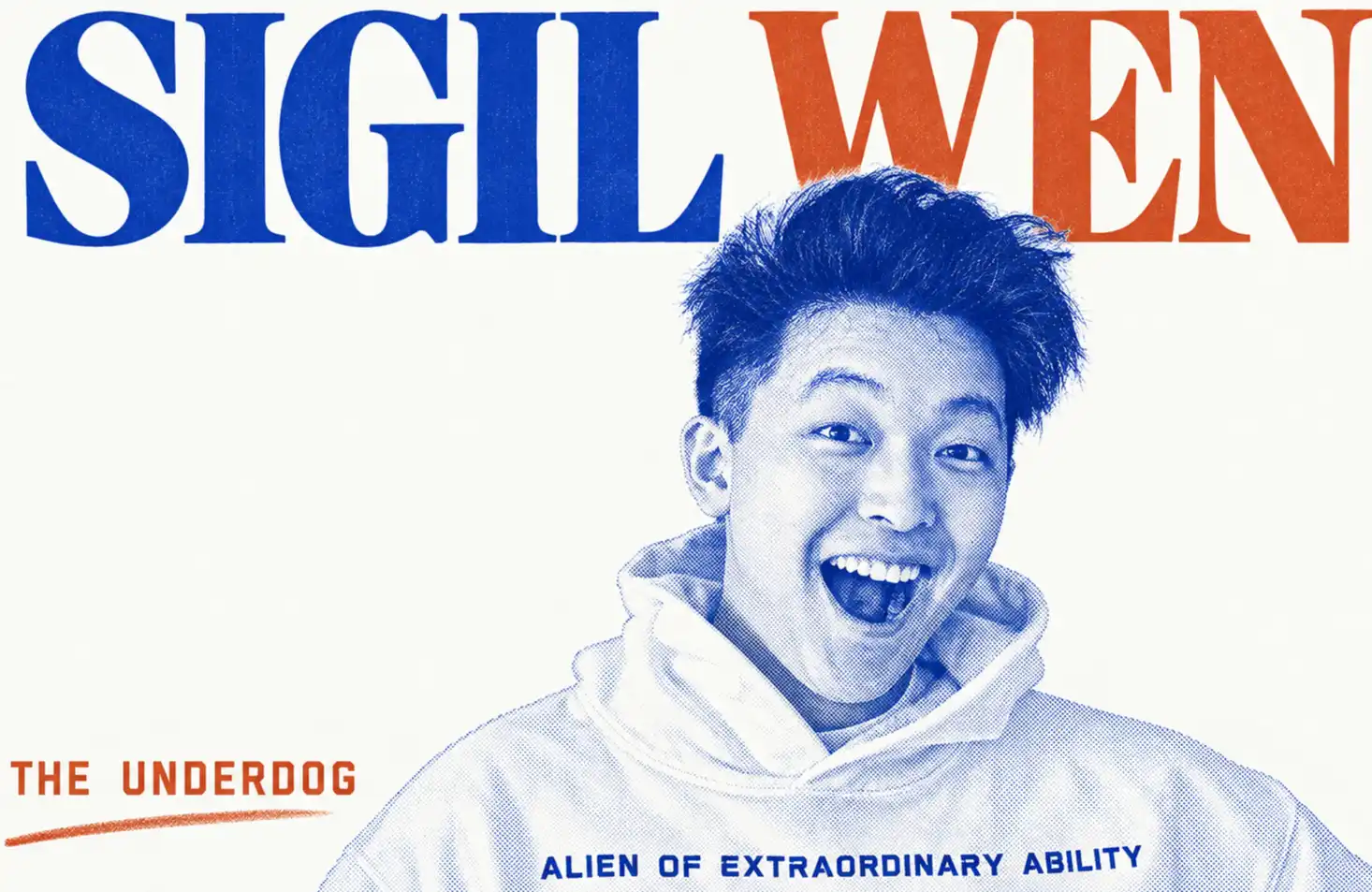
Factory founder Matan Grinberg posted a long statement that day, using harsh language and accusing this core advisor of secretly making moves while participating in confidential discussions, even suspecting that trade secrets had already leaked.
Degnan then announced he was joining Cognition and denied leaking secrets, saying he had already resigned voluntarily; Cognition founder Scott Wu also denied the allegation of improperly gathering competitor information.
Khosla himself posted in support of Degnan, publicly questioning Grinberg's account; Rabois, who belongs to the same investment firm, gave the opposite judgment, arguing that looking at the board's cards while interviewing with a direct competitor "does not hold up ethically."
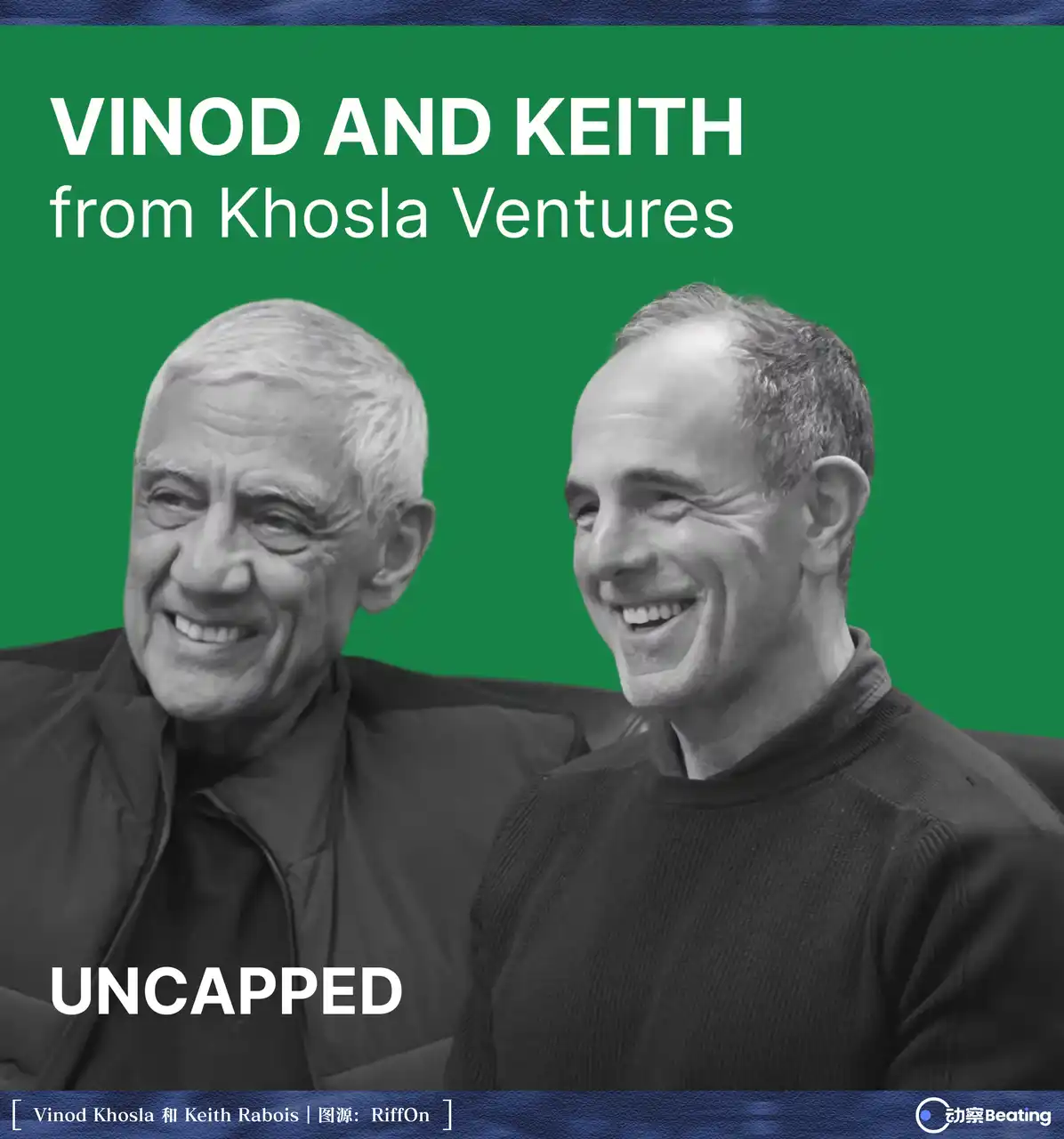
One focus of the argument landed on Keith Rabois.
Before returning to his old employer Khosla Ventures in 2024, Rabois had been a partner at Founders Fund for many years. Founders Fund was Cognition's earliest and most important backer; on the other side, Factory took a check from Sequoia Capital in its seed round.
Pulling out the shareholding relationships of the two institutions makes it easy to see this as two established funds quietly competing.
But the equity relationships are far less neat than that.
Rabois and Khosla are now at the same firm, yet supported different sides. And Khosla Ventures, where they work, itself invested in both companies, both leading Factory's $150 million Series C in April 2026 and being an early shareholder in Cognition. Lux Capital also spans both sides' shareholder lists.
Two AI star companies whose combined valuation based on their latest funding rounds has reached $53 billion are now going head-to-head, and some of the investors behind them hold stakes in both.
We have heard too many myths about VC accompaniment, trust, and faith in technology.
But this public dispute has torn open the most realistic side of the primary market.
Capital can bet on both sides, but key resources are always exclusive.
The Key
The fight over Degnan is essentially a fight over the same scarce asset.
Degnan is not the kind of guest advisor who lends his name, takes a few thousand options, and walks away. He was Snowflake's first sales employee, stayed with the company all the way through its IPO, worked there for more than a decade, and rose to chief revenue officer. In the world of enterprise software, he is a symbol in himself.
Young technical geniuses can shock the world with a few lines of code and a demo, but the procurement departments of major banks and multinational giants want to know far more than whether your model can write code.
What they care about is who can answer the phone when systems go down, who can implement security and compliance requirements, and who can lead a ground force of hundreds to complete enterprise-grade delivery. Degnan happens to have the experience to build that kind of organization.
In November 2025, Factory announced that Degnan had joined as an advisor, hoping to use his experience to expand enterprise customers at scale.
Later, Degnan joined RPT Partners. This is an institution founded by well-known Silicon Valley headhunter Chad Peets and jointly run by the two, bundling investment, sales strategy, consulting, and top-tier recruiting into a one-stop service. RPT lists Factory as an investment and advisory target while also providing services to other companies.
When Cognition announced that Degnan would serve as CRO, it also announced that it would work with Peets and the RPT team to build its own commercial team.
An advisor's advice can be cheaply divided among three companies, but an executive's physical presence and full attention can only be sold to one.
This time, Degnan gave his full-time working hours to Cognition, which is valued at $48 billion.
Loop
The story didn't actually begin with this argument, but with the very first sum of money.
In March 2023, Matan Grinberg, still pursuing a PhD in high-energy physics at Berkeley, sent an email to Sequoia partner Shaun Maguire.
Both studied theoretical physics. In less than an hour, Maguire replied. A few days later, the two took a walk and talked. Within a week, the idea of doing AI programming took shape. Sequoia later recorded on its official website, with a rather legendary flair, that everything from signing the term sheet and incorporating the company to starting development was completed within a single day.
In November of that year, Factory raised a $5 million seed round led by Sequoia and Lux, with participation from BoxGroup and SV Angel, as well as Ali Ghodsi of Databricks and Clem Delangue of Hugging Face.
This is a typical Silicon Valley myth: a young person knocks on an elder's door, and genius is instantly recognized.
But there is a precondition in this myth that is often overlooked: the door has a password. A similar academic background and a résumé that includes co-authoring papers with top scholars made that email quickly identifiable. Another equally smart founder who is not in this context might not receive such a fast reply.
Cognition's ticket to entry was obtained even earlier.
Before launching the globally stunning Devin, Scott Wu had already worked as a software engineer at Addepar when he was young. In a later retrospective, 8VC wrote that they had known Wu for nearly a decade.
The person at the helm of 8VC is Joe Lonsdale, co-founder of Palantir and Addepar. In Silicon Valley, this is a densely connected Mafia circle.
When Cognition's Devin video flooded screens, it also announced a $21 million financing round led by Founders Fund. Long before a company had mature revenue, retention, and financial models, judgments about people had already accumulated over many years.
So-called "early-stage investing is about betting on people" is, in many cases, also "betting on circles."
The stories within the circle were then amplified layer by layer. Sequoia wrote about Factory, 8VC hyped Cognition; Stripe co-founder John Collison invited Scott Wu onto his podcast to talk at length about the future.
They recount how they spotted genius at a glance, and the audience is moved. But don't forget, the storyteller is himself the dealer holding shares at the table. The more captivating the story, the more reasonable the valuation multiple appears.
The narrator and the beneficiary are, from beginning to end, the same person.
Hedging
The speed at which capital swelled was fast enough to make everyone dizzy.
Factory raised a $15 million Series A in mid-2024 at a $120 million valuation; by the fall of 2025, a $50 million Series B pushed the valuation to $300 million; in April 2026, Khosla led a $150 million Series C, driving the valuation to $1.5 billion; just five months later, another $200 million pinned the valuation at $5 billion.
Cognition ran even harder. In September 2025, Founders Fund led over $400 million at a $10.2 billion valuation; in May 2026, Lux, General Catalyst, and 8VC led over $1 billion, sending the valuation straight toward $26 billion; by September, a16z and Accel joined a new round, co-leading with Founders Fund, General Catalyst, and Avenir, pouring in over $2 billion and bringing the valuation to $48 billion.
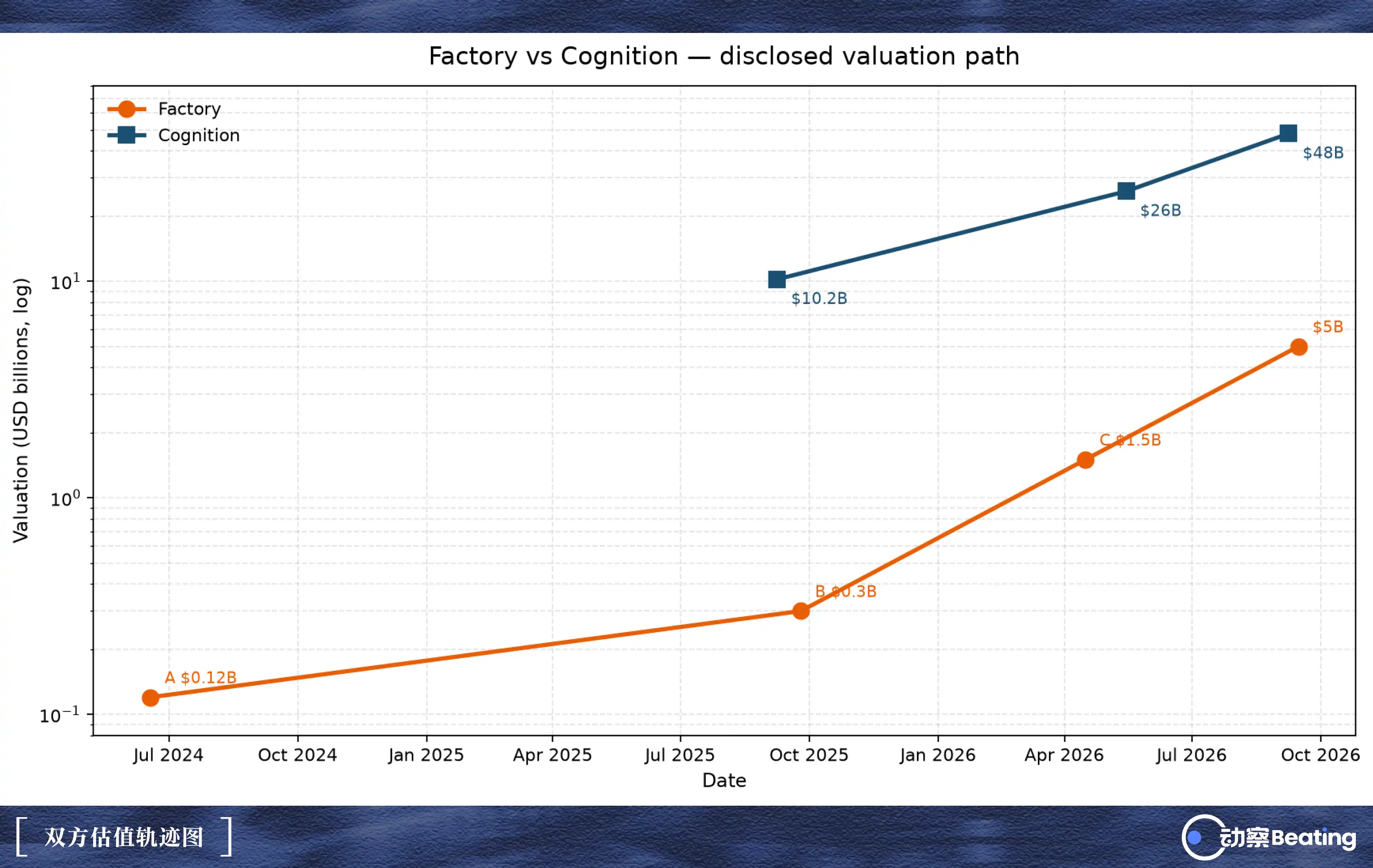
The two companies are racing on the same track, while the list of investors behind them keeps overlapping.
Lux invested in Factory's seed and Series A rounds, then turned around and led Cognition's massive financing; Khosla holds stakes in both; BoxGroup backs both.
For VCs, this maneuver has a respectable name: spreading bets.
Before the technical path has been settled, putting money on two or three runners at the same time is a way to ensure you don't leave the table.
However, capital shares can be split, but specific real-world resources may not be shared.
If a major Wall Street bank has only one pilot slot for a core system this year, whose name will the partner write on the first line of the referral letter? If both companies need a top sales commander at the same time, to whom will the investor's referral and attention go first, the side valued at $5 billion or the side valued at $48 billion?
A more subtle shift is happening inside companies. To seize the initiative, investors personally stepping into operational roles is becoming a new normal.
In May 2026, NEA partner Madison Faulkner directly resigned from the board to become head of strategy at Factory; COO Francesca LaBianca had already joined full-time after driving the Mantis investment. Cognition has a similar path: Christian Lawless of Conversion Capital and Emily Cohen of Neo had long since moved from early investors to full-time colleagues.
When the roles of investor, board member, and executive keep switching, who exactly does the so-called information firewall separate?
Terms
Many people assume that VC investment is a pure pledge of allegiance to founders.
In the past, there were indeed cases of extreme moral fastidiousness. In 2020, Sequoia Capital led a $35 million Series B for payments startup Finix, investing about $21 million itself. Weeks later, Sequoia realized this could create a competitive conflict with Stripe, in which it had previously made a heavy bet.
Sequoia made a rare decision: it gave up all its shares, its board seat, and its information rights, while Finix kept the money already received, thereby resolving the competitive conflict with Stripe.
That was an expensive exit. Sequoia put real money behind a price tag for "avoiding conflict."
But in today's AI feast, holding stakes in competitors at the same time has already appeared in the portfolios of these established institutions.
The loyalty founders expect may not necessarily have been promised in legal texts.
Open Allakos's public investor rights agreement, and you will find a cold clause. Investors explicitly reserve the right to invest in competitors, and even, to the extent permitted by applicable law, disclaim some liability for helping competing companies, even if such help has an adverse effect on the company.
But the same clause also preserves confidentiality obligations, as well as the fiduciary duties of directors and officers, and prohibits the same VC representative from simultaneously serving as a director or observer for both sides.
Competitive investment itself does not necessarily constitute a breach of contract or a violation of law. Which boundaries people with access to confidential information should observe is another matter.
Back then, Alarm.com sued ABS Capital for misusing confidential information to invest in a competitor, but the Delaware Court of Chancery dismissed the lawsuit, and the Supreme Court upheld the ruling.
In that case, where the agreement allowed competitive investments, the facts presented by the plaintiff were insufficient to reasonably infer misappropriation of information.
In his post, Grinberg called board trust a "sacred bond." This statement captures entrepreneurs' expectations, but what obligations Degnan actually had depends on his specific role and contract.
When you invite a powerful figure with countless resources onto your board, you crave access to his network. But it's hard to demand that this network be open only to you.
Transfusion
What is the biggest incremental value an investment network can bring to a startup?
It's not money. In years when hot money floods the market, money is the least valuable thing.
The answer is customers.
Years ago, former Sequoia investor Gili Raanan founded the cybersecurity fund Cyberstarts, which invented an advisory mechanism called Sunrise. They brought together a group of chief information security officers from large enterprises to provide early product advice to portfolio companies.
In return, some participants could share in 4% of the fund managers' performance fees.
This is an efficient connection that also easily breeds conflicts of interest. The IT chiefs of large enterprises hold carry interests in the fund while controlling their own companies' procurement budgets. Although the fund repeatedly stated it "never paid CISOs for purchasing products," when a procurement decision-maker has the chance to earn hundreds of thousands of dollars from fund returns, how independent can their judgment of vendors really be?
After the controversy, Cyberstarts announced in June 2024 that it would pause new compensation arrangements; the advisory program continued, and already allocated carry interests were retained.
In the AI era, new connections have emerged between investors and customers.
In Factory's financing announcement, Blackstone is both an investor and a customer. In May 2026, Anthropic even teamed up with Blackstone, Goldman Sachs, and Hellman & Friedman to jointly establish a dedicated enterprise AI services company to help enterprises deploy large models.
This looks like a perfect win-win: the startup gained a deployment scenario, and the giant gained a technological upgrade.
But for the secondary market or later buyers, it left a black box. Of the increased revenue, how much comes from product competitiveness, and how much comes from shareholder procurement and customers brought in through resource networks? When shareholder relationships change, when customers fully compare other products, will those major clients still renew?
Public growth figures cannot answer these questions.
Epilogue
In this cutthroat battle over AI programming, Cognition has demonstrated more seasoned capital tactics.
In July 2025, Windsurf fell into crisis, and its founder and some core R&D talent were absorbed by Google. Cognition quickly stepped in and signed an agreement to acquire Windsurf's remaining business, including the product, brand, intellectual property, and team, as well as, most importantly, more than 350 enterprise customers and $82 million in ARR.
According to Cognition's later disclosures, this acquisition more than doubled its combined ARR.

In the capital markets, this is textbook inorganic growth. These customer relationships no longer need to be built from scratch; the commercial legacy left by predecessors became part of the subsequent growth and financing narrative.
This is also the cruelest and most fascinating aspect of venture capital: the Power Law.
For a top-tier fund managing billions of dollars, one hundredfold-return winner may be enough to overshadow nine dead also-rans in the same track. Under this incentive, funds are motivated to direct more resources toward the companies they believe are more likely to break out.
In an investment memo, this can be called the optimal allocation of capital.
But entrepreneurs find it very difficult to hedge in this way.
Matan Grinberg's main wealth and professional reputation are still staked on Factory; meanwhile, some of the VCs who invested in him are already sitting comfortably in first class on Cognition's shareholder register.
In November 2025, Factory jubilantly posted a poster welcoming Snowflake legendary sales leader Degnan as an advisor. Less than a year later, Cognition announced that he had become its own chief revenue officer.
The two sides still hold different accounts of the timeline for confidential discussions and the exit.
As of October 2, RPT's official website still listed Factory under its roster of investments and advisors. Meanwhile, in Cognition's welcome announcement, Degnan already had a new title: Chief Revenue Officer of a company valued at $48 billion.
-END-
Original link
Welcome to join the official BlockBeats community:
Telegram Subscription Group: https://t.me/theblockbeats
Telegram Discussion Group: https://t.me/BlockBeats_App
Official Twitter Account: https://twitter.com/BlockBeatsAsia