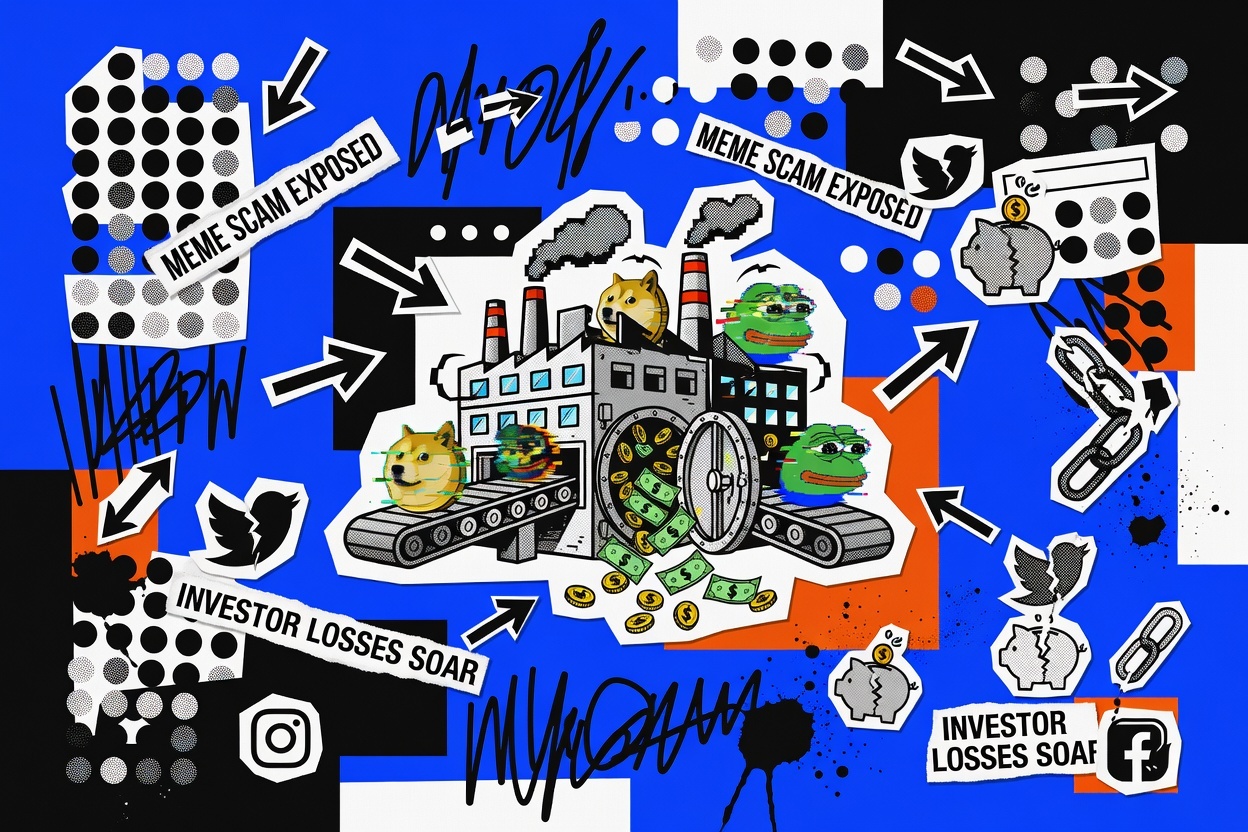
SEC Draws a Red Line on Token Buybacks: Who Controls the Repurchase Determines Whether It's a Mechanism or a Promise
The original title: "Is the buyback narrative facing a turning point? The SEC suddenly clarifies regulatory red lines—not all 'using profits to buy tokens' is absolutely safe anymore."
The original author: Gemini, Shenchao TechFlow
The SEC updates its token buyback guidance, drawing new red lines for the market.
The market has recently become obsessed with that old narrative: protocols make money, then use it to buy their own tokens on the secondary market.
From Hyperliquid to pump.fun, and then to Uniswap and Ethena, almost all leading projects are moving in this direction. "Token buybacks" have become the hardest fundamental in the current crypto market.
The more buybacks there are, the more a project resembles a profitable, high-quality company, and the more bullish factors there are for its token to rise.
But "resembling a profitable company" is precisely the most dangerous compliance tripwire in the crypto industry.
In the United States, the final authority to determine whether a token is a "security" lies with the SEC (U.S. Securities and Exchange Commission). Once the SEC believes that a project is promising the public, "We will work hard and use buybacks to make the tokens in your hands appreciate," the token will be classified as an "investment contract" (security). The consequences are devastating:
Compliant trading platforms such as Coinbase will be forced to delist it, the U.S. capital channel will be completely sealed off, and the business model will come to a direct halt.
To clarify the boundaries here, the SEC has long maintained an official guidance FAQ on "whether crypto assets are securities," which is also the "little red book" used by major law firms and project teams to avoid regulatory minefields.
According to a tip from overseas crypto journalist Eleanor Terrett, the SEC's Division of Corporation Finance updated the FAQ on token buybacks on September 28. The core meaning of the revision is:
Only when the crypto system is already functional and usable, and there is no central party, is an issuer's announcement of a token buyback plan likely not to constitute an "investment contract" promise.
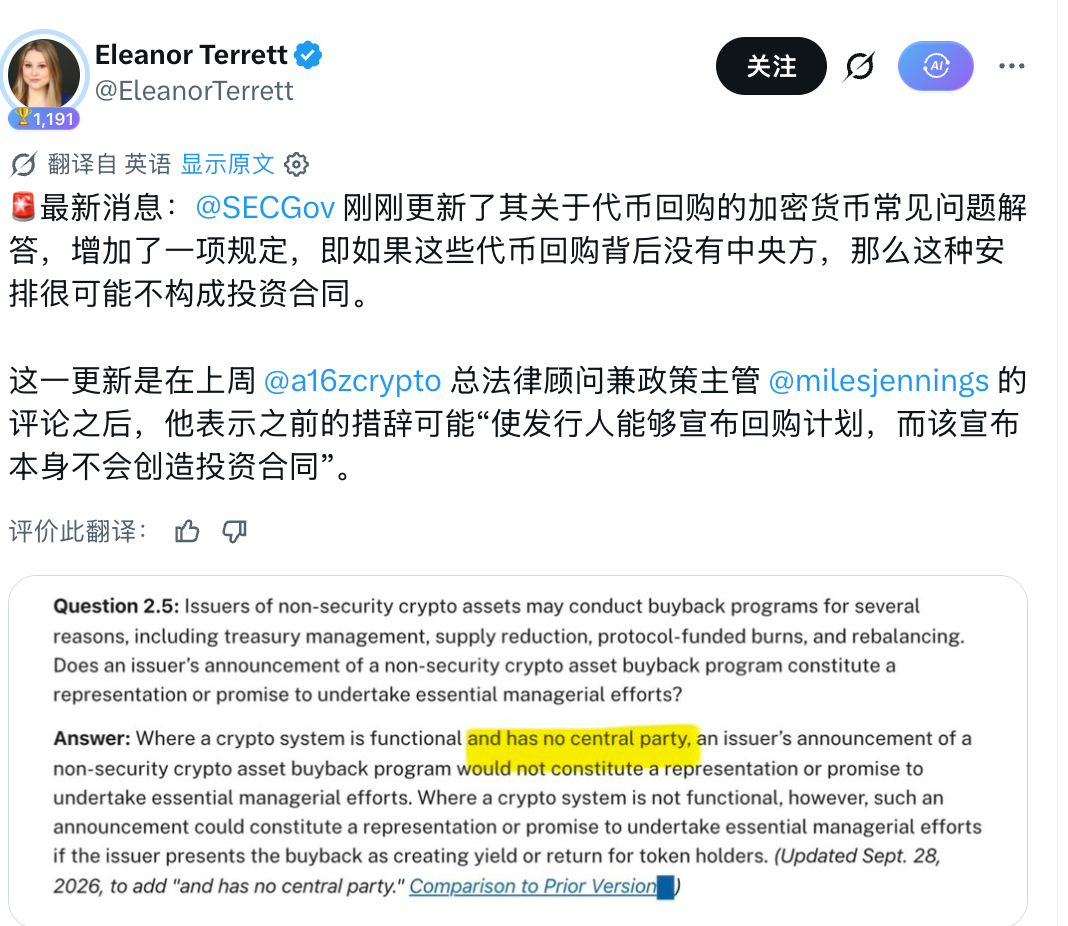
It means that the SEC does not intend to kill all buybacks with one blow, but it has drawn an extremely strict red line: if the buyback is automatically executed by on-chain code, that is called a protocol mechanism;
But if you still have a foundation and a core team (i.e., a centralized party) meeting behind the scenes to decide the buyback amount and aggressively promoting it to the community, then you remain in the high-risk zone of "unlawful securities issuance."
This red line directly forces the dozens of currently hot buyback projects into two camps: safe and high-risk.
Repricing Protocols with Buybacks
Over the past year, the market has priced buybacks in an extremely crude manner: whoever buys more > whoever announces louder > whoever has higher revenue.
But after this FAQ, the market must re-examine its holdings through a "regulatory lens." Buybacks have been clearly divided into two camps: "protocol parameters" and "PR announcements."
Tier 1: Automatic Protocol Execution, Closer to a "No Centralized Party" Safety Cushion
The common characteristics of these projects are: the product is already running, buybacks are mainly executed automatically via on-chain rules, and there is minimal room for the team to arbitrarily change rules or shill on the fly.
The FAQ update currently released by the SEC is environmentally favorable for them when promoting "buybacks," reducing the pretext of "promised managerial efforts."
Hyperliquid (HYPE): The Hardest No-Centralized-Party Sample
Approximately 99% of trading fees go into the Assistance Fund, which is directly converted into HYPE at the L1 execution layer. The funds flow into a system address with no private key that cannot be manually withdrawn. No one can schedule buybacks, and no one can pause them at will.
Based on the literal logic of the FAQ, HYPE is the least afraid of "announcing buybacks constituting an investment contract." However, note that this does not mean it has been given a regulatory "free pass." Unlock selling pressure remains, and buybacks do not equal net deflation—its price ultimately still depends on real derivatives trading volume. The regulatory narrative has stabilized, but the main variable in the income statement has not changed.
Uniswap (UNI): One Less Layer of Verbal Risk
After UNI's governance opened the fee switch, protocol fees enter the TokenJar, and outsiders can only extract these fees by burning UNI. More importantly, the official messaging is extremely restrained, explicitly stating that UNI holders have no direct claim on protocol revenue.
UNI scores high on mechanics, but because Labs and the governance system still exist, a strict application of the "no centralized party" standard keeps it from a perfect score. The FAQ's greatest value to it is substantially reducing the verbal compliance friction of "turning on the fee switch equals securitization," making this kind of "supply adjustment mechanism" more defensible.
Tier 2: Profit distribution type: buybacks are large, but the control narrative isn't clean
This is the tier with the most concentrated retail positions and the most obvious constraints under this FAQ. They still have massive real revenue and buyback activity, but carry a strong "company/team resolution" flavor.
pump.fun (PUMP): profit buybacks with an extremely heavy platform character
Cumulative buyback-and-burn scale has reached hundreds of millions of dollars, making it the symbol second only to HYPE in the current buyback narrative. But the problem is that this looks extremely like a "tech company distributing profits." The team can change the revenue-share ratio at any time, decide whether to stockpile first and burn later or burn immediately, and the platform itself has an extremely clear centralized operator.
The FAQ won't make PUMP stop buybacks, but it will make it very hard to package buybacks as "compliant returns to token holders." For traders, the buyback machine is still running; but for capital that wants to tell a grand network token story, PUMP cannot use this FAQ as a compliance endorsement, and the market will ultimately still focus on its real issuance volume and revenue-share ratio.
Ethena (ENA): highly dependent on foundation thresholds
The foundation proposal directs 95% of net revenue toward ENA buybacks, but the premise is that USDe's supply must reach a higher threshold. Revenue first goes into the foundation, then is used to buy according to governance parameters, and the centralized framework of Labs and the Foundation remains clear.
ENA is more like "the foundation promising future token回流." The least friendly aspect of the FAQ for this structure is the rhetorical restriction: if it continues to heavily promote "95% of revenue returned to token holders," it precisely steps on the language the SEC wants to crack down on.
Established DeFi like Aave / Pendle: the growing pains of moving from committees to automation
These projects have mature products and real revenue, but they are still systems with a heavy flavor of DAOs, founding teams, and treasury committees. Their buybacks can continue, but the story must urgently change from "returns to token holders" to "fund management by the protocol treasury."
In addition, projects that are still in presale, testnet, or have just issued tokens and written "promise to use X% of revenue for buybacks after launch" into their whitepaper as a core selling point are the real targets of this FAQ.
When the system is not yet functional and buybacks are packaged as future returns, the SEC explicitly states that this is highly likely to constitute a "key management promise." Such projects face the most negative constraints: they not only cannot benefit from the FAQ, but also lose "buybacks" — the best shilling weapon during the cold start phase.
Therefore, this SEC FAQ has not killed the currently hot buyback narrative.
It will not make a weak project with no trading volume stronger, but it will give projects with strong mechanisms one less excuse to be attacked by regulators, and give projects with weak mechanisms one less gimmick to sell tokens.
If you can clearly explain the source of funds and control rights, buybacks are fundamentals; if you cannot, then it is just a PR piece that could attract an SEC subpoena at any time.
Original link
Welcome to join the official BlockBeats community:
Telegram Subscription Group: https://t.me/theblockbeats
Telegram Discussion Group: https://t.me/BlockBeats_App
Official Twitter Account: https://twitter.com/BlockBeatsAsia