Crypto's 'Fundamentals Era' Has Arrived: Buybacks, Cash Flow, and Three Valuation Logics
Original: Have Fun Staying Poor: Three Worlds: The Boomerification of Crypto
Author: Evanss6
Editor's note: In 2026, a change emerged in the crypto market that had rarely been seriously discussed before: more and more protocols began discussing revenue, cash flow, and buybacks like traditional companies. According to Allium Labs data, the scale of token buybacks by crypto projects during the year reached $638 million, with Hyperliquid and Pump.fun alone accounting for nearly 90%. At the same time, S&P Dow Jones Indices has authorized Trade[XYZ] to launch officially licensed S&P 500 perpetual contracts on Hyperliquid. The most "traditional finance" side of the crypto market is, paradoxically, expanding rapidly.
On the surface, this is "token buybacks are becoming more and more popular"; at a deeper level, however, the question is: is Crypto's valuation logic splitting? In the past, most altcoins were highly dependent on the BTC cycle, liquidity, and market narratives, but when a small number of protocols begin to generate real fees and continuously return revenue to tokens, while another group of assets continues to be priced based on monetary attributes or attention premiums, the framework that "all Crypto is one type of asset" is becoming increasingly crude.
In Have Fun Staying Poor, Evanss6 calls this process Crypto's "Boomerification"—the entry of traditional asset pricing logic into the crypto market. His core judgment is not that "all tokens should be valued like stocks," but rather the opposite: the market is splitting into three completely different worlds—protocols with cash flow, currencies or Memes without cash flow but honestly relying on consensus, and projects with only roadmaps and promises and lacking a verifiable source of value.
It should be noted that this classification itself is still the author's investment framework, not a universally recognized asset classification system; the author also discloses holdings in LIT, HYPE, PUMP, ZEC, IBIT, and other assets mentioned in the text, so judgments about specific projects should be understood as market views with a clear position background, rather than neutral research conclusions.
The following is a translation of the original text:
A few years ago, the most popular taunt in the crypto market was: "Have fun staying poor."—then just keep enjoying being poor.
At the time, if anyone pressed about how much a token actually earned and where its cash flow came from, it instead made them look like they did not understand Crypto. Price came from narrative, consensus, and growth expectations, and the traditional finance toolkit of profit, valuation, and cash flow analysis was once regarded as inapplicable to "internet-native assets."
By 2026, the market is moving in a nearly opposite direction.
Crypto projects have begun buying back tokens, investors have started comparing protocol revenue, traditional institutions have started analyzing token value recapture mechanisms, and even the S&P 500 has entered on-chain markets through perpetual contracts.
The questions once used to dodge reality — how much money does this thing actually make? And how does the money it makes ultimately relate to token holders? — are once again becoming some of the most important questions.
Buybacks pull Crypto back to "fundamentals"
Hyperliquid is the most typical case of this shift.
According to Hyperliquid's current public documents, about 99% of the fees generated by the protocol go into the Assistance Fund, which automatically buys HYPE in the market; this ratio was raised from 97% to 99% in August 2025. As of August 23, 2026, the Assistance Fund had cumulatively purchased and permanently removed about 46.7 million HYPE, representing 4.7% of the initial total supply.
This has given HYPE a value transmission chain that many tokens did not have in the past: trading activity → protocol fees → token buybacks and burns.
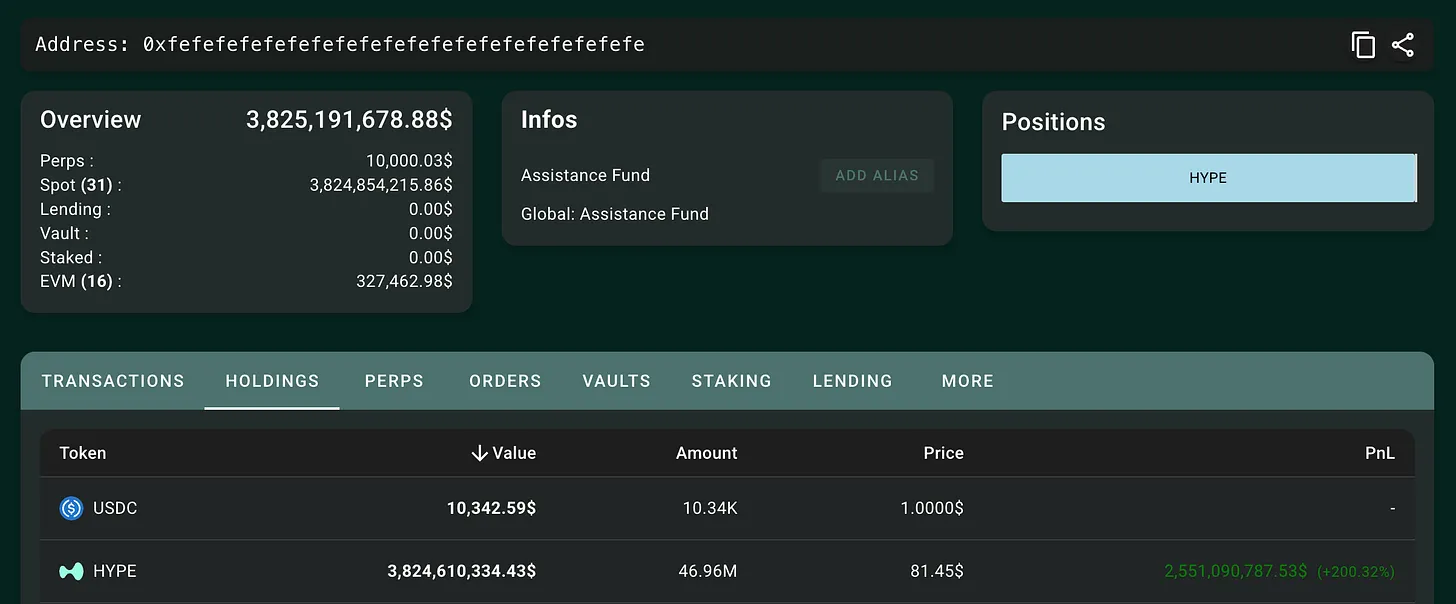
The mechanism by which the Assistance Fund continuously buys back HYPE
In other words, investors can finally begin discussing a question similar to traditional stocks: if protocol trading volume grows and fees increase, how much economic value can ultimately flow back to the token?
This model is no longer just an experiment by a single project. The Financial Times, citing Allium Labs data, reported that as of late August 2026, funds used by crypto projects for token buybacks had reached about $638 million, up from $545 million in the same period of 2025; Hyperliquid and Pump.fun together contributed nearly 90%.
Therefore, the author offers a vivid description: when traditional investors enter Crypto, they also bring their DCF (Discounted Cash Flow) framework with them.
Of course, tokens are not equal to stocks.
Protocol fees do not mean token holders own equity in the business, and buyback mechanisms do not inherently grant tokens residual claims in the traditional securities sense. More importantly, crypto protocol revenue is typically highly cyclical: trading volume rises in bull markets and fees expand rapidly; when bear markets arrive, trading volume, revenue, and valuation multiples can all decline simultaneously.
So what truly needs to be examined is not the peak revenue annualized from a single month, but rather: how much sustainable cash flow the protocol can generate across a full cycle, and how much of that cash flow actually flows back to the token.
This also leads to a simple method the author uses to judge Crypto: delete the roadmap and see what remains.
After "deleting the roadmap," Crypto splits into three worlds
In Evanss6's framework, judging a Crypto asset requires asking only two questions first: Does it actually generate revenue, and can that revenue flow back to the token? If future roadmaps, partnership expectations, and grand narratives are all removed, what remains now?
The answer corresponds to three completely different worlds.
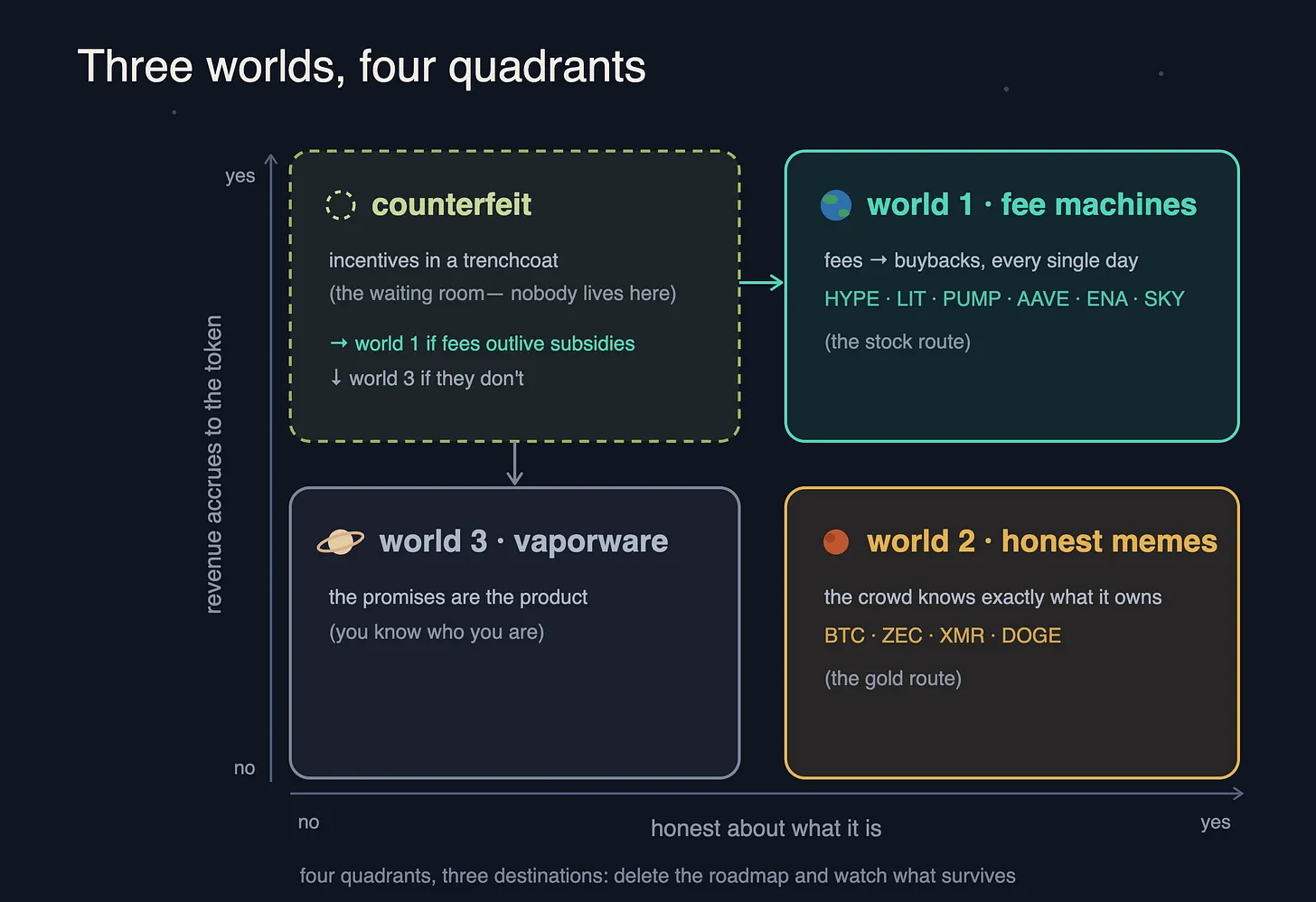
"Three Worlds" classification framework diagram
The first category is Crypto Businesses that can generate cash flow.
These projects already have products that people are willing to pay to use, and at least have a relatively clear "revenue-to-token" transmission mechanism. The author places Hyperliquid, Pump.fun, Lighter, Aave, Ethena, Sky, and others in this category.
They remain highly volatile and still depend on future growth, but the difference from pure narrative projects is that even if all future promises are deleted, users, transactions, and revenue still exist today.
Therefore, for them, the roadmap is a growth premium, not the entire source of value.
But there is another trap here: revenue itself can also be fake "fundamentals."
If trading volume mainly comes from points farming, token subsidies, or liquidity incentives, then seemingly high fees may not necessarily be sustainable. The key to judging whether a protocol can truly enter this category is not how high revenue is during the launch phase, but whether users are still willing to pay after subsidies gradually exit.
The second category is assets that have no cash flow but do not pretend to have cash flow.
The author calls them "Honest Memes." This category sounds misleading, because in the author's framework, BTC, ZEC, and XMR are grouped together with DOGE and PEPE under this broad category, yet the two groups derive value from different sources.
BTC is closer to a non-sovereign store-of-value asset. Its investment logic mainly comes from scarcity, monetary properties, capital flows, and institutional allocation demand, rather than future profits. The author compares it to gold: gold does not publish earnings reports, nor does it have a buyback plan, but that does not prevent the market from assigning it a long-term monetary premium.
On the other side are Meme Coins that rely purely on attention and cultural propagation. They also have no cash flow, but participants usually do not hide this — prices are determined by consensus, traffic, and market structure.
In the author's view, this "honesty" actually makes them easier to understand than the third category of assets.
The third category is projects whose entire value depends on future promises.
These are so-called Vaporware. Once you delete the roadmap, there is no cash flow; no monetary properties have formed; and there is not enough stable cultural or attention consensus. What remains are only promises such as "banks will adopt it later," "the ecosystem will explode in the future," or "a certain partnership is about to land."
However, this does not mean these tokens are certain to fall.
Short-term price and long-term value are two different things. When the real free float is small, perpetual contract shorts are crowded, and borrowing spot tokens is difficult, a token lacking long-term fundamentals can still experience a violent short squeeze; events such as ETF applications, exchange listings, and regulatory progress may also temporarily turn such assets into "event trades" driven by capital flows.
Therefore, "the project has no fundamentals" and "it should be shorted now" are not the same judgment.
A More Important Change: The "Casino" Has Started Trading Stocks
If only a small number of Crypto protocols had started buying back tokens, this framework would not yet count as a structural change. What really matters is that the objects from which these protocols earn fees are also changing.
In the past, the revenue of on-chain trading platforms came largely from Crypto's own speculative activity: someone issues a Meme Coin, someone buys and sells a Meme Coin, and the trading platform collects fees from it. Therefore, a very reasonable question is: are so-called Crypto "cash flow assets" ultimately still just a tax on crypto speculation?
In 2026, RWA (Real-World Assets) perpetual contracts are beginning to produce different answers to this question.
In March of this year, S&P Dow Jones Indices officially licensed Trade[XYZ] to launch S&P 500 perpetual contracts on Hyperliquid, the first on-chain S&P 500 perpetual product to receive an official index license, offering 24/7 trading to eligible non-U.S. investors.
Subsequently, perpetual trading of stocks, indices, and commodities on Hyperliquid grew rapidly. During the week of July 13 to 19, the platform's RWA-related contract volume reached approximately $25.1 billion, accounting for about 52% of total weekly volume, surpassing the combined total of all other asset categories on the platform for the first time.
This changed the revenue boundaries of the "on-chain casino."
If users begin trading Nvidia, Tesla, the S&P 500, gold, forex, and even pre-IPO companies on the same infrastructure, then protocol revenue no longer depends entirely on whether the next Meme Coin emerges.
The author therefore proposes the most important reframing of the entire piece: rather than betting on which Meme will ultimately win, it is better to observe whether the party providing the trading infrastructure can continuously collect fees from the entire market's activity.
The partnership between Robinhood Chain and Lighter is another example of this model.
Robinhood officially launched the Robinhood Chain mainnet on July 1; Lighter CEO Vlad Novakovski subsequently stated on the Unchained podcast that Lighter provides perpetual contract infrastructure for Robinhood Wallet, with related business revenue split 50/50 between the two parties, and Lighter's share going into its token buyback mechanism.
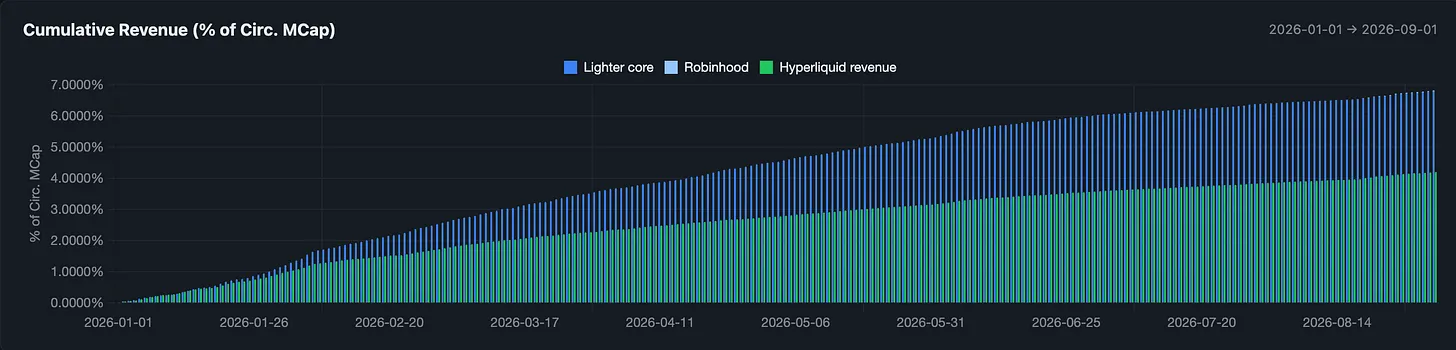
Lighter's cumulative buybacks since TGE
Meanwhile, on-chain activity on Robinhood Chain itself has also grown rapidly. The Block data shows that its single-day DEX volume reached $989 million at one point in late August, with TVL rising to approximately $708 million. However, unlike the original text's emphasis on Meme activity, as of late August, the on-chain growth structure had already begun to spread from July's Meme frenzy toward infrastructure and utility tokens, so attributing its growth entirely to Meme Coins would not be accurate.
Ethena took this logic a step further with USDe.
After the original article was published, Ethena officially announced on September 25 that it would extend part of its USDe backing strategy to tokenized U.S. equities and equity perpetual contracts: holding Binance bStocks as the spot leg while shorting the corresponding equity perpetual contracts to construct a delta-neutral position and capture funding rate yields. The Block reported that at the time, Binance equity perpetual open interest had already exceeded $2.9 billion.
This means that on-chain perpetual protocols are attempting to evolve from "infrastructure for trading Crypto" into "infrastructure for trading global assets."
If this trend persists, some protocols' revenue sources could expand from Crypto's own bull-bear cycles to broader equity, index, commodity, and forex trading activity.
This is where the author's so-called "Boomerification" truly deserves attention.
The Next Crypto Cycle May No Longer Wait for BTC's Starting Gun
In the past, the most classic trading sequence in crypto markets was BTC rallying first, ETH following, and then capital spreading to altcoins.
In that environment, viewing Crypto as a unified asset class was not much of a problem, because most assets shared the same core variable: liquidity.
Evanss6 believes this structure is loosening.
The reason is not that BTC no longer matters, but that some assets have for the first time acquired demand sources independent of BTC. Protocols with cash flows can be traded around fees, growth, and buybacks; monetary assets like BTC can be traded around capital flows, scarcity, and monetary narratives; pure Memes continue to rely on attention; and projects lacking fundamentals are more influenced by circulating supply, leverage, and market structure.
Therefore, he proposes a judgment that can be verified or falsified: in the future, Crypto's "intra-group correlation" may gradually exceed its "whole-market correlation."
In other words, the most important change in the future may not be "whether altseason will still come," but whether the market will continue to be willing to trade millions of completely different tokens as the same Beta.
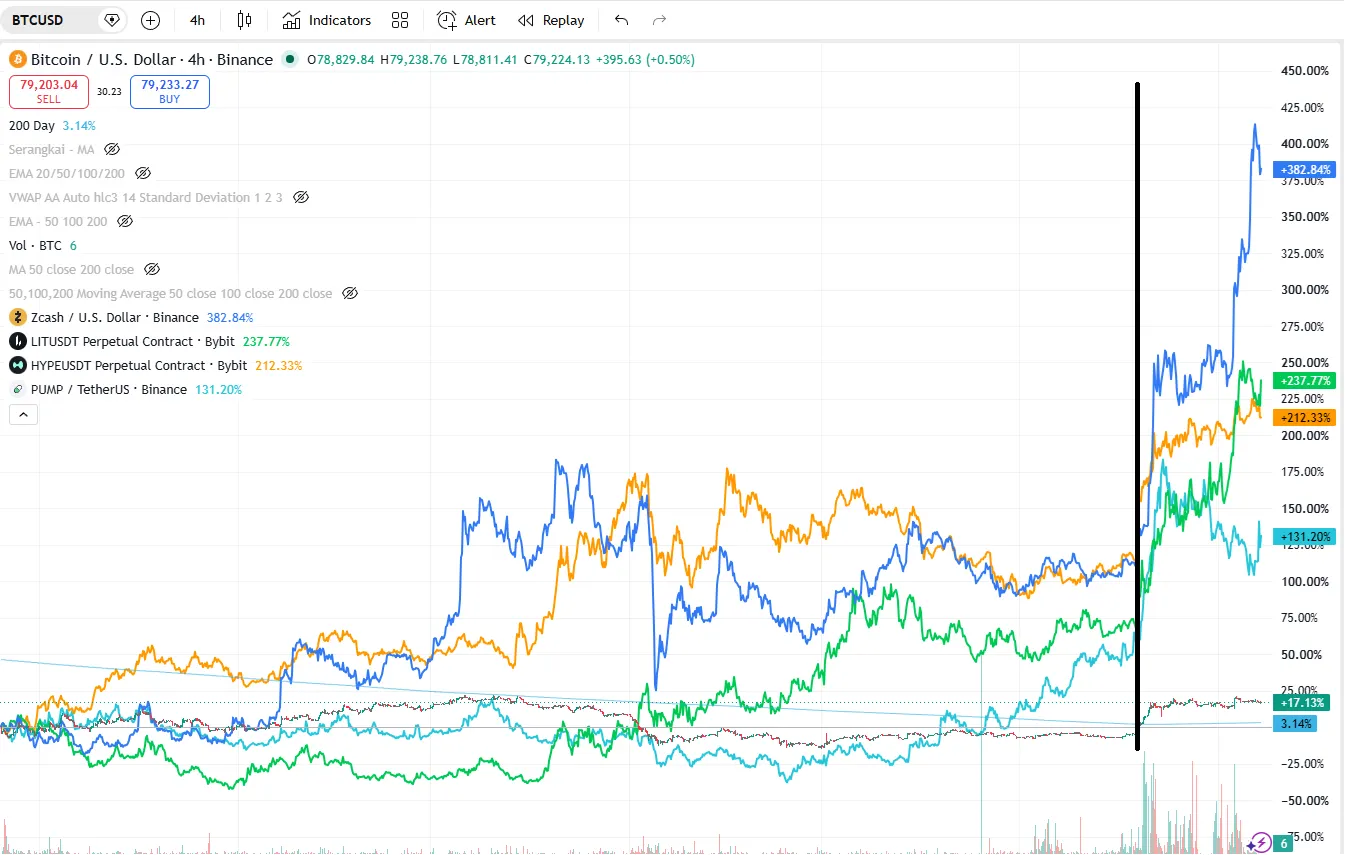
Market divergence chart of HYPE / LIT / ZEC
Regulation remains one of the biggest unresolved variables in this framework.
At the time of the original publication, the author bet that on-chain perpetual platforms such as Hyperliquid and Lighter could potentially secure broader U.S. regulatory access by 2027 at the latest, but this judgment remains a prediction rather than a confirmed regulatory path.
Policy developments since then have also diverged: the U.S. Senate failed to advance the CLARITY Act to the next stage on September 15; two days later, on September 17, the SEC used its existing statutory authority to introduce a temporary, conditional Innovation Exemption, allowing certain Tokenized Securities Venues to trade tokenized U.S. NMS stocks within licensed AMM liquidity pools.
This shows that U.S. regulators are opening up experimental space for certain on-chain securities trading, but tokenized stocks receiving a limited exemption does not mean that on-chain perpetual contracts have already obtained full legal access. The author's judgment that the U.S. market will eventually open up still needs further verification through subsequent CFTC and SEC rules as well as congressional legislation.
Therefore, the variables that truly need to be watched in the next phase are already very specific: whether protocol revenue can hold up after the market cools; whether buybacks come from real revenue rather than token incentives; whether stocks, indices, and commodities can continue to contribute on-chain trading volume; whether tokens have a clear and stable value回流 mechanism; and how much regulatory space major markets such as the U.S. will ultimately grant to on-chain perpetuals and tokenized assets.
Crypto has not therefore become "no longer speculative." What has changed is that a portion of assets has finally begun to show things that can be analyzed within a traditional financial framework: revenue, growth, cash flow, and capital allocation.
Another portion of assets continues to be priced by monetary consensus or attention. What is truly becoming harder and harder to sustain may simply be the third model—one with only a roadmap and nothing that can be verified.
Welcome to join the official BlockBeats community:
Telegram Subscription Group: https://t.me/theblockbeats
Telegram Discussion Group: https://t.me/BlockBeats_App
Official Twitter Account: https://twitter.com/BlockBeatsAsia