DeepSeek has released a visual understanding model, catching the latecomers like Big Blue Whale

Original Title: "DeepSeek Releases Visual Understanding Model, Big Blue Whale Arrives Late to the Party"
Original Author: WatchTowerBeat
On August 21, 2026, DeepSeek launched a brand-new visual understanding model called deepseek-v4-flash-vision-exp, and the multimodal API was officially opened to developers. For the first time, developers can directly feed images into DeepSeek's official interface.
The model retains V4 Flash's 1 million token context and 384,000 token maximum output, supporting JSON Output, Tool Calls, Responses API, and also compatible with Anthropic API.
The pricing is directly inherited from V4 Flash. For every million token input, in case of a cache miss, the cost is 3 yuan during peak hours and 1.5 yuan during off-peak hours; for cache hits, the costs are 0.1 yuan and 0.05 yuan respectively. The output costs 9 yuan during peak hours and 4.5 yuan during off-peak hours. Beijing's peak hours are from 9:00 to 12:00 and 14:00 to 18:00 daily, with the remaining 17 hours at half price.
Image processing is also token-based. Before entering the model, each image will automatically scale based on size, with images smaller than about 384×384 pixels enlarged and large images compressed to around 800×800 pixels based on total pixel count. A single image can take up to 384 tokens. A 2000×2000 image and a 5000×5000 image may end up consuming the same number of tokens.
Based on the 384-token limit, the input cost for a single image during peak hours with a cache miss is approximately 0.001152 yuan. Processing a thousand such images, the image input cost itself is only about 1.152 yuan, with text and model output calculated separately.
Also launched alongside is the Files API. Developers can pre-upload images and then include the file_id in the request. The same image only needs to be uploaded once and can be repeatedly referenced in different requests.
This API itself is free of charge. Individual files can be up to 64 MiB, with each user able to store a maximum of 25 GiB and 10,000 files. Files can be set to expire between 1 hour and 30 days, or they can be kept indefinitely if no expiration is set. Currently, the official platform does not offer an interface to download file contents. Developers can upload, query, and delete files, but the model can only read them. It functions more like a free image repository tailored for inference rather than a conventional cloud drive.
But what's strange is not that DeepSeek started looking at images only today.
Two Timelines
If we only look at the research, DeepSeek's vision isn't late at all.
But if we only look at the product and API, it is indeed very late.
On March 11, 2024, DeepSeek-VL was open-sourced.
It comes in two versions, 1.3B and 7B, capable of viewing natural images, web pages, formulas, charts, and documents. By October, Janus emerged, combining image understanding and generation into the same autoregressive framework. On November 13, JanusFlow followed suit. In December, DeepSeek-VL2 was released, adopting a hybrid expert architecture, with a total parameter count divided into three tiers: 3B, 16B, and 27B.
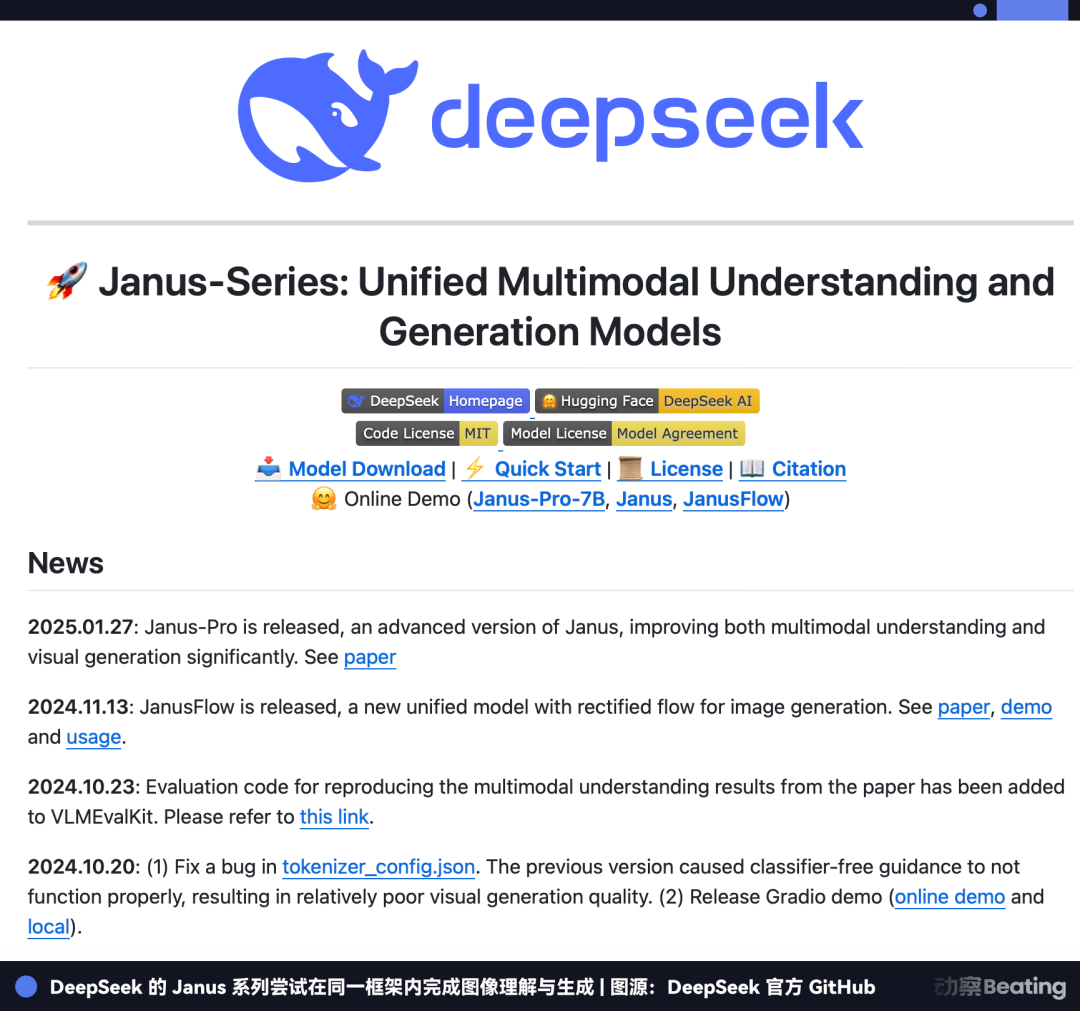
In the early morning of January 28, 2025, New Year's Eve, Janus-Pro was open-sourced. The official repository states the date as January 27 in UTC.
The 7B version achieved a score of 0.80 in GenEval, a text-to-image generation task, surpassing the 0.67 of the referenced DALL-E 3 in the paper. It has open-source weights for local deployment and public demos.
DeepSeek did not incorporate it into its managed API.
Just the week before, R1 had already put DeepSeek in the spotlight. Janus remains on GitHub and Hugging Face. For the vast majority of ordinary users, it quickly disappeared from view.
On October 20, 2025, DeepSeek-OCR was open-sourced, using visual tokens to compress long documents. OCR 2 was released on January 27, 2026.
Starting from DeepSeek-VL, in just two years, there are at least seven public records: DeepSeek-VL, Janus, JanusFlow, VL2, Janus-Pro, OCR, and OCR 2.
Visual research has always been ongoing and open to the public.
It's just that ordinary developers have never had that entry point.
On the other hand, by March 2024, developer interfaces of several major competitors could already receive images. In November 2023, OpenAI launched GPT-4 Turbo with Vision, allowing images directly into the Chat Completions API; a month later, Google rolled out the Gemini Pro Vision API; in March 2024, Claude 3 added vision capabilities across the board.
On April 25, 2025, Robin Li stated at the Baidu Create Conference that "DeepSeek is not omnipotent." Among the subsequent questions, there was a single modality.
His judgment was that multimodality would become a standard feature of base models, and the market for pure text models would shrink.
By that time, DeepSeek had been conducting visual research for a year.
Dawn
On April 7 and 8, 2026, some users opened DeepSeek and suddenly found three new entry points in the interface.
"Quick," "Expert," "Visual."
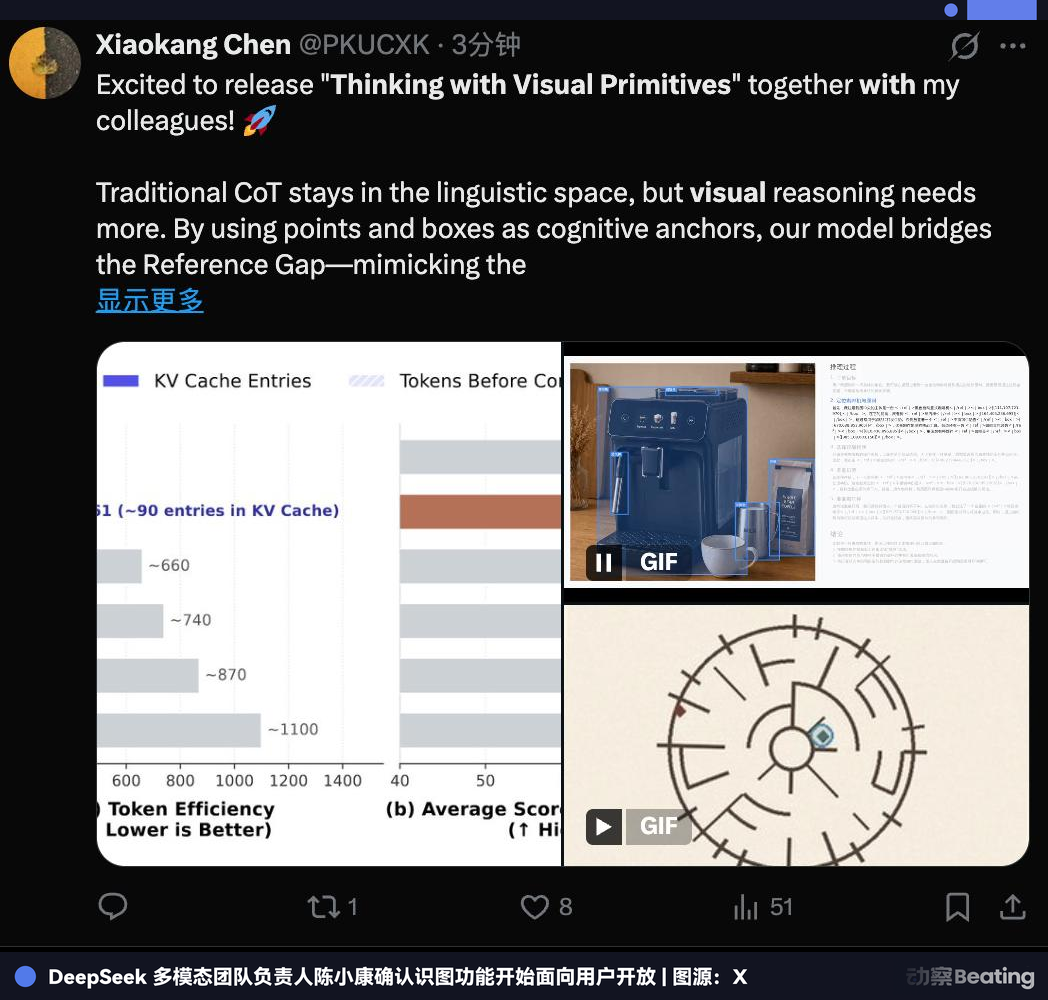
On April 29, Chen Xiaokang, the head of DeepSeek's multimodal team, confirmed that the image recognition function had started to be gradually rolled out to some users. Subsequently, a senior researcher at DeepSeek wrote, "The Little Whale can now see." The South China Morning Post directly incorporated this statement into the headline.
DeepSeek's eyes truly appeared for the first time from the product interface.
The next day, DeepSeek uploaded "Thinking with Visual Primitives" to GitHub. A few hours later, the repository and paper were taken down. By May 1, the original link was already a 404 error. DeepSeek did not provide an explanation, leaving only mirrored copies of the paper online and media coverage.
The paper focused on a very specific issue.
After seeing a crowded image, the model often knew what it was talking about but could not clarify which person or line it was referring to. The team directly inserted point coordinates and bounding boxes into the inference process, enabling the model to point out locations while continuing to process.
A 756×756 image first went through a visual encoder, creating 2916 image patch tokens that were then compressed spatially into 324 tokens through 3×3 spatial compression. V4 Flash's sparse attention further compressed the cache, leaving only 81 visual KV entries in the end.
The team also generated over 40 million training samples for this method, including data specifically designed for maze navigation and path tracing.
What this paper put a lot of effort into solving was actually the "pointing" problem.
The model must see first and then understand what it is looking at. Only in this way can it continue to reason.
This time, DeepSeek did not specify whether Vision Exp fully adopted this Visual Primitives scheme. More importantly, this research exposed DeepSeek's understanding of "visual reasoning" for the first time.
On June 18, the image recognition mode for web pages and apps was officially launched. The next day, some media uploaded a photo of Liang Wenfeng for testing, and DeepSeek mistakenly identified him as Zhang Yiming twice. In another test, it mistook Zhang Yiming for the founder of Cambricon, Chen Tianshi.
It can already read English screenshots and convert web pages into code.
However, when faced with a human face, it can't even recognize its own boss.
On August 19, DeepSeek Harness released a technically detailed document with a specific date. The official adapter can now serialize images into image URLs. The document also stated that the default model directory will not currently display deepseek-v4-flash-vision-exp and needs to wait for the corresponding API endpoint to be available.
On August 20, some developers found that submitting an image to this unreleased model name resulted in a 400 error.
On August 21, this restriction was removed. The Harness added deepseek-v4-flash-vision-exp to the default model directory, and the corresponding merge commit clearly stated "publish the vision model." Subsequently, both the DeepSeek official API documentation and WeChat official account announced the launch of Vision Exp.
The two threads finally came together.
Agent
In a transcription of an investor meeting in May this year, Liang Wenfeng outlined his understanding of the AGI roadmap in several steps: language model, thought chain, Agent, continuous learning, self-iteration, and finally embodied intelligence.
He positioned multimodality as a component, somewhat similar to search.
Regarding video generation, one line in the transcription says:
From a business perspective, it's a good deal. But this has nothing to do with intelligence.
His assessment is that video generation and world modeling are not highly related to intelligence at the current stage. What matters more now is AI training and continuous learning after training.
What makes multimodality different is that, although it is also placed in the position of "component," it is a component that DeepSeek explicitly stated would definitely be developed. Liang Wenfeng mentioned at the time that V4 and subsequent versions would support native multimodality.
In DeepSeek's roadmap, vision has always had a place, just not at the forefront.
As the roadmap progresses to the third step, Agent, the situation begins to change.
DeepSeek has not publicly stated that this vision API was "launched for Agent." However, when Liang Wenfeng's assessment of the roadmap is considered alongside today's release, it is difficult to completely separate the two.
An Agent needs to read the screen, interpret charts, and process screenshots from tools. It cannot live forever in plain text. The visual capabilities that have been developed over the past two years have finally made their way from papers, repositories, and test pages to an API.
The three examples DeepSeek presented to Vision Exp today are not the traditional "image captioning": an Agent creating a Tibet road trip PowerPoint for a high-end client, a redesign of the DeepSeek Harness website, and a frontend demo with dynamic visual effects according to visual requirements.
All of them require the model to repeatedly process visual information in long-running tasks.
The API's design is also moving in this direction. The Responses API also accepts input_image. A browser Agent can receive a webpage screenshot and feed it back into the next round of inference; a code Agent can check the rendering results, and charts, scans, and software interfaces can directly become part of the context.
The Files API addresses another issue: the same image does not need to be repeatedly uploaded in each round of requests. A file can be kept there for a long time, and the Agent only needs to repeatedly send the file_id. Each request can contain up to 600 images. When using external links or Base64, the limit for a single image is 32 MiB, which can be increased to 64 MiB when referenced through the Files API.
This is no longer just about adding an "upload image" button to a chat box.
It is more like providing the foundational infrastructure needed for an Agent to use vision.
DeepSeek's publicly announced four multimodal Agents also rarely focus on the traditional sense of "image captioning."
ApexBench focuses on lengthy process tasks such as investment banking, consulting, and legal work. Agents' Last Exam is sourced from real-world jobs in 55 professional fields. Chartography specifically covers Kaplan-Meier curves, candlestick charts, contour lines, Sankey diagrams, and Porter graphs. ZeroBench, on the other hand, uses 100 manually designed complex questions to test multi-step visual reasoning.
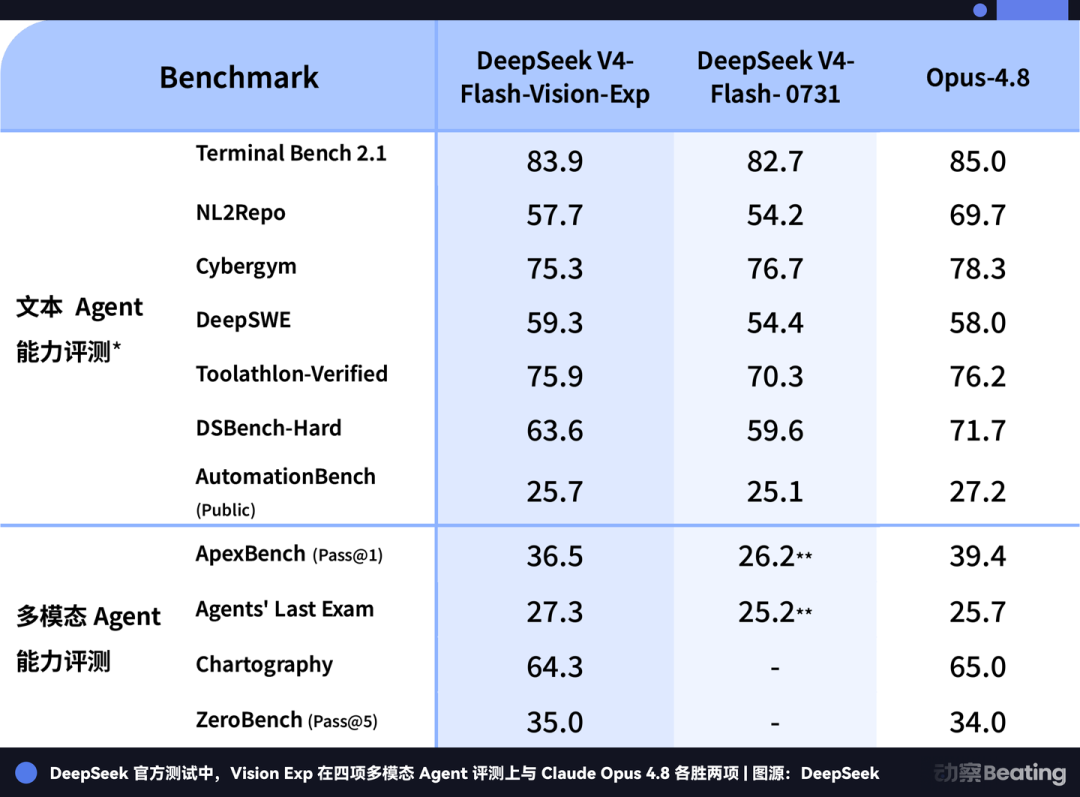
Vision Exp has achieved a 4.8 score in Claude Opus, with two wins and two losses.
The scores for Agents' Last Exam are 27.3 versus 25.7, ZeroBench is 35.0 versus 34.0, ApexBench is 36.5 versus 39.4, and Chartography is 64.3 versus 65.0. None of the four gaps exceed 3 points.
Moreso, with the addition of visual elements, the original text-based Agent's performance did not significantly decrease.
Comparing with the pure text V4 Flash released on July 31st, the official website also presents a five-item text Agent evaluation showing improvement in scores across the board.
Terminal Bench 2.1 increased from 82.7 to 83.9, NL2Repo from 54.2 to 57.7, DeepSWE from 54.4 to 59.3, DSBench-Hard from 59.6 to 63.6, and AutomationBench from 25.1 to 25.7. DeepSWE's 59.3 also surpassed Opus 4.8's 58.0 from the graph.
However, these figures come from DeepSeek's own tests. The official statement specifies that the DeepSeek series models used in the public Code Agent text task employ the DeepSeek Harness minimal mode with the inference gear set to max. They are better suited for observing changes in Vision Exp compared to their in-house V4 Flash rather than being directly treated as third-party independent rankings.
The "exp" suffix in the model names has not yet been removed.
DeepSeek explicitly marks it as an experimental model, with versions still subject to change. The current interface is only for image understanding, with text still being the output. Image generation and video capabilities have not been opened up, and the Files API only accepts JPEG, PNG, GIF, and WebP files; PDFs cannot be directly inserted.
In 2024, a developer tried to send an image to DeepSeek, but the official API couldn't handle it.
By August 21, 2026, the image finally went through.
DeepSeek's eyes did open late.
By the time it truly opened its eyes, the path ahead did not allow it to keep walking with its eyes closed.
Original Article Link
Welcome to join the official BlockBeats community:
Telegram Subscription Group: https://t.me/theblockbeats
Telegram Discussion Group: https://t.me/BlockBeats_App
Official Twitter Account: https://twitter.com/BlockBeatsAsia