HTX Research's latest research report interprets the US Stock AI Asset: Technology still in early stage, Capital Expenditure and Valuation have entered late-stage cycle
Source: HTX Research
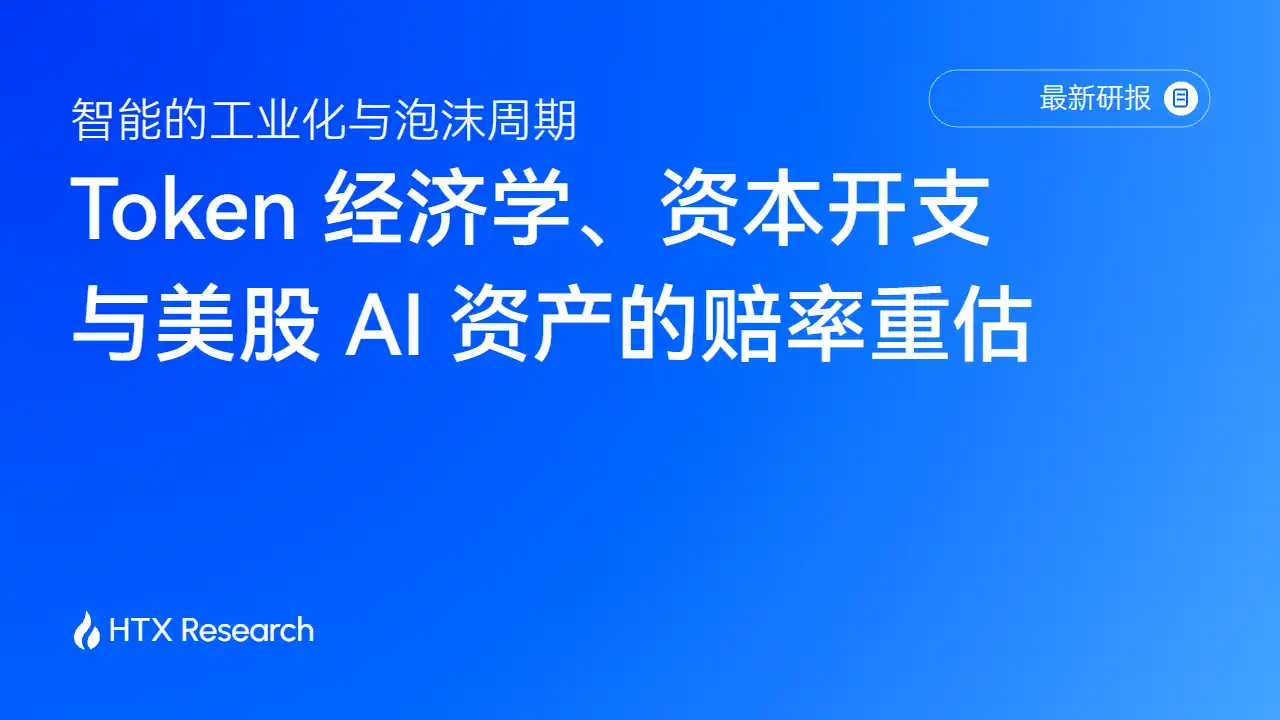
Recently, HTX Research, the research department under Huobi's HTX, released a new research report titled "Intelligent Industrialization and the Bubble Cycle: Tokenomics, Capital Expenditure, and the Reassessment of AI Stocks in the US Market." Starting from Tokenomics, the report analyzes the valuation status, cycle position, and risk-return structure of the AI industry chain. The report points out that the AI industry and AI stocks are currently not in the same time period. The technology diffusion of large models, Agents, and multimodal products is still in the early stage, with the enterprise application cycle in the early to middle stage. However, the capital expenditure cycle of Hyperscalers has entered the middle to late stage, with stock valuation, market concentration, and trading sentiment more closely resembling the latter part of a bull market.
Variables Determining Stock Price
Over the past three years, the market has first traded based on the scarcity of GPU, HBM, servers, networking, and data center supply, followed by the leap in capability of cutting-edge models, inference models, and Coding Agents. Beyond 2026, the core variables determining stock returns are shifting from model parameters and capital expenditure scale to Token production costs, task success rate, user consumption intensity, enterprise workflow penetration, and whether massive AI investments can ultimately translate into free cash flow.
Behind this shift is the magnitude change in capital expenditure. J.P. Morgan Asset Management estimates that the capital expenditure of the top five US Hyperscalers in 2026 will be around $697.0 billion, with AI capital expenditure as a percentage of these companies' operating cash flow increasing from around 33% in 2023 to an estimated 93%. When capital expenditure consumes the vast majority of operating cash flow, market focus will inevitably shift from revenue growth to capital return rate.
The Bubble Exists in the Financial Architecture, Not in the Industry Itself
The report provides a more precise breakdown of the concept of an "AI bubble." Cloud revenue, Coding Agent usage, chip revenue, and enterprise demand are all experiencing real growth, indicating that AI technology itself is not a false narrative. However, capital expenditure, external financing, data center projects, private model valuations, and some overvalued secondary targets have shown clear signs of bubble characteristics.
The way to assess target cost-effectiveness also needs adjustment. Price-to-earnings ratio on the surface cannot directly represent the true valuation level: Alphabet's P/E ratio is distorted by investment income, and Amazon's current accounting profit also cannot represent normalized valuation. The truly cost-effective companies are those that best match normalized valuation, competitive barriers, cash flow, and AI optionality.
At the current price and cycle position, the research report believes that Alphabet has the most prominent overall odds, combining full-stack capabilities and multiple growth engines; Microsoft has the highest fundamental win rate, but limited room for valuation expansion; Meta's surface valuation matches well with revenue growth, with significant capital expenditure risks; TSMC is the most stable "shovel seller" in the supply chain, but faces geopolitical tail risks; NVIDIA remains the most attractive core semiconductor target after growth adjustment; Amazon has significant AWS and Trainium optionality. Oracle and Micron are high-odds but low-win-rate cyclical assets, AMD, Arista, and Vertiv have excellent business quality, but their current prices require near-perfect execution.
The Mainstream of AI is Changing the Configuration of Crypto Users
As the influence of AI as a common theme in the global capital markets is not only reflected in U.S. stock pricing but also changing the asset allocation behavior of crypto users. When core AI targets such as NVIDIA, Micron, TSMC, Broadcom, Meta, and Alphabet, along with gold, oil, ETFs, and Pre-IPO assets, enter the daily investment portfolios of Crypto users, the boundaries between the two types of markets begin to blur. Funds can flexibly switch between BTC, ETH, AI blue-chip stocks, gold, and ETFs based on the macro environment, industry trends, and risk preferences, and an increasing number of users have come to see Crypto and U.S. stocks as different allocation directions within the same global risk asset system.
Huobi HTX is one of the early crypto exchanges to systematically drive this direction. According to data disclosed in August 2026, the platform's TradFi contract section has accumulated a trading volume of over $25 billion, supporting over 170 TradFi-related assets, covering U.S. stocks, ETFs, gold, silver, oil, AI chips, storage, aerospace, as well as Pre-IPO thematic assets like OpenAI and Anthropic.
The key to this model is that the platform already has a large number of registered, identity-verified, and asset-funded Crypto users. These users typically hold stablecoins such as USDT directly, without the need to open a traditional securities account or transfer funds to another financial system, and can complete the trading of TradFi assets in the same account. When risk appetite decreases, they allocate to gold, ETFs, or large-cap tech stocks, and when risk appetite rises, they increase the proportion of Crypto and high-beta AI stocks, all while keeping their funds within the same platform.
The Changing Competitive Landscape of Trading Platforms
The growth of TradFi businesses indicates that the future competition among trading platforms will shift from focusing on spot, futures, liquidity, and listing speed to comprehensive competition revolving around Crypto, US stocks, ETFs, commodities, Pre-IPO, wealth management, and AI investment tools. Platforms that are truly competitive in the long term will see their core capabilities evolve from a single trading ability to global asset distribution capability.
This also confirms a broader assertion made in a research report: AI is not only transforming model capabilities and computational requirements but also the flow of funds, asset allocation methods, and the organizational form of financial products. Huobi HTX's early layout in the TradFi direction, in line with HTX Research's ongoing tracking of AI trends and cross-market fund flows, echoes the importance of identifying the position in the cycle, understanding fund flows, and grasping the interrelationships among different assets. These aspects are not only core to investment research but also constitute a source of first-mover advantage in actual business decision-making. As AI drives the global financial markets into a new phase of integration, institutions that can simultaneously comprehend industry cycles and capital flows are more likely to secure a favorable position in the next round of competition.
Disclaimer: This article is not investment advice and does not constitute an offer, solicitation of an offer, or recommendation for any investment product.
About HTX Research
HTX Research is the exclusive research department of Huobi HTX, responsible for conducting in-depth analyses of a wide range of areas such as cryptocurrencies, blockchain technology, and emerging market trends, producing comprehensive reports, and offering professional evaluations. HTX Research is committed to providing data-driven insights and strategic foresight, playing a crucial role in shaping industry perspectives and supporting informed decision-making in the digital asset space. With a rigorous research methodology and cutting-edge data analysis, HTX Research always stands at the forefront of innovation, leading the development of industry thinking, and promoting a deep understanding of the ever-evolving market dynamics.Visit us.
This article is a contributed submission and does not represent the views of BlockBeats.
Welcome to join the official BlockBeats community:
Telegram Subscription Group: https://t.me/theblockbeats
Telegram Discussion Group: https://t.me/BlockBeats_App
Official Twitter Account: https://twitter.com/BlockBeatsAsia