Gold Price Returns to $4350, Has the Precious Metal Correction Ended?

TL;DR
· Sprott believes that the 2026 gold and silver pullback is more of a cyclical correction within a long-term bull market, with gold breaking above $4350 per ounce on August 7.
· Global central banks net purchased 289 tons of gold in the second quarter, about five times higher than the 57 tons corrected in the first quarter, but the gold buying volume in the first half of the year is still the lowest since 2022.
· Silver is expected to face supply deficit for the sixth consecutive year, but industrial demand is slowing down, and short-term volatility will be amplified by the U.S. dollar, real interest rates, and liquidity.
Sprott Asset Management recently released a precious metals report, categorizing the gold and silver pullback since 2026 as a cyclical correction within a long-term bull market, rather than the end of the trend that began in 2025.
As of August 7, gold once rose above $4350 per ounce, hitting a seven-week high. Previously, the gold price stabilized in the $4000–$4100 range, indicating returning safe-haven demand and improved market sentiment.
The report seeks to answer a straightforward question: after gold rose by 64.58% and silver by 147.95% in 2025, the significant pullback in the first seven months of 2026, does it signify a trend reversal, or a rebalancing after leverage and market sentiment unwinding?
As of July 31, gold closed at $4046.15 per ounce, down 6.33% year-to-date; silver closed at $57.60 per ounce, down 19.63% year-to-date. Although both metals have retraced from the beginning of the year, prices remain significantly higher than a year ago. For investors, what truly matters is not whether gold and silver experience a pullback, but whether the long-term demand supporting the previous rally has changed.
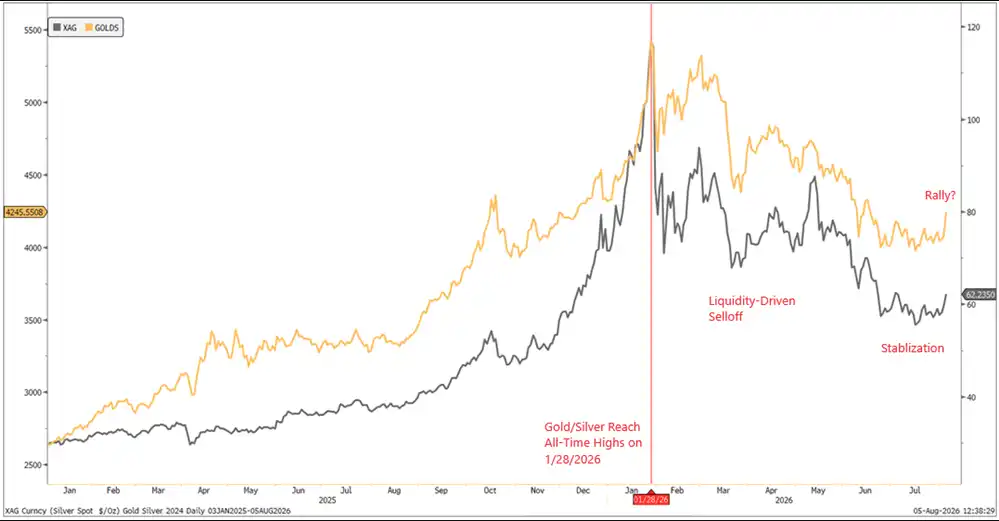
Gold and silver saw significant gains in 2025, followed by a notable pullback after reaching highs in early 2026, but as of the end of July, prices are still higher than a year ago
Gold Price Stabilizes Near $4000, Futures Funds Begin to Flow Back
Sprott's assessment is not that precious metals will not continue to decline, but rather that this pullback has not yet undermined long-term supportive factors.
With the substantial rise of gold and silver in 2025, followed by new all-time highs in early 2026, the market accumulated a lot of leverage and profit-taking positions. Sprott believes that the unexpected tightening of global liquidity due to the geopolitical conflict in March forced some leveraged investors to sell gold to raise cash; entering the second quarter, the easing of the U.S.-Iran situation, falling oil prices, a stronger U.S. dollar, and the expectation of higher U.S. interest rates for a longer period further suppressed precious metal prices.
By early summer, some selling pressure gradually eased, and gold regained physical demand and central bank buying support around $4,000 before breaking above $4,350 on August 7. Silver saw even more volatility but stabilized in the $55–60 range, briefly rising back above $60.
Futures positioning also showed signs of returning. According to Saxo Bank's analysis of CFTC data for the week ending August 4, hedge funds had increased their precious metals exposure before gold made a technical breakthrough. Silver futures speculative net long positions increased by 32% compared to the previous week, and gold net longs continued to rise, reaching a high not seen since January.
Meanwhile, speculators cut their long US dollar positions by about $13 billion in a single week, marking the largest one-week drop in six years. However, overall dollar positioning remained significantly long, and it is still premature to conclude that the dollar trend has reversed.
COT data is more suitable for observing short-term fund sentiment. It indicates that precious metals are once again attracting speculative funds, but it cannot solely prove that a new bull market has begun.
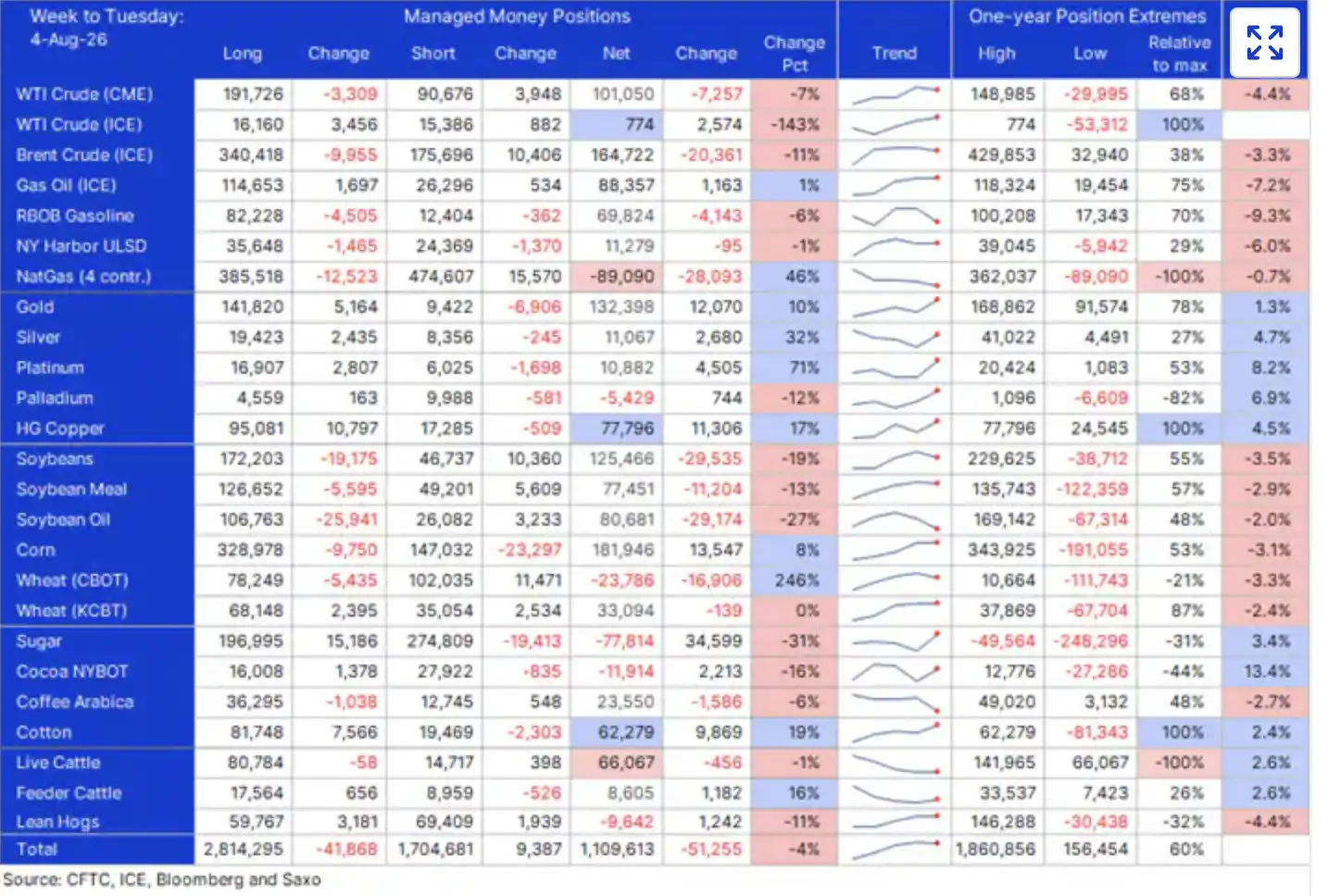
As of the week ending August 4, gold ETF net longs rose to 132,000 contracts, reaching a high not seen since January; silver net longs increased by 32% to approximately 11,000 contracts, but overall positions remained relatively low.
Central Banks Net Purchased 289 Tonnes of Gold in Q2, But First-Half Demand Has Not Fully Recovered
Gold's long-term support still relies on central banks and sovereign wealth funds.
World Gold Council data shows that global central banks' net gold purchases reached 289 tonnes in Q2 2026, nearly five times the revised 57 tonnes in Q1, a 62% year-on-year increase, and the highest Q2 level on record.
However, this data has another side to it. Due to a significant downward revision in Q1 gold purchases, central banks' net gold purchases in the first half of 2026 totaled 345 tonnes, the lowest first-half level since 2022. This means that central bank demand significantly recovered in Q2, but whether it will re-enter a sustained acceleration phase remains to be confirmed by subsequent data.
From the data already disclosed, Poland and China were notable buyers in Q2, increasing their holdings by about 51 tonnes and 33 tonnes, respectively. Official institutions continue to allocate to gold, driven by long-term factors such as sovereign debt expansion, fiscal deficits, geopolitical divergence, and reserve diversification.
Gold is not tied to any single sovereign credit, so it is still considered by some central banks as a strategic asset outside of traditional foreign exchange reserves. This type of buying pressure may not necessarily continue to drive short-term prices higher, but it could provide support for physical demand in the event of ETF outflows, leverage unwinding, or weakening investor sentiment.
Whether central bank gold purchases can maintain their strength will also be one of the key variables in assessing the stability of support around $4000.
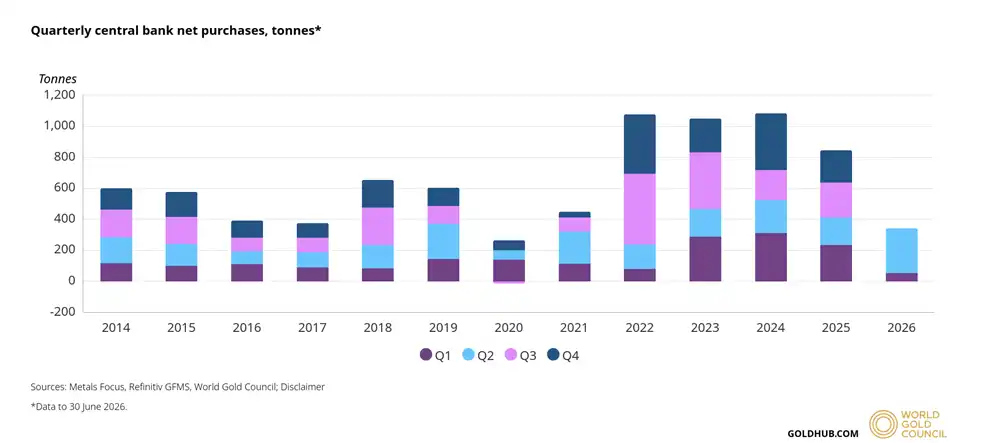
Global central banks' net gold purchases reached 289 tons in the second quarter of 2026, about five times the revised 57 tons in the first quarter, setting the highest second-quarter level on record; however, the net gold purchase volume in the first half of the year was still the lowest since 2022
Silver Industrial Demand Slows, Supply Deficit Continues to Expand
The pricing logic of silver is more complicated than that of gold. It has both monetary and investment attributes, and is also influenced by industrial demand, mining supply, and inventory changes.
The "World Silver Survey 2026" released by the Silver Institute and Metals Focus in April revealed that the global silver market had a deficit of 40.3 million ounces in 2025, which is expected to expand to 46.3 million ounces in 2026, marking the sixth consecutive year of undersupply.
A persistent deficit means that the market still needs to deplete aboveground stocks to fill the supply-demand gap. However, industrial demand in 2026 is not uniformly increasing.
The report projects that industrial demand for silver in 2026 will decrease to 639.6 million ounces, a year-on-year decline of about 3%; among them, the demand for silver in photovoltaics is expected to decrease by 19%. This mainly reflects the high silver price prompting photovoltaic companies to reduce the amount of silver used per unit product, rather than all industrial applications expanding simultaneously.
Electric grid investments, electrification, AI infrastructure, and advanced manufacturing are still long-term sources of silver demand, but it should not be simply understood that all industrial subsectors will grow in 2026. The expansion of the silver deficit is not only determined by industrial demand but is also related to mining supply, recycling supply, and changes in investment demand.
This is precisely why silver price fluctuations are usually greater than those of gold. During an uptrend, a smaller market size, inventory tightness, and speculative fund inflows can magnify price elasticity; during a downtrend, concerns about industrial demand, liquidity tightening, and deleveraging can deepen the decline.
Silver has fallen by nearly 20% in the first seven months of 2026, significantly underperforming gold. As prices stabilize in the $55–60 range, the market is reassessing the implications of persistent deficits, a recovery in investment demand, and the impact of gold's rebound on silver.
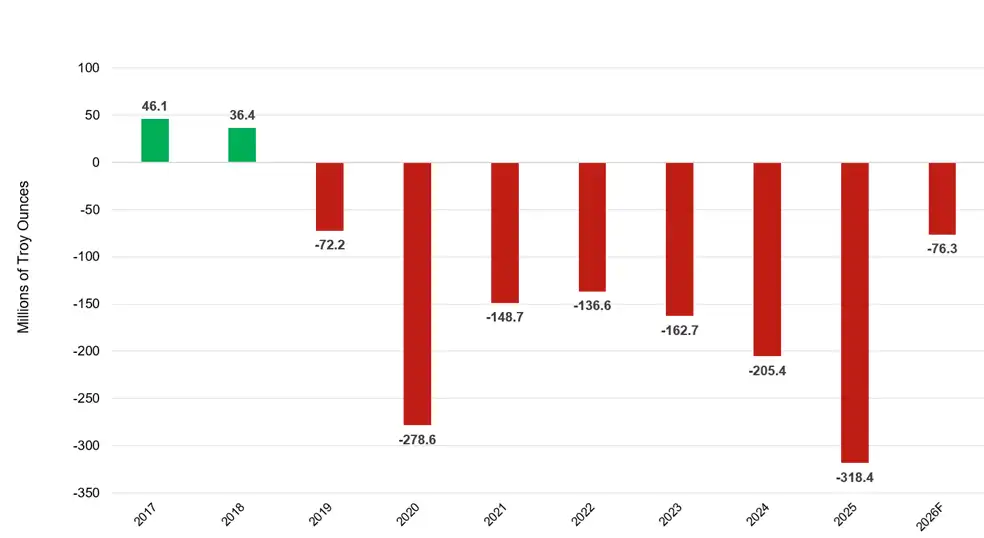
The global silver market is projected to see a supply deficit of 40.3 million ounces in 2025, which is expected to expand to 46.3 million ounces in 2026, marking the sixth consecutive year of undersupply.
The Long-Term Thesis Remains Intact, While Short-Term Reversal Is Still Pending Confirmation
Sprott's long-term bullish position is very clear, but "a correction is not the end of a bull market" should not be directly equated to "the start of a new uptrend has been confirmed."
The primary disruption faced by precious metals still stems from the macro environment. If the U.S. dollar strengthens again, real interest rates continue to rise, or global liquidity tightens once more, the rebounds in gold and silver could be interrupted. Silver, with its industrial attributes, smaller market size, and higher participation in leveraged trading, may continue to experience larger short-term fluctuations compared to gold.
Central bank gold purchases and silver deficits provide medium- to long-term support, but this does not mean that prices will not experience sharp pullbacks. While second-quarter central bank buying has notably recovered, the scale in the first half of the year remains below recent years' levels; silver, despite consecutive supply shortfalls, is facing a slowdown in industrial demand; although the Commitment of Traders report shows fund inflows, futures positions may rapidly reverse course in response to changes in the U.S. dollar and Treasury yields.
Therefore, the significance of $4350 is not just a price level but a point where, following gold stabilizing around $4000, the market begins to reassess whether the long-term bull market in precious metals is still intact.
Going forward, whether the gold and silver rebound can continue hinges primarily on four variables: the strength of central bank gold purchases, whether the silver deficit will keep depleting inventories, whether the U.S. dollar and real interest rates will trend upward again, and whether futures fund inflows can be sustained.
Current data supports that "the long-term bullish thesis remains unbroken," but it is not yet sufficient to prove that a new one-sided uptrend has begun.
Welcome to join the official BlockBeats community:
Telegram Subscription Group: https://t.me/theblockbeats
Telegram Discussion Group: https://t.me/BlockBeats_App
Official Twitter Account: https://twitter.com/BlockBeatsAsia
 Related Articles