Bitcoin Community in Turmoil, Understanding the Scaling Debate Caused by BIP-110

Original Article Title: "Bitcoin Community in Uproar! Understanding the New Bitcoin Scaling War Caused by BIP-110"
On August 10, Luke Dashjr, a long-time Bitcoin Improvement Proposal (BIP) editor and co-founder/chief technology officer of the Ocean mining pool, was removed from the editing team and had his editing permissions revoked. This action was taken because Luke, while pushing for BIP-110, bypassed the discussion process, preemptively assigned a number to the proposal, and had contributed little to the editing work in recent years.
The catalyst for this disciplinary action was a chain split that occurred a few days ago, the first genuine chain split in Bitcoin since the Bitcoin Cash hard fork in 2017. On August 8, at block height 961,632, the Bitcoin network split into two: some nodes refused to follow the main chain and instead insisted on executing BIP-110, which was deeply involved in drafting by Luke. BIP-110 is a soft fork proposal that prohibits transaction stuffing with non-transaction data. A minority chain stalled after just one block, while the main chain continued to operate normally, quickly pulling ahead by several blocks.
Who Should Control Block Space?
Bitcoin adds a new block on average every ten minutes, packing a period of transaction records, which are confirmed by miners and linked to the previous block. While blocks mainly contain transaction information, there is no rule prohibiting the inclusion of text, images, or even code as long as one is willing to pay for the space.
The conflict began with the release of Bitcoin Core v30 in October 2025, the most widely used node software on the Bitcoin network. This version lifted the 83-byte capacity limit on "OP_RETURN" (a field for additional information). This limit was originally just a software default recommendation, and removing it significantly reduced the cost of including non-transactional data.
However, some community members disagreed with this relaxation. They chose to run alternative software called Bitcoin Knots, which is free and open-source but retains the old limit. The user percentage shifted from almost zero in early 2024 to over 22% within two years.
BIP-110 was proposed against this backdrop, with the aim of enshrining Knots' limit in Bitcoin's fundamental consensus rules, making it mandatory for the entire network to comply. Originally numbered BIP-444, the draft included provisions to impose "legal and ethical consequences" on non-compliers, which sparked backlash and were later removed. In December 2025, it was renumbered as BIP-110.
What started as a technical debate has now escalated into a power struggle.
Trust Wagered on Low Entry Barriers
A Bitcoin soft fork usually requires miners (individuals or institutions running specialized equipment to secure the network and earn Bitcoin rewards) to signal their support. This is done by inserting a signaling tag in the block, and the new rule is only activated once the signaling threshold is reached by a certain percentage of the network's hashrate. The historical norm is a high threshold of 95%, meaning almost all miners need to agree to activate the new rule to avoid a split.
However, BIP-110 has lowered the threshold to 55% and added a mandatory activation clause: even if the support threshold is not met, nodes running the patch will automatically reject blocks that do not comply with the new rule.
The threshold can be written into the code, but whether miners are willing to cooperate is another story.
Since entering the signaling period on May 1st, the support has never exceeded 3%. As the final signaling period deadline approaches, the support has only risen to about 2.53%.
Mining pools like Foundry USA and AntPool have not expressed their support, with almost all supporting votes coming from Ocean mining pool and some independent miners. F2Pool co-founder Wang Chun even publicly criticized Luke, suggesting he should use a different proof-of-work algorithm, as the outcome would not be any better.
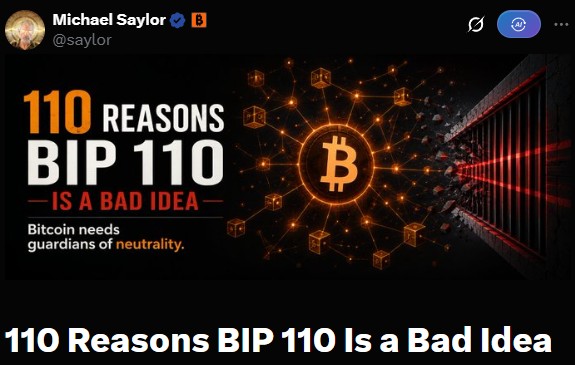
Strategy founder Michael Saylor outlined "110 Reasons" for opposition, believing that once the rules can filter based on transaction content, Bitcoin's neutrality will be compromised. Security expert Jameson Lopp was more direct, calling it "reckless" and "doomed to fail," as data can be encoded differently to bypass restrictions, potentially resulting in certain transactions' outputs never being spent.
A Fork Supported by Only One Block
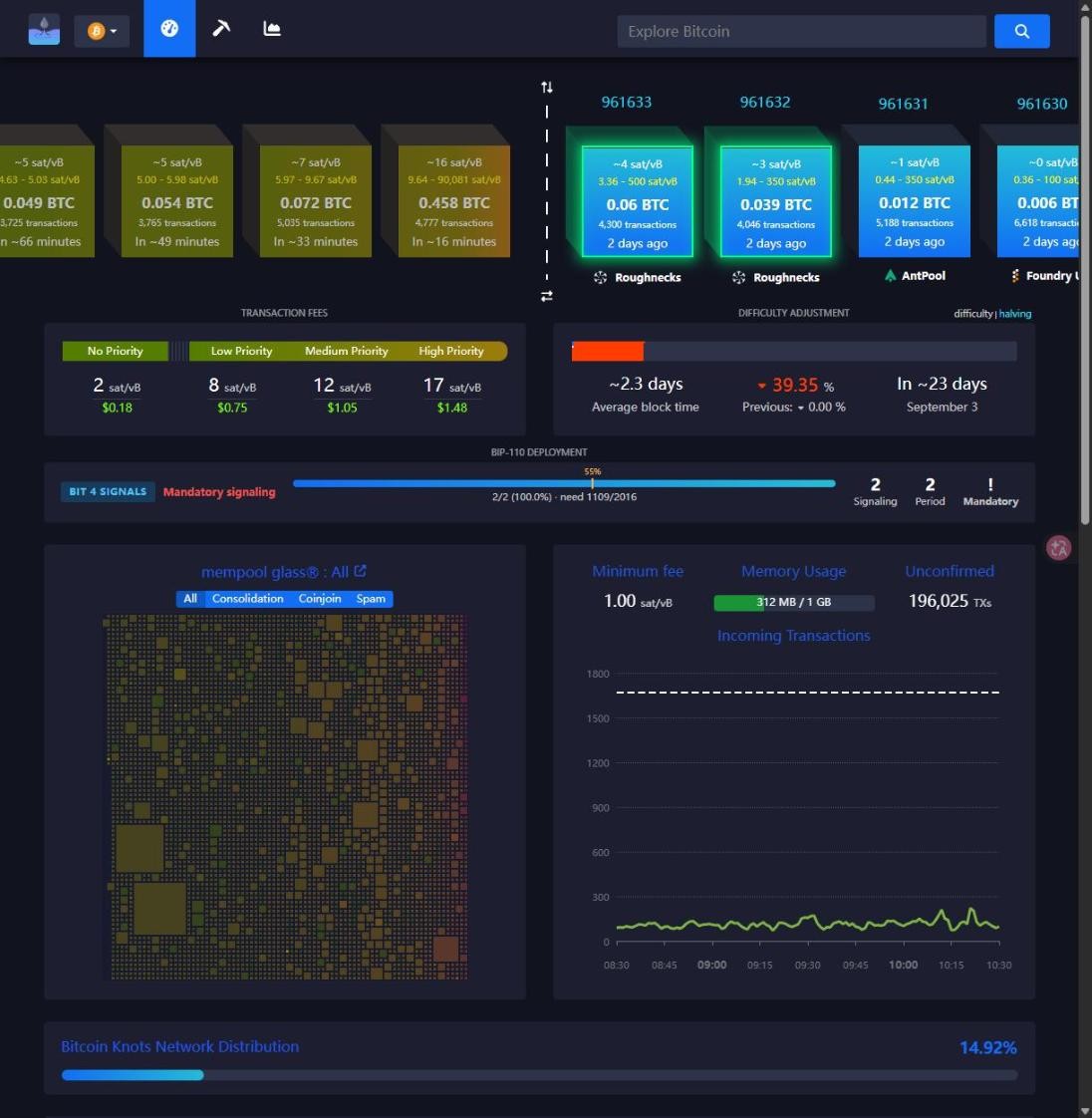
On August 8th, at block height 961,632, the block did not carry the required signal for the new rule specified in BIP-110. Nodes running the BIP-110 patch refused to acknowledge this and instead produced a separate block according to their own rules, initiating the fork. Initially, this new chain received support from about 2.53% of the network's hashrate, equivalent to roughly 1 out of every 40 mining machines worldwide willing to mine on the new chain.
However, the minority chain only produced one additional block and has not seen further updates since then. The chain with more hashrate ran faster and farther. The main chain continued to produce blocks every ten minutes, leaving the minority chain trailing by 243 blocks (data sourced from bip110.mempool.guide).
On August 10th, Japan's bitFlyer announced they would continue to monitor the impact of BIP-110 without committing to a course of action. Additionally, no major exchanges have expressed support for the minority chain, which is a stark contrast to the clear guidelines provided by various platforms during the Bitcoin Cash fork in 2017.
What one really needs to be careful of is self-custody with a node running Bitcoin Knots: BIP-110 lacks "replay protection," meaning the same transaction could be valid on both chains, allowing for a potential double spend if not handled correctly.
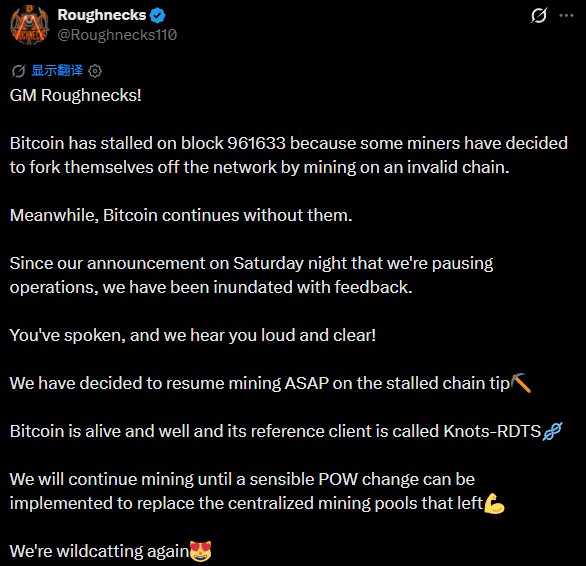
The BIP-110 largest miner, "Roughnecks," who mined that block, temporarily halted production. On August 10, they expressed intent to resume mining, but by then their signaling hash rate had plummeted from over 15 EH/s to 1.16 EH/s, with no new blocks on the chain yet. The economic cost of continuing to mine has now exceeded the rewards.
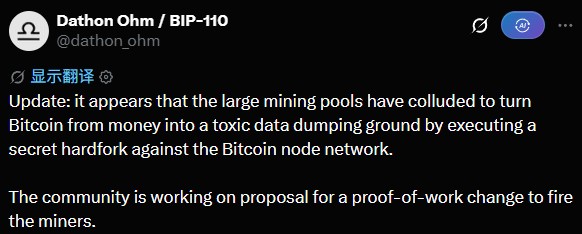
However, supporters do not seem ready to give up. Proposal authors Dathon Ohm and Luke, who recently lost their editing privileges, have truly begun discussing the path previously ridiculed by King Pure. This involves changing the proof-of-work algorithm to shake off ASIC miners, turning a minority chain into a new independent coin. This idea is still in the discussion and code testing phase.
But regardless of the direction taken, this farce confirms a rule set from Bitcoin's inception: rules can be drafted by a minority, and even self-granted editing permissions can be given, but ultimate authority lies with miners willing to continue burning electricity for a specific chain, along with exchanges and users determining which chain holds valid transactions.
Original Article Link
Welcome to join the official BlockBeats community:
Telegram Subscription Group: https://t.me/theblockbeats
Telegram Discussion Group: https://t.me/BlockBeats_App
Official Twitter Account: https://twitter.com/BlockBeatsAsia