Q2 Revenue Surges by 92%, Still Below IPO Price, Should You Buy or Wait for SpaceX?

Original Article Title: "Q2 Revenue Surges by 92%, Still Below IPO Price, Should You Buy or Wait for SpaceX?"
Original Article Author: Golem, Odaily Planet Daily
On August 4th, SpaceX released its Q2 2026 financial report, which exceeded expectations overall.
The report showed that SpaceX's Q2 2026 revenue was $7.814 billion, a 92% year-over-year increase, surpassing the market's expectation of about $6.8 billion. The connectivity business, mainly Starlink, remained the main source of revenue, with revenue reaching $4.291 billion, a 66% year-over-year increase and a 32% increase from the previous quarter; the AI business saw rapid revenue growth this quarter, reaching $2.561 billion, a staggering 247% year-over-year increase and a 213% increase from the previous quarter; the space business also saw a 29% year-over-year growth, with revenue reaching $0.962 billion.
In this quarter, SpaceX still had a net loss of $541 million, but it was within market expectations and significantly narrower than the $1.008 billion loss in the same period last year. This translates to a loss of approximately $0.09 per share, better than the market's expected loss per share of $0.23 to $0.24. Although the AI and space businesses have not yet turned a profit, with losses of $1.257 billion and $0.542 billion, respectively, consuming the $1.656 billion profit from the Starlink business, the losses have narrowed compared to market expectations and the previous quarter.
This quarter's financial report, as SpaceX's first report after going public, shows that SpaceX is already worthy of praise in terms of revenue and expectations.
Dramatically, after the financial report, SpaceX's stock price experienced a rollercoaster ride. On August 4th, after the U.S. stock market opened, SpaceX surged all the way and closed at $125.33, up 9.43%; however, after-hours trading saw a decline in SpaceX's stock price, with the decline currently standing at 7.5%, and the price around $116, essentially erasing all the gains made during regular trading hours.
The reason for SpaceX's stock price setback is not solely due to the market being too harsh on SpaceX; there are two main reasons for the decline. First, on a macro level, the market's focus on AI companies has shifted from revenue growth to concerns about when the massive AI capital expenditure will translate into actual returns; second, on a micro level, the first batch of approximately 910 million shares of SpaceX's lock-up shares will be released on August 6th, bringing selling pressure to the market.
Musk Unable to Ease Market's Concerns About Massive AI Capital Expenditure
According to the financial report, AI has grown to become SpaceX's second largest revenue source, second only to the connectivity business dominated by Starlink. For SpaceX, which has always considered the AI business as its valuation core, this is a great development. However, behind the rapid growth lies huge capital expenditure.
SpaceX's total capital expenditure in Q2 2026 was approximately $18.369 billion, with AI business capital spending accounting for $15.828 billion, representing over 86%. This AI capital expenditure not only increased by 104% compared to the previous quarter but also was 6 times the revenue from the AI business this quarter and 2 times the total revenue ($78.14 billion).
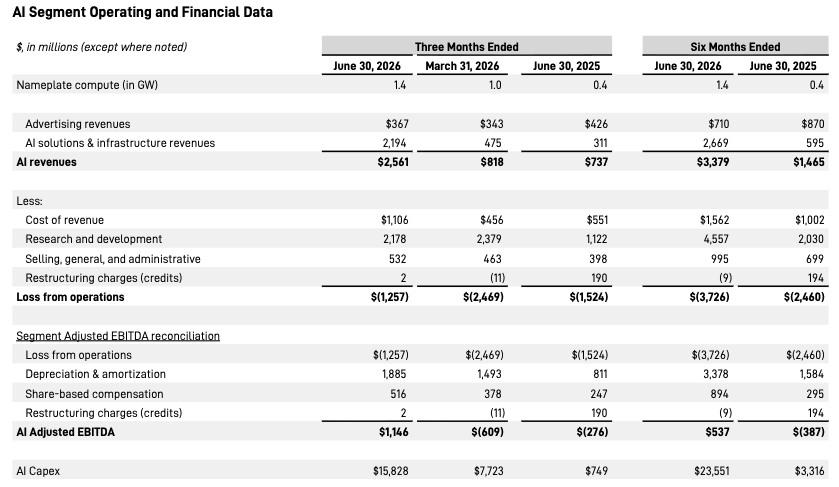
SpaceX AI Business Operations and Financial Data
Where Did the Massive AI Capital Expenditure Go?
During the earnings call, SpaceX CFO Bret Johnsen revealed that over $15.8 billion of AI spending was mainly used to support AI computing infrastructure development. By the end of the second quarter, SpaceX's total computing power load had expanded to 1.4 GW, surpassing the 1 GW in the first quarter and 0.4 GW in the same period last year. SpaceX expects to reach 2 GW by the end of this year. Musk also added that by the end of 2027, SpaceX's actual computing power will approach 10 GW instead of the previously estimated 5 GW.
At the same time, Johnsen stated that AI capital expenditure will not see significant reduction in the next two quarters. However, he also emphasized that the current cost-effectiveness will allow SpaceX to recoup the capital investment for AI computing in less than a year. To further allay market investors' concerns about the return period for SpaceX's AI capital spending, Johnsen also cited the recently signed $6.7 billion cloud service contract as an example, stating that SpaceX will achieve $100 billion in annual recurring revenue (ARR) by the end of this year.
Boldly, Musk then provocatively stated, "This target is not out of reach. Even if we do nothing, we can reach this target. I believe the actual number may be even higher." Musk also revealed that internally at SpaceX, the revenue reaching $1 trillion forecast (note, this is revenue, not ARR) has been brought forward from 2031 to 2030.
In case readers have no concept of a $1 trillion revenue, as of now, there is still no company globally that has achieved $1 trillion in annual revenue, even the "GPU Godfather" Jensen Huang only mentioned at the March 2026 GTC conference that Nvidia is confident in achieving $1 trillion in cumulative revenue by 2027, putting it in perspective, Musk's "hype" is even bigger.
Within SpaceX's $25.61 billion AI business revenue composition, the "AI Solutions and Infrastructure" revenue reached $21.94 billion, while advertising revenue was only $3.67 billion. Undoubtedly, this revenue growth was achieved through massive AI capital expenditure, but the AI revenue explosion has not covered the pace of SpaceX's AI infrastructure expansion, nor has it changed the fact that the AI business still relies on the Starlink business for its lifeblood.
Market's Overall Concerns over Massive AI Capital Expenditure Weighed on SpaceX
For SpaceX itself, this is not actually a big issue. As a long-cycle high-growth tech company, early high capital investment is necessary, and just after going public, SpaceX holds $100 billion in cash and equivalents and $475 billion in unfilled orders, with a strong financial position that allows it to "spend lavishly."
But SpaceX's mistake lies in catching a period of poor market sentiment. At a macro level, almost all AI tech companies are expanding AI infrastructure investment, but the market's patience in waiting for this massive expenditure to translate into actual returns is rapidly running out, even the "Silicon Valley Iron Man" Musk cannot calm investors' anxiety.
Last week as the U.S. stock market entered the Q2 earnings season, companies like Google, Intel, Meta all reported significant revenue increases but their stock prices plummeted, with the commonality being the rise in AI capital expenditure; meanwhile, after Microsoft reduced its full-year capital spending, its stock had its best single-day performance in 18 years.
When the nest is disturbed, how can there be whole eggs left? In a situation where the market as a whole is questioning AI capital expenditure, how can SpaceX, where AI capital expenditure accounts for 86% and the actual AI business is still losing money, break out of its independent trend?
The AI capital expenditure black hole is an objective fact for SpaceX, the key lies in how investors view it, with some worrying about it and others being optimistic because of it.
Morgan Stanley has maintained a target price of $300 for SpaceX, mainly betting on the future value of its AI business. The $300 target price breakdown is as follows: Space business $8, Starlink business $128, X and Grok business $12, Enterprise AI business $152. If we exclude the AI value, SpaceX's rocket launch and Starlink business alone are enough to support the current stock price, so adding the AI business, SpaceX is currently completely undervalued.
August 6 Stock Unlocking
On a macro level, investors have varying views on SpaceX's AI capital expenditure, but on a micro level, regarding SpaceX's initial stock unlocking on August 6, investors are mostly bearish, which is one of the reasons SpaceX's stock price has been under pressure post-earnings.
On August 6 (this Thursday), approximately 9.1 billion insider shares of SpaceX will be unlocked and enter the market, a scale much larger than the current public float of only 6.4 billion shares. After this unlocking, the stock supply in the market will significantly increase, and the market generally believes that the current buy orders are insufficient to absorb such a massive sell-off.
According to OptionCharts data, the current SPCX put/call ratio stands at 0.97. From a sentiment perspective, investor sentiment remains neutral. However, if we look at the specific distribution of contracts expiring on August 7, we will find that SPCX's psychological and technical support level has dropped to $100, with 24,947 put contracts accumulated at this price, which is currently the largest open interest contract.
If breached, a downside break in the stock price could trigger a negative Gamma effect, and SPCX falling below $90 is also highly likely.
The current long-short game focus is still concentrated around the $110-115 strike price. Considering two scenarios, if the market has already traded the negative impact of the stock unlock in advance, then SPCX is highly likely to see a temporary decline on August 6 followed by a rebound and maintain itself in that price range. If the market has not adequately traded the negative impact of the stock unlock, then SPCX is highly likely to continue to break lower as described earlier.
After the positive surprise of the earnings report was quickly digested in yesterday's U.S. stock market session, it is difficult to predict in the short term what positive factors could boost SpaceX's stock price. This does not mean that SpaceX's stock price is still expensive in the long run because compared to the $135 IPO price, SPCX has already fallen by 17%. However, if you are considering buying, it is best to wait at least until after the first wave of stock unlocking ends.
Original Article Link
Welcome to join the official BlockBeats community:
Telegram Subscription Group: https://t.me/theblockbeats
Telegram Discussion Group: https://t.me/BlockBeats_App
Official Twitter Account: https://twitter.com/BlockBeatsAsia