Bernstein Analysis: Advertising Revenue Up 27%, When Will Meta's Personal AI Monetize?

TL;DR
· Meta's Q2 revenue rose to $60.8 billion, with a Bernstein report maintaining an Outperform rating but lowering the target price to $800.
· Advantage+ annualized revenue run rate exceeds $75 billion, but the 2026 capital expenditure guidance remains high at $130 billion to $145 billion.
· Advertising and business tools have benefited from AI, while personal AI engagement, monetization velocity, and regulatory pressure continue to define the valuation boundary.
Meta's Q2 earnings report continued to demonstrate a strong advertising foundation, but AI investment has also brought profit pressure to the forefront. According to a Bernstein report, Meta is still maintained an Outperform rating, with the target price lowered from $850 to $800.
This downgrade is not a bet against the weakening of the advertising business. Meta's total revenue in Q2 was $608.01 billion, a 28% year-over-year increase, with advertising revenue at $593.63 billion, up 27% year-over-year. The issue is that the company is maintaining AI infrastructure investment at an extremely high level, with the 2026 capital expenditure guidance reaching $130 billion to $145 billion, including principal payments for financing leases. Management also indicated that AI infrastructure investment will continue at least until 2027.
Based on the report's criteria, the $800 target price corresponds to approximately a 22x P/E ratio by 2027. This target price still leaves room for upside, but the premise is clear: AI is not only about improving advertising efficiency but also helping Meta retain the next generation of consumer entry points and gradually finding a charging model for consumer-grade AI.
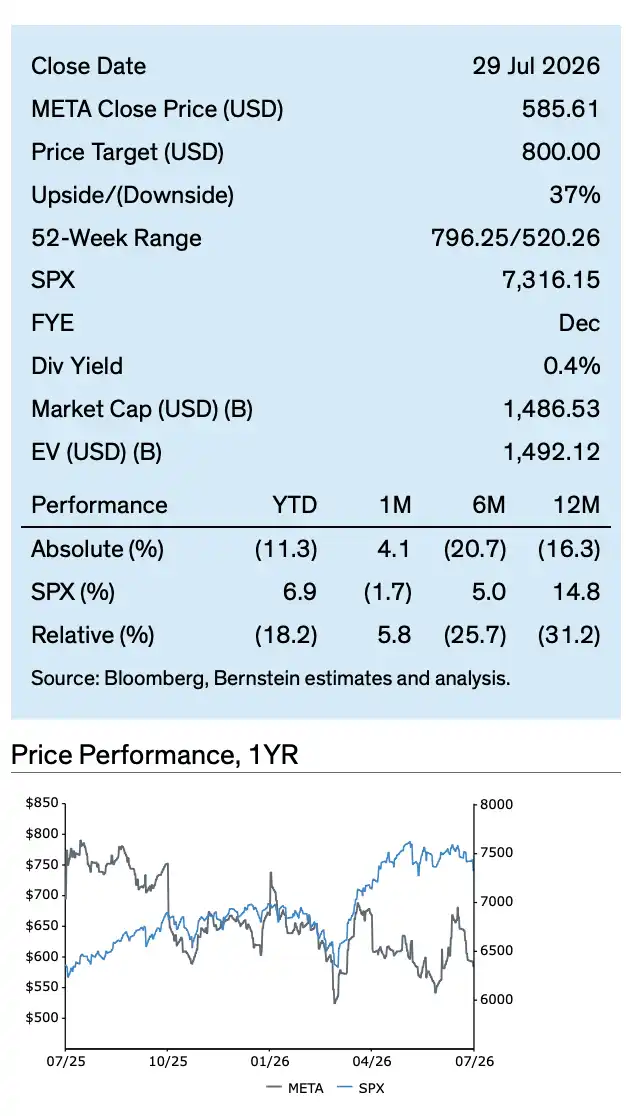
Meta's stock price has fallen from a high of $796 over the past year to around $586, underperforming the S&P 500 by 18.2% YTD.
Advertising is Still Accelerating, AI has Entered Revenue
The hardest numbers from Meta in Q2 still come from advertising.
The company's total revenue was $608.01 billion, with advertising revenue at $593.63 billion. Family daily active users reached 3.6 billion, Instagram daily actives reached 2 billion, and Threads monthly actives exceeded 500 million. WhatsApp peaks at processing 30 million messages per second, indicating that Meta's traffic base in social, communication, and business messaging scenarios remains solid.
AI is no longer just a long-term product narrative. The Advantage+ advertising suite's annualized revenue run rate exceeds $75 billion, with over 9 million small businesses using at least one AI ad creative tool. For Meta, this is more direct than launching a single AI app, as AI is being embedded in ad delivery, content generation, conversion optimization, and business tools, entering the company's most profitable systems.
After integrating Muse Spark, Meta AI saw a 60% increase in daily active users. Over 1 million merchants are already using Business Agents weekly. FoA Other revenue exceeded $1 billion in the second quarter, up from $583 million in the same period last year, representing a roughly 73% year-over-year growth.
While these figures do not directly translate to a profit growth curve, they at least indicate that AI capabilities are being actively utilized by users and merchants, rather than just remaining in keynote presentations and roadmaps.
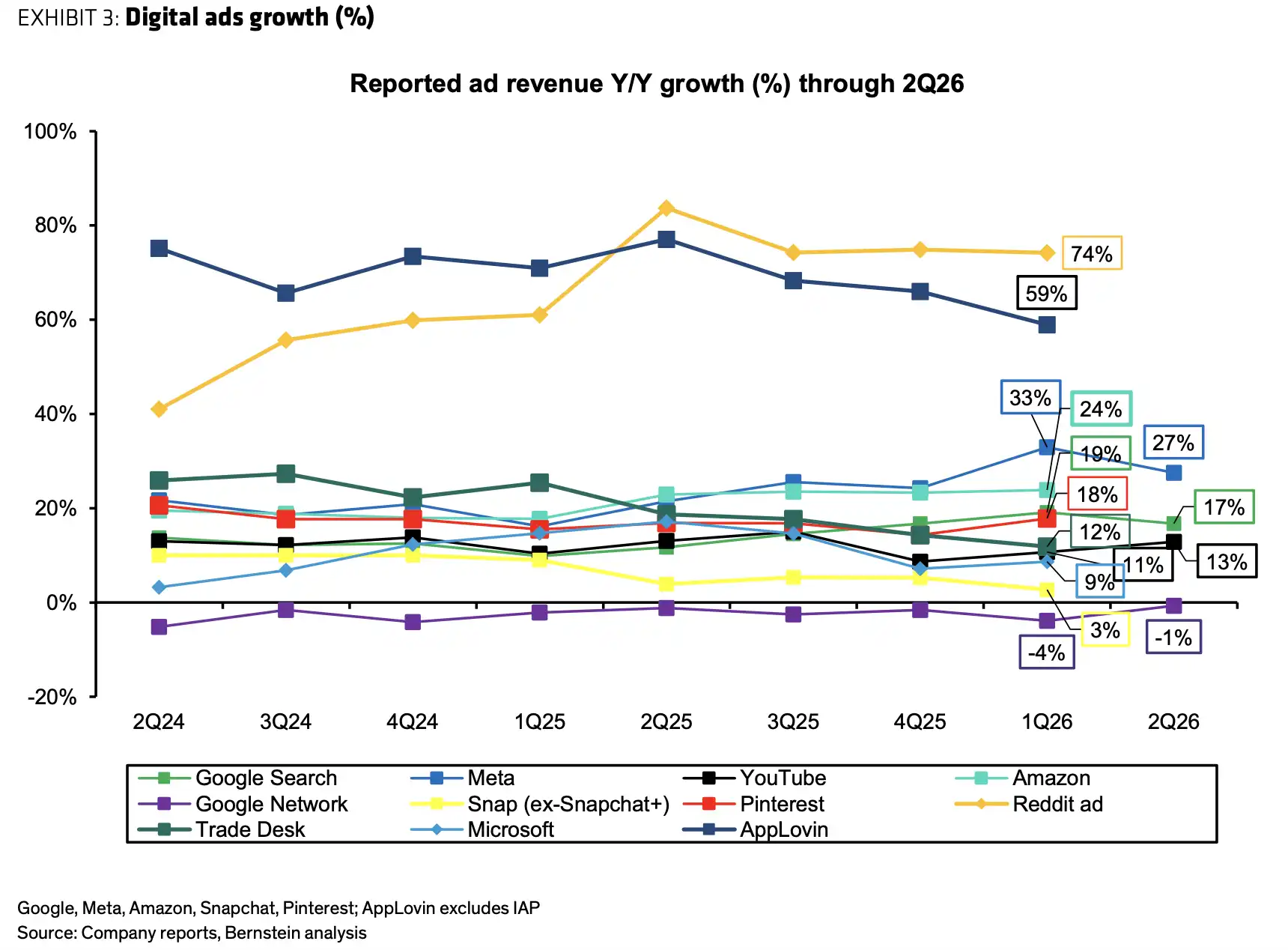
In the second quarter, Meta's advertising revenue grew by 27% year-on-year, remaining at a relatively high level among digital advertising peers.
Zuckerberg Bets on Personal AI as a Defense for the Next-Gen Gateway
Mark Zuckerberg's proposition of "Personal Superintelligence" may sound far-fetched, but within Meta's history, the logic is not complicated: Meta's biggest fear is not the short-term fluctuation in ad growth but rather the rewriting of consumer gateways by new product forms.
TikTok once caused Meta to passively play catch-up in short video migration. After the explosion of ChatGPT, Meta also failed to take a leading position in the first wave of user mentality in generative AI. For a company that earns money through user engagement and ad distribution, if users were to devote more time to AI assistants, AI agents, AI hardware, or new content generation tools in the future, Meta cannot afford to stand by as a mere spectator.
This explains why Meta is simultaneously advancing on multiple fronts: Muse Spark 1.1 paid API, Enterprise AI Agents, Meta One subscription service, AI-integrated smart glasses, and a business tools platform for merchants.
However, these are still early signals. While Other revenue is growing rapidly, the base is still small. It will take more time to prove whether APIs, subscriptions, performance-based revenue sharing, and AI agents can generate stable income.
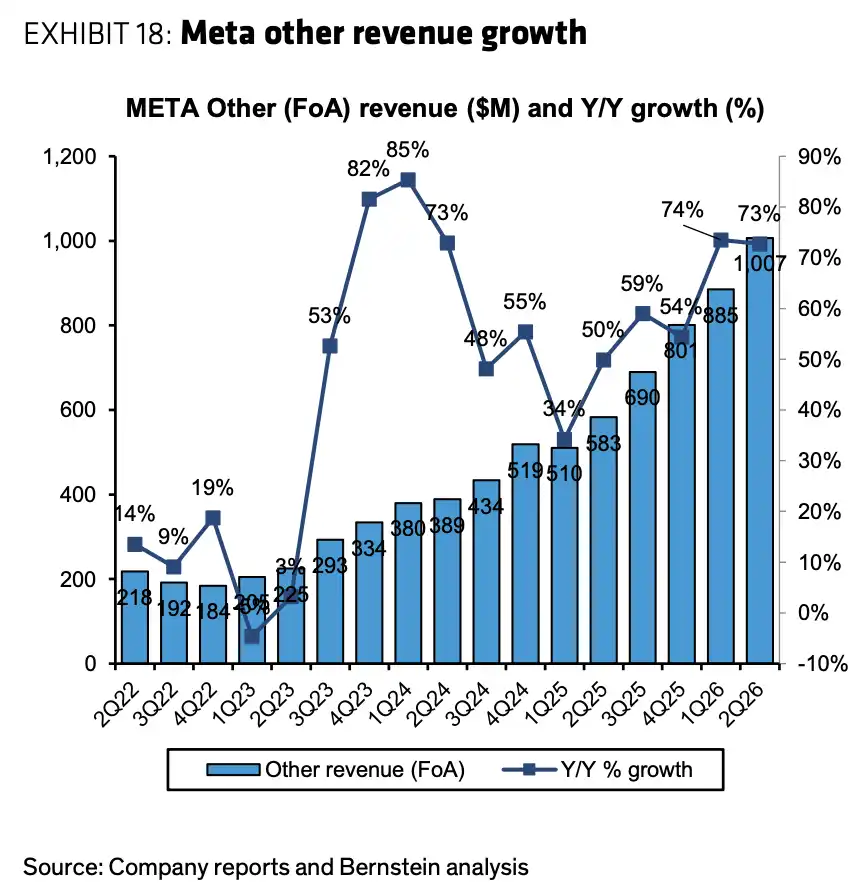
The FoA Other revenue surpassed $1 billion in the second quarter, with a year-over-year growth of around 73%, but it is still in the early stages of scaling up.
Price Target Lowered, Pressure Comes from Higher Capital Expenditure
The primary pressure driving the target price downgrade is coming from the investment side.
Meta's third-quarter revenue guidance is $61 billion to $64 billion, representing a year-over-year growth of 19% to 25%, including approximately a 1 percentage point headwind from exchange rates. While the revenue side remains strong, expenses and capital expenditures continue to meet market demands.
The full-year cost guidance is $165 billion to $169 billion. The 2026 capital expenditure guidance is $130 billion to $145 billion, with the lower end increased by $5 billion compared to the previous adjustment, including financing lease principal payments.
According to this research report model, the 2026 EPS expectation has been revised down to $32.27, and for 2027, it has been revised down to $36.68. While the revenue story remains intact, the profit pressure is clearer. Investors need to believe that these AI servers, models, chips, and talent investments will eventually translate into higher ad efficiency, stronger user stickiness, or new consumer AI revenue.
This also marks the boundary of the $800 price target. The report uses a 50/50 weighting of 2027 EV/Sales at 6.7 times and DCF models, with DCF assumptions including a 10% WACC and 3.5% perpetual growth. Since public institution target price calibers are not entirely consistent, $800 is more suitable as the valuation approach of this research report rather than the market-consensus expectation.
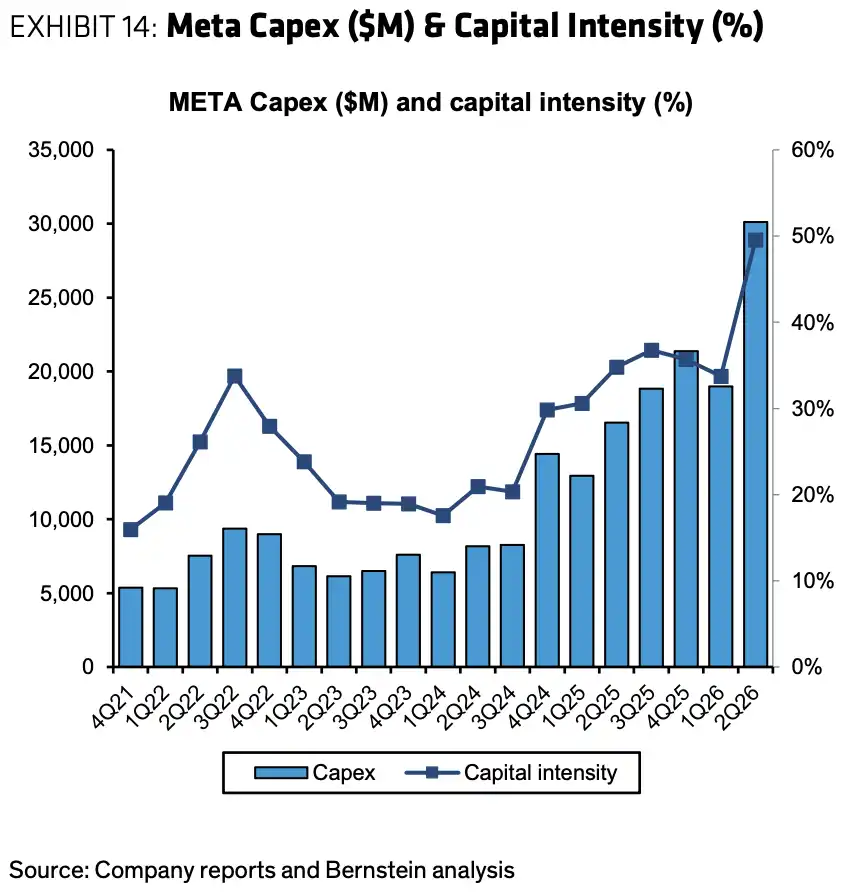
The 2026 capital expenditure guidance is $130 billion to $145 billion, and capital intensity is expected to increase to over 50% and remain high in 2027.
Advertising Can Prove the Present, Personal AI Has Yet to Prove the Future
The most compelling aspect of Meta at present is that AI has already improved ad efficiency and user experience. Ad revenue, user scale, AI ad tool revenue momentum all support the continued strong foundation.
However, the personal AI interface has not yet provided equally strong evidence.
The product form of consumer AI is still evolving. It could be a chatbot, a content generation tool, AI glasses, or an embedded information flow and commercial message agent in Instagram, WhatsApp, and Facebook. There is currently no consensus on which form will become a high-frequency entry point, which can charge stable fees, and which can improve ad conversion.
Regulation also limits the room for imagination. Meta still faces lawsuits and investigations related to adolescent protection, antitrust, and AI products. If AI products further enter communication, content recommendation, ad serving, and underage use scenarios, compliance costs may continue to rise.
Therefore, the $800 price target retains a conditionally optimistic view: the advertising business can still provide cash flow for AI investments, but personal AI has not yet become a new revenue curve that can be directly written into the profit and loss statement. Meta can continue to spend money to buy tickets for the next generation of entry points, while the market will focus on when these investments will no longer be just defensive costs.
Welcome to join the official BlockBeats community:
Telegram Subscription Group: https://t.me/theblockbeats
Telegram Discussion Group: https://t.me/BlockBeats_App
Official Twitter Account: https://twitter.com/BlockBeatsAsia
 Related Articles