Bloomberg Interpretation: 50GW Hashrate Recalculation Boosts Hardware Stocks, Is it the AI Hardware Super Cycle?

TL;DR
· Bernstein estimates that in a 50GW scenario, the cumulative WFE related to AI from 2027 to 2029 will be approximately $736 billion.
· For each additional 1GW/year of AI computing power, about 46K-50K WSPM wafer capacity is needed, with DRAM and HBM being the main components.
· Applied Materials, Lam Research, and KLA have higher profit elasticity, but pipeline capacity does not necessarily translate to real orders.
Bernstein's latest report translates AI data center expansion into semiconductor manufacturing equipment orders: if by 2030 AI data centers add 50GW of computing capacity each year, global WFE expenditure related to this could reach a cumulative total of about $736 billion from 2027 to 2029, with a single year projection of around $291 billion in 2029.
WFE refers to wafer fab equipment spending, which is a key demand driver for equipment companies such as Applied Materials (AMAT), Lam Research (LRCX), KLA (KLAC), ASML, Tokyo Electron, among others. For investors, the most direct question from this estimate is: as AI computing power continues to expand, how much additional orders and profit elasticity can it bring to equipment manufacturers.
At the time of the report's release, semiconductor equipment stocks had already experienced a significant rally, followed by a noticeable pullback from their highs. Simultaneously, the U.S. data center construction pipeline continues to expand. Public excerpts show that as of June 2026, the project pipeline capacity has increased to 338GW, with a 217GW increase in the past 12 months, far exceeding the currently operational capacity.
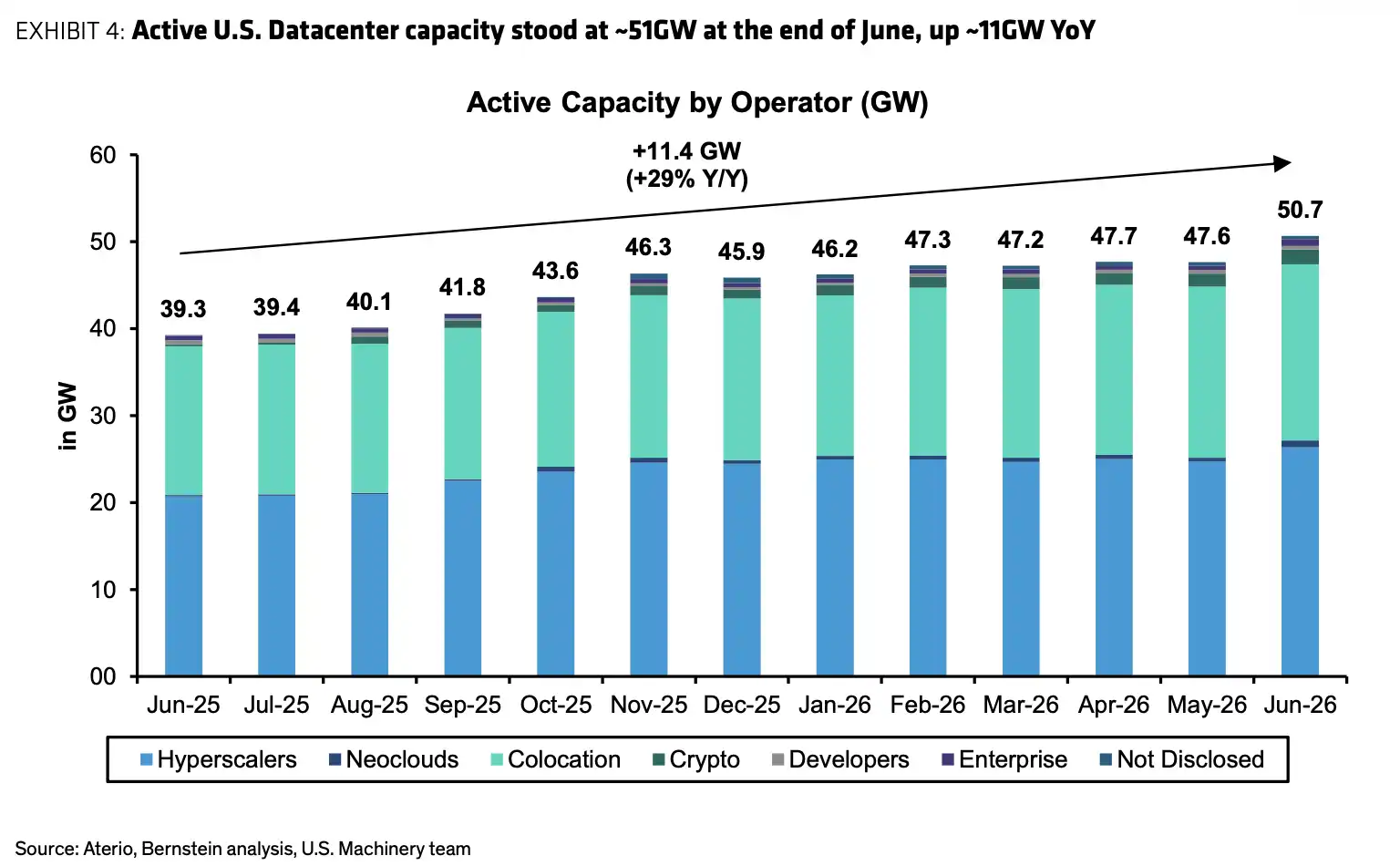
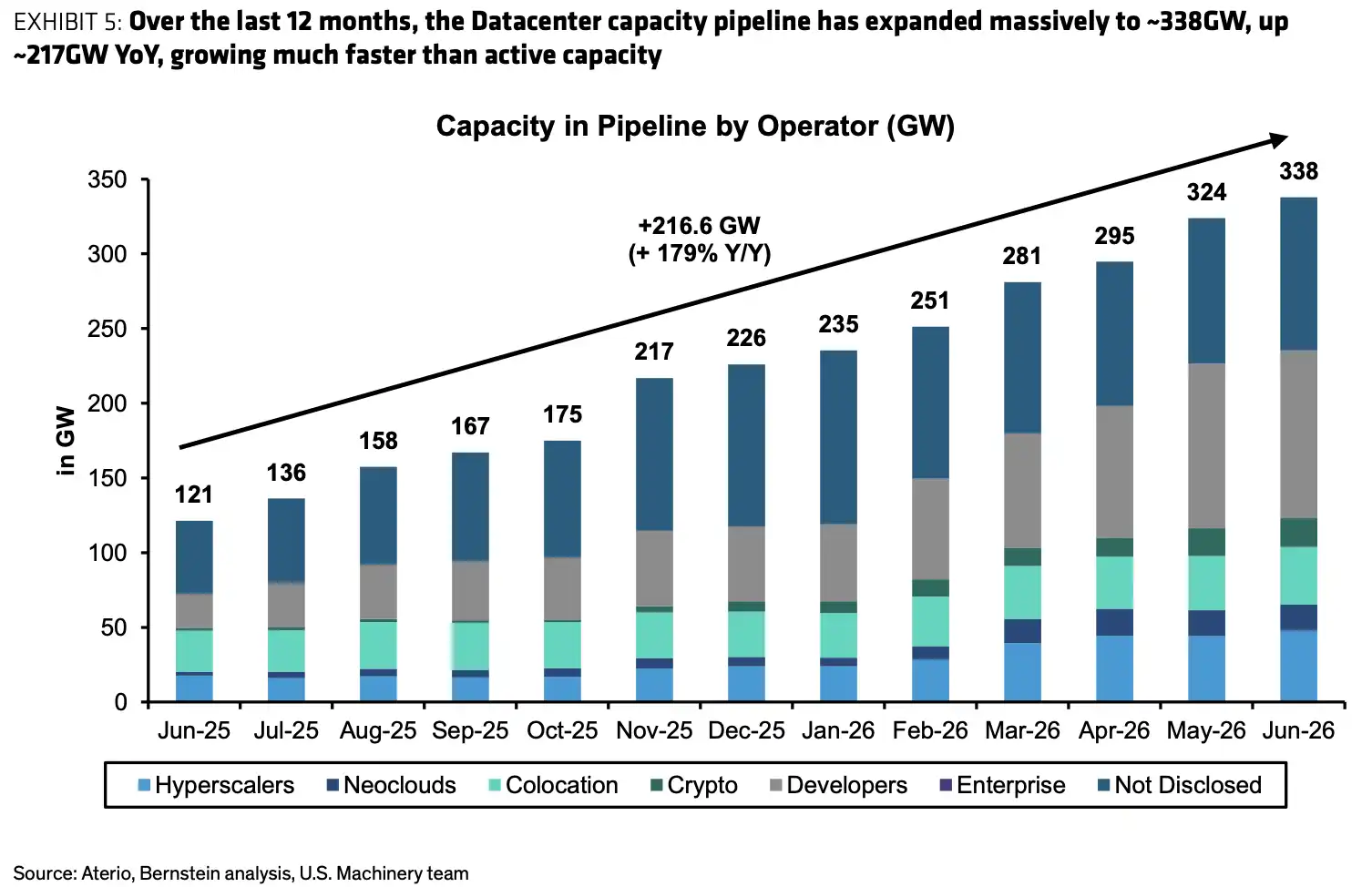
Changes in active capacity and project pipeline of U.S. data centers, with pipeline capacity increasing from 121GW to 338GW.
For every additional 1GW of computing power, about 50,000 wafers/month of wafer capacity are needed
The core conversion in this report indicates that for each additional 1GW/year of AI computing power, approximately 46K-50K WSPM of new wafer capacity is needed. WSPM refers to the number of wafers processed per month and is a common measure of wafer fab capacity.
Data center capacity itself does not directly translate into equipment orders. Only when AI servers require more GPUs, HBM, DRAM, NAND, and advanced logic chips, will wafer fabs need to expand production, and equipment companies will see additional WFE expenditures.
Out of the approximately 46K WSPM/GW of additional demand, DRAM accounts for the highest share at around 53%; NAND about 20%; HBM about 16%; and advanced logic about 11%. This means that AI data center expansion not only drives advanced process GPUs but also increases storage capacity demand, especially for DRAM and HBM.
This is also why Applied Materials is the most watched in this analysis. Incremental wafer demand mainly comes from DRAM, HBM, and NAND, with Applied Materials having a higher exposure in the storage, deposition, etch, and other processes, leading to more direct profit elasticity.
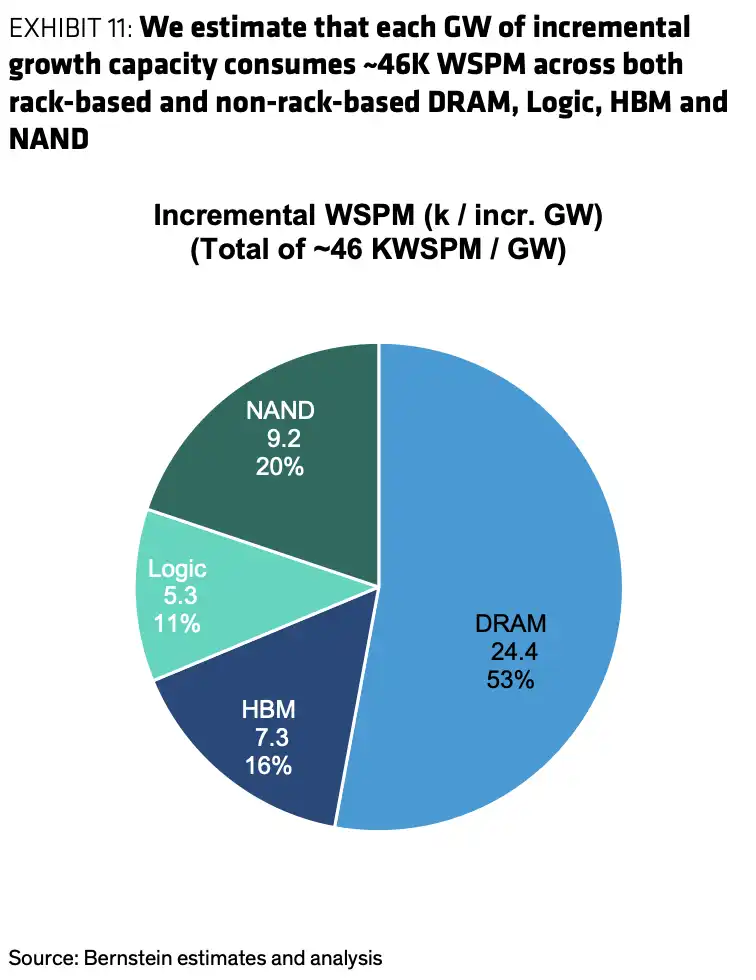
Approximately 46K WSPM is needed for every additional 1GW of computing power, with DRAM at 53%, NAND at 20%, HBM at 16%, and Logic at 11%.
In 2029, Single-Year WFE Could Approach $291.0 Billion
In a baseline scenario, AI data centers are projected to add 50GW of computing power annually by 2030 compared to the 2026 baseline. To support this goal, relevant WFE needs to be ramped up between 2027 and 2029.
The scenario analysis shows that for AI-driven WFE expenditure only, the cumulative spending for 2027-2029 is approximately $376.0 billion. If we add the annual non-AI baseline expenditure of about $120.0 billion, the total WFE expenditure for the three years is around $736.0 billion. The annual breakdown is about $200.0 billion in 2027, $245.0 billion in 2028, and $291.0 billion in 2029.
These figures are higher than the equipment spending assumptions in the current conservative models. If the 50GW scenario materializes, the 2029 WFE scale will almost reach $300.0 billion; in a higher GW scenario, there is further room for equipment spending to increase.
The report also provides a more aggressive scenario. In a 75GW scenario, equipment company profits could increase by over 100%; in a 100GW scenario, the potential 2029 WFE spending is further expanded, with some companies' valuations possibly compressed to below 10 times.
However, these are still model calculations, not confirmed orders. They depend on whether the data center construction pipeline can be transformed into actual operation, whether AI server shipments can keep pace, whether wafer fabs are willing to expand production ahead of time, and whether the equipment supply chain has sufficient delivery capacity.
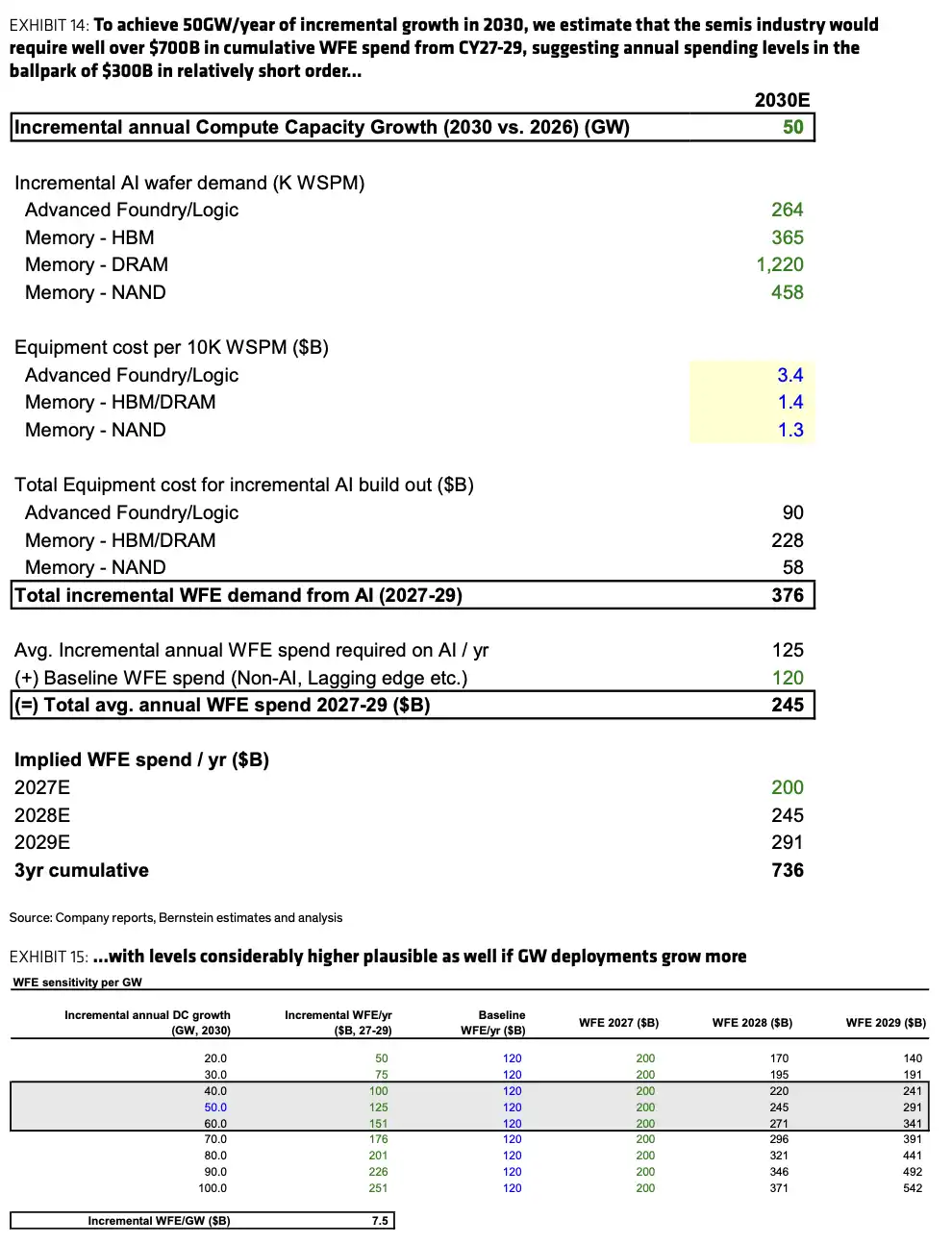
For the 50GW scenario, the cumulative WFE from 2027 to 2029 is about $736.0 billion, with approximately $291.0 billion in 2029; for the 100GW scenario, it is about $542.0 billion in 2029.
Applied Materials Most Elastic, Benefit to Lam Research and KLA
The impact on stocks is mainly concentrated on Applied Materials, Lam Research, and KLA.
In a 50GW scenario, the three companies could see their EPS by 2029 increase by approximately 37%-60% from the current Wall Street consensus. This could correspond to a forward P/E ratio in the 15-20x range, while current equipment stocks are generally trading at higher ranges.
Among them, Applied Materials is the most elastic. In a 50GW scenario, its EPS for 2029 could increase by nearly 60% from the consensus, corresponding to a forward P/E ratio of about 14.9x; Lam Research could see an EPS increase of about 54%, corresponding to around 18.4x; KLA's EPS could increase by about 37%, corresponding to around 21.2x.
The reason still lies in wafer demand composition. The additional capacity brought by AI expansion is mainly focused on DRAM, HBM, and NAND, rather than just advanced logic. Applied Materials has a broader coverage in storage-related equipment, making it easier to capture incremental growth compared to companies that only benefit from certain segments.
According to the report, Bernstein maintains an outperform rating on several equipment stocks such as Applied Materials, Lam Research, KLA, ASML, and Tokyo Electron, with Applied Materials still being the top pick. Screen has a neutral rating.
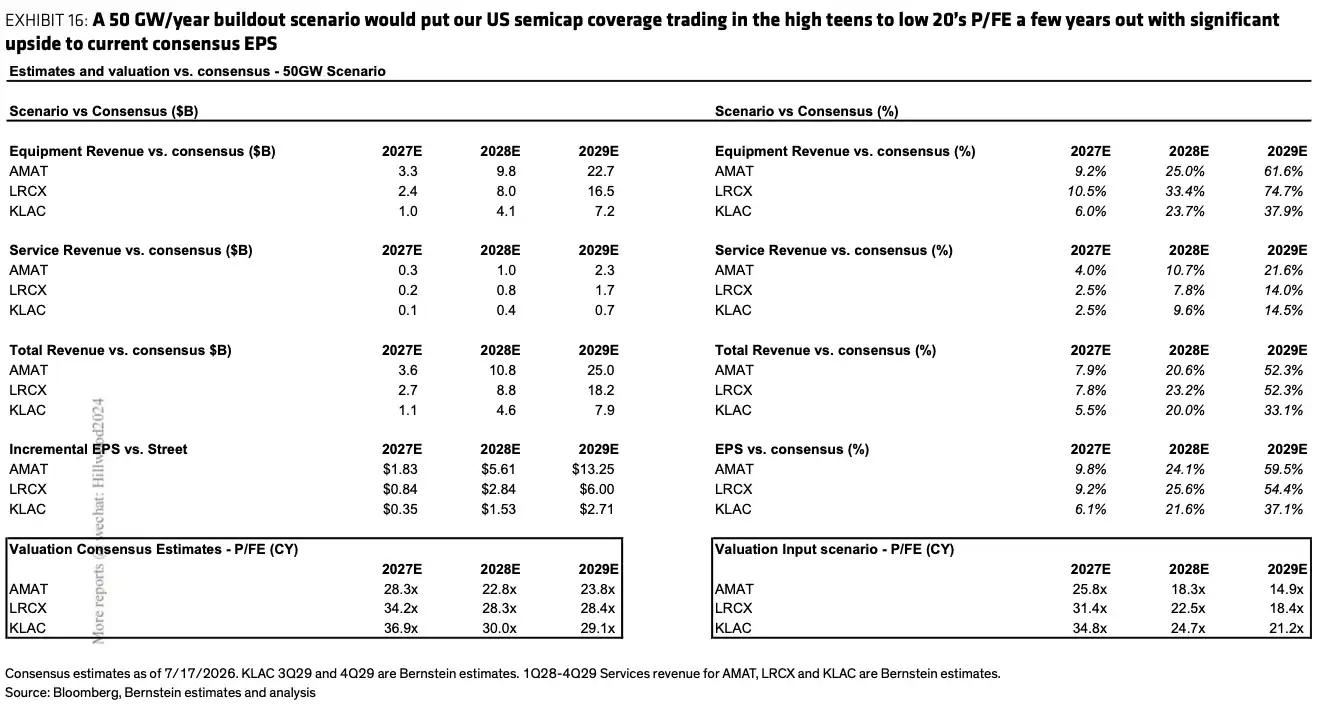
In the 50GW scenario, AMAT/LRCX/KLAC could see their 2029 EPS increase by 59.5%/54.4%/37.1% from the consensus, with P/FE ratios of 14.9x/18.4x/21.2x.
Pipeline Capacity Needs to Overcome Power, Financing, and Delivery Hurdles
The most easily misunderstood part of this calculation is to directly equate data center pipeline capacity to future equipment orders.
The U.S. data center pipeline capacity has expanded significantly in the past year, indicating a strong willingness to invest in AI infrastructure. However, there are multiple hurdles between the pipeline and deployment: power access, land approval, financing costs, GPU supply, customer demand, network, and cooling infrastructure, all of which will affect the final deployment speed.
There are also constraints on the equipment side. If the WFE scale is to ramp up to the $300 billion level in a few years, equipment companies, component suppliers, and wafer fabs all need to expand production simultaneously. The semiconductor equipment industry is not one that can ramp up infinitely fast; advanced equipment, critical components, installation and testing, and customer certification will all elongate the delivery cycle.
The model assumptions themselves also have boundaries. The related calculations are based on specific GPU architecture, power consumption, chip area, and capital intensity assumptions, and assume that the WFE must be in place by the end of 2029 to support additional computing power in 2030. Changes in architecture, a decrease in unit computing power consumption, yield rate improvements, and adjustments in capital intensity could all alter the final equipment demand.
There is also a deviation in another direction. If the demand for replacing outdated computing power by 2030 has not been fully taken into account, there may still be upside potential for equipment demand; however, if the monetization speed of AI applications is lower than expected, or if major cloud vendors slow down capital expenditures, the scenarios of 50GW, 75GW, or even 100GW may be too optimistic.
This report does not provide a firm order book but rather a set of clearer conversions: for every additional 1GW in AI data center capacity, there may be approximately 50,000 wafers per month of wafer fab equipment (WFE) capacity and around a $8 billion incremental WFE demand. The equipment stocks have already priced in some of the AI expectations, and the divergence lies in whether data center construction can materialize to a level sufficient to support an annual WFE spend of $300 billion.
Welcome to join the official BlockBeats community:
Telegram Subscription Group: https://t.me/theblockbeats
Telegram Discussion Group: https://t.me/BlockBeats_App
Official Twitter Account: https://twitter.com/BlockBeatsAsia