World Model of Everything

By Sleepy
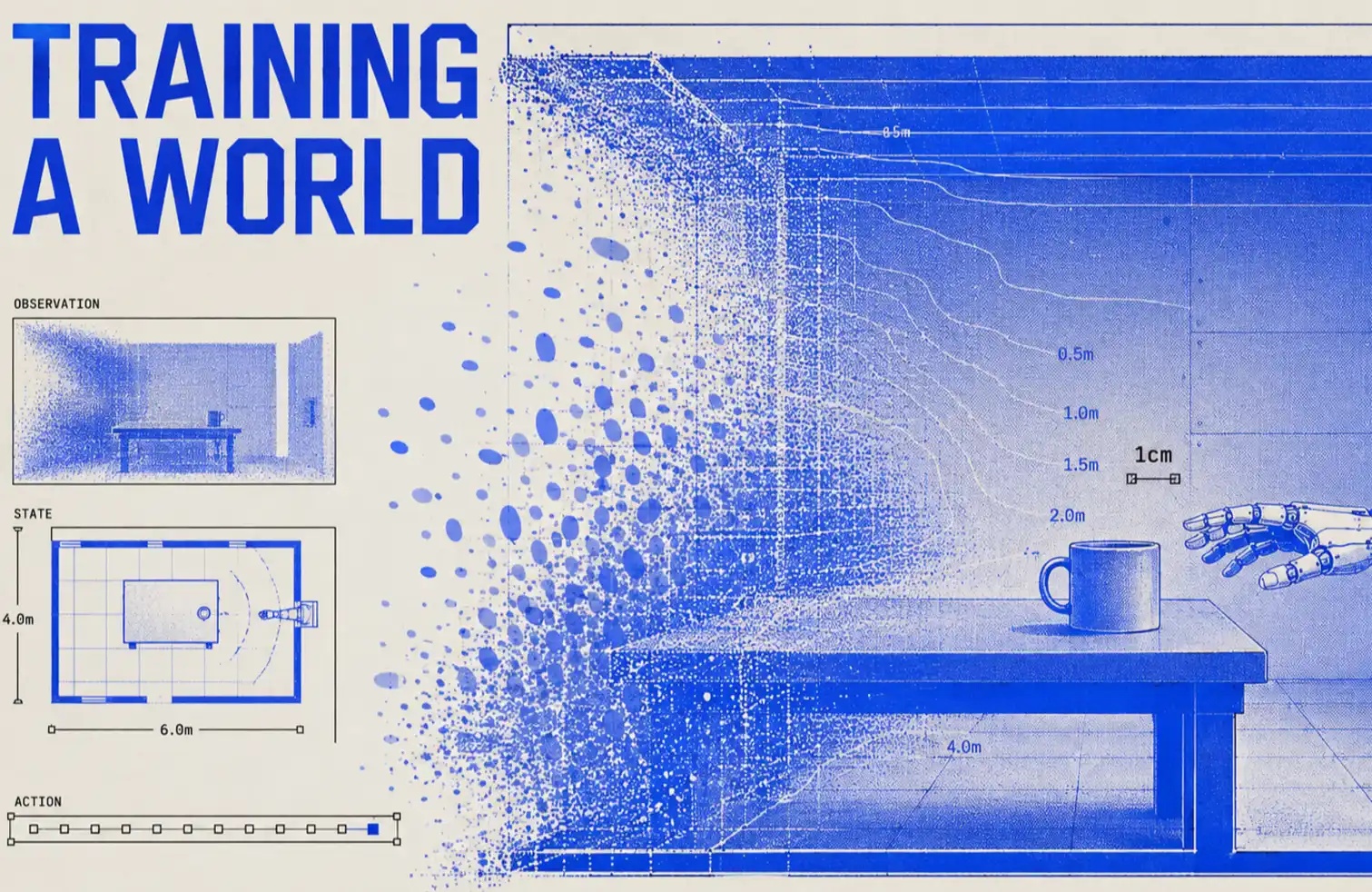
The term "World Model" has been thrown around a lot by investors lately.
In February of this year, Li Feifei's World Labs raised $1 billion, with a valuation of $5 billion, up from $1 billion just a year ago.
Yang Likun's new company, AMI Labs, raised just over $1 billion in its seed round, setting a record for the largest seed round in the history of AI startups in Europe.
In the first quarter alone, there were 25 funding rounds related to World Models in China. One company raised $2.5 billion in two rounds within a month, increasing its valuation from $5 billion to $10 billion.
What's even more unbelievable is that despite the FOMO among investors, the entire AI industry has not yet reached a consensus on what exactly "World Model" refers to. This term, which lacks a clear definition, has already attracted investments in the tens of billions. Every day, they shout slogans, seeking consensus, but in the end, they invest in something without consensus, and then call it a trend.
However, I recently heard from a few junior investors at some major VCs that they are well aware of the bubble in this area. Even though there have been heated discussions internally, the conclusion is that they still have to invest. If they don't invest, next year their LPs will ask why they missed out on World Models; if they do invest, even if they end up being wrong, at least the entire industry will be wrong together.
But when the money gets this hot, it's time to ask a rude question. Since no one can clearly explain what it is, what exactly are they all investing in?
A Process
To be fair, this concept did originally have some substance.
In 2018, two researchers published a paper titled "World Models." They had AI create a dream for itself in a racing game, practice driving in the dream, and then apply it in the actual game. Back then, ChatGPT didn't exist, and this paper was only circulated among a small group of researchers.
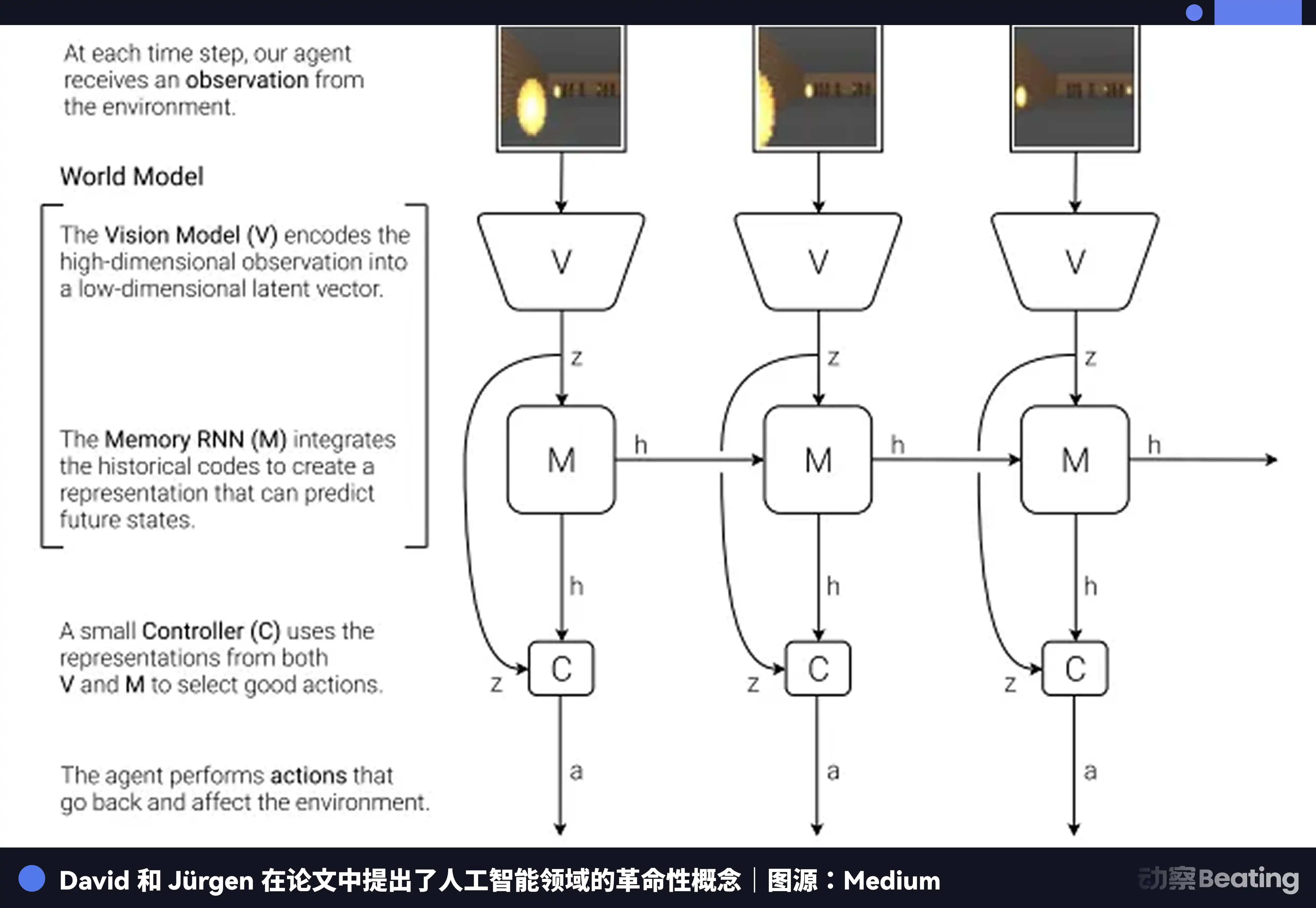
Yang Likun has actually been committed to this research direction for a long time. During the years when Silicon Valley was banking on large language models, he reiterated his view multiple times, believing that merely predicting the next word would never lead machines to true intelligence, so they must make machines understand the physical world.
He has been saying this for nearly a decade, but the trend never favored his approach. People like him don't shift their focus based on trends. In their minds, World Models are indeed a real thing.
However, when something is considered "real," it usually has to go through a process in the venture capital world.
This process will turn a research direction into a noun that can be wholesaled. What the venture capital world loves is not a technological concept, but the franchiseability of a technological concept.
In this respect, the world model is a chosen one. It is more technical than the "metaverse," sexier than "spatial intelligence," broader than "embodied cognition," and fresher than "multimodal."
Most importantly, it is very unfalsifiable. In a business plan, the more unfalsifiable a word is, the more valuable it is. Because being unfalsifiable means that in the next round, new investors can still be found to take the baton, and what the narrative earns is unfalsifiable money.
World Model Folding
And now we have the current scene.
Those making games call themselves world models, those making short films call themselves world models, those making video tools call themselves world models, those creating 3D assets call themselves world models, those making simulation robots call themselves world models.
Furthermore, those working on advertising materials, educational content, metaphysical fortune-telling, and virtual companions for chatting, as long as they dare to boast, can all enter the world model circle.
Previously, at an event, I heard an investor sharing at a roundtable that healthcare, finance, law – each field can be seen as an independent world. Following this usage, even the mechanic downstairs in my building has a world model in his mind, specifically predicting when the Third Ring Road will be congested, with an accuracy rate higher than most of the advanced driver-assistance systems I've experienced.
Recently, I saw a robotics company announce that they are simultaneously building an industrial world model and a household world model. I suddenly realized that the world is actually a countable noun that can be commercialized.
This scene was not unforeseen, and those who foresaw it have a rather special status. In March of this year, when AMI Labs raised that $1 billion, on the same day, the company's CEO told the media, "I predict that 'world model' will be the next buzzword, and within six months, every company will label themselves as a world model to raise funding."
He was not wrong at all. The only thing he miscalculated was the time; it didn't take six months at all.
Habitual Narrative
Chasing narratives has actually long been a habitual action for investors and entrepreneurs.
On May 10, 2015, a listed company whose main business was floor tiles and real estate issued an announcement, stating their ambition to become China's first internet finance company, intending to rename to "Pitutopia." Their English name was directly registered as P2P Financial Information Service, and the next day, the stock opened limit up.
That year, this company lost $100 million. Later, the actual controller was fined $3.4 billion for stock price manipulation and was sentenced.
In the same circle, the Hunan-Hubei-themed restaurant renamed to Zhongke Cloud Network, the fireworks maker rebranded to Panda Financial Holdings, and the trousers seller rebranded to Cross-Border Payment Gateway.
Then there were the metaverse projects from previous years. In 2021, a gaming company claimed to be the metaverse, a social media company also claimed to be the metaverse, NFT sellers said they were building a metaverse, there was even a project selling virtual real estate in the metaverse, and a liquor brand released a metaverse edition. Facebook went as far as changing its name.
The median transaction price of virtual land on Decentraland dropped from $45 to $5. JJ Lin spent $123,000 to buy three pieces of virtual land, which were worth around $10,000 a little over a year later, resulting in an unrealized loss of 91%. This platform, touted as the world's platform, was once reported to have only 38 daily active users, quieter than a neighborhood homeowners' group.
Those metaverse projects from back in the day, if they managed to survive through cost-cutting measures until today, probably could all afford a world-model outfit and then some.
Even the big companies were not spared. Meta, formerly known as Facebook, suffered a loss of over $60 billion in the following years in its Reality Labs division.
Speaking of Meta, one cannot ignore Song Xiaodong, who was announced at the end of June to join the Meta Superintelligence Lab as the VP of AI Research, responsible for AI security.
In 2018, UC Berkeley professor Song Xiaodong founded Oasis Labs. The company raised $45 million shortly after its establishment, being the first project Andreessen Horowitz invested in in the crypto space, part of the first batch invested by Binance Labs, with Coinbase's co-founder participating as an individual investor.
Over the next few years, this project underwent one self-introduction after another. Initially called a blockchain-based cloud computing platform, it launched its mainnet in 2020 under the name of a privacy-focused public chain, and its token ROSE was listed on Binance. It then discussed the data economy, talked about DeFi when DeFi was hot, and even released a set of AI-generated rose NFTs at the end of 2021 when NFTs were taking off. In 2025, it launched a new framework and rebranded itself as the "Trustless AWS of the AI era." In January this year, the narrative of "Privacy AI" caused ROSE to surge by 105% in a month.
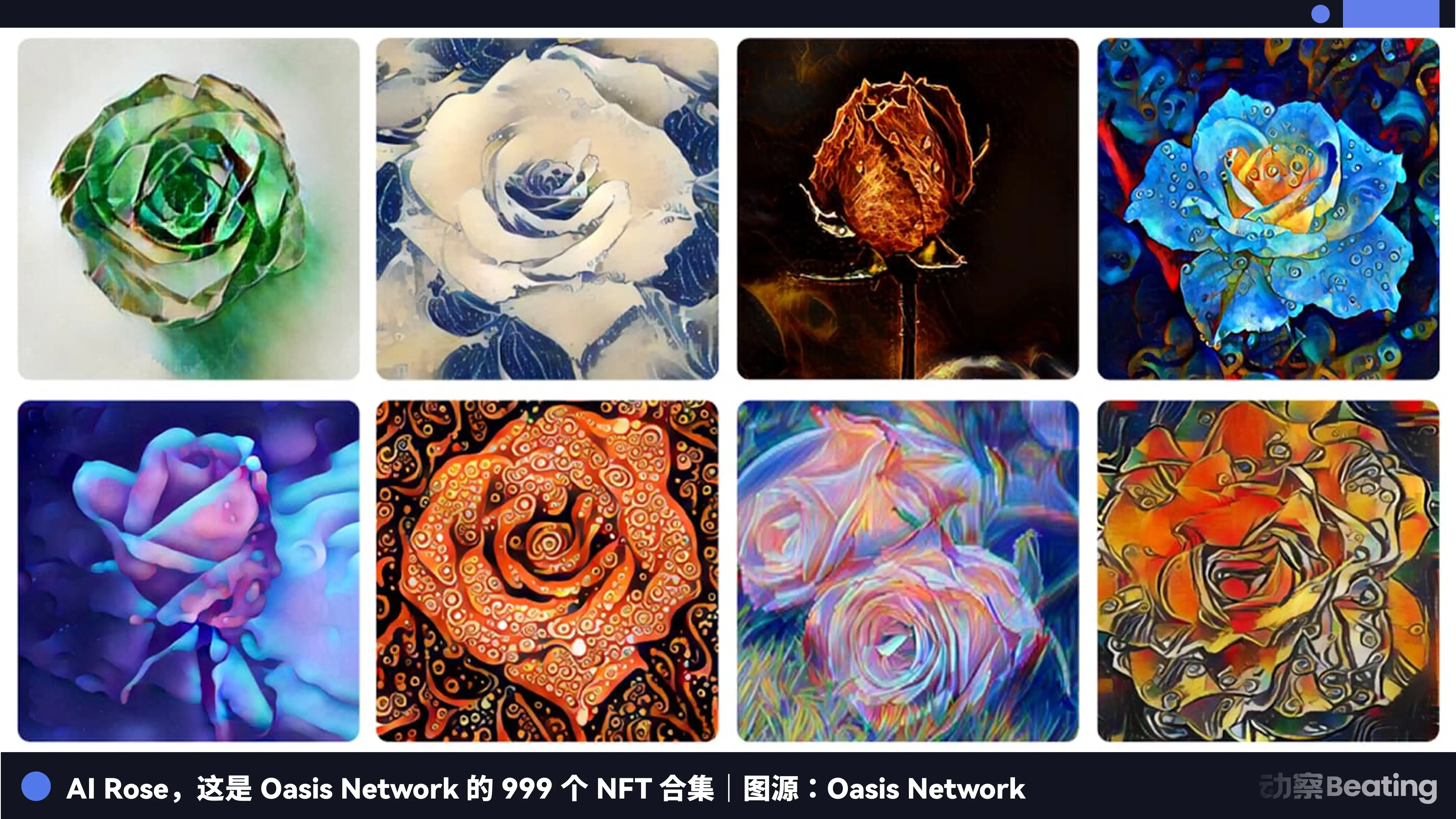
After the surge, one ROSE token was worth less than two cents. Its all-time high price was $0.596, but last week, it was $0.0059, marking a 99% drop. The project's current market capitalization is now $44 million, less than the amount it raised on its founding day in 2018.
It's not just any other industry, the AI industry itself hasn't even shed its scab yet. In the 2023 Battle of the Giants Models, 305 large models were released domestically within a year, with a peak moment when three hundred companies stood on the same stage. By 2025, according to media reports, companies in the modeling layer only completed 22 financing deals throughout the year. The proportion of financing for large models in AI's total investment dropped from 51% the previous year to 14%. Over ninety percent of people are no longer in the game.
In the dictionary, there are hardly any words larger than the world, with General Artificial Intelligence being one.
Eyes Wide Open Blowing Bubbles
At this point, theoretically, we should be cursing the project teams riding on the concept wave. They deserve the criticism, and our good friend Buried AI also just published an article last Friday.
I want to talk about another matter in this article.
The current situation is that as a founder, whether you include the four words "world model" in your business plan significantly impacts the number of potential investors you can attract and the valuation you can negotiate. Not including these words may result in a lack of investor interest, while including them could potentially multiply your valuation and extend your team's runway. If it were you, what would you choose?
It's the same story on the investors' side. For example, the aforementioned small-caliber investors all know there is a bubble in this space, a quite substantial and extensive bubble, and they may even be aware of it earlier than the entrepreneurs. However, investing is not an entrance exam; it's not about who is right. It's about who can get in before the bubble inflates and who can exit before it bursts. When a new narrative emerges, they are not concerned about whether it is reliable but whether more people will believe in it in the coming years.
Keynes explained this dilemma nearly a hundred years ago. For someone managing money on behalf of others, failing conventionally is more honorable than succeeding unconventionally, as sticking with the herd's mistakes is safe.
What follows naturally is that funds must also sell a narrative to their Limited Partners (LPs). The valuation of the projects they invest in must increase, requiring someone to buy in during the next round. The new entrants need to believe in the same narrative. The narrative is the unit of account in the primary market.
So, in my opinion, many times it's not the project teams inventing a narrative to scam money; it's the capital that first selects an imaginative-sounding narrative. Entrepreneurs just need to address them as 'Dad' to receive funding, almost like a wedding ritual.
If you trace back along this chain of reasoning, you can understand why this term still doesn't have a unified definition. There can't be a unified definition; definitions are exclusive. Once it's made clear what a world model is, it simultaneously specifies who isn't a world model, and then a significant portion, if not more, of the companies will have to pack up and leave. Ambiguity is the industry's infrastructure, tacitly maintained by everyone present.
The Reign of Narrative
Some people call it a cycle. The word 'cycle' is too gentle; it implies that everything will return to the starting point. Some things can never go back.
After running the same playbook through several rounds, what changes is the very definition of the craft of entrepreneurship.

The company's first customer has transitioned from a user to an investor. The company's initial goal has shifted from the product to the narrative. The age-old essence of business, creating something, selling it to users, receiving money, has evolved from a must-answer question to an optional one. After hearing numerous pitches, there is a rough tactile sensation; when discussing narratives, everyone's eyes light up, but when discussing retention and gross margin, the stage falls silent for a few seconds, as if someone brought up something not quite respectable.
This kind of environment sieves people out. Those who can execute find it harder to raise funds compared to those who can craft a compelling narrative. If you can't raise money, you won't survive to prove yourself another day. Those sieved out are not necessarily from bad companies; many are from honest ones. Those who remain are becoming more similar, all adept at rhetoric, all grandiose, all speaking about the next decade, with no one mentioning the next quarter. In the era where narrative reigns supreme, the first capability to depreciate is the ability to run a business well.
The individual who wrote that paper in 2018, the one who started talking about enabling AI to understand the real world ten years ago, has finally caught the wave, but has also lost the term 'world model.' Those who are actually building world models must now find a new term to distinguish themselves from that group of people.
That new term likely already exists in some paper, clean, precise, currently underutilized. A word's life usually unfolds this way: born in a paper, rises to prominence in a conference, dies in a financing pitch deck.
References
[1] AI Pioneer Fei-Fei Li's Startup World Labs Raises $1 Billion, Bloomberg
[2] World Labs lands $1B, with $200M from Autodesk, to bring world models into 3D workflows, TechCrunch
[3] Yann LeCun's AMI Labs raises $1.03B to develop "world models", TechCrunch
[4] World Models: Computing the Uncomputable, Not Boring (Packy McCormick & Pim De Witte
[5] The Price of Land in the Metaverse Is Plunging, The Information
[6] It's Lonely in the Metaverse, CoinDesk
[7] Meta's Reality Labs posts $4.97 billion loss in the fourth quarter, CNBC
[8] A16z Leads $45 Million Raise for Blockchain Startup Oasis Labs, CoinDesk
[9] Oasis Labs Raises $45 Million to Launch Privacy-first Cloud Computing on Blockchain, PR Newswire
[10] Meta hires Oasis founder Dawn Song for AI safety push, Axios
Welcome to join the official BlockBeats community:
Telegram Subscription Group: https://t.me/theblockbeats
Telegram Discussion Group: https://t.me/BlockBeats_App
Official Twitter Account: https://twitter.com/BlockBeatsAsia

 Related Articles