Morgan Stanley Analysis: Raises SIMO Price Target to $400, AI Servers Reshaping the NAND Cycle

TL;DR
· Morgan Stanley has raised SIMO's price target from $155 to $400, citing AI driving enterprise SSD and boot drive demand acceleration.
· It expects a global NAND shortage of 15% in 2026, continuing at 9% in 2027, with AI-related demand reaching 609EB by 2027.
· Suppliers and controller vendors benefit more directly, but consumer end price increases are limited, with YMTC expansion and AI capex slowing down possibly changing the supply-demand dynamics in 2028.
Morgan Stanley significantly raised its price targets for Silicon Motion (SIMO.O) and Longsys in its latest report, attributing the core reason to the NAND demand gap driven by AI servers. For investors, this is not just a regular SSD price hike expectation but a shift where AI data centers are transitioning NAND demand from consumer electronics like phones and PCs to enterprise SSDs, AI boot drives, and long-term purchases by cloud players.
The most aggressive adjustment is on SIMO. Morgan Stanley raised its price target from $155 to $400, corresponding to 23x 2027 expected EPS, and anticipates the company's 2026 revenue to hit a record high. Longsys' price target also increased from CNY 300 to CNY 673, and Phison's target rose from NT$ 2248 to NT$ 2588. However, Morgan Stanley still maintains an Equal Weight rating for Longsys and Phison, indicating that not all module makers will benefit equally from this uptrend.
The core conclusion of this report is that AI's pull on NAND will persist until 2027. In 2025, the previous oversupply is still keeping the global NAND market at about a 2% surplus; by 2026, the market is expected to shift to a 15% shortage; even in 2027, despite continued supply releases, there may still be a 9% gap. The key driver behind this is not phones and PCs but AI servers, cloud player SSDs, enterprise storage, and boot drive demands.
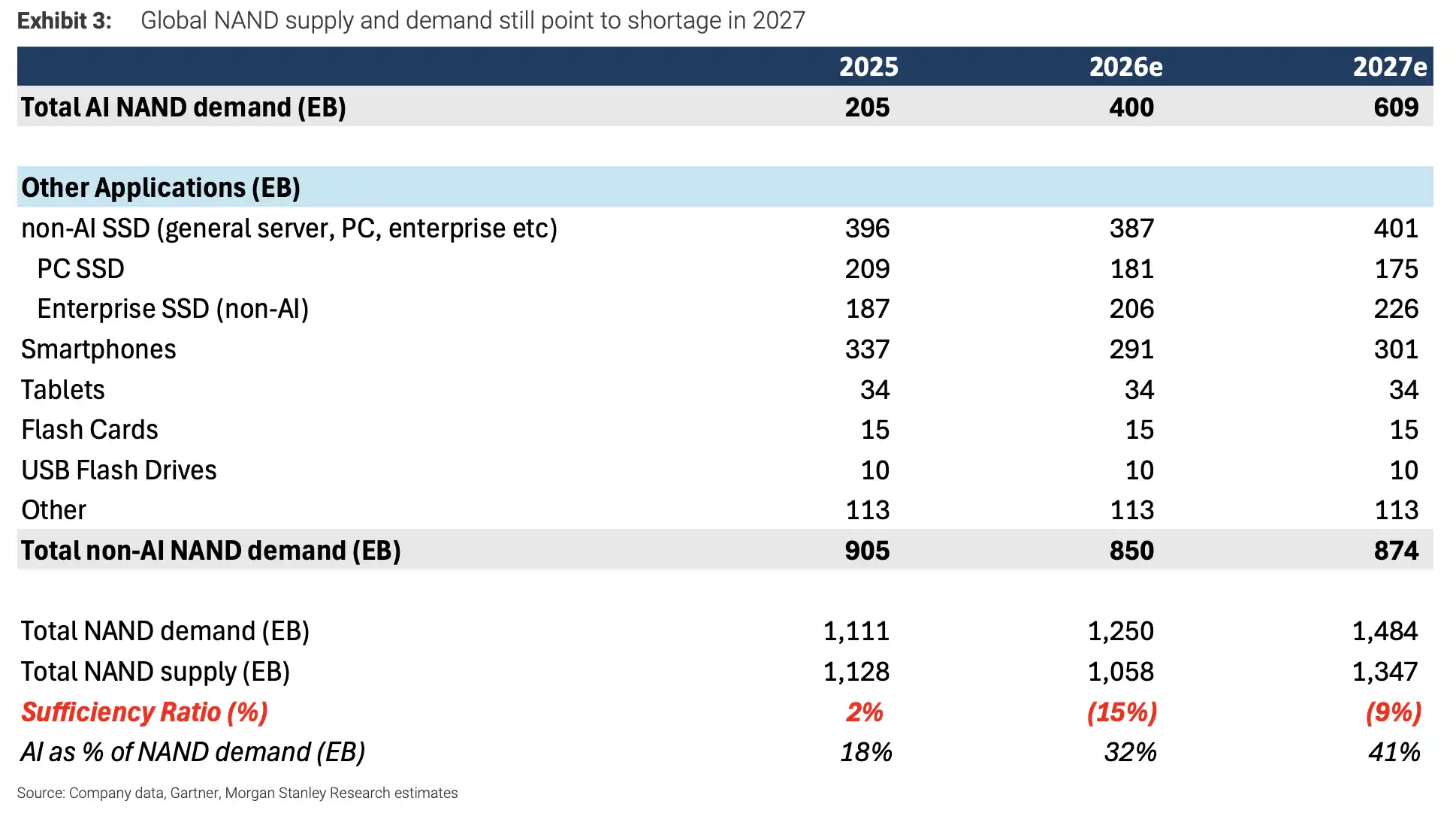
Global NAND supply-demand imbalance still points to a shortage in 2027. Total demand of 1111/1250/1484 EB for 2025-2027e, supply of 1128/1058/1347 EB, with the supply-demand ratio shifting from 2% to -15% and -9%.
AI Shifts NAND Demand Focus from Consumer Electronics to Data Centers
In the past, NAND was more easily influenced by the inventory cycles of smartphones, PCs, and consumer-grade SSDs. The current change is that AI servers require not only GPUs and HBMs but also a large amount of local storage, enterprise-grade SSDs, and boot drives. Once cloud providers enter into long-term contracts, the way NAND prices and supply-demand fluctuate will also change.
Morgan Stanley predicts that by 2027, AI-related NAND demand will grow by 60% year-on-year, reaching 609EB, accounting for 41% of the total NAND demand. In the same year, global NAND total demand is projected to be 1484EB, with a supply of 1347EB, resulting in approximately a 9% shortage. In contrast, the assumptions for smartphones and PCs are not as aggressive: standalone NAND capacity remains relatively stable, and end-device shipments continue to decline according to the hardware team model.
This means that the shortage assessment in the report is not based on a comprehensive recovery of consumer electronics but on the continued expansion of AI servers and cloud capital expenditure. The greater the contribution of AI demand, the higher the sensitivity of the NAND cycle to CSP procurement, server configuration, and enterprise-grade SSD supply.
Channel prices have also begun to diverge. Channel checks in 3Q26 show that TLC enterprise-grade SSD pricing increased by about 30% month-on-month, server-grade DRAM increased by 20% month-on-month, and legacy DRAM such as DDR3/DDR4 increased by 30%-40%. However, the price increase for consumer-grade NAND is significantly smaller because customers in the smartphone and PC segments face greater profit pressure and are unable to withstand the same magnitude of price increases.
In other words, price increases are indeed occurring, but the products most affected by the increases are those related to data centers, not all NAND categories.
Why Was SIMO Raised the Most?
The core reason for the target price increase for SIMO this time is that its business aligns perfectly with two aspects of AI storage growth: enterprise-grade SSD controllers and AI boot drive modules.
The MonTitan enterprise-grade SSD business is seen as the most important new growth driver for the company in the coming years. Morgan Stanley projects that this business will contribute 5%, 13%, and 19% of SIMO's revenue in 2026, 2027, and 2028, respectively. At the same time, the boot drive modules will also begin to scale up, with an estimated contribution to the company's revenue of about 15% and 21% in 2026 and 2027, respectively.
For AI servers, the boot drive may not be the most prominent component, but it is an essential storage configuration for system booting, management, and operation. As AI server shipments increase, the demand for related controllers and modules will also rise in parallel. SIMO, which was originally more easily seen by the market as a consumer-grade controller company, now sees a key valuation upgrade due to the potential rapid increase in the proportion of enterprise-grade and AI-related revenue.
However, this is still a forecast, not realized profit. Goldman Sachs' $400 target price corresponds to 23 times the 2027 expected EPS. The implicit assumption is that enterprise SSD and boot drive volume ramp smoothly, customer adoption continues to progress, and AI server demand does not significantly slow down. Any shortfall in any of these areas could affect whether the valuation can hold.
Module Manufacturers Raise Target Prices, But May Not Get the Biggest Piece of the Pie
Longsys and Phison also benefit from rising storage prices and AI server demand, but the reports did not upgrade the ratings of the two to a more optimistic level. The reason is that module manufacturers face a reality check in this cycle: when NAND supply is tight, the OEMs are more likely to prioritize capacity allocation to large cloud providers and key CSP customers, and the incremental amount received by module manufacturers may not be sufficient.
This is also why the target price can be raised, but the rating is still maintained as Equal Weight. Price increases are beneficial for inventory and ASP, an improved portfolio of enterprise products can also support profit margins, but if the volume is locked up by upstream suppliers and large customers, the revenue elasticity of module manufacturers will be limited.
Long-Term Agreements (LTA) are another important clue. Suppliers can obtain some price downside protection through LTAs, with Kioxia's 2027 LTA coverage rate expected to exceed 50%. However, these agreements are not unilaterally favorable. Micron also indicated that LTAs often have both price ceilings and floors. They can reduce the risk of price collapse but may also limit the price increase space for suppliers during extreme shortages.
Module manufacturers hope to transfer more inventory pressure to customers through TCM and other models, with long-term gross margin stability in the 25%-35% range. However, this also depends on customer acceptance, the extent of supply tightness, and whether the products are high-end enough.
The Risk in 2028 Lies in Supply and AI Spending
The biggest limit to this round of optimistic forecasts lies in 2028.
In Goldman Sachs' base case scenario, even by 2028, if AI NAND demand continues to grow by 60% year-on-year and YMTC capacity remains around 310kwpm, the market may still face about a 5% shortfall. However, if YMTC capacity rises to 470kwpm, while AI growth slows down, the NAND market may shift from shortage to oversupply.
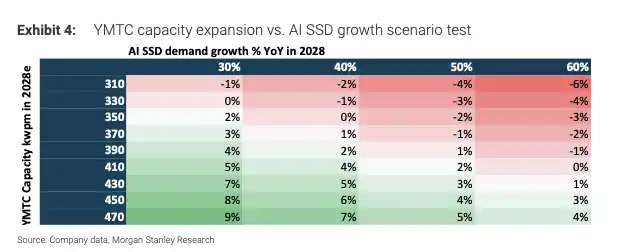
YMTC 2028 capacity expansion vs. AI SSD growth scenario test. The matrix shows that under the combination of YMTC capacity of 310-470kwpm and AI growth of 30%-60%, supply and demand may shift from shortage to near balance or even oversupply.
This is also the most difficult part of the memory cycle to assess: Short-term price increases and low inventory levels easily reinforce optimistic expectations, but once semiconductor storage supply discipline loosens, oversupply could quickly return. Some consumer-side order reductions have already emerged, with limited tolerance for price hikes from smartphone and PC clients, and the price ceiling for consumer-grade NAND may be reached earlier than for enterprise products.
Therefore, the real question posed to the market by this report is not "Will SSD prices rise," but rather whether AI demand can be strong enough to absorb the additional supply over the next two years. For controller companies like SIMO and companies in the AI storage chain, 2026 may be the starting point for the volume shipment of enterprise and AI businesses; for the entire NAND cycle, the key to determining whether the shortage can continue lies in the expansion pace of manufacturers like YMTC in 2028, CSP capital expenditure intensity, and supplier discipline.
Welcome to join the official BlockBeats community:
Telegram Subscription Group: https://t.me/theblockbeats
Telegram Discussion Group: https://t.me/BlockBeats_App
Official Twitter Account: https://twitter.com/BlockBeatsAsia
 Related Articles