$1.2 trillion Fund Rebalancing: From SpaceX to Galaxy Digital, Russell 3000 New Additions Explained

Original Title: "From SpaceX, Micron to GalaxyDigital, Understanding Russell's New 37 AI Companies and 7 Crypto Dark Horses in One Article"
Original Author: Golem, Odaily Planet Daily
After the U.S. stock market closed on June 26, the Russell U.S. Index completed its latest index reconstitution, with all index constituents and weights finalized. On June 29 (today), the U.S. stock market will officially trade under the new index after market open.
The Russell U.S. Index is one of the world's most important U.S. stock market benchmark indices, tracking the stock price performance of the top 3000 publicly listed companies in the U.S.
(Odaily Note: The actual number may fluctuate slightly due to companies going public or delisting, for example, the data for 2025-2026 is around 2900+)
It represents approximately 98% of the investable U.S. stock market and is the broadest U.S. large-cap + small-cap composite index.
If the Russell U.S. Index is likened to a pyramid, the Russell 1000 represents the top of the pyramid, consisting of the top 1000 large-cap stocks by market capitalization in the U.S.; the Russell 2000 is the middle to lower part of the pyramid, comprising small-cap stocks ranked from 1001 to 3000 by market capitalization. Together, they form the complete Russell U.S. Index, also known as the Russell 3000 Index.
According to official sources, currently over $12 trillion in assets globally are benchmarked to the Russell U.S. Index (including passive ETFs, mutual funds, pension funds, etc.). Therefore, during the annual reconstitution, a large number of ETFs, index funds, and institutional accounts must adjust their holdings simultaneously.
According to data released by Nasdaq, on the reconstitution day of June 26, their Closing Cross system processed a trading volume of $334.27 billion, marking the highest single-day volume in the history of Nasdaq's Closing Cross for the Russell 3000 Index reconstitution, far exceeding the data from 2025.
The total number of stocks listed on Nasdaq and the NYSE is approximately 5650. Although from a market capitalization perspective, the Russell 3000 Index covers 97% of the U.S. investment market, in terms of the number of constituent stocks, it only accounts for 53%. Therefore, the post-reconstitution constituent stocks of the Russell 3000 Index are also highly anticipated by the market, especially those newly included in the index, as this means these stocks will attract trillion-dollar passive fund inflows for the first time, and the stocks may have better future performance, making them worth watching.
224 New Companies Added to the Russell 3000 Index
According to official disclosures, after this restructuring, the market cap thresholds dividing the Russell 1000 and Russell 2000 surged by 24%, reaching $57 billion. This means many companies with market caps around $50 billion were moved from the Russell 1000 Index to the Russell 2000 Index, with the smallest component stock market cap threshold in the Russell 2000 Index rising to $14.64 billion (almost a 23% increase from 2025).
A total of 61 companies were newly included in the Russell 1000 Index, with 42 promoted from the Russell 2000 Index. These new additions are mainly concentrated in the technology (18 companies) and industrial (17 companies) sectors, with only 19 truly new companies joining the Russell 1000 Index.
A total of 244 companies were newly included in the Russell 2000 Index, with 39 demoted from the Russell 1000, 83 companies coming from the Russell Microcap Index, 17 companies joining the Russell 2000 Index through IPOs, and the remaining new companies coming from outside the Russell US Index component stock range.
Among the 244 newly added companies, 88 belong to the healthcare sector, 36 to the technology sector, 31 to the consumer discretionary sector, and 28 to the industrial sector.
Therefore, in this restructuring, a total of 224 new companies have been added to the Russell 3000 Index, with 19 entering the Russell 1000 Index and 205 entering the Russell 2000 Index, while 118 companies have been completely removed from the Russell 3000 Index.
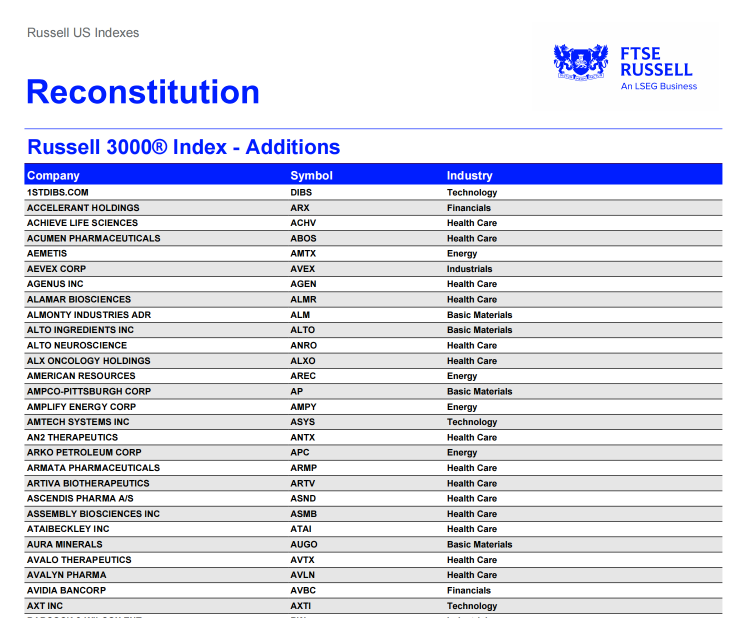
List of New Companies Added to the Russell 3000 Index (Click to View Full List)
Approximately 37 New AI and Semiconductor Companies Added to the Russell 3000 Index
Compared to the Russell 2000 Index, the technology sector's industry representation in the Russell 1000 Index is significantly higher than other industries. With Nvidia's rapid market cap expansion, it has officially replaced Apple as the largest-weighted component stock in the Russell 1000 Index. With this year's AI and semiconductor industry boom, semiconductor stocks saw the greatest increase in weight in the Russell 1000 Growth Index.
(Odaily Note: The Russell 1000 Index can also be further divided into Growth, Value, Top 200, and Mega Cap).
By weight, the largest new additions to the Russell 1000 Growth Index are Micron Technology and SanDisk, both of which have transitioned from 100% Value to 100% Growth.
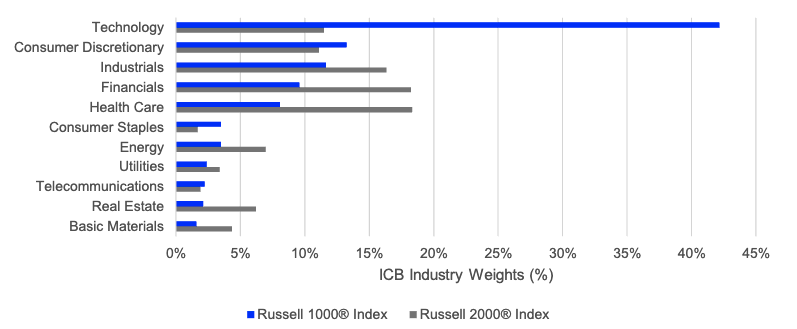
Industry Composition of Companies in the Russell 1000 Index versus the Russell 2000 Index
Meanwhile, according to Odaily's statistics, out of the total 224 new additions to the Russell 3000 Index, approximately 37 companies are involved in the AI industry's upstream and downstream businesses, accounting for about 17% of the new entrants.
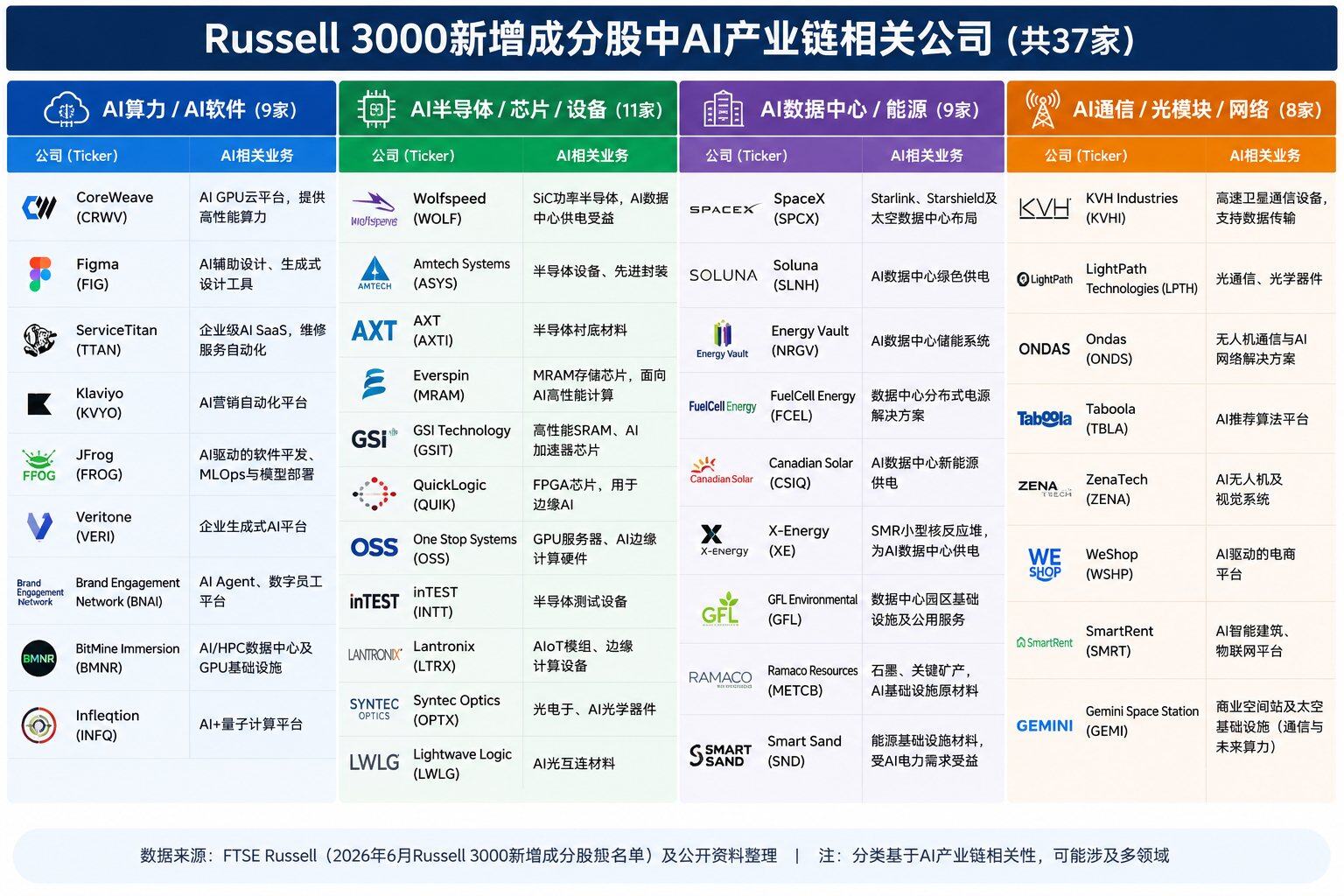
Companies Related to the AI Industry among New Additions to the Russell 3000 Index (by AI mapping)
Among these 37 companies, the most eye-catching is SpaceX. Following SpaceX's IPO on June 12, 2026, with a market value exceeding $2 trillion, it triggered the Russell's "Fast-track" mechanism, leading to a direct inclusion in the Russell 1000 Index and also entering the Russell Top 200 Index simultaneously.
SpaceX's stock will be classified as approximately 90.4% Growth and 9.6% Value, making it a significant component of growth-oriented investments linked to the Russell 1000 Index.
In addition to the Russell 1000 Index, SpaceX is also set to be included in the Nasdaq 100 Index and commence trading officially on July 6.
For other AI concept stocks newly added to the Russell 3000 Index, this is not just an honorific title but also a hardcore bullish factor that can directly translate into secondary market liquidity and stock price support.
Previously, these small and medium-sized AI and semiconductor companies (especially those with a market value below $5.7 billion and classified in the Russell 2000) were unable to enter the stock pools of large Wall Street mutual funds or hedge funds due to market value restrictions.
After a company is included in the index, Wall Street analysts may have to start covering the company, increasing visibility to institutional investors. Benefiting from being in the hot AI field, they may attract some active funds or pooled funds to enter, driving up their stock price.
Approximately 7 New Crypto-Related Companies Added to Russell 3000 Index
After the Russell 3000 Index rebalancing, some crypto companies were also included for the first time.
According to Odaily's statistics, out of a total of 224 new companies added to the Russell 3000 Index, approximately 7 companies are related to the crypto industry, accounting for about 3% of the new additions. These companies are Galaxy Digital, SharpLink, Bitmine, Forward Industries, Hyperliquid Strategies, Tron, and IREN.
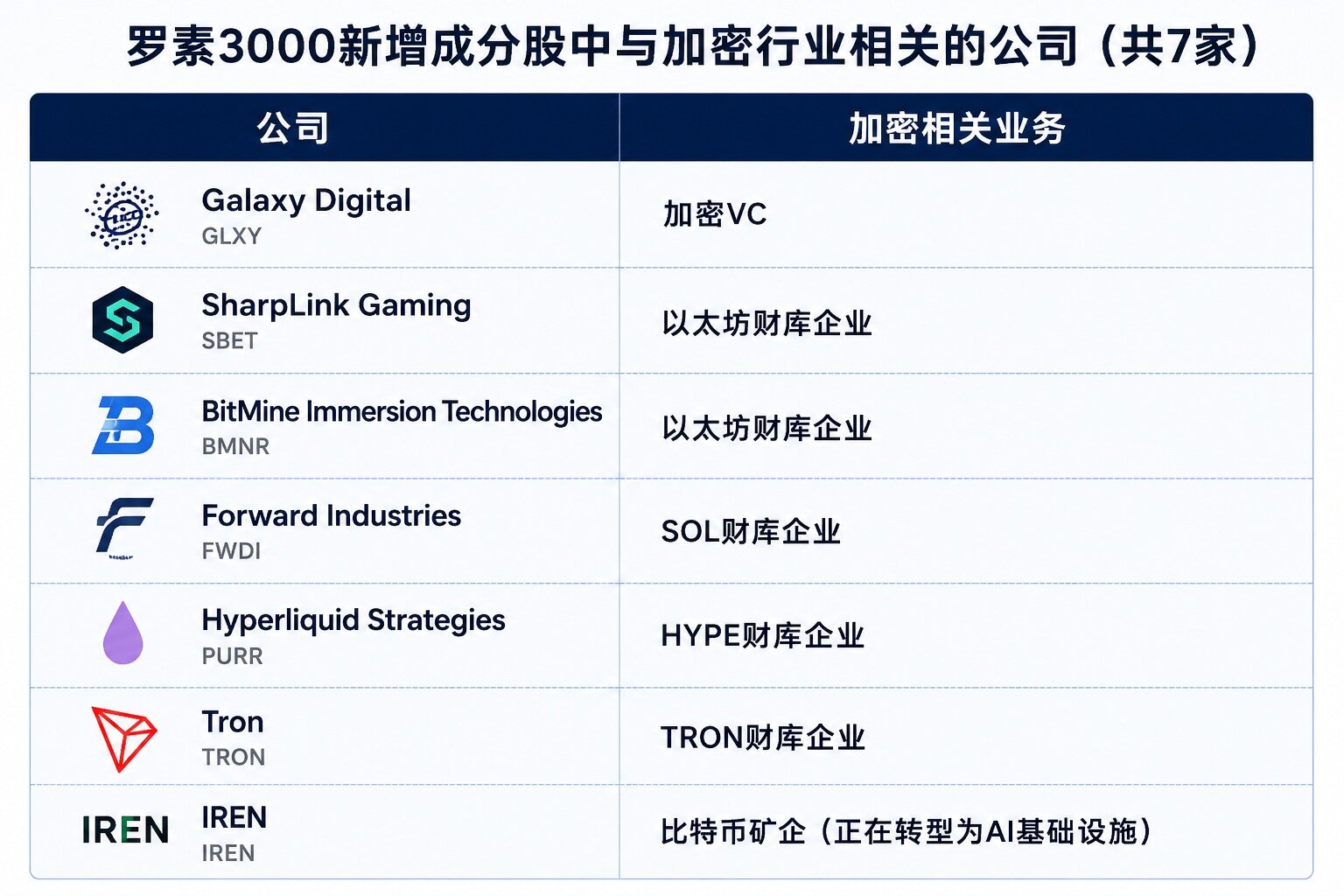
Companies related to crypto among the new additions to the Russell 3000 Index (as depicted by AI)
Being included in the Russell 3000 Index means that these 7 companies' stocks will also become part of the passive allocation of a large number of funds, with a certain potential for price appreciation.
At the same time, out of the 7 companies selected for the Russell 3000 Index, 5 are engaged in DAT business, corresponding to different ecosystems such as ETH, SOL, HYPE, TRON, etc. It is worth noting that the Russell 3000 Index is essentially a cold-hearted machine that ignores subjective preferences and speaks purely based on market capitalization. The fact that these 5 companies were selected proves that although the DAT craze has passed, their models have stood the test of the market and time.
Original Article Link
Welcome to join the official BlockBeats community:
Telegram Subscription Group: https://t.me/theblockbeats
Telegram Discussion Group: https://t.me/BlockBeats_App
Official Twitter Account: https://twitter.com/BlockBeatsAsia