Another Line in the AI Downtrend: OpenAI Forced to Lower Prices

TL;DR
· An Uber executive openly stated that the connection between Token consumption and tangible product improvement "does not yet exist"; OpenAI also acknowledged that the cost of enterprise AI is becoming an increasingly real issue.
· AI demand has not disappeared, but enterprises are shifting from trials to ROI audits, model vendors are discussing price cuts, and the growth elasticity of cloud, GPUs, and data centers needs to be revalidated.
· Related Tickers: NVDA, MSFT, AMZN, GOOG, MU, AVGO, AMD, TSM, ARM, ORCL.
After two months of continuous growth in the AI stock market, there has recently been a weakening and pullback, prompting the market to openly seek reasons.
Interest rates, valuation crowding, and earnings disruptions can all explain this pullback, but the market is now auditing a more fundamental assumption: does a greater Token consumption by enterprises necessarily lead to more revenue, efficiency, and profit.
Over the past two years, there has been a smooth chain of AI transactions. Enterprises extensively use AI, Token (the unit for measuring model processing of text) consumption rises, model vendors' revenue grows, cloud providers sell more computing power, GPUs, HBM (High Bandwidth Memory), servers, data centers, and power requirements continue to expand. As long as Token usage continues to grow, the market can interpret it as AI adoption acceleration and give higher valuations to upstream hardware and capital expenditures.
However, a recent change is that even model vendors themselves have started discussing cost issues.
According to The Wall Street Journal, OpenAI is researching further reductions in model calling prices to address enterprise budget pressures and challenges from competitors like Anthropic. Meanwhile, OpenAI CEO Sam Altman recently stated publicly that more and more enterprises are beginning to see AI costs as a significant issue, with some customers even exhausting their originally planned annual AI budgets in the first quarter.
While this alone may not be enough to change the industry landscape, it has released a noteworthy signal: the market is no longer only discussing model capabilities but also costs, pricing, and return on investment.
What is now at stake is not "whether enterprises still use AI" but "whether enterprises are willing to continue unconditionally footing the bill for high-priced Tokens."
Uber's President and Chief Operating Officer, Andrew Macdonald, said on a podcast that the linkage between Token consumption growth and "useful consumer features" does not yet exist. This statement comes from the paying party, not the selling side, investment banks, or model startups.
If the market previously believed that "usage is key to success," we are now entering the second phase: whether a token can ultimately translate into revenue growth, reduction in labor costs, or margin improvement. Once this question is systematically raised by the finance department, the valuation narrative of the AI industry will shift from "infinite demand" to "return validation."
Uber's High Adoption Rate Exposes Budget Pressure
The case of Uber is worth examining, not because it lacks AI knowledge or willingness to use AI. On the contrary, Uber's internal adoption of AI coding tools is very high. According to multiple media reports, out of around 5,000 engineers, the monthly adoption rate once reached between 84% and 95%, with individual engineers receiving monthly bills ranging from hundreds to $2,000.
The issue lies precisely here. When the adoption rate is high enough, the bill ceases to be a small experimentation cost for the innovation department and becomes a real cost that needs to be explained by the operational layer. According to the company's CTO, Uber's annual Claude Code budget was exhausted within four months. Macdonald described this as a "mind-blowing" moment.
Internally in a company, AI tools often initially enter the budget under the guise of "increasing efficiency." Engineers code faster, customer service replies quicker, and the operations team writes reports faster — these are all easily perceivable changes.
However, as the scale of usage expands, the finance department will look at several tougher questions: Is there any increase in revenue? Has real human labor costs decreased? Has the profit margin improved?
The phenomenon of "token maxing" mentioned by Macdonald also indicates that high usage may be disconnected from high value. Token maxing refers to teams or individuals consuming a large number of tokens to maximize the use of AI tools. While usage data may look good, it may not necessarily correspond to better product outcomes. For AI service providers, this is revenue; for a company, it might just be another out-of-control cloud bill.
The signal from Uber is more significant than just "AI tools are too expensive."
It is not saying that AI is useless but rather that when AI transitions from an experimentation budget to an operational budget, the enterprise needs to prove that every dollar of token expenditure can deliver measurable business results. High adoption rates no longer automatically equate to success; instead, they will swiftly expose the cost structure.
Cost Pressure Start to Ripple Across the Value Chain
Corporate buyers are starting to take stock, and the platform is also changing its fee structure.
GitHub has announced that starting from June 1, 2026, Copilot will transition to a usage-based billing model and introduce monthly AI Credits. For light users, this may only mean a change in the billing structure; however, for developers who frequently use the AI-assisted coding functionality, some heavy users have reported that the cost per session could reach tens of dollars, leading to a heated community discussion.
The significance of this is that the platform is no longer willing to entirely cover the cost of unlimited token usage within a fixed subscription fee.
In the past, users paid a monthly fee, and the platform bore the cost of the underlying model invocations. Now, as the number of AI-assisted calls, context lengths, and multi-turn tasks increase, cost pressures are starting to become explicit. The more you use, the more you pay—this is a correction to the "infinite AI" narrative.
More notably, this pressure has now shifted from the application layer to the model layer.
Over the past two years, the mainstream narrative in the large model industry has been about cost reduction, efficiency improvement, and scaling. However, as enterprise procurement departments begin to audit ROI, model providers are also facing a new challenge: if customers are unwilling to continue paying for high-priced tokens, how can growth be sustained?
A recent signal from OpenAI is very typical. On one hand, Sam Altman acknowledges that enterprise budgets are under pressure, and on the other hand, there are reports in the market that OpenAI is further lowering its research pricing. This indicates that the industry's focus is shifting from "is the model capability leading-edge" to "is the unit cost of intelligence low enough."
For enterprise customers, the most critical issue is no longer which model is the most powerful, but which model can deliver more business results on the same budget.
Internally at Microsoft, Claude Code authorizations have also been reduced in the same direction. According to media reports from The Verge, Axios, TechRadar, and others, Microsoft's Experiences & Devices division has canceled most internal Claude Code licenses and shifted towards its proprietary Copilot tool. The specific scale and reasons are still awaiting further disclosure and cannot be directly stated as Microsoft has confirmed cutting external tool purchases due to costs.
However, this action at least indicates that even large tech companies are reallocating external model invocation costs.
The impact on the AI industry chain is not about how much less revenue a particular tool generates, but rather that buyer discipline is starting to permeate upwards. Enterprises can limit quotas, choose cheaper models, shift some tasks to open source or in-house solutions, request discounts from vendors, among other actions. Model providers and application layer companies will still have demand, but pricing power is no longer solely determined by "the model is superior," but also by "whether the customer can justify the cost."
Cloud providers will also be affected. In the past, the AI portion of cloud revenue had a strong narrative: model training, inference, and enterprise applications all require computing power, and the more Token usage, the more certain the cloud demand. However, if enterprises start to drive down the unit Token cost or shift high-frequency, low-value tasks to cheaper inference paths, cloud providers' revenue elasticity may be lower than previously expected by the market.
High Usage Needs to Justify High Value
Enterprises are starting audits at this point for a reason—AI usage has reached a large enough sample stage where the inefficient parts are no longer easily ignored.
A study released by Entelligence.AI in May 2026 analyzed 2,444 organizations and over 1 million Pull Requests. According to their calculations, for every $1 of AI Token cost, only $0.18 generated actual user-value touchpoints, $0.44 was used to fix bugs introduced by AI, $0.27 was spent on rework, and $0.11 was consumed in review friction.
This data cannot be extrapolated as an industry-wide conclusion. It comes from a vendor's proprietary research page, mainly reflecting software engineering scenarios, and is not an independent audit or academic paper. However, it is sufficient to illustrate a point: there is indeed ROI audit pressure on the enterprise side, particularly in scenarios where AI-generated content still requires human review, correction, and integration.
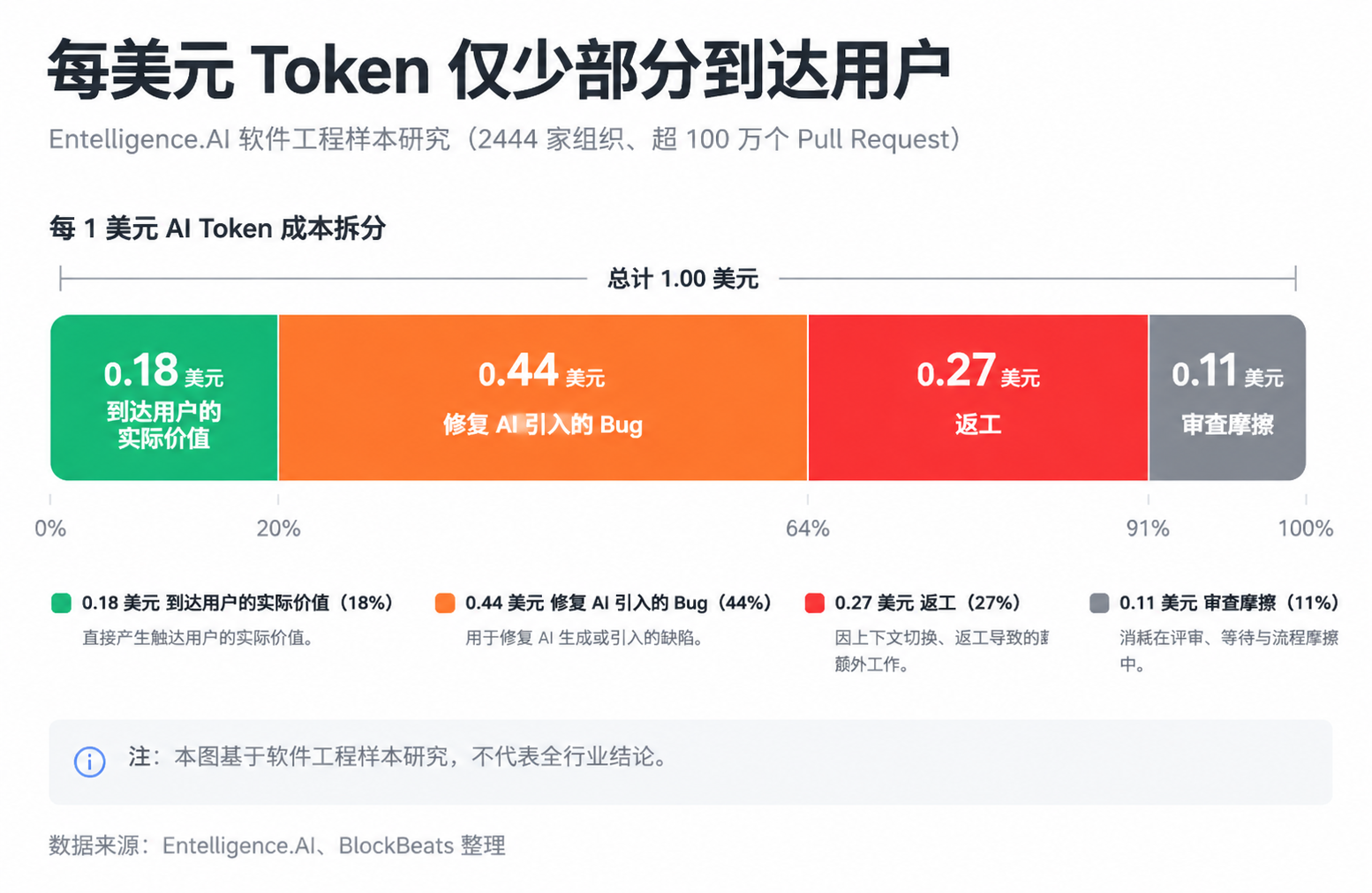
AI tools most easily demonstrate speed of generation, but what enterprises truly pay for is the deliverable results. If AI-generated code introduces more bugs, requiring more review, rework, and testing in the aftermath, the time saved on the front end will reappear on the back end. For individual users, this may only be an experience issue; for large enterprises, it becomes a financial and organizational challenge.
This also explains why the growth in Token usage can no longer be simply equated with AI success.
Token is the unit for revenue billing and cost measurement. For a model vendor, more Tokens mean more revenue; for an enterprise, more Tokens are only a budget item worth expanding continuously if they bring more revenue, lower costs, or higher profit margins.
If the market previously treated Token growth as a leading indicator of hardware demand, it now needs to add the other half: Token value conversion rate. Only when Token consumption can consistently translate into business results will cloud providers' AI revenue, GPU orders, HBM expansion, and data center construction have a more solid end-to-end support.
Payment Willingness to Cascade Up the Industry Chain
Macro strategist Andreas Steno Larsen recently pointed out that the Silicon Data-related LLM Token Expenditure Index is one of the charts worth tracking in the current market. According to reports, the index tracks the expenditure or price level corporates pay per million Tokens, which saw a noticeable uptrend in early 2026 but showed signs of pullback around the end of May.
Here, boundaries need to be respected. The Silicon Data public page is more of a product introduction, and the index methodology and complete historical data are not adequately disclosed. It cannot be taken as a firm conclusion but can serve as a signal to observe changes in corporate payment willingness.
A retreat in the Token Expenditure Index does not equate to a decrease in AI usage.
In fact, the current market is more like witnessing the AI industry transition from "computing power competition" to "unit intelligent cost competition." Companies still need AI but may not be willing to continue purchasing AI based on the previous pricing system.
If OpenAI eventually initiates a new round of price adjustments, it would mean that while enterprise-side budget pressures ease, the model industry officially enters a price competition stage. At that time, the market needs to reassess: will future growth come from new demand or from usage expansion after price reductions?
AI demand may still grow, but the revenue productivity of growth and upstream pass-through elasticity may change.
The impact on different sectors is not the same. The application layer and model layer will face price pressure first: companies will demand clearer ROI, reduce low-value calls, or switch costs between different models.
Cloud service providers face income elasticity issues: with the same usage, if unit prices fall, cache and batch processing increase, and self-built solutions rise, the revenue growth of cloud AI may not look as good as the total Token volume growth.
Further upstream, GPU, HBM, advanced packaging, server, and data center construction transactions are future capital expenditures. If corporate payment discipline makes model providers and cloud service providers more cautious about future income, the pace of hardware orders and data center construction will be reassessed.
Larsen's warning is not to suggest an immediate disappearance of hardware demand but to indicate that if Token pricing continues to weaken, the market will begin to doubt the slope of this round of AI infrastructure investment cycle.
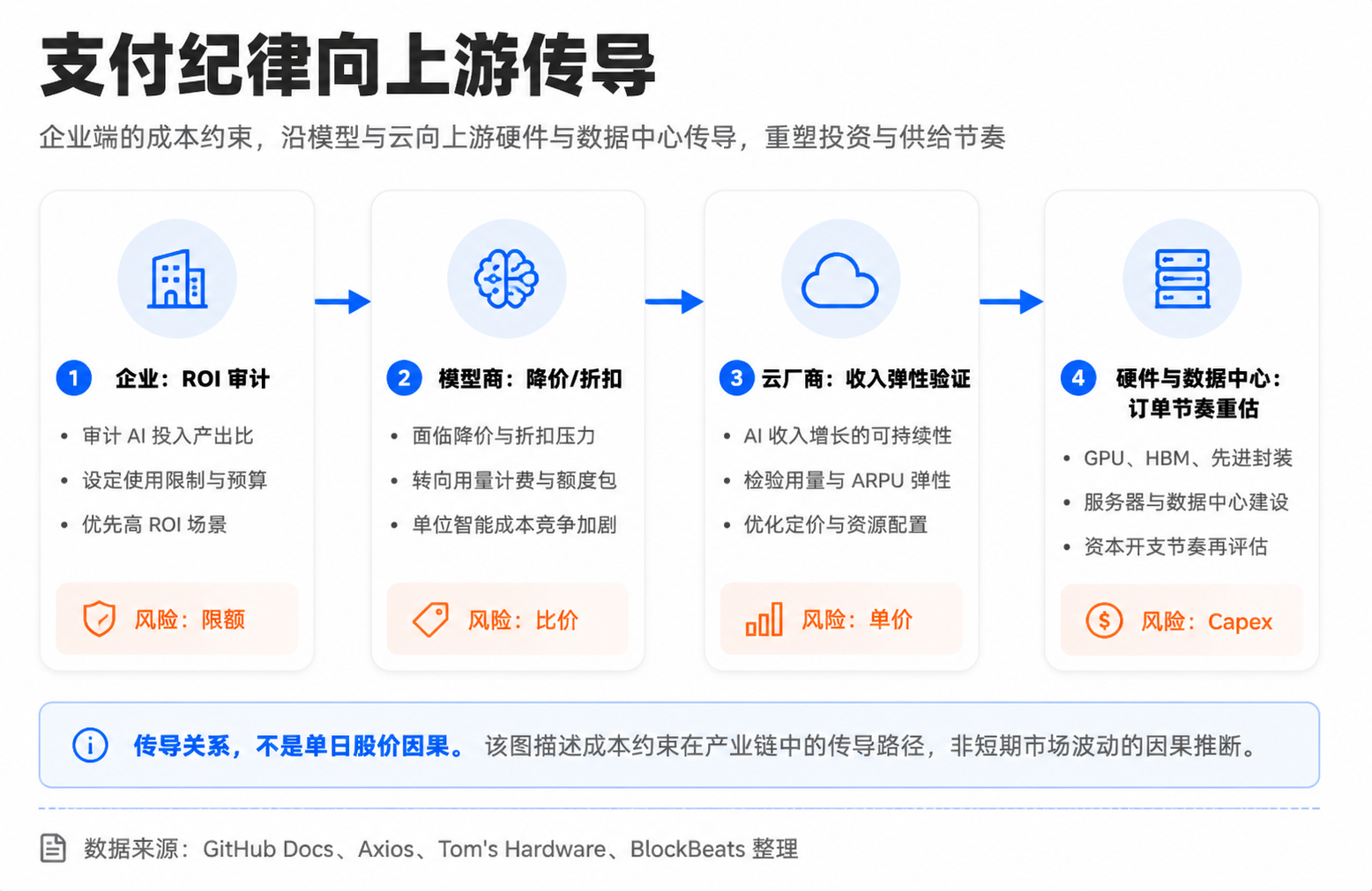
There is not a simple cause-and-effect relationship between the AI stock pullback and Token billings audit. It cannot be said that chip stocks are falling because Uber blew through its budget, but they are on the same chain: when valuations already reflect long-term high growth, any signal about end-user payment willingness and ROI will be magnified into a reassessment of upstream capital expenditure.
Next, Look at Revenue Elasticity and Order Cadence in Earnings Reports
Current evidence does not support the idea that the "AI bubble has burst." Companies have not stopped using AI, and developers will not go back to a pre-Copilot, Claude, or other intelligent agent tool era. A more reasonable assessment is that AI adoption is transitioning from early enthusiasm to budget discipline, and the market is starting to differentiate which use cases can prove a return and which are just generating bills.
The most important validation going forward is not finding another company to say AI is too expensive but to see if there is a change in language in the financial reports of cloud providers and software companies. Can the AI cloud revenue growth rates of Microsoft, Amazon, and Google continue to maintain high elasticity? How do renewals, downgrades, and complaints change after usage-based billing for enterprise tools such as Copilot and Claude Code? These factors will be more indicative of buyer discipline strengthening systemically than single-day stock prices.
On the hardware side, it is important to look for signs of GPU, HBM, and data center order reductions. As long as cloud provider capital expenditures continue to rise and advanced chip orders remain tight, a decline in Token payment willingness appears more like a healthy adjustment. If cloud AI revenue elasticity weakens while upstream orders and data center construction pace begin to slow down, the market will then price it as a deeper cyclical inflection point.
The AI trade is not over, but its pricing language is changing. Previously, the market asked "How many Tokens were used?" Now, the question is "How much profit did these Tokens ultimately become?" This difference will determine the direction of valuation differentiation along the AI industry chain going forward.
Welcome to join the official BlockBeats community:
Telegram Subscription Group: https://t.me/theblockbeats
Telegram Discussion Group: https://t.me/BlockBeats_App
Official Twitter Account: https://twitter.com/BlockBeatsAsia