U.S. Independence Day May See 'Pain at the Pump': How Two Waterways Are Choking the Global Oil Lifeline
Original Title: IRAN JUST FUCKED BIBI & DONALD BEYOND ALL RECOGNITION
Original Author: I Fucking Love Australia, Substack
Translation: Peggy
Editor's Note: July 4th was originally the U.S. Independence Day. In 2026, this day will also mark the 250th anniversary of the U.S. founding. However, against the backdrop of escalating tensions in the Middle East, it is being imbued with another layer of more ironic significance: the U.S. may, while celebrating its "independence," face the reality of an energy supply that is not independent.
Recently, Iran has stopped exchanging information with the U.S. through intermediaries, and the risks in the Strait of Hormuz have escalated once again. The rapid surge in oil prices is not simply a market sentiment fluctuation but a repricing of the global energy system due to the blockage of key waterways. The Strait of Hormuz carries significant global oil flow, while the Bab el Mandeb strait connects the Red Sea and the Gulf of Aden. If both straits come under pressure simultaneously, alternative routes such as the east-west Saudi oil pipeline may lose their significance, forcing tankers to detour around Africa, increasing shipping times, insurance costs, and delivery risks.
As the U.S. celebrates its 250th anniversary, the narrative of energy independence may be colliding with the reality of running on empty. Furthermore, this crisis has expanded from an oil price issue to involve diplomatic miscalculations, maritime chokepoints, and nuclear deterrence. For the global market, the real danger is not a sudden surge in a single oil price candlestick, but the presence of all warnings while the system continues to slide in the same direction.
The following is the original text:
Rerouting. Rerouting. You have arrived. Welcome to the "End of Control".
Imagine the entire world squeezed into the same car. Donald is in the driver's seat, reclined back, one hand on the horn, telling everyone he knows a shortcut. The rest of us are crammed in the back, repeatedly reminding him to make a U-turn. Meanwhile, the GPS remains calm, patient, and mechanical, repeating the same phrase at every intersection for the past four months: "Please make a U-turn at the next intersection."
He didn't.
The map was dismissed as a hoax, the brakes seen as weak, and the turn signals attributed to a "deep state" conspiracy. The person in the driver's seat always believed that they understood the direction better than everyone else in the car.
And this morning, the car has finally reached the end point. The engine is sputtering, and the fuel tank is empty. Destination: Out of Control.
Because Iran has exited the negotiations. Not a symbolic pause, but a substantive departure.
No longer passing messages through intermediaries, no longer allowing Pakistan to act as a messenger between two adults unwilling to sit at the same negotiating table. The conditions set by Tehran are very clear: unless Israel ceases its military strikes on Lebanon and Gaza and withdraws from the occupied territories, the negotiations will not resume.
Until then, Iran will close the Strait of Hormuz. Completely closed.
And the Strait of Mandeb, which connects the Red Sea to the Gulf of Aden, could be the next target, with related actions already underway.
Washington clearly misjudged the situation, thinking this was just a negotiating posture.
But read that sentence again: This is no longer just a threat. A threat usually implies "we might do this." And now, it looks more like an execution checklist. Two global energy and trade chokepoints have been sequentially included in the blockade agenda, with a clear sense of timing.
Trump had previously praised Iranians on TV as "excellent, cunning negotiators." It turns out they are indeed. They let him signal optimism, show supposed progress in negotiations, and prematurely declare victory. And while he was still admiring himself in the rearview mirror, the other party had closed two doors and put the keys in their pocket.
This is truly a dramatic turn of events.
Nine days. The entire story's crucial turn occurred in these nine days.
Just nine days ago, on Saturday, May 23, Trump publicly stated that an agreement was "essentially done" and would be "announced very soon." He claimed that the Strait of Hormuz "will be open." He also mentioned that he had spoken with Saudi Arabia, the UAE, Qatar, Turkey, Egypt, Jordan, Bahrain, and Netanyahu himself, and that the communications were "progressing very smoothly."
“Soon to be announced," “essentially done,” “progressing very smoothly”—at the time, these words formed a classic market-calming narrative.
"An agreement is essentially done… The Strait of Hormuz will be open."
— Donald Trump, Truth Social, May 23, 2026
Nine days later, Iran completely rejected this narrative, cut off all communication channels, and began pushing for the closure not just of one strait but two critical global passages.
This is the full trajectory of the evolving crisis.
From "soon to announce an agreement" to "global oil transportation lifelines facing closure," less than ten days have passed in between.
This is not the final tug-of-war before a successful negotiation, but a rapid loss of control after a miscalculation. Trump failed to close the deal or stabilize the situation. Even in the simplest negotiation scenario, he might not be able to extricate himself from trouble.
And market panic often begins like this: first a word, then a waterway, and finally a straight upward risk curve.
The Oil Price Has Already Provided the Answer
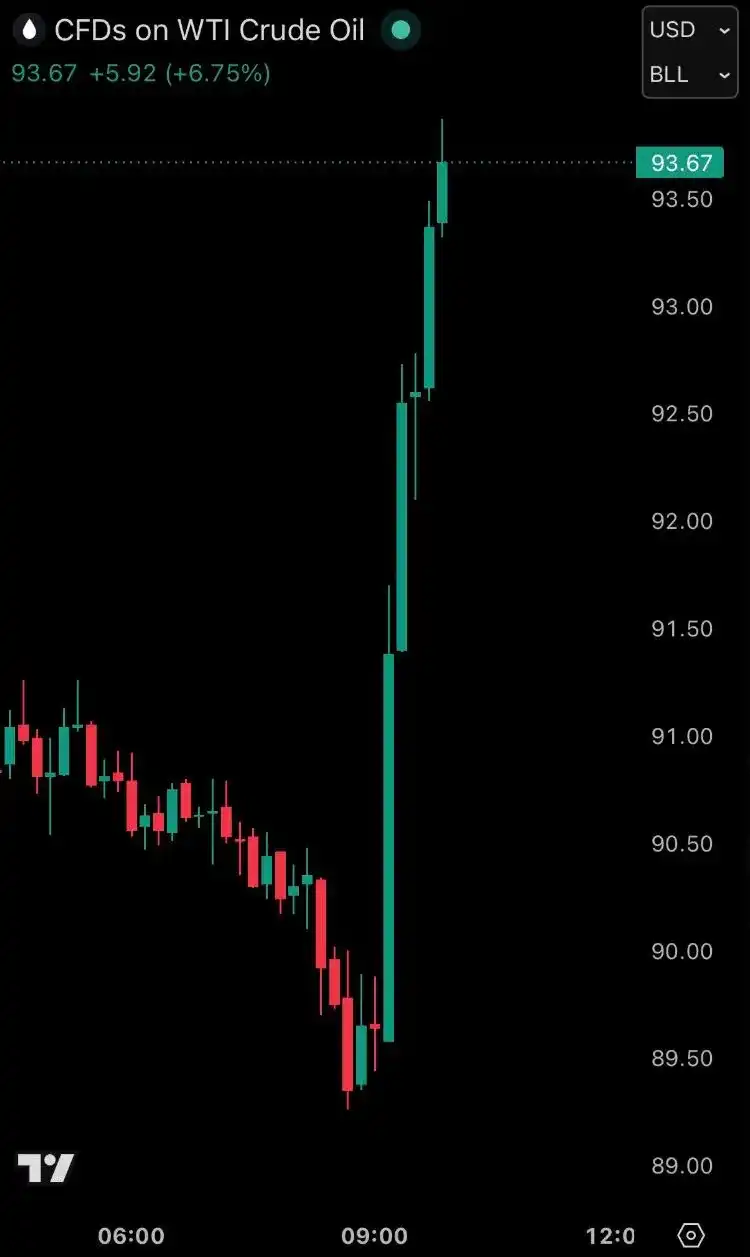
If you want to see how panic is depicted in a chart, just pull up this morning's oil price trend.
All night long, the oil price was slowly declining, with the market in a sea of red, as if the market had become numb to the war. Until Tehran issued that message, the next second, a green candlestick almost vertically surged, launching like a rocket from the pad.
WTI crude oil rose nearly 7% in a single trading day, reaching above $93 and still climbing. Many people's coffee hadn't even cooled yet, and the market sentiment had completely flipped.
This vertical line going up is the news itself.
This is how the market reacted when a global chokepoint was repriced.
More ironically, just a few days ago, U.S. gasoline prices were actually falling. Trump lifted the maritime blockade, and the market bet that he would finally reach an agreement. The national average gasoline price in the U.S. dropped from $4.56 per gallon to $4.39 as the war-time peak. Everyone breathed a sigh of relief: finally, an adult was back at the negotiation table, and the agreement was imminent.
As it turned out, it was just an illusion. That was not relief but the inhale before the scream.
Two Straits Blocking Global Energy
Next comes the numbers. Because in this matter, emotions are not enough to explain the issue.
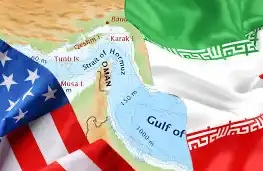
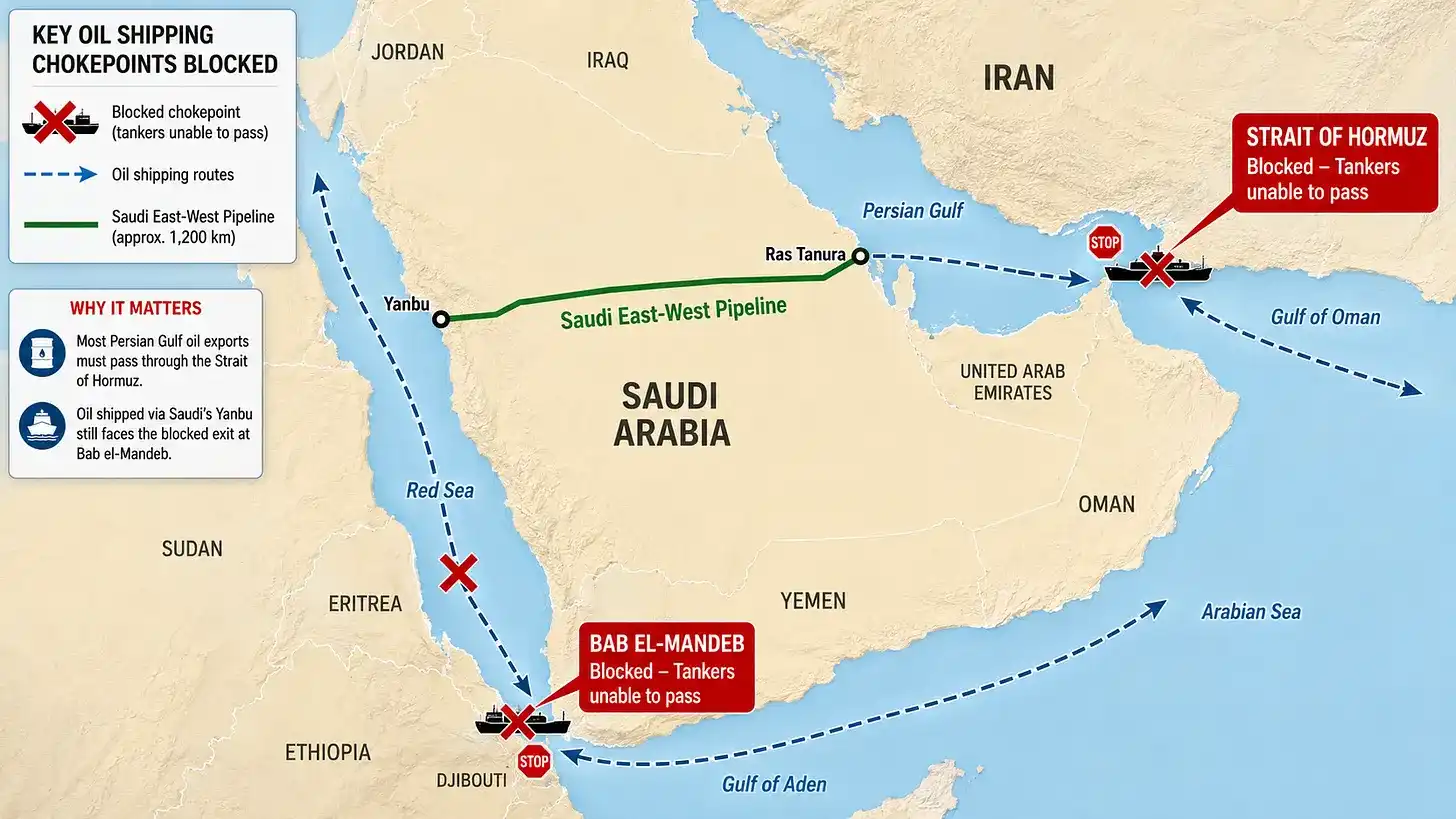
The Strait of Hormuz transports about 20 million barrels of oil per day, equivalent to one-fifth of the world's daily oil consumption. Just one strait carries an extremely critical part of the global energy flow.
The Bab el-Mandeb strait is smaller in scale, with a recent average daily transport volume of about 4 million barrels. But the key issue is that you cannot simply add these two numbers together and come up with a superficial impact scale.
Because fundamentally, they are part of the same transportation pipeline.
When the Strait of Hormuz is blocked, one of the truly available alternative passages is the Saudi east-west oil pipeline. This pipeline can transport about 7 million barrels of oil per day, crossing Saudi Arabia to deliver crude oil to the Yanbu port on the Red Sea coast.
At first glance, this looks like a safety valve.
However, the issue is that if the oil departing from Bandar Abbas is to be transported to Europe, it still needs to pass through the Strait of Hormuz. Once Iran further closes the strait, it will not simply add another layer of impact on top of existing risks, but will directly block the emergency exit after the Hormuz bottleneck.
In other words, the detour route turns into a dead end.
At that point, the remaining option for oil tankers is only one: circumnavigating the southern tip of Africa. This means that the journey of each oil tanker will be forced to lengthen by several weeks, and transportation costs, insurance costs, delivery timelines, and global energy prices will also be repriced accordingly.
After Inventory Hits Rock Bottom, the Crisis Is More Than Just an Oil Price Issue
This also explains why, even if only part of the Strait of Hormuz is blocked, tracking data shows that the global market has already experienced a supply gap of about 13 million barrels per day, and there are almost no sufficient alternative sources to quickly make up for it.
If even the alternative routes are closed, this gap will not be repaired, but will only further widen and find no way out. In more technical economic terms, we are entering an extremely passive situation.
Now, first put down the beer.
Next, what to watch is the oil storage tank. And this part is where the real concern lies.
Jeff Currie, who previously spent nearly two decades in commodity business at Goldman Sachs and now works at Carlyle, is clearly not someone who just emotionalizes. He explained on a Bloomberg show the difference between "deficit" and "shortage", because many people are not aware that these are not the same thing.
A deficit refers to consumption exceeding inflow, as the system starts to tap into inventories. A shortage, on the other hand, is the day when inventories truly hit rock bottom, and there is not much left to draw upon.
Currently, the United States and Europe are in a deficit state. Currie observed a decrease in inventories of about 25 million barrels per week, followed by another 25 million barrels. He stated that in his entire career, he had only seen such numbers once before, during the COVID-19 pandemic.
More crucially, he warned the market: this is still the demand off-season.
This is the weakest period of demand in the year. The system has not truly entered a high-pressure state yet, but inventories are rapidly draining like water out of a bathtub. According to his timeline, oil storage tanks in Europe may hit rock bottom sometime in May. As for the United States, it could be around "around July 4th," or even earlier.
The diesel inventory is currently about 11% below the five-year average. And this is just the beginning, even before the second strait is completely closed.
This sentence is worth reading again. Because it implies that the market is not tightening in a high-demand environment but is already showing supply pressures in the traditional off-season.
Of course, it's not just traders who are saying this. More notably, those who are actually responsible for producing oil are also starting to issue public warnings.
ExxonMobil CEO Darren Woods recently stated directly in front of the camera: "We are approaching unprecedented inventory levels. Really, very, very low."
The weight of this statement is significant. ExxonMobil, known for its stability and prudence as an oil giant, usually does not easily use exaggerated language to describe market risks. According to Woods's timeline, oil prices could see an almost vertical surge in the next two to three weeks.
When even Exxon starts flashing a red light, the argument that the "market is just overreacting" becomes hard to sustain. The real players who extract oil from the ground and are responsible for the physical supply are telling the market: the shelves may soon be empty.
As for those who might say, "They will eventually reopen the strait." The issue is that even if it reopens, it will not return to normal quickly.
Even if Iran reopens the passage tomorrow, Exxon's CEO believes that resuming transportation and production could still take months. First, it must be ensured that there are no mines in the water; then, insurance companies must believe that the related risks have decreased; next, global oil tankers need to be rescheduled; finally, the production capacity that has been forcibly shut down must be restarted, with the actual extent of the damage not yet fully assessed.
Currie's assessment is that it will take at least three months before the supply can start flowing again. He also warns that the production capacity closed during the pandemic took a full two years to fully recover.
In other words, there is no "recovery switch" on the wall that can be easily pressed. Even if a ceasefire is reached today, the market has already locked in a supply shortage of months.
And this is the true essence of the entire article.
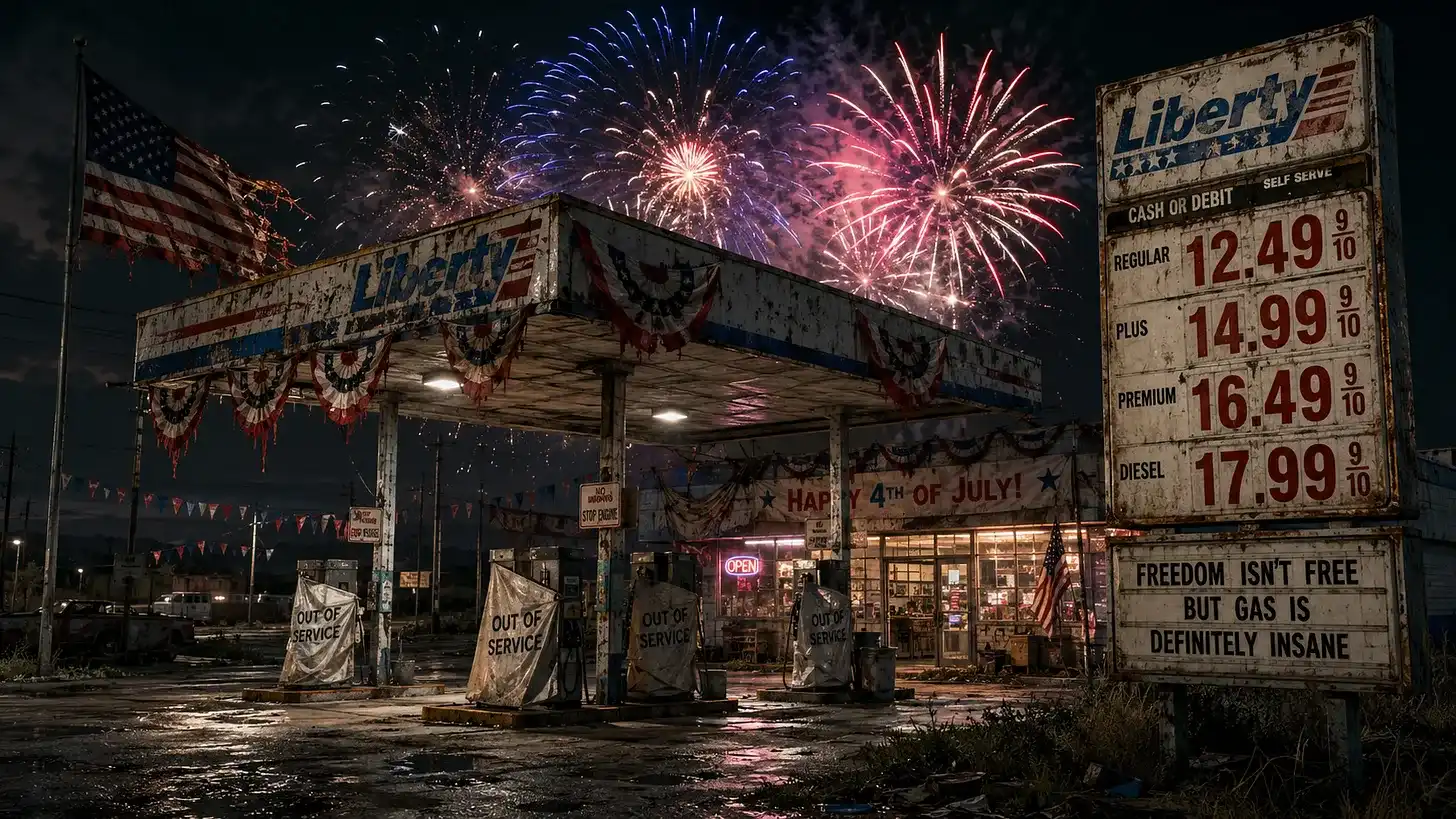
The U.S. petroleum stockpile may bottom out around July 4th.
That is the 250th anniversary of the U.S. founding. It is also the week when Trump plans to hold a UFC match on the White House lawn, celebrating his 80th birthday. Fireworks, fights, celebrations—all packaged as a display of national glory.
However, at the same time, the world's most powerful country may find itself unable to secure its own fuel supply independently.
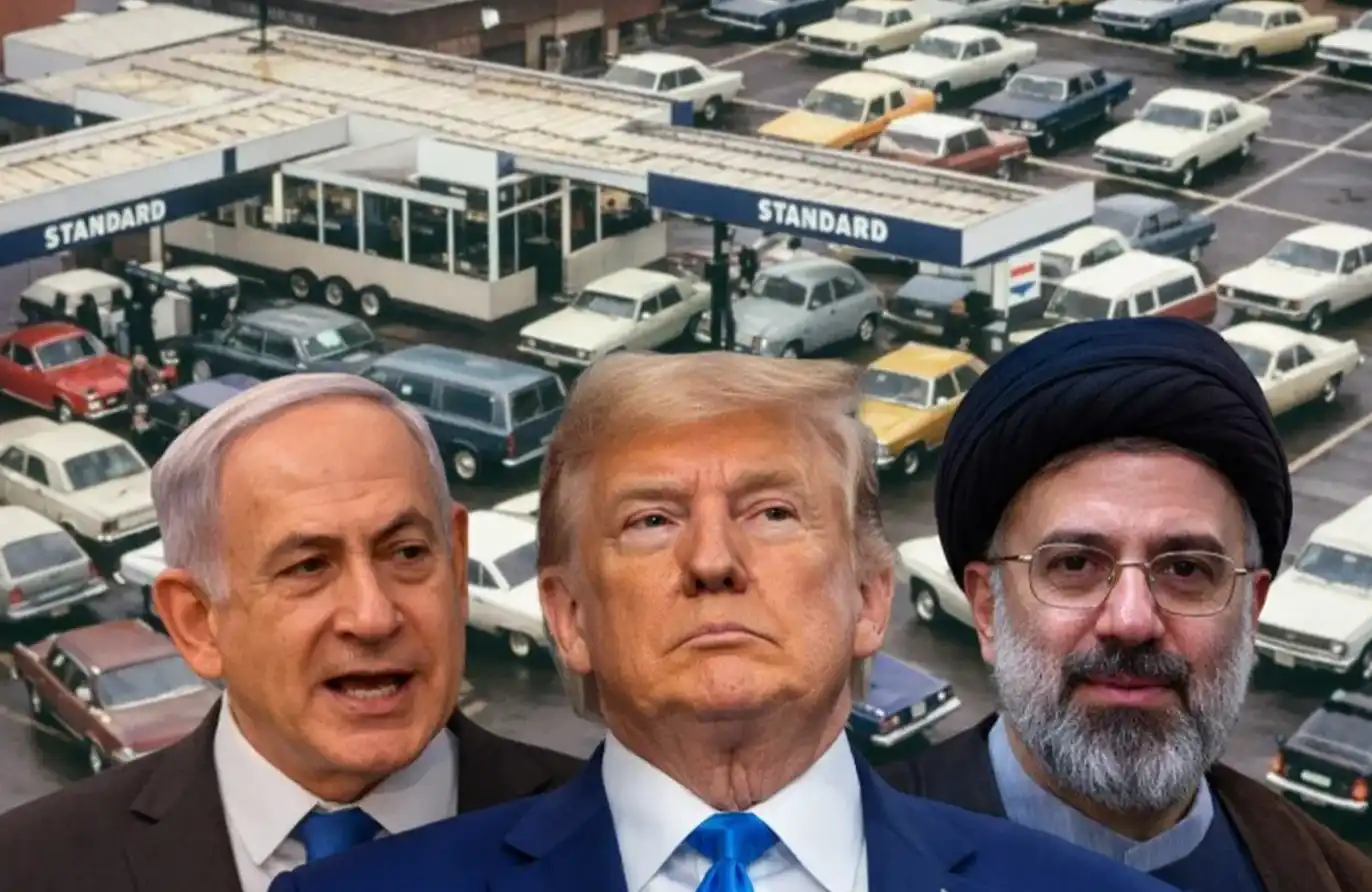
On Independence Day, American consumers may have to line up at dry gas stations. This juxtaposition almost carries a sense of absurd symbolism: a country that prides itself on energy independence and national strength, finding itself in a supply chain dead-end due to a miscalculated negotiation.
Such a storyline may sound overly dramatic. However, reality is already following it forward.
The Moment the Wheel Came Off
If you want to know exactly when diplomacy completely broke down, there are traces to follow, and it has even been recorded.
When asked whether Iran and Oman were planning to jointly control the Strait of Hormuz, Trump's response almost encapsulated all the issues in this crisis.
Oman has always played a relatively neutral middleman role in this war. It has hosted negotiations, relayed messages, and carried out those unthanked yet crucial diplomatic coordination efforts.
But Trump's response was: "Oman will act like everyone else. So we have to bomb them."
Bomb Oman. Bomb the mediator. Bomb the few countries left in this room still trying to prevent the escalation of war.
This is no longer a negotiating posture; it is an instinctive response that sees diplomacy as a demolition project. You can't threaten to bomb the referee on one hand and then act incredulous when the other party leaves the field.
This is a classic snooker stalemate
Those who have been closely following this crisis are no strangers to such a plot. The story of the "Hormuz cry wolf" has been played out too many times.
The agreement is always "just 24 hours away." The absolute deadline is always "next Tuesday." Trump keeps threatening, promising, posturing, then backtracking at crucial junctures, and explains all this as some kind of higher-level strategy. The only consistent rule throughout the entire process is: the problem is never truly resolved, but the cost keeps rising.
But those who continuously bluff will eventually encounter a fatal flaw: someday, the opponent will choose not to play along.
Today, someone did just that.
Iran's move was clearly not impromptu. They have been preparing for this day for years: laying mines, studying oil tanker routes, observing the opponent's negotiation patterns, and then waiting for someone confident enough, yet careless enough, to walk into the trap.
Today, Trump finds himself completely trapped. With no clear way out, the cue ball is blocked by the black ball. Agreements have been broken, stocks are plummeting, and his birthday celebration happens to fall on the very week the energy system starts flashing red.
This is an almost ironically timed overlap of events.
But this issue is no longer just about Trump.
The U.S. media may not be willing to say it outright, but this crisis is not just a personal failure of Trump. It is also a failure of Israel.
Stripping away all political packaging, what was the trigger condition that Iran laid out on the table? Cease strikes on Gaza and Lebanon, withdraw from occupied territories. Regardless of how the Tehran regime is perceived externally, at this moment, it is indeed the only player on the board willing to impose a cost on the Netanyahu government's actions in Gaza.
For a long time, most other countries of the world have mostly stayed at the level of issuing statements of "deep concern" and then moved back to their daily agendas. Iran, on the other hand, chose to shut off the oil flow.
That was the line it drew: withdraw, or else the global energy switch will be turned off.
What is most unsettling for Washington and Tel Aviv is that this move might actually work. Not because Iran has become the "just" side, the reality is clearly not that simple, but because it has found a leverage that no country can afford to ignore.
When one who has long operated with military, political, and diplomatic impunity encounters a cost that cannot be bypassed with funds, bombs, or negotiation postures for the first time, that is a failure.
While Trump bears the brunt of the political responsibility on the forefront, the Netanyahu government may soon realize that the world's patience is not limitless.
What really needs serious consideration is this
The next part is where the utmost vigilance is warranted. For now, set aside your views on the Tehran regime and put yourself in its position.
You are a country neighboring a nuclear-armed state. Everyone knows that country possesses nuclear weapons, but no one is willing to openly acknowledge this fact. You witness that country destroying land and its residents on live broadcast, while the world's most powerful military force continues to provide cover for it, labeling it as self-defense.
In such a scenario, what would be the survival instinct of a nation?
The answer is harsh: it would want to possess the same deterrent capability.
This is not a recognition of nuclear proliferation, but a logic of fear. Historically, nearly every nuclear-armed state has followed a similar security calculus on its path to acquiring nuclear capabilities.
No matter how many inspectors you send, no matter how long you argue about uranium enrichment and high-enriched stockpiles. Vice President Pence was still talking about "high-enriched stockpiles and uranium enrichment issues" this week, as if this were merely some sort of border dispute. But as long as one country watches its neighbor act with military advantage and continues to receive external support, it is hard to persuade it to give up its deterrent capability.
At this point, the West itself has provided the most compelling argument for nuclear proliferation, even more so than any Iranian general.
So, where do we go from here?
If the cornered party is close to or already has in hand the bargaining chips that the outside world has been trying to prevent it from obtaining for the past decade, how will the situation evolve?
Frankly, no one knows.
And that is precisely the most dangerous core of the whole affair.
We have pushed ourselves into a standoff: one party is prepared for years, pushed to the brink, holds key waterways, and may even have a stronger card up its sleeve; the other is a political performer trapped in a negotiation theater, scheduling celebrations for the week of July 4th.
Who will blink first? No one knows.
And when the stakes involve nuclear risks, "no one knows" itself is the most terrifying position. The Third World War, once hyperbole, is gradually becoming a reality risk that cannot be completely ruled out.
We are not lost; we have been repeatedly warned but failed to change course
So, we have arrived here.
The engine is still making strange noises, the fuel tank is empty, and the destination has been reached.
And the most infuriating part is, we are not here because we got lost. Along the way, all warnings have been issued.
The GPS had warned. The bond market had warned. Analysts had warned. Jeff Currie had warned. ExxonMobil had warned. Everyone who could read a tanker's route map had warned.
The brakes have always been on.
The problem is, we handed the steering wheel to someone who sees expertise as a conspiracy, deadlines as suggestions, and whose immediate response to uncooperative mediators is to threaten the use of force.
Reroute?
There is no more restructuring to be done.
We've reached the end.
Welcome to join the official BlockBeats community:
Telegram Subscription Group: https://t.me/theblockbeats
Telegram Discussion Group: https://t.me/BlockBeats_App
Official Twitter Account: https://twitter.com/BlockBeatsAsia
 Related Articles