Energy Crisis Looms as U.S. Inches Closer to Confrontation with Iran
Original Title: Trump Has Officially Lost The War In Iran And The Great Energy Collapse Of 2026 Is Coming.
Original Author: Dean Blundell
Translation: Peggy
Editor's Note: When a military operation originally packaged as a "swift victory" evolves into a prolonged blockade of the Strait of Hormuz, global energy price spikes, countries implementing fuel rationing, and strategic reserves being released, the consequences of war no longer remain on the battlefield but seep into the deep layers of the global economic system.
This article, inspired by Robert Kagan's piece in The Atlantic, highlights a symbolic turning point: those who have long provided strategic rationale for U.S. military intervention now have to admit that the U.S. is not facing a mere tactical setback in Iran but a profound strategic failure. What the author truly wants to discuss is not just whether America has won a war but whether America still possesses the capacity to underpin global energy security, Gulf order, and the allied system.
Of greater significance is not whether the Strait of Hormuz will reopen in the short term but that the global trust structure formed around this strait has been rewritten. Previously, the U.S. maintained "freedom of navigation" through naval power and security commitments; now, the author argues, this mechanism is being replaced by a new "licensing regime," with licensing authority shifting towards Tehran. Gulf nations are reassessing their relations with Iran, allies are questioning the efficacy of U.S. commitments, and energy-importing nations are responding to the new reality through rationing, reserves, alternative imports, and price controls.
The sharpness of the article lies in intertwining military failure, energy crisis, and domestic political deception on the same chain of understanding: war is not an isolated event but a culmination of years of strategic hubris, policy miscalculations, and political theatrics. When decision-makers treat war as a televised victory narrative, the real costs are borne by people queuing at gas stations, small businesses reliant on diesel transport, food systems impacted by fertilizer price hikes, and everyday individuals dependent on the global supply chain.
As the U.S. fails to reopen an energy lifeline it has long pledged to protect, the global order has already begun repricing around this fact. The cost of war will transition from sentences in strategic reports to numbers on everyone's bill.
Below is the original text:
On Saturday, Robert Kagan published an article in The Atlantic titled "Checkmate in Iran."
Yes, that's right, the husband of Victoria Nuland, co-founder of the Project for the New American Century, brother of Frederick Kagan, and the "house philosopher" of every U.S. war for the past thirty years.
In the article, he wrote that the U.S. had experienced "a thorough debacle in a conflict, a defeat so decisive that this strategic loss is neither remediable nor ignorable."
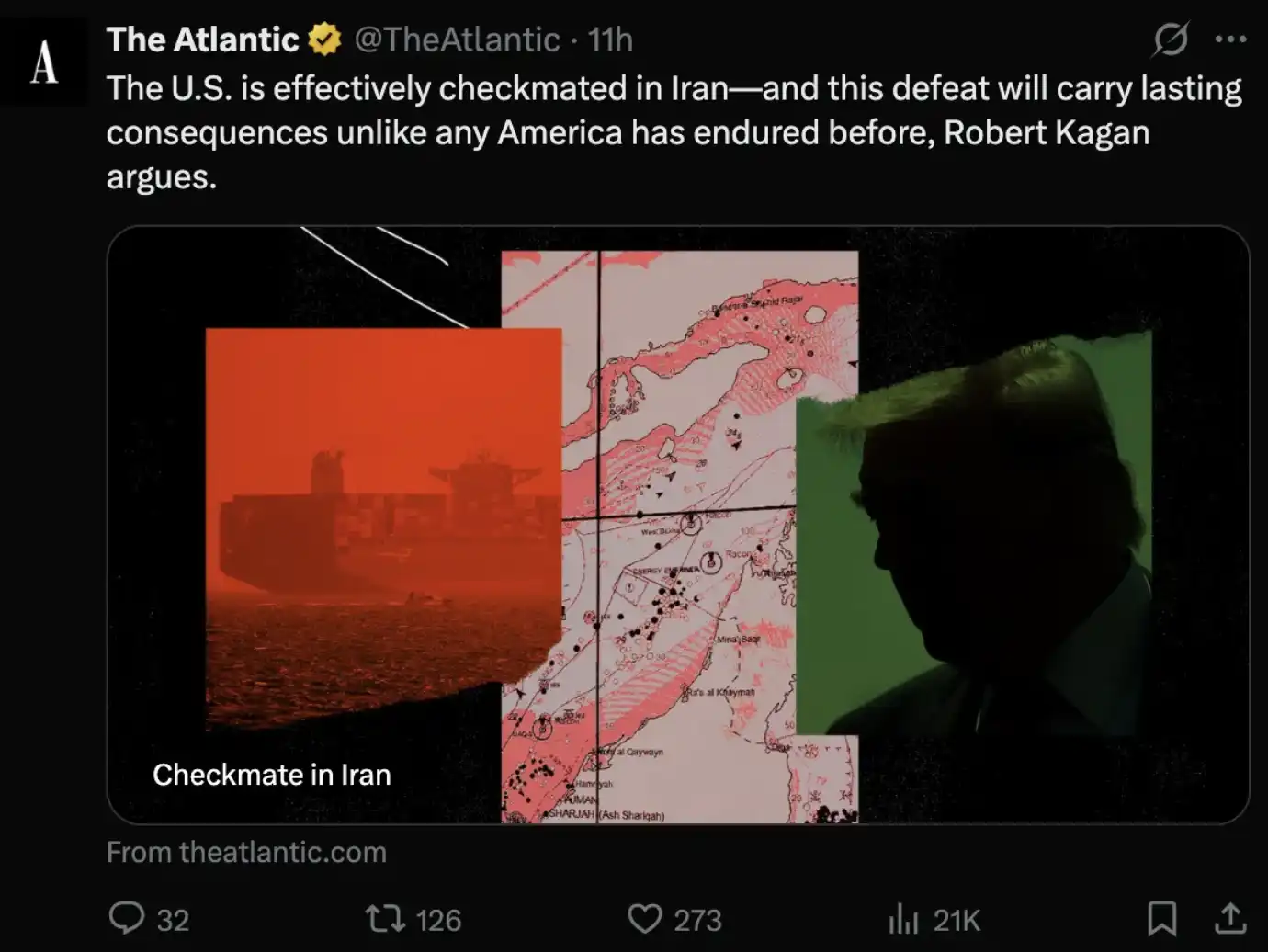
This is not an ordinary critic but someone who has long provided strategic justification for hardliners like Dick Cheney; this is not an ordinary media outlet but a magazine that has almost been able to package every U.S. military intervention as "strategic necessity."
However, now they are telling readers in a language that they would likely have condemned as "defeatism" or even "unpatriotic" in the past: America just lost. It didn't lose a battle or a military operation but its place in the global order.
If even Uncle McDonald's starts saying the burgers are bad, then the problem is really serious.
What is even more worthy of every American's serious consideration is that while Kagan was still writing the postmortem for this strategic failure in the comment section of The Atlantic, the real world—the world made up of gas stations, supermarkets, refineries, and freight—had already begun to feel the consequences.
Sri Lanka is starting fuel rationing through QR codes; Pakistan is implementing a four-day workweek; India has only 6 to 10 days of strategic oil reserves left; South Korea is enforcing odd-even license plate driving restrictions; Japan is conducting its second emergency oil release this year. And in the U.S., a country whose Secretary of Defense publicly declared in February that Iran would "surrender or be destroyed" on camera, gasoline prices are on the rise, and strategic oil reserves are being included in the largest coordinated release action in the history of the International Energy Agency.
This is the reality of a "war of choice": the so-called choice is made by a group of people willing to burn down their own country to manipulate the market and satisfy fragile egos.
Let's take it step by step.
I. Trump Tells You This War Could End in a Weekend
Let's turn the clock back (not too far, just 70 days from now) to February 28, 2026.
On that night, the Trump administration, in conjunction with Israel, launched "Operation Epic Fury." It was an airborne and naval coordinated strike. In just 72 hours, the Supreme Leader of Iran was killed, the Iranian navy was destroyed, the Iranian defense industry system was severely crippled, and an entire generation of Iranian military leadership was subjected to a cleansing strike.
The smoke had not yet cleared when Trump announced on Truth Social that he was seeking "peace through strength." Pete Hegseth — a man who now insists on being called the "Secretary of War" and always seems unable to resist some kind of role-playing at press conferences — then took to the Pentagon podium. With his usual bluster and almost nonexistent depth of analysis, he declared that Iran had "no defense industry, no replenishment capability."
But he missed a key detail. What Iran is about to do next does not require a defense industry. It only needs a map.
On March 4th, the sixth day after Hegseth claimed victory in the war, the Islamic Revolutionary Guard Corps announced the closure of the Strait of Hormuz. Not "restricted passage," not "limited navigation," but closed. According to the Iranian authorities, without Tehran's permission, "not a drop of oil" will be allowed through. Any vessel attempting to pass and "connected to the United States, Israel, or its allies" will be deemed a "legitimate target."
Within 48 hours, war risk insurance premiums multiplied fivefold. Within 72 hours, AIS transponders of several large oil tankers worldwide went dark. The strait, which normally handles about 20% of global seaborne oil shipments and a significant portion of liquefied natural gas transports, fell eerily quiet.
To be fair, the Joint Chiefs of Staff had not failed to warn Trump. According to multiple reports, in briefings before the "Epic Fury" operation, the military had unequivocally cautioned that Iran's most likely countermeasure would be to close the Strait of Hormuz.
And Trump's response at the time was dismissive: Iran would "surrender"; if they didn't, "we'll just open the strait again."
But the reality is, the U.S. did not reopen it. The U.S. could not reopen it.
That, in essence, is the crux of the whole story.
II. What Kagan Truly Admitted, and What He Still Can't Say
What is most noteworthy about Kagan's piece is not what it predicted but what it admitted.
If you strip away the usual strategic jargon, and the rhetorical packaging characteristic of The Atlantic, what remains is essentially a confession. Put more bluntly, he admitted the following:
First, this is not Vietnam, nor is it Afghanistan. According to Kagan, those wars "did not inflict lasting damage on America's overall position in the world." But this time, he bluntly acknowledges that its nature is "wholly different," its consequences "neither reparable nor ignorable."
Second, Iran will not give up the Strait of Hormuz. Not "not this year," not "only if negotiations fail," but not. As Kagan puts it, Iran can now "demand tolls and restrict the passage of those countries it favors."
In other words, the "freedom of navigation" system that has underpinned the global oil order since Carterism—the core premise that has legitimized the U.S. military presence in the Persian Gulf for the past 40 years—is over. What we have now is a new permit regime, with permits controlled by Tehran.
Third, the Gulf monarchies must capitulate to Iran. Kagan writes, "The U.S. will demonstrate that it is a paper tiger, forcing the Gulf and other Arab countries to make concessions to Iran."
To put it more bluntly: every Saudi and Emirati royal who has watched America fail to defend refineries and shipping lanes is now on the phone with Tehran, negotiating new arrangements. In other words, the security architecture the U.S. spent half a century building in the Gulf is now unraveling in real time.
Fourth, the U.S. Navy cannot reopen the strait. This is worth considering because it is the most explosive admission in the entire article. Kagan writes, "If the U.S., with its powerful navy, cannot or will not open the strait, then neither can any coalition, even one with only a fraction of America's capabilities."
German Defense Minister Boris Pistorius put it in even blunter terms: What does Trump expect a few European frigates to do that even the mighty U.S. Navy cannot?
This statement could almost be read as an obituary. The U.S. is asking allies to clean up its mess, and allies are asking in return: with what?
Fifth, the U.S. arsenal is depleted. Kagan writes, "A mere week or two of war with a second-rate power"—note the term "second-rate power" coming from this longtime advocate of regime change—"has depleted U.S. weapon stocks to a dangerous level, with no quick replenishment in sight."
If you are sitting in Taipei, Seoul, or Warsaw right now, reading these words in The Atlantic, you are not feeling more secure, you are feeling significantly less secure.
Sixth, allied trust is eroded, U.S. security guarantees have been exposed as hollow, and China's and Russia's judgments have been validated. Kagan almost doesn't say this directly—he can't, at least not so baldly in The Atlantic—but this conclusion is baked into every sentence he writes, like a corpse under the floorboards.
Of course, what he truly cannot bring himself to say is: how the U.S. got to this point.
Because he himself is one of the individuals who brought America to this point. He, his wife, his brother, every cosigner of every "Project for the New American Century" public letter since 1997, every think tank researcher who has spent the past 25 years steadily molding Iran into America's indispensable enemy, are all part of this process.
In his writing, there is not a trace of self-reflection. Not a single moment of acknowledgment that perhaps 30 years of maximum pressure have forged the adversary that is now capable of boxing America into a corner.
The room is already filled with smoke, yet the arsonist is still puzzled by the smell of burnt air.
So, what is the solution he proposes?
You would first want to laugh, then find that you can't.
The answer is: a larger-scale war. Specifically, he advocates for "launching a full-scale ground and naval war to overthrow the current Iranian regime and occupy Iran."
A person who has just written 4000 words explaining why the U.S. Navy cannot reopen a 21-mile-wide strait in the face of what he calls a "second-rate power" actually concludes with: invade and occupy a country with a population of 90 million, situated on the most defensible mountainous terrain in West Asia.
The arsonist's firefighting plan is to start a bigger fire.
III. Meanwhile, in the real world: a global oil crisis is unfolding country by country
Strategic analysis is one thing. A strategic analyst can finish writing an article, walk to a café on a corner in D.C., order a latte macchiato, and not have to think about which diesel that milk truck driving by is burning.
But other people on this planet are doing that math right now. And the math is not pretty.
As of this morning, the global situation has shaped up as follows:
· Sri Lanka has entered a nationwide fuel rationing state. Every vehicle is allocated quotas through QR codes, and schools and universities have adopted energy-saving measures. This is not a prediction; it is a current reality.
· Pakistan has implemented a four-day workweek in both the public and private sectors. Markets are closing early, remote work is being widely adopted to reduce commuting demands.
· India has strategic oil reserves of only about 6 to 10 days. While the total system inventory is around 60 days, panic buying is rapidly increasing, and the government is scrambling to find emergency import sources. More and more crude is coming from Russia, and Russia seems more than willing to oblige.
·South Korea has implemented mandatory odd-even license plate restrictions for the public sector, voluntary measures for other groups, and incentivization through price ceilings. Additionally, South Korea has enforced a five-month ban on the export of naphtha.
·Japan is carrying out its second large-scale emergency strategic reserve release of the year. The first one took place in March. Japan is now tapping into the 230-day buffer stock previously declared to the International Energy Agency.
·The UK has entered a price shock mode. The government has introduced targeted assistance schemes for households using heating oil, legislation for windfall taxes is back on the agenda, and enforcement against price gouging has been initiated.
·Germany has extended tax relief for gasoline and diesel and is starting to introduce a fuel subsidy borne by employers.
·France has launched targeted fuel discounts and is accelerating the distribution of energy vouchers to high-mileage drivers, transportation workers, fishermen, and the agricultural sector.
·South Africa has significantly reduced fuel taxes, but gas station queues continue.
·Turkey has lowered the special consumption tax on fuel.
·Brazil has eliminated the diesel tax and is providing direct subsidies to producers and importers.
·Australia is cutting the fuel excise tax in half, launching a nationwide "Every Drop Counts" energy efficiency campaign, and offering commercial support loans to industries affected by the fuel shock.
·The United States is participating in the IEA's largest-ever coordinated strategic reserve release operation, with a total volume of 400 million barrels. Meanwhile, several states have implemented gasoline tax relief, and the federal government is openly considering expanding this policy nationwide.
·China, as the world's largest crude oil importer, is responding in its typical crisis manner: by pulling up the drawbridge. Massive domestic reserves are being retained, refined oil exports are banned, and domestic price controls are further tightened. Meanwhile, it quietly buys every discounted spot cargo of Russian and Venezuelan crude oil it can find. Because of course it does.
All this is happening while the IEA has already launched a historic level of coordinated release action.
Now, read this next part carefully, because from here on out, it's not just numbers on a chart anymore; it's going to hit home.
Energy analyst Eric Nuttall of Ninepoint Partners recently stated in an interview with Bloomberg, based on my paraphrase, his key takeaway: "We are not talking about months or quarters ahead. In the next few weeks, you're going to have to crush demand by more than what we saw in the depths of the COVID-19 period."
According to his description—not my paraphrasing—this could be the "largest energy crisis in modern history." And rationing, especially demand-side rationing, the kind of rationing the U.S. has hardly seen since 1973, may now be "just weeks away."
Weeks. Not months, not some abstract medium term, but weeks.
You should now look at the car sitting in your driveway with an entirely different perspective.
Four, Why This Won't Just "Blow Over"
I want to pause here because American readers might be quick to dismiss this as a temporary disturbance.
They might instinctively assume that with some combination of events, things will just resolve themselves by the next news cycle: Iran will "blink"; Trump will find a graceful way out; Saudi will turn on the spigots; or the U.S. Navy will finally "take action."
But this won't happen, for the following reasons.
Iran has no incentive to give up the Strait of Hormuz.
None whatsoever.
Today, the strait is Iran's most valuable strategic asset—more valuable than its nominally pursued nuclear program, more valuable than its various proxy networks used as negotiating leverage in the past. Iranian Parliament Speaker Kalibaf has openly stated that "the situation in the Strait of Hormuz will not return to pre-war conditions."
This is not saber-rattling; this is policy pronouncement.
For the past 40 years, Iran has been told it has no chips to play. Now, it holds the single most important card in the global economy. The next Iranian regime—and there will be a next one, as enough of the old guard has been killed off in airstrikes to make a power transition all but inevitable—will inherit and use that card as well.
Believing that Iran will simply hand it back is to fundamentally misunderstand everything that has just happened.
The Gulf monarchies are also no longer able to openly contest Iran. Saudi's refining network, the UAE's ports, Qatar's LNG terminals—all are within range of Iranian missiles, drones, and proxy forces. And these countries have just seen that the U.S. failed to defend Israel's most strategically important targets, failed to protect its bases in the UAE and Bahrain, and failed to reopen the straits that are the lifeblood of its economy.
The so-called security guarantee has been empirically invalidated.
Riyadh and Abu Dhabi will not stake the survival of their countries on a guarantor who has just proven unable to provide guarantees. They will seek deals. In fact, they are already seeking deals.
The U.S. military also cannot feasibly reopen this strait. This should have been a wake-up call for everyone.
In terms of sheer power, the U.S. Navy remains the most formidable maritime force in human history. But it has just engaged in 38 days of "major combat operations" with an adversary that Karg called a "second-rate power," depleting its arsenal to a "dangerously low level."
Now, the U.S. Navy has launched an increasingly euphemistic operation called "Project Freedom" to attempt escorting a single merchant ship through the Hormuz Strait. The result is only two passages in a week.
Two passages. Whereas the prewar average was 130 per day.
On Tuesday, Rubio, in describing "Project Freedom," termed it the "first step" toward establishing a "protective bubble."
A bubble. The strait, once a thoroughfare akin to a freeway, now finds the U.S. attempting to protect a bubble.
More crucially, there will be no coalition coming to the rescue. Boris Pistoles made that abundantly clear. The U.K. and French defense ministries were somewhat less direct, but equally forthright. Trump called on South Korea to "join the mission" on Truth Social, to which South Korea politely responded, "We will consider the proposal." In diplomatic language, this translates to: We will not join.
Japan is busy drawing down its strategic reserves, with no capacity to dispatch its navy to the strait. India is buying Russian oil. China, as the country most reliant on Hormuz passage, is conspicuously absent—and seemingly unwilling to clean up a mess not of China's making, one that arguably benefits China.
The U.S. is appealing to the world for help. The world, surveying the situation, crunching the numbers, has concluded an uncomfortable truth: For the first time in 80 years, the U.S. is effectively unable to underwrite global energy security.
That means the world is reorganizing itself around this reality. This isn't a news cycle; it's an order change. It just isn't the "regime change" Trump and Hegseth originally envisioned.
Part V. Trump and Hegseth: Deception as Policy
We need to be precise about the accusation here, because it matters.
This is not an unforeseen catastrophe. It is not a black swan event. Nearly everything that has unfolded was predicted in advance: the Joint Chiefs of Staff warned in pre-war briefings; every major think tank analyst not aligned with the Keane crowd issued warnings; every U.S. veteran with experience in the Gulf region issued warnings; even Iran itself, in two decades of public statements, issued repeated warnings.
The scenarios for the Strait of Hormuz were played out so extensively that they even have their own Wikipedia category. Yet this administration proceeded.
Why? Because Trump needed a win. Because Esper needed to look like a real defense secretary. Because the political logic of Trump's second term—domestic turmoil, sinking polls, a restless base—required a foreign escapade: one with a clear villain, preferably one where a swift victory narrative could play out on TV screens.
The Bush era called this kind of thing a “nice little war.” Esper referred to the 2025 preemptive strike Operation Midnight Hammer as “the most sophisticated, secretive military operation in history.” Such historically ignorant phrasing should have ended his tenure on the spot.
But it did not.
He is still there. He still calls himself the “Secretary of War.” He still steps up to the Pentagon podium, proclaiming ceasefires even as missiles fly, insisting that actions are not offensive even as ships burn, claiming that Iran has been “destroyed” even as Los Angeles diesel prices hit $7.40 per gallon.
This person is fundamentally a cable news pundit in a Pentagon suit. And the position he holds demands the most rigorous strategic judgment and logistical competence within the U.S. government. He possesses neither.
The consequences of this mismatch are now being borne in real-time by every ordinary person on Earth: the commuters, the students on buses, the small business owners reliant on logistics, the consumers of nitrogen-fertilized crops, and the inhabitants of nations kept running on imported diesel.
In other words, nearly all of us.
This war is illegal. A hostile action of this scale was not authorized by Congress, not sanctioned by the United Nations, and there was no credible imminent threat. It had only a president hungry for war, a defense secretary hungry for a press conference, and a national security apparatus—trained over 30 years by Keane and his cohorts—to ultimately answer “yes.”
And those who once said “yes” are now writing a 4,000-word essay in The Atlantic, explaining how all of this was so unexpected.
Six, What You Should Do This Week
I usually don't write a practical advice section. This newsletter is usually not that kind.
But Natal said “weeks.” Sri Lanka, Pakistan, and Korea are no longer waiting. The IEA's strategic reserve release is not infinite. I think those reading this far deserve to hear some straight talk.
So:
· If you've been contemplating buying an electric vehicle, the calculus has now changed. I'm not telling you how to use your savings. I'm simply saying that the marginal cost of holding onto a gasoline car for each additional week has now increased significantly from last month; and the marginal benefit of electrification—the ability to keep moving when gas stations have long lines, fuel tanks run dry, or fuel has started to be rationed—has also gone up accordingly.
· If your charging situation allows, now is the moment of a turning point in the calculus.
· If you have the ability to stock some staple food items that rely on a diesel-intensive delivery system, do it now. Not panic buying, but sensible household stocking up. The fertilizer supply shock—don't forget, the Persian Gulf accounts for 30% to 35% of global urea exports and a significant proportion of ammonia exports—will transmit to grain prices in 6 to 9 months, but it will transmit. Beans, rice, oats, frozen proteins. This is standard emergency preparedness, not doomsday hoarding.
· If your job relies on a physical goods supply chain, this week is the time to discuss contingency plans with your employer. Especially as air freight costs will continue to rise—North American aviation fuel prices are already up 95% pre-war levels with no short-term relief in sight.
· If you are American, call your member of Congress about an “Authorization for Use of Military Force.” None of the recent events in the Persian Gulf have any congressional authorization. Not in the past, not now. The legal basis that the “Freedom Project” relies on is a residue of the “Epic Fury Action” authorization, and Rubio himself has said that the latter is over. The legal architecture that underpins all of this, in technical terms, has evaporated.
· If you are a journalist or analyst, go read the article by Kagan. Read it twice. Notice what’s missing: moral reflection, self-examination, human cost, names of the dead. Also, notice what it presents: a strategic-level recognition—the neoconservative project is over. This is a historically significant document that should be read as both an indictment and a warning.
·If you are outside of the U.S., you may have already done the math. You are allocating, hoarding, hedging. You don't need my advice. Perhaps you just need to know that some Americans are still paying attention. Not many, but they do exist.
Seven, Smoke
I want to end with a sentence that has been lingering in my mind since reading that article by Kagan, because I think it sums up the whole thing.
The arsonist smells smoke.
For 30 years, there has been a specific group of people in Washington — Kagan, Newland, Frederick Kagan, every signatory of each "New American Century" public letter, every think tank researcher with "America," "Defense," or "Security" in their name — who have consistently argued that the U.S. must maintain military dominance in the Middle East.
They said that regime change in Iraq would lead to democracy across the region.
They said that maximum pressure on Iran would either topple the regime or neutralize its threat.
They said that the U.S. could indefinitely provide security for the Gulf monarchies.
They said that American weapons, American intelligence, American naval power, and American resolve were enough to keep the global energy system perpetually on Washington's terms.
Now, all these propositions have been empirically refuted in real-time.
In just 70 days, a war originally envisioned as the crowning triumph of this project has instead become its obituary. And in many ways, the core architects of this catastrophic worldview now sit in the pages of The Atlantic, writing in nearly blunt terms: We lost.
But he still can't say: We caused this.
He still cannot mention the dead — 165 female students killed in one airstrike, thousands of Iranian civilians under bombardment, workers on burning oil tankers, staff at the Bahrain port, passengers on buses in Tel Aviv, soldiers from a dozen countries.
They do not appear in his article.
To him, this was a strategic chess problem, with pieces that just happen to be human.
But strategic issues are themselves moral issues. The two are not separate.
A war initiated by con artists, peddled by con artists, executed by con artists, and ultimately lost by con artists is first and foremost a moral catastrophe before it is a strategic one. And the strategic catastrophe is a direct outgrowth of the moral catastrophe: the same incapacity for clear thinking that manufactured lies also led to operational blunders. The hubris that disregarded warnings about the Strait of Hormuz and the hubris that disregarded warnings about the human cost were one and the same.
Over the next six months, Trump will continue to try to spin failure as success. Hegeseth will keep holding press conferences, where the word "destroy" will be used far more frequently than "fact." Cable news networks will swing back and forth between manufacturing outrage and manufacturing optimism. The strategic reserve will continue to be depleted. Lines at gas stations will grow longer. Shipping rates will keep rising. The price of fertilizer will eventually trickle down to the price of bread.
And somewhere in Washington, Bob Kagan might be holding a glass of wine, feeling for the first time in his life something akin to fear.
Not for those schoolgirls, not for the truck driver in Karachi, not for the families in Sri Lanka receiving ration cards, but for the project. For the building he had been involved in constructing for 30 years—now, that building was collapsing before his eyes, along with its foundation.
The arsonist smelled smoke. And he finally, just now, began to realize that the house was his.
Americans are now left to bear these consequences. And the consequences will become increasingly painful in the coming months, possibly lasting for years to come.
So, brace yourselves, everyone.
Welcome to join the official BlockBeats community:
Telegram Subscription Group: https://t.me/theblockbeats
Telegram Discussion Group: https://t.me/BlockBeats_App
Official Twitter Account: https://twitter.com/BlockBeatsAsia