Interview with Devin Founder Scott Wu: How Did a Nerdy Chinese-American Transform AI into a Software Engineer?
Original Title: The Wu Tapes
Original Author: Jeremy Stern
Translation: Peggy, BlockBeats
Editor's Note: Against the backdrop of the continuous overflow of large-scale model capabilities and the AI agent's transition from concept to productization, industry discussions are shifting from "how powerful the model is" to "how AI truly takes over complex work." However, as code generation, automatic bug fixing, and long-term autonomous task execution gradually become reality, a more critical question begins to emerge: In the next stage of AI competition, is it a battle of model capabilities or a battle of organization, product, and infrastructure?
This article is based on Jeremy Stern's extensive interview with Cognition's founder and CEO, Scott Wu. Scott Wu is an International Olympiad in Informatics gold medalist and one of the key entrepreneurs behind the AI programming intelligence agent Devin. Cognition, through Devin, delves into software engineering automation, attempting to transition AI from an "assistant tool" to an "autonomous colleague."
Note: Devin is the AI programming intelligence agent launched by Cognition, which can be understood as an "AI software engineer."
In this conversation, Scott Wu does not just narrate the story of a teenage genius founding an AI unicorn, but rather deconstructs the rise of the AI agent into a set of more fundamental structural issues: how model capabilities translate into real productivity, how technical genius transforms into an entrepreneurial organization, why software engineering has become the first entry point for AI transforming the real world, and when cognition itself is automated, how human value should be repositioned.
First, the technological paradigm is shifting from "completion" to "agency." In the past, the mainstream imagination of generative AI still lingered on text completion, question answering, and code assistance, where AI was more like a reactive tool. However, in Wu's view, the real change lies in the emergence of the agent form: it does not wait for user prompts word by word but receives tasks like a colleague, understands codebases, debugs, tests, and submits reviewable results. This means that the core of AI products is no longer just model invocation but whether they can be embedded in real workflows to continuously accomplish high-context tasks.
Second, software engineering is shifting from "labor-intensive work" to "cognitive processes that can be scaled." In the past, coding relied on engineers' time, experience, and team bandwidth, and a team always had projects that could not be completed, requiring trade-offs within limited resources. The direction represented by Devin is to have AI take on a large part of the execution layer's work, freeing engineers from repetitive coding, debugging, and maintenance. This does not mean the disappearance of software creation but rather a shift in the bottleneck of software production from "who writes" to "who defines problems, designs architectures, and makes judgments."
Third, we have seen a shift in the AI entrepreneur profile. In the past, tech companies were often understood as a combination of Jobsian product intuition, business narratives, and organizational charisma. However, in highly technical fields such as AI and crypto, the new wave of founders increasingly come from mathematical, competitive programming, and quant training backgrounds. Their advantage lies not only in intelligence but in analytical skills, competitiveness, and self-iterative mechanisms honed in long-term competitive environments. This implies that in the AI era, entrepreneurial competition is more deeply intertwined with technical acumen, research understanding, and product execution capabilities.
Fourth, AI risk has shifted from abstract doomsday narratives to real-world adaptation friction. Wu's concerns about AI stem not primarily from the technology itself but from the imbalance brought about by the rapid pace of technological diffusion: a few elites gaining capabilities first while mainstream organizations, educational systems, and security defenses lag behind. Particularly in cybersecurity, software infrastructure, and enterprise production systems, if offensive capabilities spread faster than defensive capabilities, society will face a more complex imbalance.
Fifth, human value is transitioning from "problem-solving ability" to "setting goals and self-expression." If AI eventually takes on more and more of the routine cognitive labor, then humans will no longer be defined solely by computational power, logical reasoning, or execution efficiency. Wu's response carries strong technological optimism: AI will propel humanity from a "survival mode" to a "creative mode." However, this also raises deeper questions: when cognition is replicated and execution is automated, the truly irreplaceable aspects of humanity may no longer be the abilities themselves but memory, context, desires, dignity, and how we choose to use our abilities.
If we were to distill this conversation into one assessment, it would be this: Devin's significance is not just an AI programming product but a preliminary trial of an AI agent entering real-world production systems. In this sense, the subject of this article is no longer just Scott Wu or Cognition but a structural turning point in the AI industry from model worship to workflow reconfiguration, from capability showcasing to productivity infrastructure.
The following is the original text (reorganized for better comprehension):
Introduction
There was a classic narrative about mathematical geniuses that captivated the public imagination for a long time.
It was an era when Americans still believed they could win wars and campus nerds would be stuffed into lockers. The public face of technological power still belonged to WASPs (White Anglo-Saxon Protestants), old elite networks, and sports stars.
These kinds of stories usually follow a familiar four-act structure.
Act One: A new proof or theorem emerges, and a genius disrupts the entire field with their explosive talent, offending existing authorities—academic elites, award-winning figures, and all those whose status he challenges.
Act Two: He begins to vindicate himself. Papers, lectures, public appearances, and a cohort of loyal students and followers form a protracted defense movement. The process is fraught with obstacles, but ultimately forces institutional bodies to reluctantly recognize his value. Meanwhile, governmental bodies and foreign intelligence take an interest in him and seek to exploit his work.
Act Three: Symptoms of severe insomnia, paranoia, and mental imbalance become impossible to ignore. Divorce, malnutrition, self-harm, psychiatric hospitalization, or descending into the campus eccentric—robed and wandering into seminars, scribbling unsettling symbols and sentences on the chalkboard.
Act Four: Irreversible mental collapse, sedation, or death. Subsequently, a mythos emerges: madness is interpreted as the price a genius must pay, and his story enters the undergraduate syllabus and middle-class cultural canon, becoming fodder for literary awards, biographical writing, and Oscar-bait films.
We still love to tell such stories to this day. The success of "A Beautiful Mind" and "The Imitation Game," as well as recent work by Jonathan Rosen and Benjamin Rapaport, are evidence of this trend. However, these stories almost always have to hark back to the 20th century, and this is no accident.
In the first quarter of the 21st century, the fate of America's top geeks has undergone a reversal.
Today, those in the same field as the young "nerd genius" no longer see him as a personal threat but are more likely to view him as a risk investment with a power-law payoff or a talent acquisition in the nine figures. Domestic and foreign governments, especially intelligence agencies, are no longer just potential surveillers but may become his clients, partners, or even business lines. Rejection has, in fact, become a ticket to the Ivy League.
He no longer needs paranoia and seclusion to complete the genius narrative. The image of complete rupture from family, society, and reality is being replaced by another lifestyle: a highly socialized network, Eastern meditation, psychedelic experiences, ethical veganism, and optimized sleep management. He no longer needs to wander barefoot on the campus lawns, murmuring apocalyptic delusions. He simply needs to appear on a TV show, tell Anderson Cooper that the technology he is building might destroy numerous jobs, or even alter human destiny—and in any case, this will create shareholder value.
Perhaps the most significant change is that the old-guard nerd geniuses' zeal for "truth" seems to be waning. That zeal used to contain two contradictory things: a desire to be understood and a willingness to be exiled for not being understood.
Today, fame, wealth, and power no longer need to wait until after death to be acknowledged. They can manifest in real time through valuation, IPOs, control of key infrastructure, lobbying of heads of state, and the ability to orchestrate people and systems. They will also be daily smudged, amplified, and rationalized on the timeline of X: a group of worshipers tamed by technology will package the true intelligence of a nerd genius, along with openly displayed personality flaws, into a Steve Jobs-style entrepreneurial myth, staunchly declaring that this is just a temporary flare-up of a "founder pattern."
This is why the idea of a "beloved AI giant" is essentially a cocktail party-style oxymoron, much like "Canadian villain" or "German comedian."
No one truly enjoys this situation. Even those who don't have to worry about their white-collar jobs being replaced, don't need to understand how data centers consume water resources, and don't harbor a strong hatred for technology find it hard to relax about it.
Because at the cultural core, Americans are still middle class. They instinctively believe that the rightful place for a nerd genius is not rubbing shoulders with Cannes media personalities, nor standing in a position stronger than the nation. He should serve national security, or explore the stars; then perhaps work in a "real company" like Costco; and finally retire to a University cottage with a constant temperature, quietness, and a small window, contemplating how to build a "gentle singularity" or "world brain"—and reminding people that if this system falls into the wrong hands, it could "kill everyone."
Those with this intuition are likely bagging your groceries at the supermarket or inviting you to join their podcast today. As you have long known, they too will eventually enter this technological narrative. But if you still want them to continue paying taxes, to continue complying with institutional arrangements, and even to continue fighting for the country when needed, the "god" you want to build must also be put into a box that they can understand and accept.
Personal Story
And that brings us to Scott Wu.
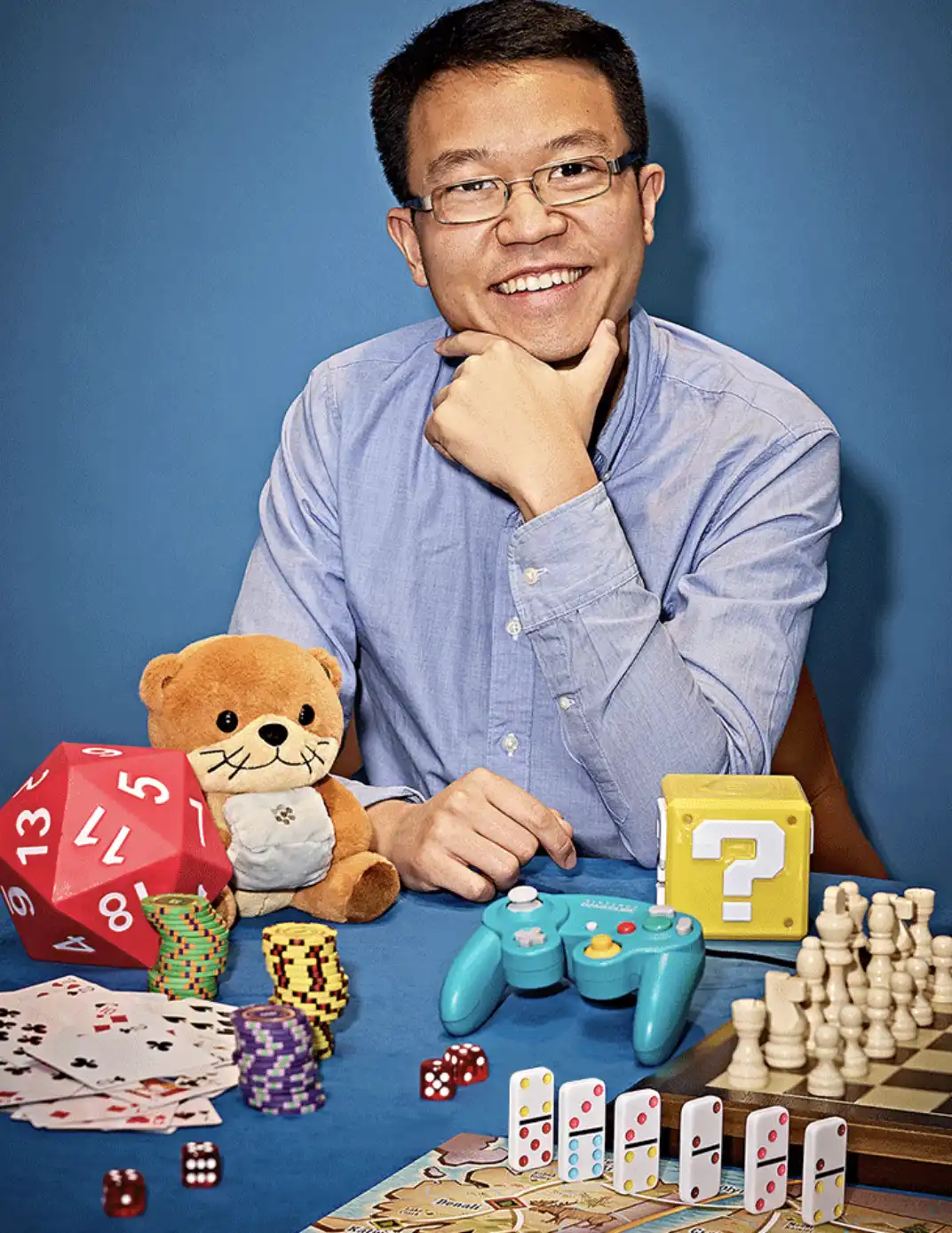
Scott Wu, founder and CEO of Cognition, now heads an AI programming intelligence company. The company is considered one of the most prominent new players in the AI application layer and one of the fastest-growing tech startups in recent years. But so far, Wu's most well-known identity is still that of the "Michael Jordan" figure in the competitive math and programming circles.
He grew up in Baton Rouge, Louisiana, a not-so-typical American incubator for tech genius, but he rose to fame early in the high-pressure training ground of math and programming. He is one of the most outstanding American gold medalists in the International Olympiad in Informatics (IOI) and one of the very few who have left marks on teammates, coaches, and competition records alike. He enjoys challenging others to poker and chess matches and performs math tricks with playing cards. In other words, he is the textbook definition of a nerd genius.
Wu first made a name for himself in his field in 2003. At the time, he was just a second grader who decided to participate in a high school math competition. A 7-year-old entered the competition in the seventh-grade category, expecting to hear his own name called during the award ceremony, but it never happened. Twenty years later, when he recalled this experience, it was etched in his memory like Jordan reminiscing about every snub in his professional career.
The following year, he competed in the ninth-grade category as a third grader and won first place. By the time he was 17 and ready to leave high school, he had already clinched the national championship title in MathCounts, the most prestigious middle school math competition in the United States, and secured the first of his three IOI gold medals. His teammates at the time included Alexandr Wang, Johnny Ho, and Jesse Zhang—who would later become the founders of Scale AI, Perplexity, and Decagon, respectively.
Eugene Wigner once famously said: "Dirac, Szilard, Taylor, and even Einstein would be willing to admit that von Neumann was the smartest of them all." Similarly, Wu's IOI teammates—whose companies' combined valuations had reached approximately $80 billion a decade after their final gold medal win—seemed to view him in a similar light.
Walden Yan, co-founder of Cognition and also an IOI gold medalist, once remarked: "The gap between Scott and me is like the gap between me and those who didn't even qualify to compete."
Around Wu, almost everyone has a "genius" story to tell.
Steven Hao, the third co-founder of Cognition and former IOI teammate, once presented Wu with a Putnam Mathematical Competition qualifying question, challenging him to solve it on paper within two hours. Wu, without even touching his pen, provided the solution in just 90 seconds as he ruminated out loud.
On another occasion, Wu initiated a game of chess and poker with his primary investor, Peter Thiel, and Napoleon Ta, aiming to negotiate better investment terms for the company using both the chessboard and the poker table. There were also emotional rumors within the IOI circle: the girl whom almost everyone admired originally almost ended up with a key player on the Chinese team but ultimately chose Wu instead. The original text jokingly concluded this with a rather provocative remark: "Surrender, Team China."
Once, Founders Fund hosted a local area network party featuring a "Super Smash Bros. Melee" tournament. A special guest was Mango, the leader of the "Five Gods" and one of the greatest "Melee" players of all time. While Wu was never a deity-level player in this game, he attended the party and defeated Mango. This victory was not due to professional-level training but rather his quicker reflexes and judgment akin to a poker bluff.
The key point is that, if in a different era, a self-made, ambitious, multi-skilled, and occasionally combative programmer with a penchant for competition and the occasional desire for a "battle" from the east bank of the Mississippi River and an international chess champion, by the age of 29, might have reached a point between the second act and the third act of the traditional nerd genius narrative: being recognized by the system on one side, while starting to be consumed by his own talent, paranoia, and loneliness on the other.
If he were a different kind of person, he might have already appeared on 60 Minutes, warning the public that if the government did not impose almost prohibitive regulatory costs on emerging competitors, or if he had not won a crucial lawsuit, his company would rip an irreparable tear in the fabric of American society.
But the real-life Wu did not choose this dramatic path. He quietly built Cognition.
Cognition's flagship product, Devin, is a self-learning AI software engineer: it runs on its own machine, can take on programming tasks, understand existing codebases, test and debug its own work, and finally submit a pull request for human review.
If this sounds almost boring to the point of tedium—somewhat, in a sense—it is all the more noteworthy that Cognition has become one of the fastest-growing companies in business history. The usage of Devin doubles every eight weeks, reaching a revenue run rate of $4.45 billion in the first 18 months after the service was launched. There are roughly four reasons behind this.
First, Wu foresaw earlier than most that the AI industry would converge towards intelligent agent forms. The future of AI is no longer just a code completion tool but an entity that runs in the background 24/7, taking on tasks like a colleague.
Second, he saw that the capabilities of models in the era of GPT-4 were already sufficient to support the early development of such intelligent agents. At that time, the industry consensus still believed that a truly usable AI agent would take several more years.
Third, while the outside world was still skeptical about whether an AI agent had product-market fit, Wu believed this was not a question at all. The reason was simple: the world was already spending trillions of dollars annually on the "meat computers"—i.e., human software engineers.
Fourth, he was willing to release the product early enough and endure the backlash that followed. In March 2024, Wu launched Devin. At that time, it scored only 13% on SWE-Bench. SWE-Bench is a test for AI programming agents designed to measure how much of the software bugs the model can autonomously fix. This score drew widespread public criticism, but Wu used this lead time to iterate continuously, ultimately establishing Cognition's present-day first-mover advantage.
Today, the relevant benchmark test scores have reached nearly 90% on the original SWE-Bench and close to 80% on SWE-Bench Pro. Devin has also become an AI programming intelligence trusted by clients such as the U.S. Army, Goldman Sachs, and Mercedes-Benz. A year and a half ago, Cognition had zero customers; today, the company is raising funds at a valuation of around $25 billion.
When Wu talks about Cognition, as well as AI more broadly, he is not keen on painting doomsday scenarios or getting lost in grand narratives about technological dominance. He more often discusses how to "make it easier for everyone to build truly usable software."
What he means is allowing the DMV, the IRS, hospitals, airlines, and the website of your child's elementary school to run smoothly and intuitively like Instagram. He hopes AI can eliminate the maddening inefficiencies, bottlenecks, and systemic friction in modern life.
As he likes to say, "This way, we can stop living in 'survival mode' of My World and start living in the creative mode." For an AI titan, a "nerd emperor," this is almost a surprisingly normal aspiration.
So, will Cognition succeed?
Perhaps not. Perhaps AI is fundamentally a zero-sum game, and founding an AI lab only in November 2023 may be too late for Wu. Perhaps this is indeed a saturated market, but Cognition could still be crushed by a hybrid of OpenAI's Codex, Claude Code, or the combination of xAI and Cursor. Perhaps trying to win this war with a super team entirely composed of nerds and almost no "jocks" is not a wise choice.
Perhaps Devin's early reviews are not as favorable as they are today, which could have a lasting impact on market perception. Perhaps this doesn't matter, but Cognition may ultimately relinquish its independence like Cursor did in front of larger modeling or platform companies. Or maybe we are just once again discussing an NFT-style bubble narrative, and none of this really mattered from the beginning.
As a writer and a collector of a kind of "rare human butterfly," I recently visited Cognition's headquarters in San Francisco and had a long conversation with Wu. When we met, he handed me an otter plush toy—that is Devin's animal avatar, named after a wordplay on 'development.'
I casually mentioned that I noticed no employees using the gym equipment when I walked in, perhaps because the gym also doubles as a place for the company to store wet trash. Wu responded, saying they store the wet trash in the gym because they are Math Olympians.
I placed my interview tools on the table, waiting for Metronome's founder and CEO Kevin Liu to finish handing Wu a box of strawberries — he said these strawberries "will change your life" — before pressing the record button.
Below is the transcript of this conversation. The dialogue lasted about three hours and has been edited and condensed for readability.
Interview Transcript
Martian: Chinese Prodigy Teen
Jeremy Stern (Host): Scott, you are now an AI mogul, and around you has formed quite a rich personal legend: you seem more like a computer than flesh and blood; and, you grew up in a swamp. So let's look back.
Scott Wu: My parents are both from Shanghai, and they grew up in China. At that time, for a long period, the normal college entrance examination system did not exist in China. It lasted for about 10 years. My parents happened to be in this period, not only did not go to college, they barely completed middle and high school.
Later, the exams reopened. The natural situation that arose was: students who had accumulated over ten years were competing for the same number of college slots. And because they actually had not received a complete education, my mom was working in a textile factory at that time. They worked during the day, reviewed and studied at night, and finally got into college. They both had very good grades when they were studying.
My dad loves to play chess, and he had a professor he often played chess with. That professor later went to the United States and wrote to my dad, saying he should come to the U.S. to study because it was much better here, with many more opportunities. He helped my dad apply to schools and with the related procedures. So my dad came to the U.S. first, and six months later, my mom came too. They later studied Chemical Engineering at Colorado State University.
Jeremy Stern: Did they ever talk about the cultural shock at that time?
Scott Wu: It was definitely very different for them. But at least in terms of housing and food, the U.S. was already much better — those things were still quite scarce in China at that time. They were very grateful for that. My dad always says the best decision he ever made in his life was to come to the U.S. I think that's true.
They had never left China before. Even afterward—it was the same. My mom passed away a few years ago, and she had only been to China and the U.S. in her entire life. My dad was the same way until last year when I took him to Japan. So, that was definitely a huge culture shock.
There were many little things. China was very poor at the time, and they saved up money for several months to come to the U.S. When my dad first arrived in the U.S., he probably had a total of only $80 on him. He told me a story: he and other graduate students took a taxi from the airport, and everyone naturally chipped in some money for the tip. When he took out one or two dollars as a tip, he suddenly realized that was almost 3% of his entire net worth. That moment was very shocking and a bit embarrassing for him.
Jeremy Stern: What year was that?
Scott Wu: 1989.
Jeremy Stern: So, that was indeed a very special time to be in the U.S. as a student, rather than staying in China. How did you later end up in Baton Rouge? It doesn't seem quite like the traditional 'Ellis Island immigrant experience'.
Scott Wu: They both studied chemical engineering. Naturally, because Louisiana has a significant oil and gas industry, they later found jobs there. My dad did consulting on air quality permits, and my mom worked in the government's environmental quality department.
I have an older brother, Neal, who is four years older than me. I was born in 1996. By that time, we already had a small house and were living a relatively typical middle-class life in the suburbs of Baton Rouge.
I was noticeably different from people around me since I was young. They were probably much more normal than me. During breaks, everyone would play soccer, but I was never really interested. I loved math and was always very competitive. I remember starting to learn the multiplication table when I was about three or four years old. A lot of early math knowledge was actually learned naturally at home.
This was also thanks to my brother being four years older. We had many common interests, and I admired him a lot because in Baton Rouge, Louisiana, there weren't many people like us.
Jeremy Stern: There's no particular reason for me to think this way, but were you bullied as a child?
Scott Wu: Of course, I was. I was bullied frequently. I was just very different. I was quite lonely until I started meeting people like myself through competitions. To be honest, in a way, I felt more like I was growing up with math and programming competition participants from across the U.S. and even the world because they were far more like me than the people around me.
Jeremy Stern: I'd like to discuss the competition later. But first, let's talk about how, apart from challenging other kids during recess to recite the multiplication table, you expressed your passion for mathematics.
Scott Wu: (laughs) When my brother was in sixth grade, I was in first grade. That's when he started getting into middle school math competitions. I naturally followed along and wanted to do math as well. That's really how it all began.
At the time, I was at Buchanan Elementary, our local public school's gifted program. Next to it was a middle school called McKinley. I started taking high school math classes there from third grade onwards. For a few years, every day a teacher would come to the elementary school to pick me up and take me to McKinley. By fifth grade, I was walking there by myself. The local school system had something great going on: they were very accommodating and made sure this worked.
My brother taught me programming around my fourth grade. I used to play Pokémon a lot on computer emulators, which further got me into programming. I also played Tetris and a card game called 24. Various similar mini-games, essentially all about logic, puzzles, or strategy, where you can calculate different options. These have always been my biggest hobbies.
My parents did push me to study and practice to a large extent, but soon, I entered a phase where I was doing it all on my own. I was completely self-driven. If you're not deeply interested, it's hard to achieve this. I've always loved math because it's so elegant. Of course, parental encouragement was also very helpful.
Jeremy Stern: How does a kid perceive ''elegance''?
Scott Wu: I remember my dad explaining the quadratic formula to me. He wrote down on a piece of paper: Ax² + Bx + C = 0. Then he told me to proceed this way: divide out the A, complete the square, solve the equation, and finally get negative B plus/minus something. I really enjoyed this process.
I've always liked logic and enjoy reasoning things out step by step to their natural conclusion. The coolest thing about math is that if you truly understand these things deeply, they all make logical sense. Of course, I'm good at math, so I can beat others, which isn't a bad thing. And I clearly enjoy beating others.
Jeremy Stern: You say ''clearly,'' but where does this competitiveness come from?
Scott Wu: I'm still the strongest one in our family now, but my parents and brother are basically all in the 99th percentile when it comes to competitiveness. Perhaps my mom is the most competitive among us, if I had to guess.
There is a stereotype about parents: they always compare you to other kids, like, "So-and-so's child is doing better." But my mom always does the opposite. For example, "That supposedly smart kid isn't that amazing. That person's child got into Princeton, but they are not that impressive, actually."
She has always instilled in me a strong belief: you have the potential to be the best. She never said, "Others are too good, you should learn from them." It was more like, "What they can do, you can do too."
Nerd Olympics
Jeremy Stern: Okay, let's continue with this Michael Jordan analogy. James Jordan set up a basketball hoop in the backyard of their Wilmington home. Michael's first love was baseball, but he later started playing one-on-one with his brother Larry in the yard. He idolized Larry but also wanted to beat him. Then came that crucial moment that changed the rest of his life: Michael initially thought he could make the school team, but after tryouts, he was cut. Tell us about a similar period in your life.
Scott Wu: (laughs) I'm not sure I accept that premise. The greatest competitive programmer of all time is Gennady Korotkevich, who now works at Cognition.
Jeremy Stern: Of course, but being "like Jordan" is not just about championship rings. It also includes a multi-billion-dollar sneaker business, the ability to turn every mundane thing into a competition, that 1000-watt smile, and a charming Cuban-American wife. By the way, I think she also modeled for Alexander Wang. Of course, a different Alexander Wang.
Scott Wu: Well, my first math competition was at Southern University in Baton Rouge. It was a competition for middle and high school students—sixth graders in the sixth-grade math division, seventh graders in the seventh-grade math division, and so on. I was in second grade at the time, but I signed up for the seventh-grade math division.
During the awards ceremony, they started announcing the winners' names. I kept thinking I would hear my name at some point. But I didn't. I was very displeased at the time. Seriously, very, very displeased. I still remember this to this day. It is one of my earliest memories.
In the same competition, I went back when I was in third grade. By then, I was already studying Algebra 1. I participated in the ninth-grade division and I remember getting a perfect score and coming in first. From a very young age, I always wanted to beat everyone. The fact that my opponents were older didn't matter.
Jeremy Stern: As we have confirmed earlier, you were indeed bullied in your childhood.
Scott Wu: In second grade, I didn't have many friends. But around sixth grade, which is middle school, things started to change. There was a competition in middle school called MathCounts. The best kids in school would participate in the city competition, and the winners of the city competition would go to the state competition, and the winners of the state competition would then go to the national competition. The organizers would fly everyone to Disney World, and the whole trip would last for three to four days.
The competition started with a large written test in the morning. Everyone sat in a huge room taking the test. Then, the top 12 participants would move on to what they called the Countdown Round, which is a one-on-one showdown.
Jeremy Stern: That's the one with the viral video of you and that poor girl.
Scott Wu: Yes. So I went to the national competition, where I met a lot of other kids. After that, we would stay in touch through Google Hangouts. By high school, this connection continued. The top math and programming students would also attend various summer camps. Many of those people later became a significant part of my closest friends. I co-founded Cognition with many of them.
Most of them, as you can imagine, either came from Cupertino, or around Washington D.C., went to Thomas Jefferson, or came from Stuyvesant in New York. I come from Louisiana, but I still feel more similar to them. We have always been very close.
That's how I met Jesse Zhang, Johnny Ho, Jeffrey Yan from Hyperliquid, and Alexandr Wang from Scale. Jeff is one of my best friends from high school and college. Alexandr is like my best friend from middle school. He is from New Mexico, so in that sense, we are somewhat similar.
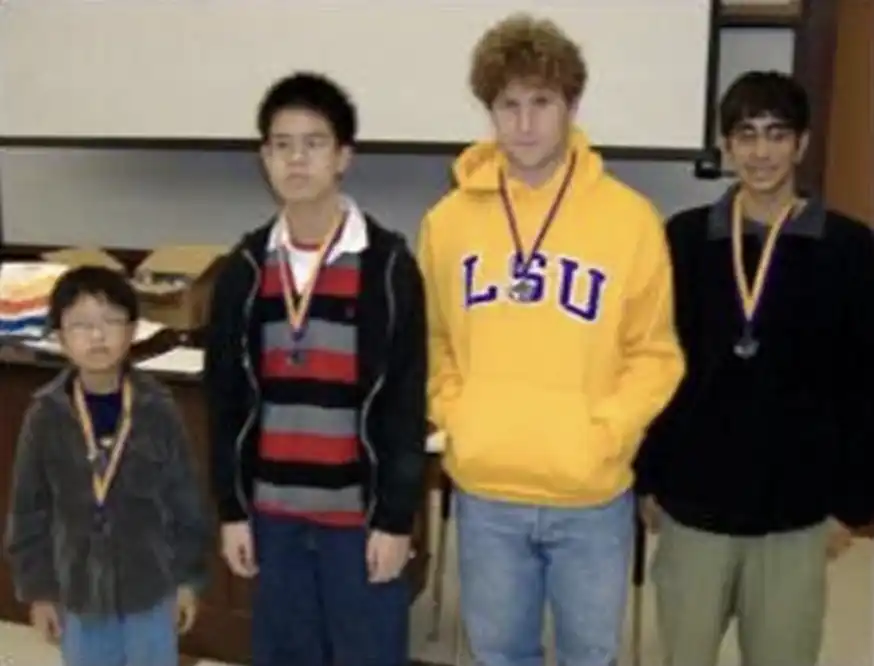
Third-grade Wu wins the ninth-grade math team competition. (2006)
Jeremy Stern: Why did you later switch from "baseball" to "basketball"?
Scott Wu: I was always involved in both math and programming competitions, but I was stronger in programming. I preferred programming competitions for several reasons.
First of all, the coding questions themselves align more with my interests. In mathematics, I excel in probability, combinatorics, and counting problems. These are actually quite similar to strategy games: you need to calculate different options and understand what leads to what. In contrast, I can also do geometry-related questions, but I don't enjoy them as much. Many problems in programming are fundamentally closer to combinatorics.
Another point is that mathematics has many terms. For example, here you need to use Pascal's principle, there you need to use Pólya's enumeration theorem, or some other theorem. Interestingly, a consistently stable trait of mine is: I never really remember these names.
I have always understood them at a more intuitive level. For example, when this condition holds, the result will inevitably be like this. I often don't know what something is called or which theorem it corresponds to. To me, it is just a specific case of some broader, more general truth.
This happened again yesterday. We were listening to a research presentation on perceptual learning. They mentioned many terms, and I said, "I'm sorry, I don't know what these terms mean. But what you're actually saying is part of doing this first, then that, right?" I think I have always understood things in a more intuitive way. It's indeed a bit unusual.
And programming has a very obvious characteristic: it is very practical. I remember when I was training for the MathCounts national competition, I once wrote a program for myself to continuously generate mental math problems for me. I would play the game I made and use it for practice. Realizing that I could actually create something hands-on was very fulfilling for me.
Jeremy Stern: So, you won the gold medal three times at the IOI, then later became a coach and mentor for young participants, and built a distributed circle of friends consisting of math and programming geniuses. And as far as I know, you dropped out of high school. Is that legal?
Scott Wu: Strictly speaking, I graduated; I just left high school after junior year. California's child labor laws stipulate that until you turn 18 or receive a high school diploma, you cannot work full-time in California. At that time, I wanted to work in the Bay Area, so I basically figured out what I needed to do to get my diploma. And then I did it.
New Budapest: The Next Generation of AI Founders
Note: "New Budapest" is the author's historical analogy. In the early 20th century, a group of exceptionally brilliant Hungarian Jewish mathematicians and physicists emerged around Budapest, and today, it seems that the AI field is also witnessing a similar cluster of technical geniuses and entrepreneurs.
Jeremy Stern: There has been a lingering question: Why were so many of the greatest mathematicians and physicists of the 20th century—those who later worked together at Los Alamos or the Met Lab, or formulated the foundational models of modern mathematics, physics, and economics—almost exclusively middle-class Jewish Hungarians born around 1900 in Budapest and its surrounds? I remember, it was Szilard who referred to them collectively as “Martians.”
Richard Rhodes speculated in his book on the atomic bomb that the answer is probably a combination of factors: the rapid modernization of Budapest, a Jewish bourgeoisie already assimilated but still excluded by the old class system, excellent schools and math competitions, a culture that valued intellectual excellence, forced migration to Germany and then the U.S., and wartime scientific opportunities. This explanation is nearly boringly imagine, but I guess it might be accurate.
I just likened you to the “Air Jordan,” so I don’t intend to refer to you and your friends as “Martians” again—at least not to your face. But I am genuinely curious how to account for such a foundational cohort: you all participated in MathCounts and IOI, kept in touch via Google Hangouts, later dropped out of Harvard, entered the quant training system, then seized the LLM opportunity; and, most of you are Chinese American, born around the turn of the millennium.
Scott Wu: I often think about this question too. First of all, I think we are very fortunate. The coolest thing for all of us is to be able to stand at the dawn of AGI. I think this may really be the most transformative event in human history. At least, it must be the most important event our generation has experienced.
I have a few thoughts.
One of them is that everything eventually reaches a point where it basically becomes “Moneyball.” Like poker. In the 1970s, 80s, and 90s, there were many very primitive characters in the poker world, carrying a Hollywood-esque “troubled life” vibe. When they played cards, they relied on very deep-seated intuition about the game. Of course, they also analyzed, but not as systematically as nerds studying probability.
But as time went on, what poker ultimately evolved into was, in fact, mathematics. There is a lot of math in it, and many of today’s top poker players are essentially math geeks. Chess is the same, and many similar games too.
I kind of feel that entrepreneurship has also gone through a similar arc. There used to be a Steve Jobs-like character image. But now, especially in the AI field, to some extent including crypto, the image of entrepreneurs has clearly shifted towards high technicality.
The AI mega-companies that people are talking about now are often run by individuals from similar circles. OpenAI is a case in point. For example, Greg Brockman, who is slightly older than me, but has participated in all the same competitions as us. He was once in the top 24 in the USA Math Olympiad, a member of the USA Chemistry Olympiad team, and a silver medalist in the Chemistry Olympiad. Mark Chen, the head of research at OpenAI, and I have coached the USA IOI team together. Jakub Pachocki, OpenAI's Chief Scientist, is someone I used to compete with frequently. He is from Poland, but we competed in the same set of international competitions. Dario Amodei from Anthropic was a member of the USA Physics team.
In short, firstly, there is evidently a transferable deep analytical capability here. Secondly, especially in the field of AI, a very strong technical background, for better or for worse, has been proven to be extremely valuable because the problems you are tackling are inherently highly technical.
But for our generation, there is also an "infectious" factor. Regarding this point, I highly acknowledge the role of Alexandr Wang. Because he was indeed the first among us to say, "Well, I'm going to start a company." Since we are very close and understand each other, it felt like we should all be doing this.
Alexandr and I even wrote a startup idea document together in middle school, and I still remember it. Those ideas were definitely terrible, but at that time, we were already thinking that someday, we should start a company.
Jeremy Stern: Okay, so this explains the timing and also explains the intelligence. Not every phase in the history of technology has been so "IQ-worshipping"; but AI does have a certain characteristic that makes many of those who have made significant advances in AI, such as Noam Shazeer, also a math competition champion.
Perhaps intelligence also explains part of the first-principles reasoning ability. For example, being able to see further along a decision tree: how good a model will ultimately become, or not become; how scalability and reinforcement learning will come into play; how data and computing power will change, and so on. That part I can understand.
But it still does not explain another part: you must also be a leader. You must be able to attract other very smart people. In an entire puppet show, you must be clearly the main puppet. In a group photo, you must look like you are illuminated by another beam of light. You also need product intuition and interpersonal skills.
If there are approximately 25 such gold medalists each year, and we assume the truly relevant time window is 10 years, then among billions of people on Earth, this is at most a pool of a few hundred people. Yet the vast majority of these people don't have even a hint of entrepreneurial qualities, let alone multiple abilities.
So I am still very curious about Chinese Americans in this regard. Because until very recently, this was not a fact. I am trying hard to avoid that obvious answer—I would subtly liken it to Jews and Hollywood, or the banking industry.
Scott Wu: It seems like you are trying to make me sound like a smug jerk.
Jeremy Stern: That's my issue, not yours. I assure you no one will confuse this.
Scott Wu: I think my view on this issue is that in our field, the two truly important qualities are intelligence and hunger.
Everything else you mentioned earlier flows down from these two fundamental traits. And what the competitive community sifts out are these two points: first, you are very smart; second, you are very hungry and want to crush everyone.
If you are smart enough to constantly analyze, adjust, reflect on what you did wrong, and do better the next time; at the same time, if you have strong enough drive to do this day in and day out, continuously for years, I think generally, you can excel in these other downstream abilities.
As for Chinese Americans, part of it is that infectiousness I mentioned earlier. We are really, really lucky to have each other. Many people actually don't realize that entrepreneurship is also an option for them. I just feel that we are fortunate to be able to go through this process together and watch each other blossom.
The Wilderness Years: A Decade of Trial and Error
Jeremy Stern: I derailed the topic. Let's speed up a bit. You went to California at 17, what year was that?
Scott Wu: 2014.
Jeremy Stern: Okay, so according to California law, you were still considered a "child worker" at that time, but you managed to get a high school diploma and met the exemption criteria, so Addepar could hire you. You worked there for a while, then went to HRT with other "Martians," then entered Harvard, dropped out, founded LunchClub, and finally started Cognition. In nearly a decade, what impressed you the most?
Scott Wu: Yes. I met Vlad Novakovski through Johnny Ho. Vlad was the VP of Engineering at Addepar at the time. I was a software engineer at Addepar, mainly focusing on performance engineering and optimization.
Addepar has a lot of financial analysis features that require computing various data for clients and wealth management firms. Much of my work involved making these computations run faster. During my time there, the performance of certain specific metrics improved by around 100x.
I also spent a lot of time participating in recruiting efforts. That year, I was probably the second or third most prolific interviewer in the company, frequently going to MIT for campus events. All the candidates were older than me, but I would stand there and explain to them why they should really come work at Addepar, listing out the reasons.
Jeremy Stern: How was your business acumen back then?
Scott Wu: Zero.
So much of my life had been spent on math and coding. I could make things, but when it came to understanding how the world worked, I had almost no experience. Everything was a learning experience from scratch.
Later, I left Addepar and went to Harvard for about two years. I majored in Economics, which is quite funny to think about now. I kind of knew I wouldn't graduate. I took writing classes, public speaking classes, philosophy classes, and even a computer class. But I didn't really care about the whole school thing itself.
Harvard always has a reading week before final exams, which is a week where everyone uses it to catch up on papers and study. And I just didn't care. That whole week, I was meeting different people, chatting, hanging out. Many people studied throughout the week and hardly saw anyone else. To quite a few of them, I was their only break from studying that week.
Afterward, I dropped out, moved to San Francisco, and co-founded LunchClub with Vlad. That was in the summer of 2017. We completed our pre-seed funding round and were operating out of the first cohort of the SPC (South Park Commons) incubator.
The initial idea was called Elliot Technologies, an application for scheduling meetings and determining whom you should reconnect with or meet. Later on, we made many progressive pivots. It evolved from personal reconnecting to more professional networking, from scheduling to helping you decide which new people you should meet. And that's how it gradually transformed into LunchClub.
It was a very interesting experience. We ran this company together for about five years, facilitating millions of meetings, with the team growing to about 30 people at most. There was indeed a small group of people who really enjoyed LunchClub, relishing the continuous process of meeting new people and forming connections.
A lot of things happened later on. First, of course, was COVID — which was quite unique for a product that facilitated in-person meetings. Then, at a certain point, both growth and commercialization became increasingly challenging. Meanwhile, my mom fell very ill starting in 2020. I left LunchClub in June 2022.
Jeremy Stern: When did she pass away?
Scott Wu: October 2023.
Jeremy Stern: When I asked others about you, apart from racing, card tricks, and Cognition, this is usually the first thing they mention.
Scott Wu: She was diagnosed with stage IV lung cancer. She had a targeted therapy for a few years. Later, other complications and issues arose.
Jeremy Stern: But what people mention is not just that she passed away, but that you moved back home to take care of her. You personally took care of her.
Scott Wu: That was probably... that was one of the most significant events in my life. (Pause) I'm sorry.
(Pause) Later, I moved back to Louisiana. I was with her most of the time during COVID. I stayed at home for over a year. In that sense, COVID, for me and my brother, was actually a kind of blessing. It gave us an opportunity to truly be with our parents during that time.
In 2021, as the outside world began to reopen, I started spending more time elsewhere. I lived in Miami for a while, then went to New York. Around 2023, when my mom's condition significantly deteriorated, I came back home.
Overall, it was a very special period. For me, a big part of it was figuring out what I really wanted from life. I had done the first company, which turned out okay but not a massive success. I took a break, explored various other ideas. Meanwhile, I was taking care of my mother.
The whole process was very emotionally intense. But it was also a time for reflection: what do I value, what do I care about, what do I want my life's work to be.
Jeremy Stern: What ideas were you exploring at that time?
Scott Wu: Steven Hao, Andrew He, and I played around with many things to get a sense of the world. There are some interesting directions in Crypto that helped us understand the market. There are also some intriguing issues to explore in the security field, such as zero-knowledge proofs.
Later, ChatGPT was released in November 2022. By the second half of that year, we naturally spent a lot of time delving deeper into AI, contemplating earnestly about what the future of this technology would hold.
But I almost saw that period as a vacation because I also spent a lot of time with my mother. My mom passed away on October 6, 2023. A month later, we founded Cognition.

Cognition is located in Burlingame, California. (November 25, 2025)
Cognition: How Devin Evolved from a Hacker Lair to an AI Software Engineer
Jeremy Stern: On one hand, considering your entire life trajectory, training our AI overlord to code seems like something you were destined to do in this world. On the other hand, it all seems full of happenstance. I guess, in a way, we all are. How do you perceive the relationship between these two?
Scott Wu: I could certainly spin a hindsight version, framing the whole story as everything happening by design. But I don't think that's entirely true.
What actually happened was that we were exploring generative AI at that time. Shortly after the release of ChatGPT, everyone was discussing various applications. Back then, most were still focused on text completion. The natural thought model was: this thing was trained on the entire internet, so it should be able to complete what someone on the internet would say. ChatGPT is also a question-answering system, just like it is now.
Jeremy Stern: You're quite bold.
Scott Wu: But naturally, from the get-go, one of the very interesting directions for us was programming because we are all programmers. And teaching AI to code might be one of the coolest things you could attempt.
By the end of 2023, there was a specific moment when people really began to see reinforcement learning make an impact. I see that as the start of the second era of generative AI. ChatGPT was the first era, but it was relatively more basic.
Jeremy Stern: Apart from knowing a lot of people in the lab, how do you know that reinforcement learning was starting to work?
Scott Wu: That is indeed one reason, but I have also been keeping up with the relevant research, and you can see it in the papers.
It's been an interesting phenomenon in the AI field. In the past, almost all research results would be published. However, in November 2022, when people realized the technology might have significant commercial value, that practice almost immediately stopped. Nevertheless, you could still see some work training models on tasks like math problems and code.
There were some very interesting papers at that time. In essence, the next step logically seemed quite clear, it's just that step was not publicly documented. So, we started engaging with some people to further understand this. Eventually, we gradually formed an assessment: AI would become extremely powerful in these logical reasoning tasks. So, what happens next?
That was the seed of Cognition.
But the real turning point was on November 17, 2023, the day Sam Altman was ousted from the OpenAI board.
Jeremy Stern: Why did that event make a difference?
Scott Wu: On that day, I was having lunch in New York with a few people. I was discussing this idea: reasoning ability was significantly improving, reinforcement learning was beginning to bear fruit, and now might be a suitable time to start a new lab.
At that time, this idea was still very research-driven. We hadn't clearly defined what the product would be or what the business model would be. Then that afternoon, Sam was ousted. We naturally thought: well, if there ever was a time to do this, it's probably now.
In reality, we had already planned to do it, and it was highly likely we would. But this event acted as a great catalyst, an external trigger that made us speed up and take it seriously. Sometimes, entrepreneurship requires such moments: a moment that truly engages you, making you say, okay, we've started companies before, we've been founders before, but this time is different. This time is big. This time is something we're going to do for a lifetime.
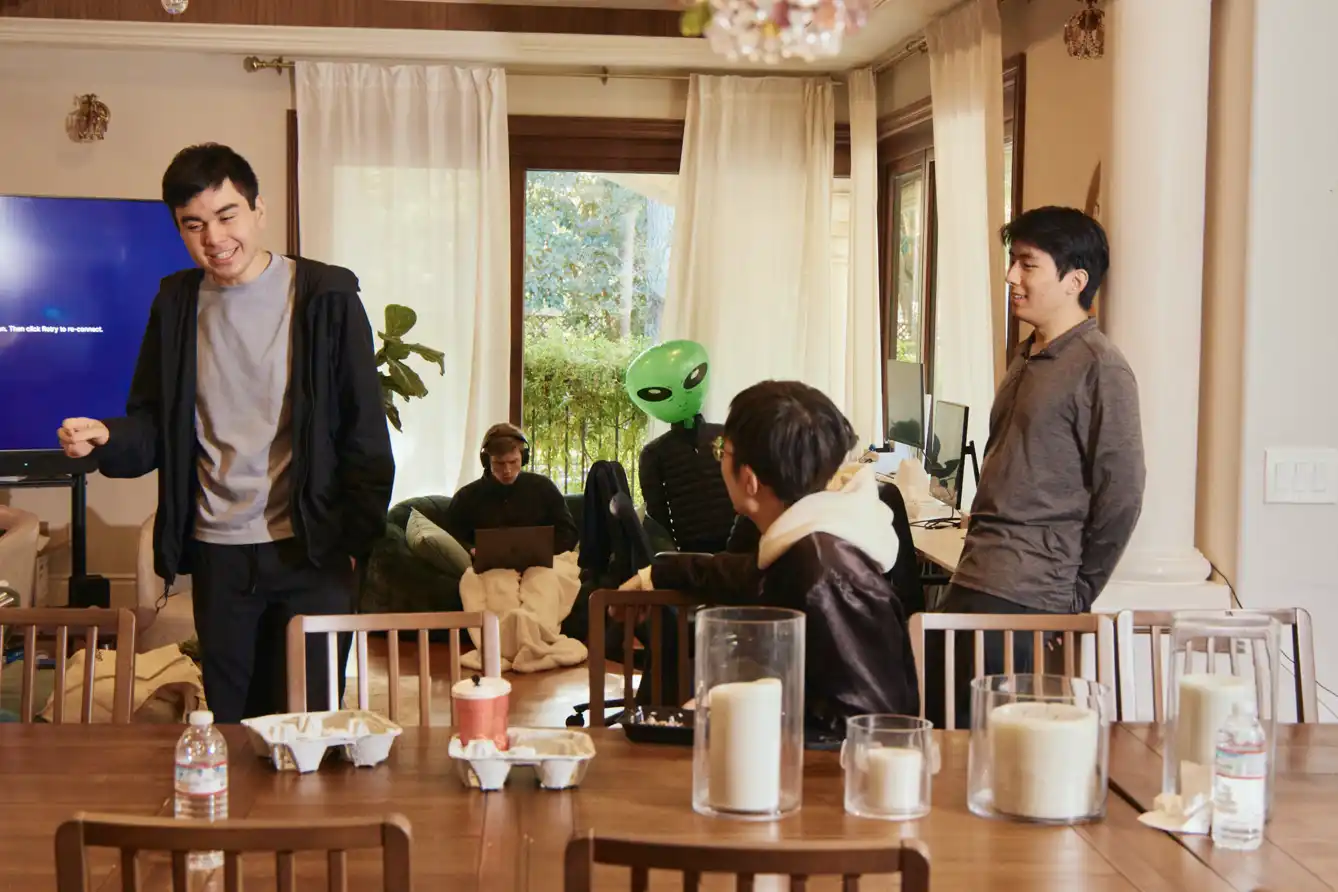
So, we flew to the Bay Area and organized a hack house. We sent emails and messages to a group of AI practitioners we knew. We said, hey, we're setting this thing up, come over and hack with us, explore together, and see what we can build in the end.
The house was in Burlingame, California.
Jeremy Stern: Burlingame, the town, was named after Abraham Lincoln who was sent as an ambassador to China. He negotiated a treaty that lifted restrictions on Chinese immigration to the U.S.
Scott Wu: Yeah, that's interesting. We actually have a conference room here now named after the address of that house.
We stayed there for about two weeks. It happened to be over Thanksgiving. I was supposed to spend Thanksgiving with my dad, just a few weeks after my mom passed away. But I felt like I had to do this now. We had to make it happen. So I canceled my original plans.
As a result, that Thanksgiving turned out to be a pretty good one, spending it with friends coding and tinkering.
Later, we did another hack house in December. And from there, we kept pushing forward until it actually became a company. And not just until the company was established, but far beyond that point. We kept the operation running at that house until January this year.

Photography: Andria Lo
Jeremy Stern: When did you decide on what Devin would ultimately look like?
Scott Wu: We always thought of it in the form of a "colleague."
Of course, there are many differences between an AI colleague and a human colleague. But even two years ago—when you could say we were too early on this concept—that was always our approach. It should be a complete entity, have its own machinery, be able to do its job on its own, run in the same system, show up in Slack with you, show up in Jira or other tools with you, and then collaborate with you like a colleague.
Even the name was like that. We decided to call it Devin instead of giving it a more tool-centric name for a reason. We always saw it as an independent entity that could go off and do things on its own.
As time has passed, this has become more and more true for us. Two years ago, it was more of a vision. In day-to-day use, you obviously still needed a lot of hands-on guidance with Devin. But to be honest, we have now reached a stage where you can really treat it as a colleague to collaborate with.
A concrete example is that, so far, a significant portion of Devin sessions, whether inside our organization or in client-run sessions, are no longer initiated actively by humans, but rather run automatically.
Some Devin sessions are triggered by specific conditions; others have Devin running in a loop, continuously looking for certain behaviors or identifying anomalies in the product and then fixing them on its own. In other words, Devin not only completes the tasks you assign to it, but it actually proactively seeks out tasks it should do on its own.
Jeremy Stern: How do you assess whether an AI or model is truly improving and becoming more useful in the real world, rather than just being optimized for evaluation and benchmarking? After all, when a model becomes smart enough, benchmarks get maxed out, and the model learns to "game" the tests. We have all seen people with poor judgment and mediocre abilities score highly on the SAT. As a competitive exam taker, you have probably thought about this.
Scott Wu: Once a language model starts beating us on the AMC (American Mathematics Competition), the rest of the story becomes quite clear. The AMC is a very tough high school math competition.
As you said, there is obviously a huge difference between performance in a sandbox environment and actually entering the real world of work. However, I wouldn't see it as a direct application but more as a proof of "what is possible."
To solve some very difficult problems, you need to develop a lot of basic logical reasoning ability, creativity, and the ability to string together very long chains of reasoning and ensure that each step aligns. Knowing that a model can do these with enough reinforcement learning and the right training data is already a pretty clear indication that many practical tasks in the real world can also be accomplished.
This first happened around early 2024 when the model began to perform well on these types of math problems. What you have seen in the past two years is essentially the widespread application of the same set of technologies.
I want to particularly note that I do not think there have been any significant breakthroughs in attention scales or even reinforcement learning itself over the past two years. In fact, the real changes that have occurred in the past two years are primarily in other areas.
One aspect is certainly scale: more computing power, more data. But beyond that, much of the work is actually about figuring out how to address the real-world problems people around the world face every day; how to train models based on these evaluation criteria; how to make the model understand what is good and bad in a specific task; and then deploy it into the real world to build a product experience that truly brings users there.
What has really driven the explosion of AI adoption and delivered value to people from AI in the past two years is, in fact, this messy, concrete, practical work. Its importance has exceeded any singular breakthrough on the pure technological front.
Jeremy Stern: When will model intelligence no longer be so uneven? When will they stop making those particularly stupid mistakes?
Scott Wu: Perhaps it can be said: I think they will always be uneven, but they will reach a level where this unevenness begins to intersect with human capabilities.
That makes sense. Because if you ask what a human is trained to do, that's very different from what models are. Therefore, it should also be expected that they will exhibit different capability distributions. The most obvious example is probably the difference between working in the physical world and engaging in knowledge work and abstract thinking.
The models are trained on all tokens on the internet, so they naturally perform better first on knowledge work. And what humans first have to learn is to walk and talk. More of our neurons are also dedicated to these kinds of problems. So I think this unevenness will persist.
Here's an interesting question: Models may still be uneven compared to humans, but in those areas where humans are close to perfect, can models also do just as well, or even slightly better? We are nearing theoretical limits in these respects. And in other areas, humans were not originally meant to excel, but optimized and trained computers perform very well.
Interestingly, in programming and mathematics, in a sense, it's astonishing that humans can do math problems. I'm not sure which part of our survival experience as cavemen taught us that doing math is crucial. But that ability does exist.
In this sense, the fact that models focused on programming can be trained to do better than humans might not be so surprising. After all, programming is essentially conversing with computers, telling them what to do. From this perspective, programming happens to be the first great AI use case, and it's not that crazy. But my point is: this almost more speaks to human intelligence than computer intelligence.
Jeremy Stern: I've heard many people in the industry say that everything is moving towards convergence: model companies are moving into the application layer, and application layer companies are starting to build cutting-edge models. What is stopping you from becoming a model company?
Scott Wu: I believe that for a company, focus is crucial.
You can have different functions, different verticals. But I think you can only have one goal. You can't be trying to do this, do that, and at the same time be trying to solve some foundational research problem.
If you were to ask what Cognition's sole goal is, I would say it is to make it easier for everyone around the world to build software. That is the goal we are striving for, and I think that is different from the goal of a foundational model lab.
To achieve this goal, there is indeed work to be done in model training and in products. But this is our fundamental goal.
I think a company's DNA is somewhat rigid to a certain extent, more rigid than people usually imagine. The mission can change over time, but the magnitude of change is not as large as you might think. At some point, everyone in the company will be thinking about the same thing: your customers, your product, your business model. All of these are rooted in a specific core goal.
So yes, I think as you said, both sides will continue to move, continue to expand outward. But for companies like us, the core DNA is about bringing the benefits of AI programming to people around the world. This is very different from a company that is truly more focused on pushing the research frontier itself.
Jeremy Stern: Are you going down the Cursor path?
Scott Wu: We really like being the "Switzerland." There are several reasons for this. First, we believe we are building a necessary infrastructure for companies to trust us, see us as partners, and figure out how to move faster and deliver more together. So frankly, neutrality is very valuable.
You have seen this to some extent in your relationship with Databricks and the major cloud providers. But here, I think the situation is even more extreme. Because tying our trust to a particular model would be a terrible thing. No one knows who will have the best model in 12 months.
Therefore, by working with all different models, using them when each model is best suited for a particular use case, we can quickly adapt to changes and also help partners understand how they should be using different models in their work. This is very important.
In addition, I would also like to point out that there is currently a discussion in the tech industry, roughly asking: Why bother creating something new? Is it really still a time to start from scratch and build something?
There seems to be an assumption behind this: There can only be so many companies in the world because existing companies will eventually devour everything. Silicon Valley now has a somewhat entrenched cynicism about "whether it is still possible to meaningfully build new things from scratch." I believe this is completely wrong.
So, we just really enjoy this challenge and ambition: a group of people sitting in the same room, creating something great on their own.
It's more interesting this way.

Photography: Andria Lo
When AI Takes Over Mental Labor, What Is Left for Humans
Jeremy Stern: In the world of AGI, what will human genius look like?
Scott Wu: I think, for everyone involved in AI, one of the most important references is the existence of the human brain itself.
We do not understand everything about the human brain, but I believe we understand enough to say that it is ultimately also a kind of circuit — essentially a flesh-based computer. Of course, there are a lot of details in this, and many interesting questions about how it is formed. But in the field of AI, we call these circuits "neural networks" precisely because they are modeled after the neurons in the brain.
From the way the human brain is connected, we can see that it can learn and solve some extremely difficult problems. Naturally, the next inference is: as long as there is enough time, scale, and energy, we should be able to create an "electronic brain" that operates in a similar way. The difference is that we can create more such brains, and we can add more circuits to them.
People often ask: Is there anything that humans can do forever and AI can never do? This is actually quite interesting because over the past few years, many of the answers people gave have been proven invalid.
I remember someone used to say that computers might be able to play international chess, but they could never play Go. That's because Go requires a certain deep intuition and a profound understanding of the world, which is not something computers can grasp. Obviously, that's not the case.
Solving math problems, generating code, absorbing new information, and proving new theorems are all the same. AI has already crossed these thresholds. Going back to your question about the role of the human mind, I don't think that from a long enough time scale, there exists any ability that AI can never achieve but humans can.
However, I believe human experience itself still holds a lot of inherent value. My co-founder, Walden, once said, "We have been living in 'Survival Mode of My World,' and now, we will be entering the Creative Mode." I think that's true.
We all have desires, things we want to build, ways to express ourselves, and ways to find joy and meaning. We will still want to do these things. And now, we will have AI to help us tackle those incredibly difficult yet crucial problems.
Jeremy Stern: But humans are not actually flesh-and-blood computers. We have things like dignity. And in the tradition we are part of, dignity is equally given to every person regardless of their capabilities, so it cannot be competed away.
We are born at a specific time, in a specific place, from specific parents, and given a name. We come from somewhere. We are largely shaped by memory, and these memories are not of our own choosing. They shape some of the most fundamental aspects of our understanding of consciousness, such as the concept of "home."
If all of this is just replicable circuits, then isn't the so-called "inherent value" just a sedative? Or perhaps an escape?
Scott Wu: The version we were just talking about is closer to the long-term endgame of AI. But in the short and medium term, AGI is not a truly binary concept—it is more of a gradual ascent.
In the coming time, there will be continued incremental progress: okay, it can do these things now, but not quite that one thing. And then, we will also solve that thing.
It is because of this that I believe many high-context, general-purpose tasks—where you must understand a vast amount of things happening worldwide, absorb a massive amount of diverse information, and draw the correct intuitive conclusions—humans still have an advantage in the mid-term.
As time progresses, if AI has the same context as humans and is working towards the same goals, then it should eventually be able to as well.
Right now, I believe I, or anyone human, one of our greatest advantages is that we all have access to extremely rich soft-context.
If I think about the work we do every day at Cognition, or the work at any company, there are too many things that do not involve solving a fundamental logic problem from scratch. At a pure logical level, AI is basically as strong as any human in most things.
On the other hand, if I think about all the small decisions we make every day, or the principles we choose to operate by, or a specific piece of history—such as, "This is why we originally designed the system architecture this way, but since a new technology emerged, we decided to gradually transition to a different framework"; or, "This is the way Cognition does things, different from most other companies"—in all these things, the human ability to process context, retrieve information, and draw on experience is very powerful.
I somewhat like to say that retrieval is one of the things humans are truly good at. This actually aligns well with what you just mentioned about memory.
When comparing models to the human brain, a model has a context window, tokens it can see and read, tools it can call upon, and one of those tools may be retrieval. Our context window is much poorer. On this note, a joke I often make is about the six-digit verification code used for two-factor authentication. If the code were to become ten digits, I don't know if we could handle it. That's how short our context window is.
On the other hand, as a human, you possess a wonderful ability: you open a code file and are suddenly hit with a memory—oh, right, four months ago when I dealt with this issue, we encountered this bug, and this is how it happened. And that happens to be the information you need to know to complete the current task.
Jeremy Stern: The programmer's madeleine dipped in tea.
Scott Wu: Or you're talking to someone and suddenly remember: oh, right, seven months ago, did you mention this?
That is different from the original context. It is more like accumulating and understanding all the soft context we have experienced. I think that is currently the main advantage humans have over AI.
Now, in the field of AI, there are several types of problems being researched around this point. One of them is known as embedded search. In a sense, it is the most direct counterpart: in a large database containing all past conversations, various code files, or any data you may want to search, how do you accurately retrieve the most relevant part to the current issue?
There is another actively advancing set of problems, most commonly referred to in the industry as continual learning. It is about—I think this is closer to how the human mind operates—how AI can update its own weights based on what it learns?
Here is a rough idea, that is, "neurons that fire together, wire together." You want AI to be able to update its own weights through conversation and experiencing these things. In theory, this should allow it to recall in the next encounter with a related issue. These are all topics that are currently being actively explored. I think there will be a point, perhaps not too far off, where AI can do this. But for now, humans still hold the advantage here.
In a sense, solving the problem of AI really means solving cognition itself.
This is a very crazy thing, one that must be taken seriously. Because throughout human history, we have always lived under the assumption that we can make this tool or that tool faster, but ultimately, it still takes a human to solve the problem, to figure out how to do it. There still has to be a human to invent that thing.
Until now, we have always regarded "the ability to think and solve new problems" as the most core part of being human. And just because that is changing doesn’t necessarily mean it’s a bad thing. I think having AI that can assist us in this aspect would be a very good thing.
In a more poetic sense, AI is a lever that will ensure our dreams don't have to remain just dreams forever. But as you say, it is indeed time to rethink and reposition "what makes us human."
Jeremy Stern: So, what makes us human?
Scott Wu: I would give this analogy.
Imagine how our ancestors from hundreds or thousands of years ago would see us today. They see us pressing buttons on a computer, then walking into a room and just talking to others there. We call this a meeting, and we call this work. Meanwhile, they toiled in the fields every day of the week to ensure they had enough food to eat.
Lets fast forward to the changes today, which basically means we have learned to automate primitive physical labor. That is, humans have been able to engage in work primarily based on knowledge and thought. If you were to summarize what humanity has done in the past 200 years in one sentence, it would be this.
And now, we are close to solving the problem of "primitive brainpower."
What will this bring? Some more straightforward examples: Do you want a perfectly nutritious and delicious pizza? Do you want a Ferrari? Do you want to slam dunk? Well, now you can.
On a more serious note, I believe that transitioning from survival mode to a creative mode is the right direction. It won't happen in the next two or four years, but it is coming.
At some point, the only limit you will truly face is what you can imagine and how you choose to live your life. It will be a very different existence.
Returning to your question, I believe a significant part of it will be pure self-expression. People will be able to live the lives they dream of. The bottleneck of turning dreams into reality will be greatly narrowed.
And our current way of life will seem very wild in comparison.
Jeremy Stern: What are you most afraid of?
Scott Wu: The first thing that came to mind when I heard this question was the past technological revolutions.
In Silicon Valley, people often think of phones, the internet, cloud computing, and personal computers. But you can also continue back to electricity, and even the Industrial Revolution. Although I believe AI's scale is larger and its form may be different from these technologies, at a higher level, they are actually very similar.
In the long term, AI is an extremely powerful capability. It will change the lives of all of us, allowing us to do more. I think we can all agree that being able to live like today, instead of having 90% of human labor in agriculture, is a great innovation.
However, on the other hand, in the short and medium term, I do think there will be real friction. It could even be said that I am most concerned not about AI itself, but the friction that comes from all of this developing too rapidly.
This largely points to one issue: we must pay very close attention to the education of ordinary people worldwide. How should people use this technology? How does it make people's lives better? And how can more people access it as synchronously as possible?
I think the worst outcome is that for quite a long time, only the elite of San Francisco, or similar small circles, can truly harness these capabilities while others are left out.
Or to give a specific example that we have been experiencing in the past few weeks: if models already have strong capabilities for network attacks, but many people in the world do not have the same capabilities for defense, and those clever hackers are already using them to attack, the world will be in a very tricky state of imbalance.
So, what's truly important is for the whole world to understand this technology, be able to use it, and work alongside it. A large part of the problem actually lies in how quickly we can prepare humanity for it.
The Industrial Revolution happened over several generations. It was a very gradual shift, and people would learn slowly over time, and these changes would slowly enter their lived world. But the changes we see now are much faster.
I believe people can adapt, and we will find various ways to let new technology enhance our lives—whether it's discovering drugs, creating a pizza that is both perfectly delicious and perfectly nutritious, or improving all the technology we use every day.
But this also means that people have to keep up with what is happening. In many past technological revolutions, if you adopted a couple of years later, or even five years later, you could still catch up. But this time, adaptation must happen faster.
Jeremy Stern: When you are not one of the people really involved in AI research and development, it is indeed hard to seriously imagine these things. That is why those of us on the outside often feel that many key figures in the AI field talk nonsense, at least when they talk about the future.
Scott Wu: One thing I often think about is the METR study.
The study showed that smart agents can now complete the equivalent of several hours of human work before needing interruption, and this duration is still doubling every few months. This is how in the past few years, smart agents have progressed from only being able to work for a few seconds to being able to work continuously for several hours.
The obvious question is: What happens if this doubling continues? We are no longer talking about a few hours, but about several days, several weeks, and eventually maybe a whole year.
Interestingly, we have already seen along this curve how it has gone from seconds to minutes, and then from minutes to hours. Yet, even so, it still feels unfamiliar. When it comes to things our human minds are not good at, we are truly terrible at understanding exponential curves.
What does a smart agent that can complete a year's worth of work mean? You give it a task, and it says, "I'll take care of it." Then a year later, it comes back, and the task is done. It sounds crazy, but I believe we will actually get there.
I think many people outside the AI circle always have this feeling: Okay, the curve suddenly shoots up, but this should be where it stops and enters a plateau. Then it continues to rise, and they say, okay, but surely this time it must be the ceiling.
For those in the AI field, who have witnessed all of this, the experience feels different, partly because you see every little data point on the curve. You know how it got to where it is. In the past three years, there have not been 14 breakthroughs; maybe just one. But we can see that if we continue along this path, pushing the capabilities forward, we can achieve so much more.
Even for all those deeply embedded in the AI field, this is still something very hard to truly digest.
Jeremy Stern: How much of the daily drudgery can you automate for me so I can get back to my favorite pastime?
Scott Wu: (laughs) Put simply: How many ideas does a person have in a day? And out of those ideas, how many actually get executed?
As long as that ratio is not at 100%, you know there is still a significant bottleneck at the execution level. I don't think that ratio is anywhere close to 100% right now—it might only be 5%. You have all sorts of things you want to do, want to create, want to try, but in reality, actually doing them is much harder.
I believe this is one of the significant capabilities that AI will unlock. You can especially see this in the software field.
I have never seen any engineering team approach their work like this: Alright, we'll release this project this month, and by next month, we'll have done everything, we won't need software anymore, we've built everything we wanted to build.
Reality is always the opposite: You have 85 projects, but you can only choose 6 because your bandwidth is limited. In the future, we will see more people being able to do everything they want to do.
When people say they love building software, what is it that they truly love? In reality, only about 10% of the work is genuine self-expression: you can think about what trade-offs to make in each problem, what architecture to use, and build what kind of specific product.
The other 90% is writing code, debugging, executing, and a lot of repetitive labor. When people say they truly love building software, they are usually attracted to the former.
Every field is like that. We will reach a stage where you can do that 10% you truly love, times 10.
Jeremy Stern: One last question. I have always been interested in those who are somehow blessed by the divine, or burdened by it.
They have a certain gift. They might also work hard, be born into a good family, receive a good education, encounter excellent friends and mentors, be fortunate enough to be born in the right era, or do everything Malcolm Gladwell told them to do to achieve what they have today.
But fundamentally, there is a gift there. And that is the edge in their lives.
It can be used for good or abused. It can be wasted or exploited. It can do what you say AI will do—make all dreams come true. It can also be drained along the way, even turn around and destroy you.
So I'm curious: As someone gifted—some concoction of a 16-cylinder math brain sprinkled with a touch of defiance—what do you believe you're choosing to do with this gift? And, do you think you're choosing wisely?
Scott Wu: Simply put...
AI could be the most significant event in human history, and programming is how it learns to act and construct things in the real world. If I'm destined for something, if there's a reason I'm here, I think it's to be the one who teaches AI how to program.
I might fail. If it turns out that I'm not the one destined to fill that role, I'd be certainly disappointed. Because I'm extremely competitive and very averse to giving up.
But what would truly haunt me is a different outcome: that I had something that perfectly aligned with what I've always naturally loved, cared about, and been gifted with, yet didn't give it my all.
If the ultimate question is that I didn't work hard enough or didn't have enough drive to do that thing, I feel I wouldn't be able to look myself in the mirror.
Jeremy Stern: Thank you, Scott.
Scott Wu: Well. Let's taste these strawberries.
Welcome to join the official BlockBeats community:
Telegram Subscription Group: https://t.me/theblockbeats
Telegram Discussion Group: https://t.me/BlockBeats_App
Official Twitter Account: https://twitter.com/BlockBeatsAsia
 Related Articles