Circle's Triple Challenge This Week: Earnings Report, Legislation, Fed Transition - Short-term Pressure or Long-term Benefit?

Original Title: "Earnings Report, Bill, Fed... Circle Faces Three Major Tests This Week"
Original Author: Azuma, Odaily
On May 11, the Q1 earnings report, May 14, the CLARITY Act Senate review, May 15, the Fed transition... Circle (CRCL) will face three consecutive major tests this week, and each test will directly impact CRCL's price trend, even redefining its valuation logic.
In the following text, Odaily will analyze the progress and expectations of these three major events in order, and predict the potential impact on CRCL (Odaily Note: The following content does not constitute any investment advice).
Event One: 2026 Q1 Earnings Report
At 8:00 PM tonight, Circle will release its Q1 2026 earnings report before the U.S. stock market opens, followed by an earnings conference call.
There are three main highlights of this earnings report.
· The first is Circle's Q1 comprehensive revenue and profit data for this year, with the current market expectation for Circle's Q1 revenue at $715 million and an earnings per share (EPS) expectation of $0.178.
· The second is the proportion of Circle's distribution costs (mainly distributed to Coinbase) to total revenue, which represents Circle's level of reliance on distribution platforms like Coinbase. This ratio has shown a slight downward trend over the past few quarters and is expected to continue in Q1.
· The third is the growth of non-interest income, i.e., revenue obtained through payments, enterprise, on-chain activities, etc. This is the most important long-term data for Circle, representing whether it can find a second revenue stream beyond U.S. Treasury interest.
Regarding the distribution contract with Coinbase, analysts will definitely ask this question at the earnings conference, and Circle's response will be crucial. In August 2023, Circle signed a three-year contract with Coinbase, stipulating that Coinbase will receive all interest income generated on its platform from USDC, while interest income generated off the platform will be shared equally between Coinbase and Circle.
The contract is set to expire in August this year, but last week, Coinbase's CFO emphasized that the contract is "renewed every three years and never changes." Continuing to renew the contract under the original terms would definitely not be favorable to Circle. However, considering the current financial pressure on Coinbase and its strong reliance on Circle — the contracts were all negotiated, which could become a favorable factor for Circle to seek modifications to the revenue-sharing terms.
· Odaily Note: Refer to "Q1 Net Loss of $3.941 Billion, Coinbase Can Only Cling to Circle's Thighs."
Individuals will take a cautious optimistic view of tonight's financial report, expecting solid performance, but the key focus will be on Circle's stance regarding the August renewal.
Event 2: CLARITY Act Breakthrough in the Senate
On May 14, the U.S. Senate Banking Committee will hold a vote hearing on the "Cryptocurrency Market Transparency" Act (CLARITY Act), a key step towards CLARITY's progression through the Senate and formal enactment as a law.
The CLARITY Act aims to establish a regulatory framework for digital assets, clearly defining the classification of digital assets, and delineating the regulatory responsibilities of the U.S. Securities and Exchange Commission (SEC) and the Commodity Futures Trading Commission (CFTC).
On July 17 last year, CLARITY smoothly passed through the U.S. House of Representatives with an overwhelming majority (approximately 294–134 votes). However, when it was subsequently transferred to the Senate, it faced resistance due to various conflicting forces.
The dispute mainly focused on stablecoin yields, the regulatory approach to DeFi, and ethical standards related to the Trump family, particularly the issues related to stablecoin yields. The banking industry engaged in fierce battles with the crypto industry, and Coinbase temporarily withdrew from the negotiating table, causing the bill to stall (recommended reading: "Why Do Banks Insist on Cracking Down on Stablecoin Yields?").
A significant shift in the situation has recently occurred, with Senators Tom Tillis and Angela Alsebrook reaching a compromise proposal, intending to ban yield on static stablecoin reserves but allow rewards for active stablecoins.
Currently, on the prediction market Polymarket, the probability of CLARITY becoming a law this year is as high as 76%, and the market is relatively optimistic about the bill's progress.
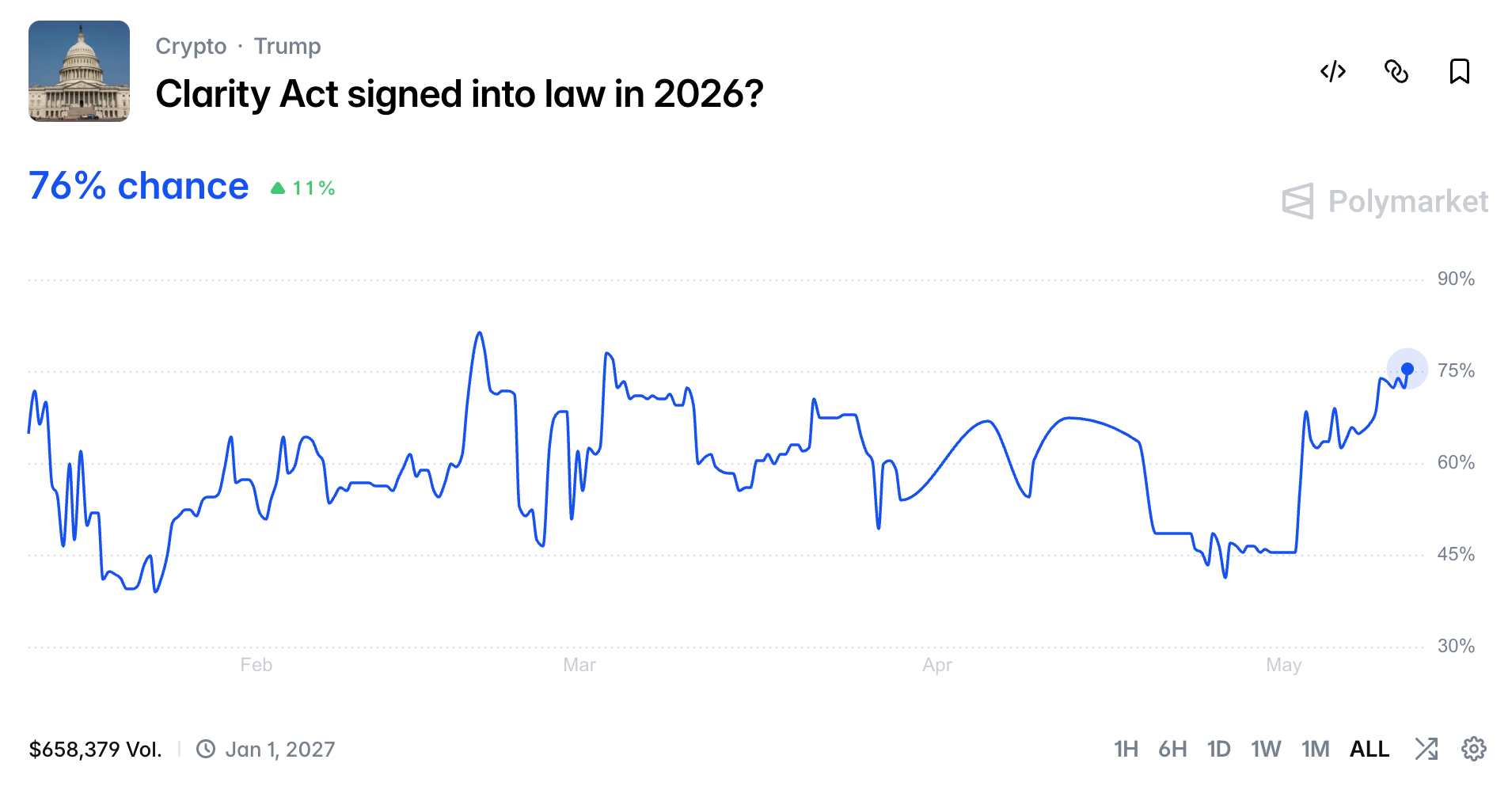
Once the CLARITY Act becomes law, it will establish a clear and functional federal regulatory framework for the U.S. digital asset market, addressing the long-standing issues of regulatory ambiguity and inconsistent enforcement. This will be a significant benefit to all industry participants, including Circle. The author is relatively optimistic about this development.
Event Three: Federal Reserve Leadership Change
On May 15, Jerome Powell's term as Chair of the Federal Reserve will officially end (after which he will continue as a board member until 2028), and the successor will be Kevin Warsh.
On April 29, the U.S. Senate Banking Committee voted to approve Warsh's nomination. Although the full Senate vote has not yet taken place, it is expected to happen in the next couple of days.
Unlike Powell, Warsh advocates for a combination of "balance sheet reduction + rate cuts," supporting the control of inflation through balance sheet reduction (QT) while providing liquidity to the real economy through rate cuts. He believes that balance sheet reduction targets the financial sector while rate cuts benefit the real economy.
For Circle, which currently relies heavily on U.S. Treasuries for income, a shift towards a rate-cutting cycle would directly negatively impact CRCL. Additionally, balance sheet reduction may tighten short-term financial market liquidity and suppress the stock market.
However, Warsh himself is a cryptocurrency holder, making him the first Fed Chair in history to have direct investments in the cryptocurrency space. He is particularly focused on the "digital upgrade of U.S. financial competitiveness."
Warsh has also explicitly opposed the issuance of an official Fed CBDC, believing that its credit is deeply tied to national sovereignty. If the U.S. dollar credit is damaged, the CBDC will also collapse. Therefore, he hopes to include private stablecoins like USDC in the Fed's regulatory system, making them a "shadow dollar."
Therefore, in the long term, Warsh's tenure is expected to provide some policy tailwinds to Circle's business, facilitating its expansion.
Therefore, in terms of expectations, the short term may lean towards pessimism, but the long term may shift to neutral or optimism.
Original Article Link
Welcome to join the official BlockBeats community:
Telegram Subscription Group: https://t.me/theblockbeats
Telegram Discussion Group: https://t.me/BlockBeats_App
Official Twitter Account: https://twitter.com/BlockBeatsAsia