How did Hyperliquid Rewrite Prediction Markets through HIP-4?
Original Title: HIP-4: How Hyperliquid's outcome primitive actually works
Original Author: @PDmytriiev
Translation: Peggy, BlockBeats
Editor's Note: Prediction markets are becoming a new hot spot in the crypto market. In April, the total trading volume of Polymarket and Kalshi reached $22 billion, and the entire category has grown 11x in the past six months. However, compared to centralized platforms, the scale of on-chain prediction markets is still much smaller, and HIP-4 is precisely targeting this gap.
The HIP-4 launched by Hyperliquid is not simply a chain version of Polymarket. Its core lies in integrating the prediction market into Hyperliquid's existing perpetual contract and spot trading system: using the same CLOB matching engine, settling in USDH collateral, and supporting the future permissionless creation of markets by staking 1 million HYPE tokens.
What is truly worth noting is not whether HIP-4 can replicate Polymarket, but whether it can create a new trading scenario: event contracts can share the same margin with BTC perpetual and spot positions. For example, traders can both long BTC perpetual and simultaneously buy the outcome contract for "Will BTC break $80,000 this week."
Of course, HIP-4 still has many issues to be verified. Its oracle mechanism emphasizes speed, but how settlement will occur in complex scenarios such as sports, elections, macro data, is not yet clear enough; liquidation fees, the formal launch time of composite margin, permissionless market creation mechanism, all need further implementation.
Therefore, HIP-4 is more like Hyperliquid's redefinition of the prediction market. It is not about competing on Polymarket's home turf, but rather aiming to prove that the prediction market can become part of a leverage trading system. The mechanism has emerged, and what needs to be seen next is whether the market truly needs it.
The following is the original text:
On May 2, 2026, Hyperliquid activated HIP-4 on the mainnet, just four days after Polymarket launched CLOB V2 and migrated to $pUSD.
Both upgrades were scheduled to be completed in the same week. This was no coincidence.
HIP-4 is not a replica of Polymarket. It is a new type of primitive introduced on the same execution layer as the Hyperliquid perpetual contract and spot market, settling in $USDH, utilizing full collateralization, and built around three constraints that are difficult to achieve simultaneously on existing prediction market platforms: unified margin across perpetual and spot; end-to-end on-chain transparency; permissionless deployment achieved through staking 1 million $HYPE.
This article will delve into this mechanism: what each part does, why it had to be designed as a separate contract type, and what the cost of using it is.
In April of this year, Polymarket and Kalshi saw trading volumes of $22 billion.
The prediction market category has grown 11x in six months.
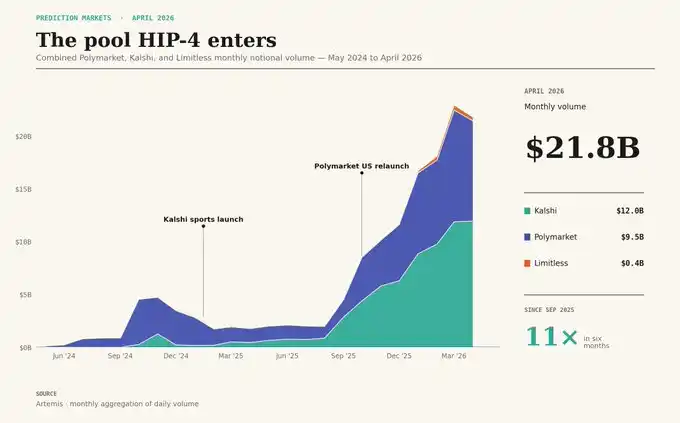
April Prediction Market Trading Volume
Sporting markets drove Kalshi to a monthly trading volume of $12 billion. Geopolitical markets supported Polymarket's growth. As the closest on-chain comparable platform, Limitless has also surpassed a certain scale in trading volume.
The volume of on-chain prediction markets is two orders of magnitude smaller than that of centralized counterparts. And that is exactly the opportunity that HIP-4 is betting on.
What Is HIP-4
It is a binary contract. Trading price ranges from 0.001 to 0.999, settling ultimately at 0 or 1 and collateralized in $USDH.
This is similar to the model used by @Polymarket and @Kalshi.
What truly sets it apart is all the peripheral mechanisms built around this contract.
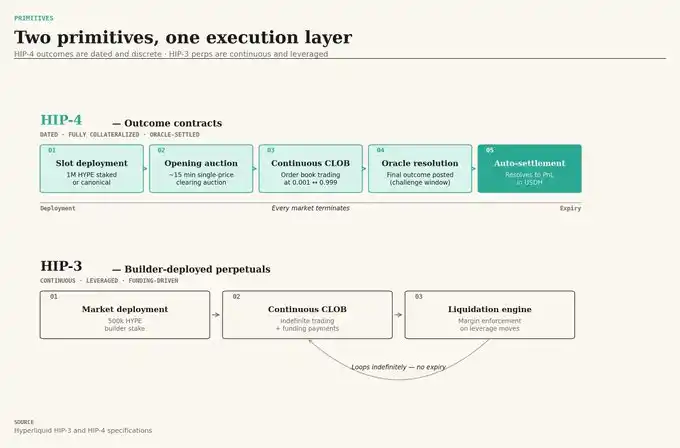
HIP-4 Lifecycle
The HIP-4 market has a clear expiration time. When the market opens, it undergoes a round of approximately 15 minutes of settlement auction mechanism—this design is borrowed from stock markets to prevent setting an arbitrary price anchor for the market with the first trade.
Subsequently, the market runs on the same CLOB matching engine as the Hyperliquid perpetual contract and settles on-chain in USDH.
The first market to go live on the mainnet is a daily recurring BTC binary contract:
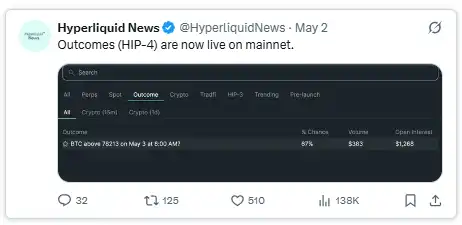
A collateral of 1 million $HYPE can support hundreds of daily recurring contracts. By reusing market slots, the capital cost can be spread across the entire contract series.
Why HIP-3 Doesn't Cut It
Hyperliquid has already supported permissionless deployment of perpetual contracts through HIP-3. So, why can't the result market be deployed directly on HIP-3?
Because HIP-3's oracle architecture would be disastrous for binary contracts.
HIP-3 limits the mark price update of each oracle tick to within 1%. This is a reasonable design for perpetual contracts like $$WTIOIL or $$TSLA; however, for a contract that needs to settle instantaneously from 0.50 to 1.00 upon event resolution, this would be catastrophic.
Under this constraint, the mark price would need about 50 consecutive ticks to reach the actual settlement value.
This means that anyone watching the market would have a nearly risk-free arbitrage opportunity for 50 minutes.
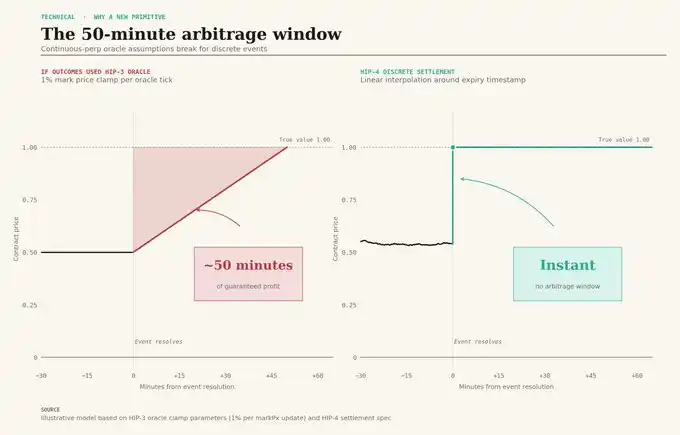
Oracle Constraint
HIP-4 completely bypasses this issue. It will perform linear interpolation around the expiration timestamp, have authorized oracles submit the binary result, and can set an optional dispute window, thereby achieving instant settlement.
This is also why HIP-4 must be designed as a distinct contract type: the mechanism itself is the product.
Three Things Only HIP-4 Can Do
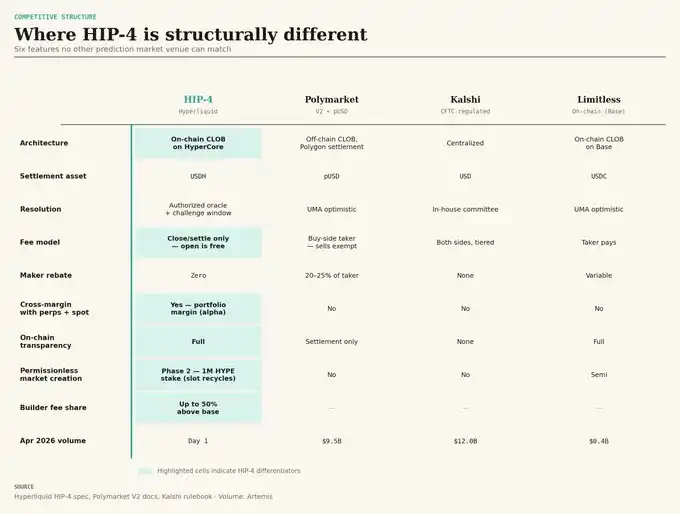
Hyperliquid vs Polymarket vs Kalshi vs Limitless Comparison
Sharing margin between perpetuals and spot.
A long position in a BTC perpetual can share the same $USDH collateral with a result contract betting on BTC breaking 80,000 before this Friday. Polymarket operates on Polygon, while Kalshi exists within the broker-dealer account system. None of the prediction market platforms can achieve unified margin with leveraged perpetuals. Not a single one.
End-to-End On-Chain Operation
Polymarket's V2 still uses off-chain matching. Kalshi has no on-chain presence whatsoever. Every step of HIP-4 runs on HyperCore: order placement, matching, settlement, oracle confirmation.
Permissionless Deployment through Slashable Staking
Stake 1 million $HYPE tokens that can be slashed and burned. In addition to base fees, the deployer can earn up to a 50% share of the builder fee. By Phase 2, market creation will shift from a "curated listing" feature to a deployable, monetizable revenue stream.
The trade-off is that at HIP-4 launch, makers do not receive rebates, unlike Polymarket, which pays makers 20%–25% of the taker fee. For HIP-4 makers, revenue solely comes from spread capture. There is also an asymmetry in that fees are only charged upon liquidation, not upon opening.
Free to enter, pay to exit. No other platform does it this way.
Speed Comes at a Cost
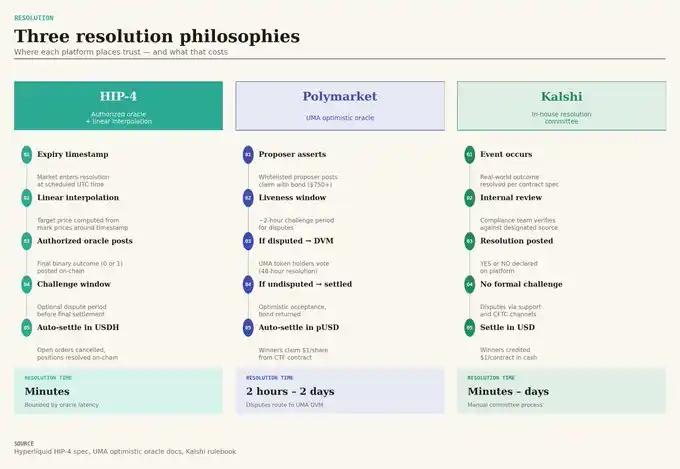
Three Settlement Philosophies
HIP-4 opts for speed: oracle authorization, with results confirmed in minutes. UMA's optimistic oracle is slower but has been battle-tested in disputes involving billions of dollars. Kalshi's committee mechanism is fast in regular cases but can become opaque in edge cases.
A more honest appraisal would be: in the current documentation, the oracle architecture for HIP-4 is the least fleshed out part of the entire spec. (It is also possible that deployers could choose a different oracle as with HIP-3.)
For daily BTC binary contracts, the oracle is HyperCore's price feed. It has years of operation data, making it relatively reliable.
But what about sports, elections, macro data releases? This oracle infrastructure has not been publicly architected.
Three Things That Will Determine the Viability of This Thesis
1. Closing Side Fee Basis Points
The documentation confirms zero fees for opening positions and non-zero fees for closing. However, the specific rates have not been disclosed. Polymarket's total take rate is around 35 bps of volume, with its $8.1 billion volume in April translating to approximately $28 million in fee revenue. HIP-4's rates may fall between 5 and 50 bps. Until these figures are released, all revenue projections are speculative.
2. Composite Margin Officially Launched.
Cross-margin is the core selling point of HIP-4.
3. The First Non-Curated Builder.
Phase 1 is still curated by validators. Phase 2 will grant deployment permissions to anyone willing to stake 1 million $HYPE and have an opinion on a market. The first market created by an independent builder and the category they choose will tell us whether HIP-4 will be a standalone product or remain just a feature of Hyperliquid.
What I'm Watching for the Next 90 Days
The daily BTC perpetual contract trading volume, whether it can rival the BTC 24-hour price market on Polymarket; the switch time for Phase 2 and when the first builder will emerge; the milestone of the official launch of Composite Margin; when the liquidation side fee schedule will be announced.
HIP-4 is not trying to beat Polymarket on its home turf.
What it really aims to be is a trading venue where event contracts can share collateral with leveraged perpetual contracts; a market creation system that can turn into a permissionless revenue stream; a platform where every step from order placement, matching to settlement is done on-chain.
This is a different product.
The mechanism itself is sound. The real question is: Does the market need it.
The next 90 days will provide the answer.
Welcome to join the official BlockBeats community:
Telegram Subscription Group: https://t.me/theblockbeats
Telegram Discussion Group: https://t.me/BlockBeats_App
Official Twitter Account: https://twitter.com/BlockBeatsAsia
 Related Articles