a16z: Will AI Really Bring About the End of Jobs?
Original Title: The "AI Job Apocalypse" Is a Complete Fantasy
Original Author: David George, a16z
Translation: Peggy, BlockBeats
Editor's Note: Whether AI will cause mass unemployment is one of the most common technological anxieties today.
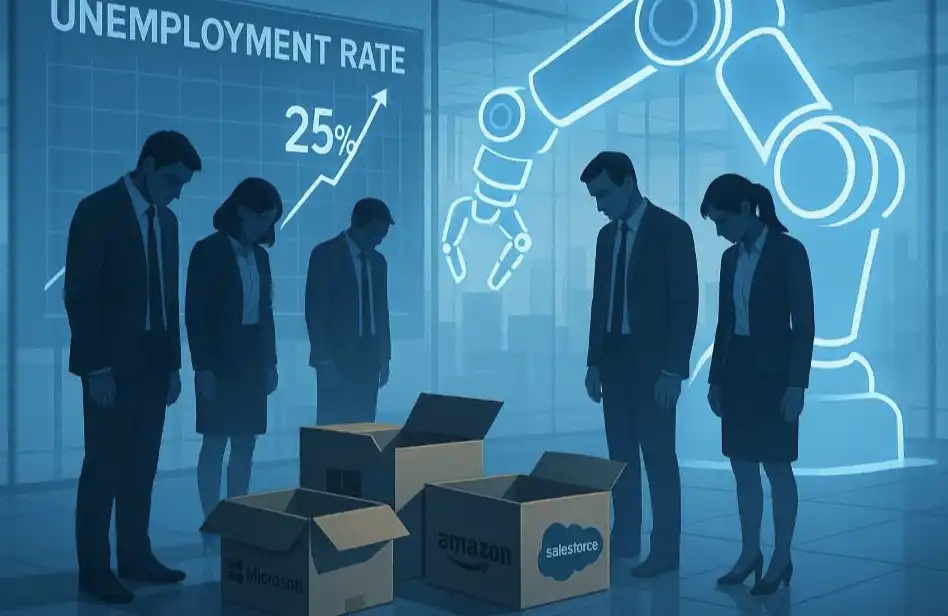
This article believes that the "AI job doomsday theory" is not new. It essentially follows the old logic of "fixed total amount of work," believing that there is only so much work in society, and the more AI does, the less humans can do.
The author argues that history has not unfolded this way. Tractors reduced farmers but brought about manufacturing, services, and software industries; electricity replaced old power sources but restructured factories and the consumer goods industry; Excel did not eradicate finance work but instead gave rise to more financial analysis roles. Technology does indeed eliminate some tasks and positions, but the larger outcome is often the creation of new demands and new jobs.
Applied to AI, what is truly worth noting is not "whether humans will be completely replaced" but "which jobs will be redefined by AI." AI will automate some repetitive tasks but will also make positions such as software engineers, product managers, and systems designers more efficient and important. In other words, AI is more like a productivity tool rather than a mere job killer.
The core argument of this article is: AI will not halt the economy; it will only force a redistribution of the labor market. Doomsayers only see the jobs being replaced but overlook that technological revolutions have continually created new industries, new professions, and new areas of growth.
Below is the original article:
The panic of so-called "permanent underclass" by AI pessimists is not a compelling narrative. It is not even a new story. It is merely a re-skinned version of the "fixed total amount of work fallacy."
The so-called "fixed total amount of work fallacy" refers to a viewpoint: the total amount of work needed in society is fixed. It assumes a zero-sum competition between existing workers and any entity that could potentially perform similar work—whether that be other workers, machines, or this round of AI. If the total amount of useful work is fixed, then the more AI does, the less humans can inevitably do.
The problem with this premise is that it goes against our basic understanding of humans, markets, and the economy. Human desires and needs have never been fixed. About a century ago, Keynes famously predicted that automation would lead to a 15-hour workweek, but the fact is, Keynes was wrong. He was right about one thing: automation did create "surplus labor"; however, we did not just lie down and enjoy leisure time; instead, we continuously found new, different productive activities to fill our time.
Of course, AI will certainly eliminate some tasks and compress some job roles — and there is evidence to suggest that this transformation may already be underway. The shape of the labor market will change, as it always does with each release of transformative technology. However, the claim that AI will result in widespread, permanent unemployment across the entire economy is not only a useless marketing slogan and a poor economic judgment, but also a misreading of history. On the contrary, productivity gains should increase the demand for labor, as labor itself becomes more valuable.
Here is our argument.
Humans, Obsoleted by Generals?
We agree with the judgment of those doomsayers — frankly, anyone with their eyes open can see — that the price of cognition is collapsing. AI is becoming increasingly adept at handling tasks that until recently were considered the exclusive domain of the human mind.
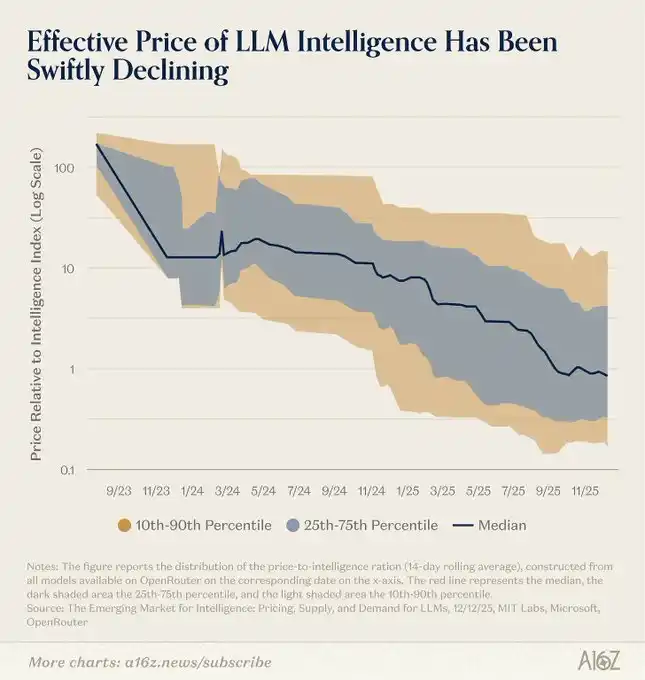
The logic of the doomsayers is: "If AI can think for us, then the 'moat' of humanity will disappear, and our ultimate value will be reduced to zero." Obsoleted by generals, humans. As if we have already completed all the thinking that needs to be done and wanted to be done; and now, since AI will take on an increasingly large portion of cognitive load, humans can only slide into obsolescence and uselessness.
But the issue is: whether through historical precedent or intuition, both tell us that when the cost of a powerful input falls, the economy does not politely stand still. Cost reduction, quality improvement, speed acceleration, new products becoming viable, the demand curve shifts outward. The Jevons Paradox still holds true here. When fossil fuels initially made energy cheap and abundant, we didn't just make whalers and loggers unemployed; we also invented plastic.
Contrary to the doomsayers, we have every reason to expect that AI will have similar effects. As AI takes on an increasingly large portion of cognitive load, humans can instead free themselves to explore frontiers that are more ambitious than ever before.
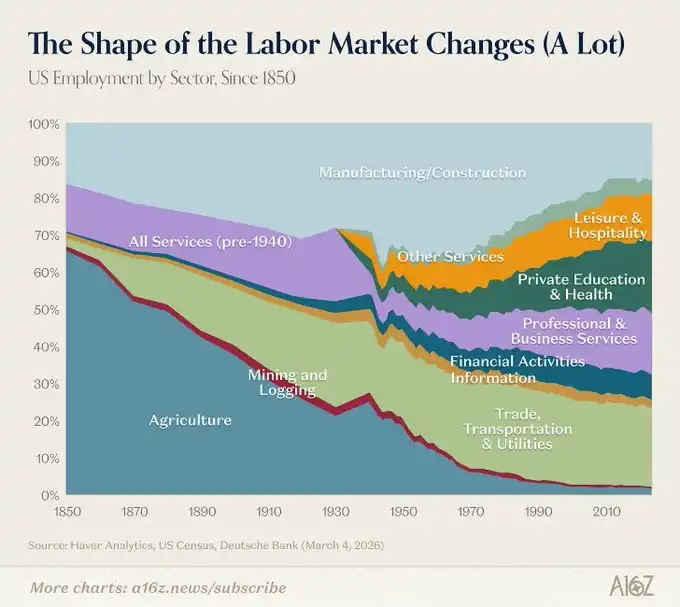
If historical experience is still relevant, then we can expect that technological change will make the entire economic pie bigger.
Every economic sector that has ever been dominant has eventually given way to a larger successor, which in turn has further driven the overall economy to become larger.
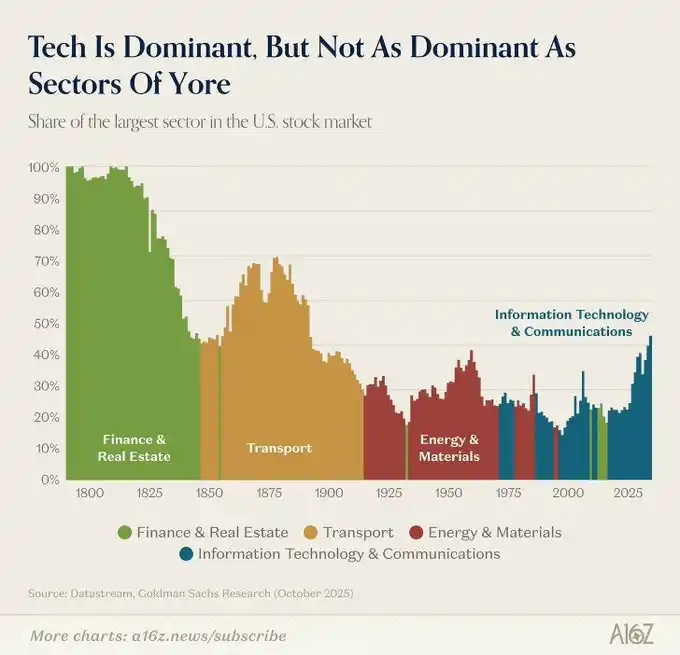
Today, the scale of the tech industry has surpassed what the financial, railway, or industrial sectors had achieved in the past, yet its share of the entire economy or market remains smaller. Productivity gains are far from a zero-sum game; they are a massively magnified positive force. After entrusting so much labor to machines, the end result is not an economic and labor market contraction, but rather that they become larger, more diverse, and more complex.
Doomsayers want you to ignore the history of innovation, focus only on the frame of "cognitive collapse," and then call it the entire movie. When they see a task replaced, they stop there.
"Our cognitive output will increase tenfold, but we will not think about more things because of it; instead, we'll pat our bellies, go to lunch early; everyone else will do the same." This idea not only exposes a huge lack of imagination but also reveals a failure to observe basic reality. The Doomsayers call this "realism," but it is not something that has ever truly happened in history—never.
The Failure of Luddism
Let's see what actually happened when a great leap in productivity swept through the economy.
Agriculture
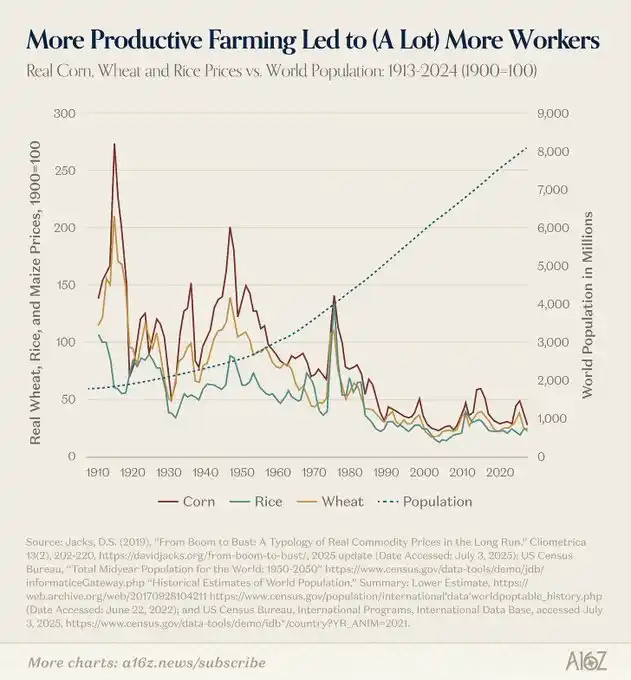
At the beginning of the 20th century, before the mechanization of agriculture was widespread, about one-third of the U.S. workforce was employed in agriculture. By 2017, this proportion had dropped to about 2%.
If automation were to cause permanent unemployment, then tractors should have long since completely destroyed the labor market. However, the opposite is true: agricultural output almost doubled, supporting a massive population growth; and those who left the farms did not become permanently unemployed but flowed into previously unimaginable new industries—factories, stores, offices, hospitals, laboratories, and eventually into the service and software industries.
So, it can certainly be said that technology did disrupt the career prospects of ordinary farmworkers; but it was also in this process that it unleashed a global labor and resource surplus, opening up an entirely new economic system.
Electrification
The story of electrification is similar.
Electrification is not just about replacing one power source with another. It replaced drive shafts and belts with standalone electric motors, forcing factories to reorganize around entirely new workflows and create entirely new categories of consumer and industrial products.
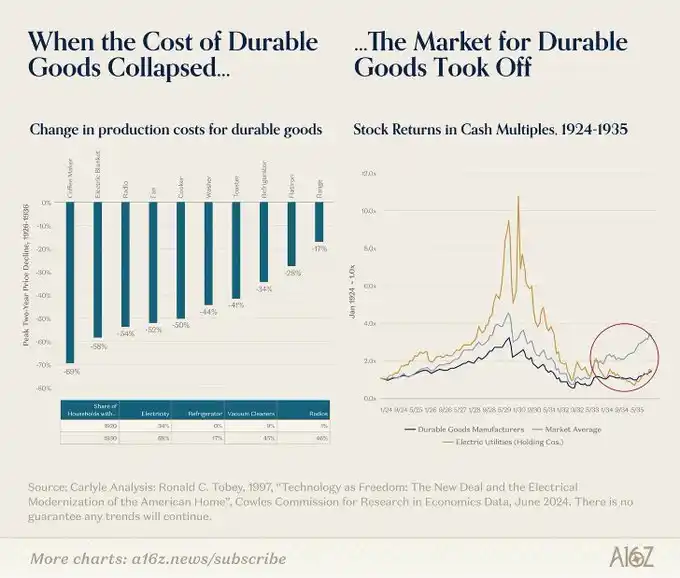
This is precisely the typical feature of a technological revolution at different stages. Carlota Perez documented this process in "Technological Revolutions and Financial Capital": early massive investments and high financial capital interest, a sharp decline in the cost of durable goods, followed by a growth period for durable goods manufacturers lasting a generation.
Electricity truly unleashed the magic of productivity and also went through quite a long period. by the turn of the 20th century, only 5% of U.S. factories used electrically driven machinery, and less than 10% of homes were electrified.
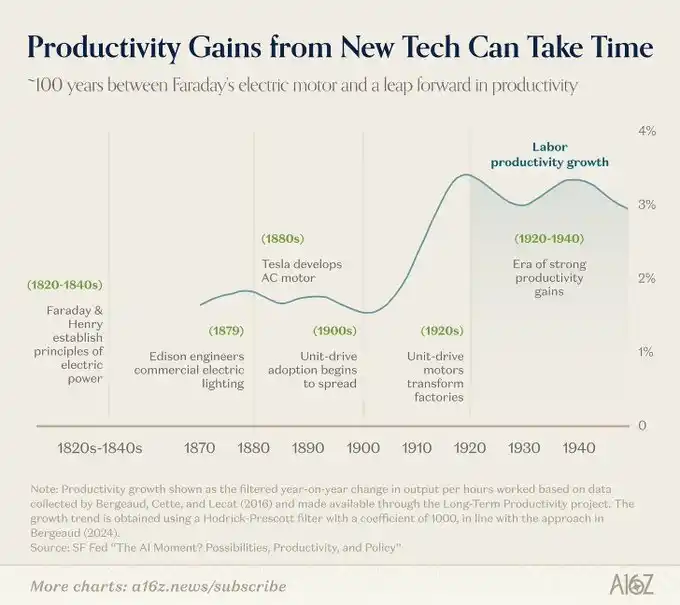
By 1930, electricity was providing nearly 80% of the power for U.S. manufacturing, and labor productivity growth would double over the following decades.
It didn't destroy the demand for labor. On the contrary, higher productivity meant more manufacturing activity, more salespeople, more lending, and more business activity. Not to mention the second-order effects of labor-saving devices like washing machines and cars—both of which freed up more people from their previously inefficient labor to engage in higher-value activities that were previously out of reach.
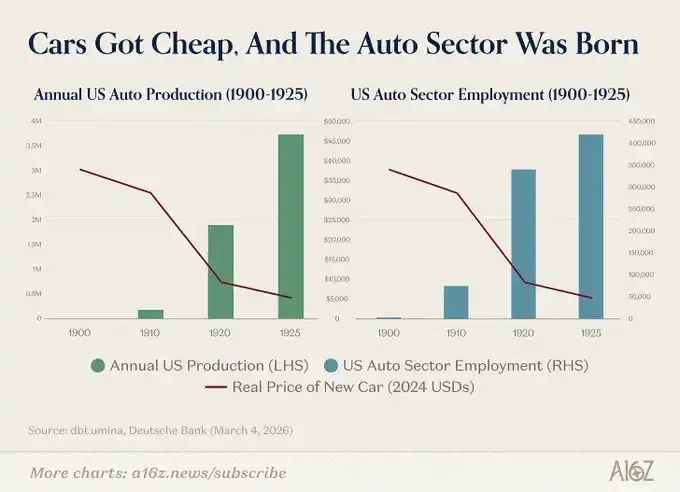
As car prices fell, both car production and employment exploded. This is the outcome of a true general purpose technology: it reorganizes the economy and expands the boundaries of "useful work."
We've seen this time and time again. Did VisiCalc and Excel spell doomsday for accountants? Clearly not. The greatly improved computational efficiency actually expanded accounting roles and created the entire FP&A (financial planning and analysis) industry.
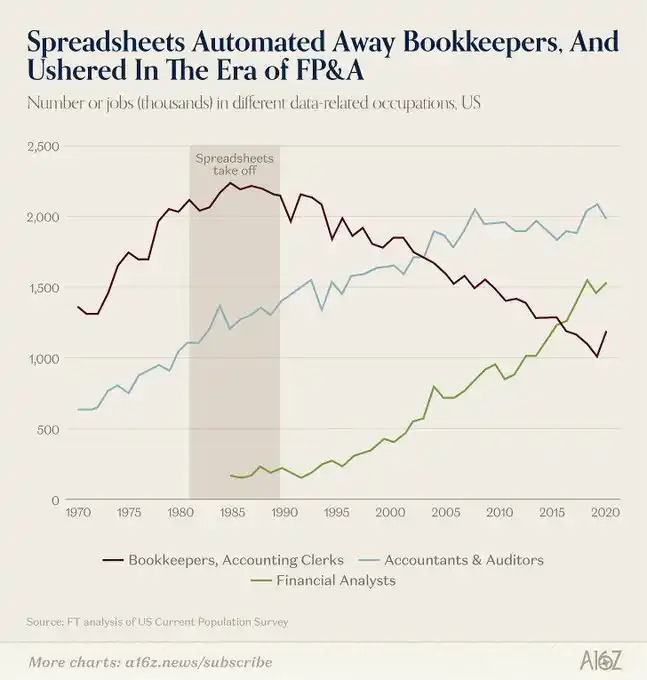
We lost around 1 million "accountant" roles but gained about 1.5 million "financial analyst" roles.
Those New Service Sector Jobs
Of course, task substitution doesn't always result in job growth in adjacent sectors of the economy. Sometimes, the surplus released by productivity shows up as entirely new job growth in a completely unrelated industry.
But what if AI means some people become extremely wealthy while leaving others behind?
At the very least, those extremely wealthy individuals will spend money somewhere, thereby creating an entirely new service sector from scratch. This has happened before:
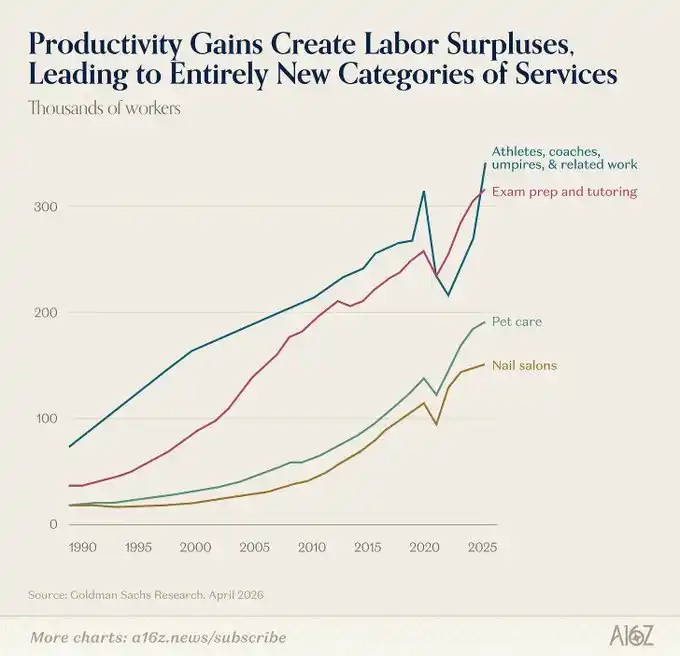
The widespread productivity improvements and the subsequent wealth creation have given rise to many entirely new types of jobs. Without the rise in income and the increase in available labor, these jobs may have never actually materialized—even though they were technically feasible well before the 1990s. Regardless of how people view service industries catering to the wealthy, the net result is that everyone is better off: rising demand drives a substantial increase in median wages, thus creating more "wealthy individuals" in the process.
Stripe's in-house economist, Ernie Tedeschi, provides a very interesting "composite case" of how a role was technologically disrupted, transformed, and reshaped—a travel agent.
Has Technology Reduced the Need for Travel Agents? Yes, It Has:
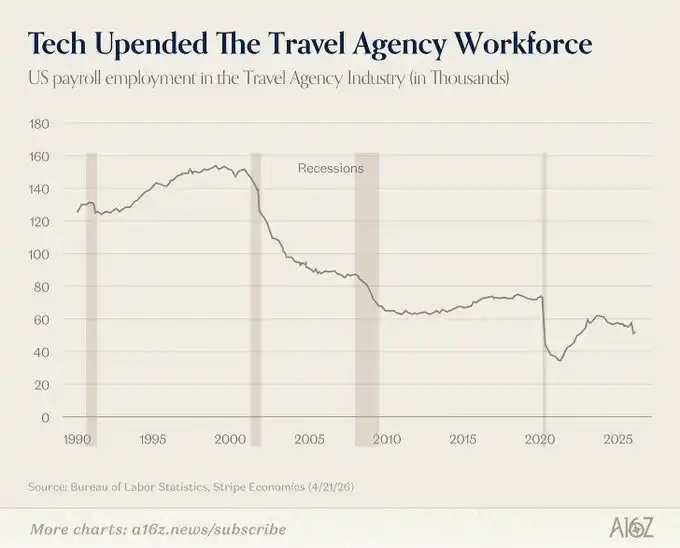
Today, the number of travel agency employees is roughly only half of what it was in the early 2000s, a change that is almost certainly technology-driven.
So, does this mean that technology is a job killer? The answer is still no. This is because travel agents have not been permanently unemployed as a result. They have found work elsewhere in the economy; overall, the employment-population ratio today is roughly the same as it was in 2000 after adjusting for age structure.
Meanwhile, for those still in the industry empowered by technology, the increased productivity has meant higher wages for them:
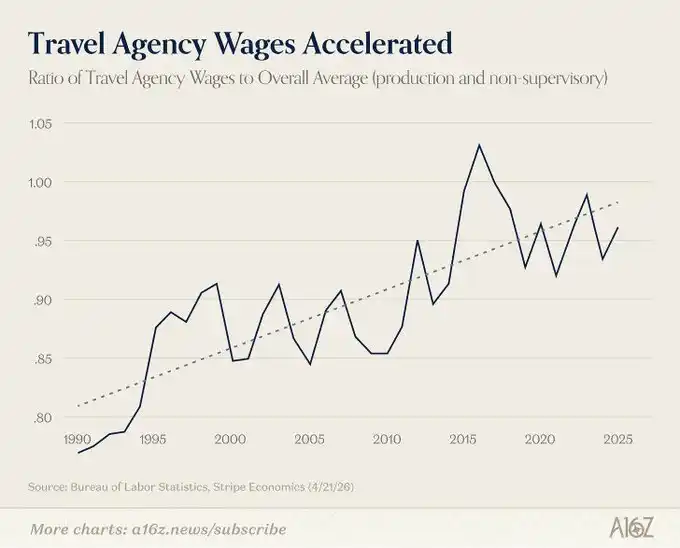
“In the golden age of 2000, the average weekly wage at travel agencies was 87% of the overall average weekly wage. By 2025, this figure had reached 99%, which means over that period, the wage growth in the travel agency sector exceeded the overall private sector level.”
So, even in this case where technology did indeed decimate the employment scale of travel agents, on the whole, the employment situation of the working-age population has remained stable, and those remaining travel agents are actually better off than ever before.
Enhance > Replace, and Jobs Yet to Come
This final point is crucial and once again underscores that doomsayers only tell a small part of the whole story.
For some jobs, AI indeed poses a threat to survival. This is true. But for other jobs, AI is a force multiplier, making these positions more valuable. For every job at risk of AI replacement, there are other positions that could benefit from AI:
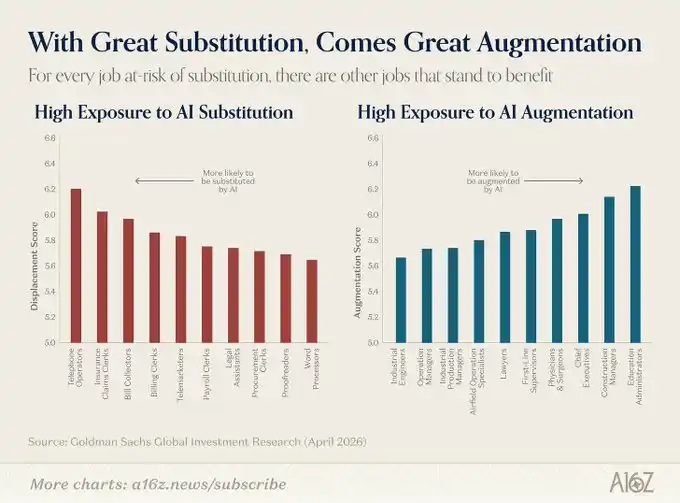
Goldman Sachs estimates that the “AI replacement” effect has already been offset by the “AI enhancement” effect, with the latter even more pronounced. Management also appears to be more focused on “enhancement” rather than “replacement” — a point worth noting:
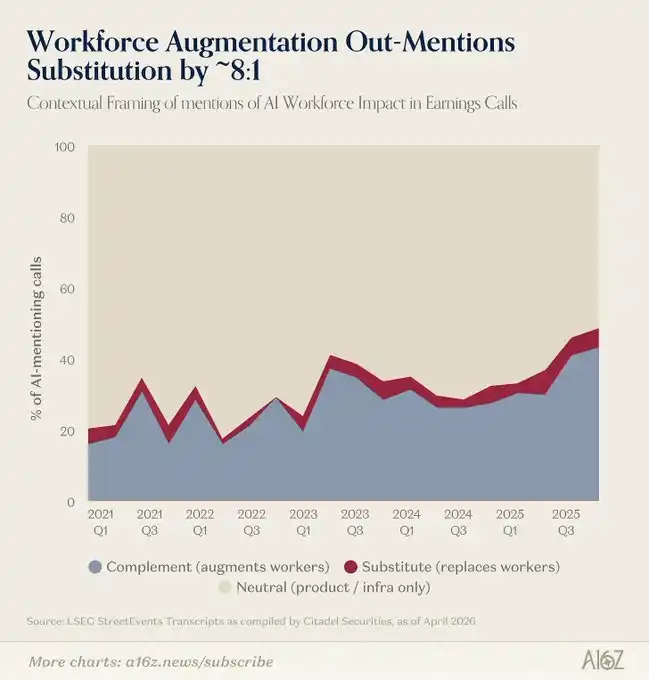
As of now, in corporate earnings calls, mentions of “AI as an augmenting tool” outnumber “AI as a replacing tool” by approximately 8 times.
Although Goldman Sachs didn’t even include software engineers in its “enhancement” list, software engineers are likely the prime example of AI-augmented roles. AI is a force multiplier for coding. Not only are Git commits skyrocketing, but the number of new applications and startups is also increasing, and the demand for software engineers seems to be at an inflection point:
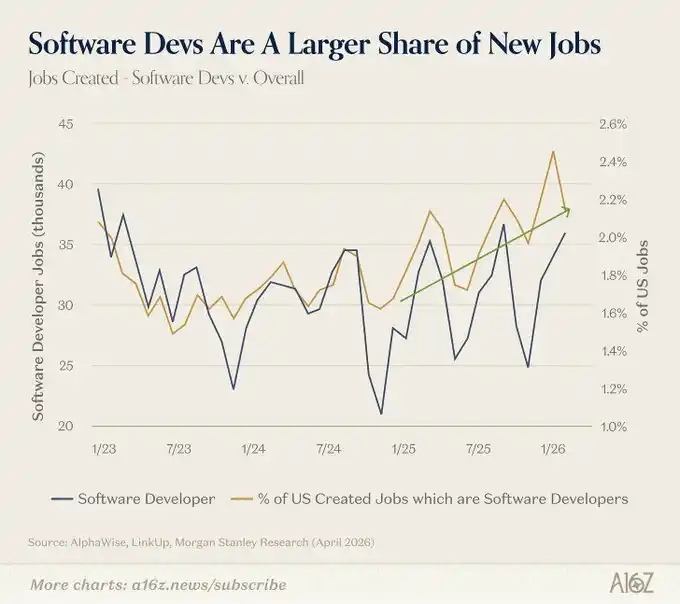
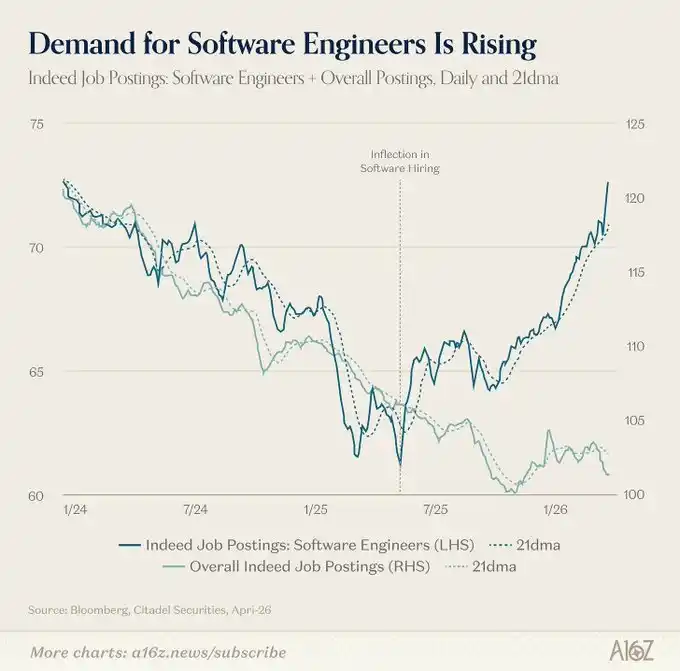
Both in terms of the number of positions and its share of the overall job market, software development roles have been on the rise since early 2025.
Is this because of AI? Frankly, it may still be too early to tell. But AI is undoubtedly enhancing the job capabilities of software engineers, not to mention that AI has already become a top concern for every company and executive.
As everyone is trying to figure out how to integrate AI into their business, companies naturally have reason to engage in significant recruitment efforts to achieve this goal. This will make certain employees more valuable, not less:
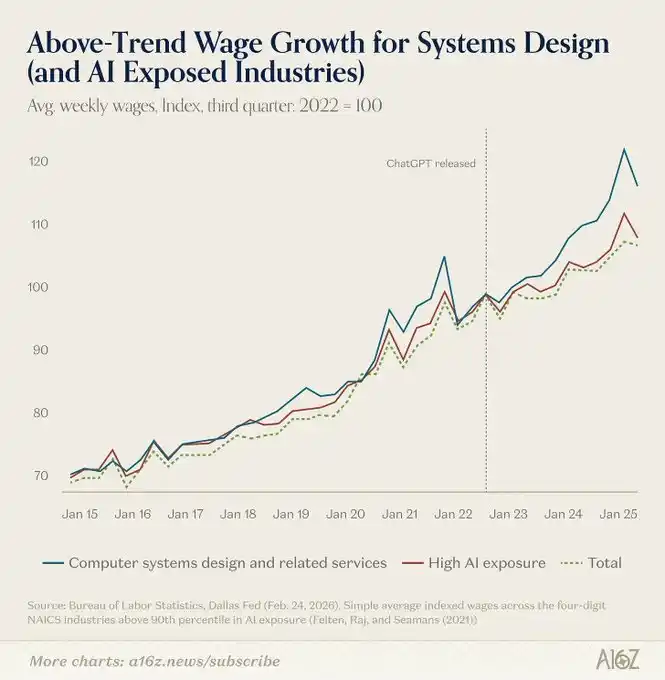
Roles with high AI exposure seem to be driving wage growth above trend levels; this is particularly evident in systems design positions.
These gains may currently be relatively concentrated, but it is still very, very early. As expertise spreads, so will opportunities. In any case, this is not the data doomsayers hope you see.
Meanwhile, according to Lenny Rachitsky—author of Lenny's Newsletter and a key insider in the tech industry—data shows that open product manager positions continue to rise, rebounding from the rate-driven collapse and reaching their most abundant levels since 2022:
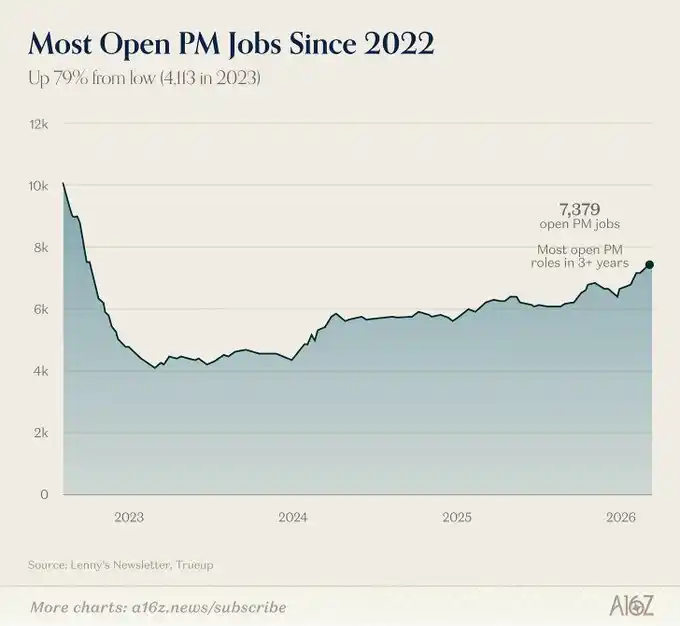
The simultaneous growth in software engineering and product manager recruitment is a clear example of why the "fixed pie fallacy" is wrong. If AI were replacing thought in a 1:1 manner, then you might reasonably expect: "Product managers needing fewer engineers," or conversely, you might also say "Engineers needing fewer product managers." But that is not the reality we observe. What we see is that the demand for both types of roles continues to rebound because what truly matters is people being able to get more done.
This is why the doomsayers' failure is fundamentally a failure of imagination. They focus only on the tasks automated out of existence, overlooking a new frontier of demand—one that will create jobs we have not even imagined yet:
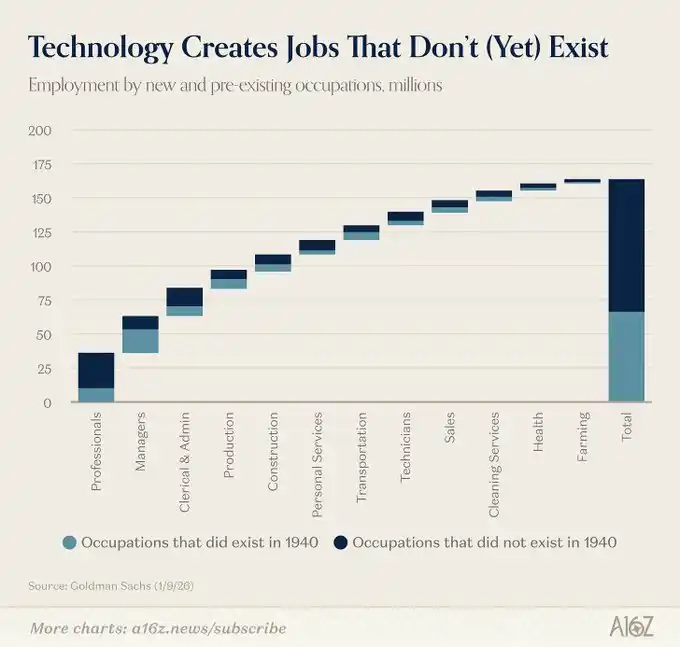
Most of the new jobs created since 1940 did not exist in 1940. By the year 2000, it was easy to imagine a large number of travel agents losing their jobs, but it was probably hard to imagine a mid-market tech services industry centered around "cloud migration"—after all, this was more than a decade before cloud computing really took off.
Welcome to join the official BlockBeats community:
Telegram Subscription Group: https://t.me/theblockbeats
Telegram Discussion Group: https://t.me/BlockBeats_App
Official Twitter Account: https://twitter.com/BlockBeatsAsia
 Related Articles