What Should the Fair Interest Rate for DeFi Be?
Original Article Title: What should DeFi Rates really be?
Original Article Author: Tom Dunleavy, Head of Varys Capital
Original Article Translation: Chopper, Foresight News
KelpDAO fell victim to a $2.92 billion cross-chain bridge attack, with the risk spreading to Aave, causing a $13 billion evaporative drop in DeFi TVL within 48 hours.
If you are earning only a 5% yield on your USDC in the money market, the real key issue is not whether DeFi carries risk, but rather:
Does your yield match the risk you are taking?
This article will use bond pricing logic to dissect this issue.
Two weeks ago, an attacker siphoned $2.92 billion from KelpDAO, with the stolen rsETH subsequently redeposited into Aave V3 as collateral, directly resulting in approximately $196 million in Aave insolvency. In just three days, Aave's TVL plummeted from $26.4 billion to $17.9 billion.
Prior to this, two weeks ago, the Drift Protocol in the Solana ecosystem fell victim to a North Korean hacker social engineering attack on the admin private key, resulting in a $285 million loss, with the attack planning traced back as early as the fall of 2025.
With only a three-week gap between the two major security events, a total of $577 million in losses were incurred. Due to risk-run on, Aave's USDC borrowing market fund utilization rate hit a peak of 99.87% for four consecutive days, driving deposit rates to soar to 12.4%. Circle's Chief Economist Gordon Liao even proposed a governance proposal to quadruple the borrowing cap to alleviate withdrawal demand.
A month ago, many users deposited stablecoins into DeFi money markets, earning only a 4%–6% annualized yield.
Now everyone needs to face a core question: Are these types of yield structures themselves priced reasonably? Weeks before the KelpDAO incident, Santiago R Santos questioned in the Blockworks podcast: In DeFi, we have long taken on high risk without ever getting full risk compensation. In the future, the rational risk premium for various assets should be redefined.
How Traditional Finance Prices Credit Risk
The yield of all corporate bonds is composed of a multi-layered risk compensation overlay. The core pricing formula is as follows:
· Yield = Rf + [PD x LGD] + Risk Premium + Liquidity Premium
· Rf is the risk-free rate, benchmarked against the duration-matched U.S. Treasury bond yield.
PD × LGD represents Expected Loss = Default Probability × Loss Given Default, where Loss Given Default = 1 - Asset Recovery Rate. The Risk Premium compensates for uncertainty beyond expected loss; even if two assets have identical PD and LGD, if the risk outcome volatility ranges differ, pricing will also vary. The Liquidity Premium refers to the additional cost of asset markdown realization and exiting positions.
Combining long-term historical data since 1920 from Moody's, the reference benchmarks are as follows:
· U.S. Investment-Grade Bond long-term average annual default rate is 4.5%, 3.2% in the past twelve months, expected to rise to 4.1% in the first quarter of 2026;
· High-Yield Unsecured Bonds historical average recovery rate is about 40%, corresponding to a default loss rate of about 60%;
· High-Yield Bond long-term annualized expected loss: 4.5% × 60% = 2.7%;
· In the Private Credit sector, KBRA predicts a 3.0% direct lending default rate in 2026, with an average recovery rate of around 48% for 2023–2024 cases;
· Senior Secured Leverage Loan historical recovery rate range is 65%–75%.
April 2026 Traditional Finance Yield Tier
Let's look at the current real data. The 10-year U.S. Treasury bond closed at a yield of 4.29% last Wednesday. At the same time, let's take a look at the April 2026 ICE Bank of America All Credit Option-Adjusted Spread.
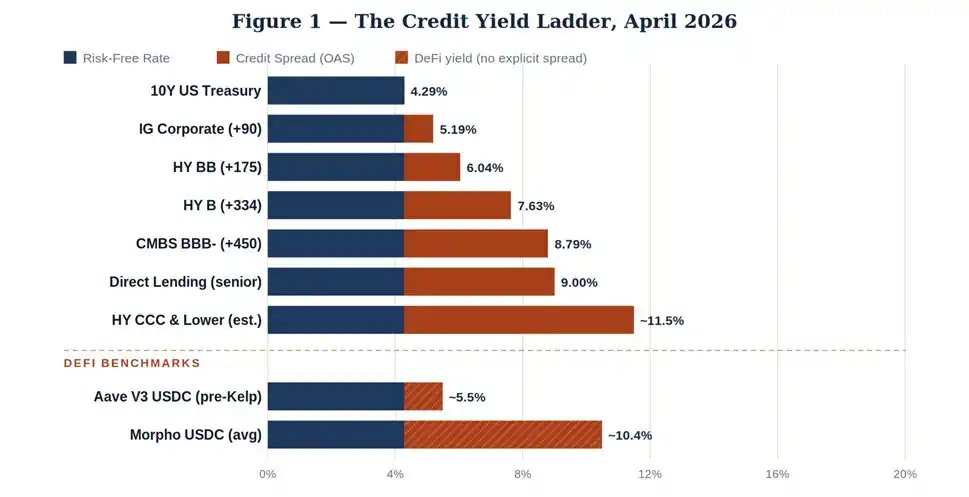
The pricing logic is clear and common-sense: Along the capital hierarchy from government bonds, investment-grade bonds, high-yield bonds, to subordinated commercial real estate assets, the yield escalates synchronously to compensate for the rising default probability and loss magnitude.
Private direct lending yields remain around 9%, not because borrowers have a higher default rate, but primarily due to the extremely illiquid nature of non-standard private assets, with a significant liquidity premium.
Looking at the DeFi Market: Prior to the KelpDAO incident, Aave's USDC deposit rate was around 5.5%, priced between investment-grade bonds and high-yield single B-rated bonds. Meanwhile, with the curated treasury and actively managed selection of Morpho, the yield was approximately 10.4%. These two numbers cannot simultaneously reflect the same underlying risk.
Three Unique Default Patterns in DeFi, Completely Absent in Traditional Finance
Traditional credit default processes are tedious. Borrowers fail to pay interest, bondholders trigger debt acceleration clauses, businesses undergo restructuring, assets undergo liquidation, and asset recovery is negotiated, making the process lengthy and subject to negotiation.
However, DeFi lacks a debt restructuring mechanism, with threats primarily stemming from protocol attacks and divided into three completely different default patterns, each with unique loss characteristics.
Pattern One: Smart Contract Vulnerability Attack
Code vulnerabilities lead to fund theft, such as reentrancy attacks, failed parameter validation, lack of permission controls, and more. Attackers directly drain the liquidity pool. Historical data shows that in protocol attacks involving white-hat hackers, the average fund recovery rate is only 5%-15%; if a nation-state-level hacker group, such as North Korea, is involved, the recovery rate is close to zero.
In 2021, the Poly Network suffered a $611 million hack, and all funds were returned, marking an extreme case. The Ronin $625 million and Wormhole $325 million hacks eventually recovered losses, relying entirely on the project teams and liquidity providers to cover the shortfall, which was not a market-driven asset recovery but essentially a shareholder reimbursement.
Pattern Two: Oracle Manipulation and Governance Attack
By maliciously manipulating price feed data in low-liquidity decentralized trading pools, bad debt is artificially created; or attackers accumulate governance tokens, maliciously pass proposals, and drain treasury funds. The 2022 Beanstalk governance attack resulting in a $182 million loss is a typical example. While some losses from this type of risk can be partially mitigated through protocol intervention, the assets held by lenders often end up as worthless token holdings.
Pattern Three: Composability-Driven Cascade Failure
The recent KelpDAO incident falls into this category, which is the most dangerous and difficult-to-audit risk pattern. Protocol A issues liquid staking/re-staking derivatives, protocol B accepts this asset as collateral, and protocol C is responsible for cross-chain asset bridging and transfer.
If any part of this chain is attacked, it will result in a cascading liquidation of all downstream positions. Attackers do not need to breach Aave itself; they only need to exploit the underlying rsETH protocol upstream, causing Aave lenders to directly absorb massive defaults.
Three types of risks share a common feature, which is also the core difference between DeFi and the traditional credit market: the risk event unfolds in minutes, not quarters. There is no covenant negotiation, no bankruptcy financing backstop; smart contracts self-execute, and code is law. Once a code vulnerability is exploited, the loss is almost irreversible. Aave V3's rsETH bad debt skyrocketed from zero to $196 million, taking only about four hours. In comparison, BB-rated traditional high-yield bonds take a median of 14 months from risk warning to debt restructuring.
The Truth Revealed by Real Loss Data
Chainalysis' Mid-Year Report for 2025 revealed a set of contradictory data: from early 2024 to October 2025, the total value of locked assets in DeFi rose from $400 billion to a peak of $1.75 trillion. However, the exclusive DeFi hacker attack losses remained at the low levels seen in 2023.
In 2025, the total amount of cryptocurrency stolen for the year was $3.4 billion, with the risk highly concentrated on hacks of centralized exchanges and individual wallet theft.
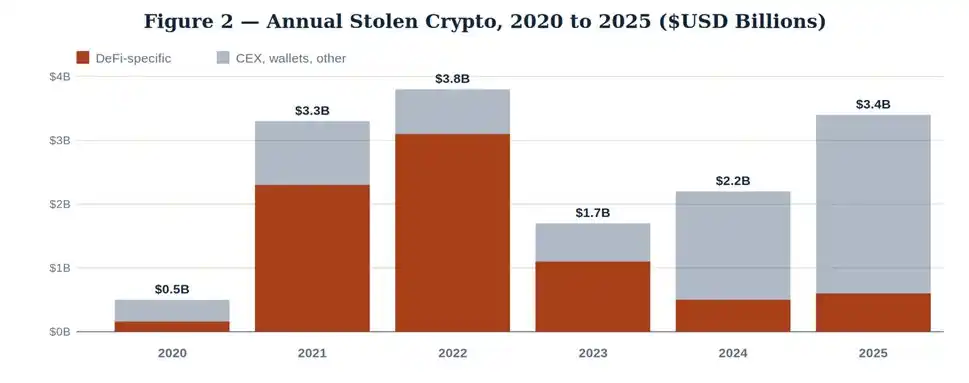
From this data alone, it is easy to misjudge that the DeFi security level continues to improve. The objective fact does exist: the contract audit industry is maturing, bug bounty platforms like Immunefi safeguard over a trillion dollars of user assets, and cross-chain bridges are gradually introducing time locks and multi-party verification mechanisms.
But the reality of 2026 is completely different: on April 1st, Drift lost $285 million, and on April 18th, KelpDAO lost $292 million. Two billion-dollar rug pulls occurred within 18 days, targeting composability architecture vulnerabilities rather than the lending protocols themselves.
Combining the average annual locked asset size, calculating the DeFi annualized loss rate in recent years:
· 2024: DeFi specific losses of about $500 million, with an average lock of $750 billion → Annualized loss rate of 0.67%
· 2025: Losses of about $600 million, with an average lock of $1.2 trillion → Annualized loss rate of 0.50%
· In 2026 year-to-date (annualized calculation): Losses of $577 million from just two events in the second quarter, with an average lock of $950 billion → If the risk pace continues, the annualized loss rate will reach 2.0%–2.5%
Based on this calculation, the forward-looking annualized default probability of the top DeFi lending business is approximately 1.5%–2.0%. Considering a 90% default loss rate in extreme attacks (with only a 5%–15% normal coin recovery rate in the absence of external backing), the annualized expected loss is 1.35%–1.80%. This figure has surpassed traditional high-yield bonds and does not yet account for uncertainty premium, liquidity discount, regulatory risk, and cross-chain composability contagion risk.
DeFi Reasonable Risk Premium Model
Based on bond pricing logic, we calculate the fair yield rate of top DeFi stablecoin deposits: benchmarking against Ethereum mainnet top protocols (Aave, Compound), fully over-collateralized, USDC lending products targeting retail and quant borrowers.
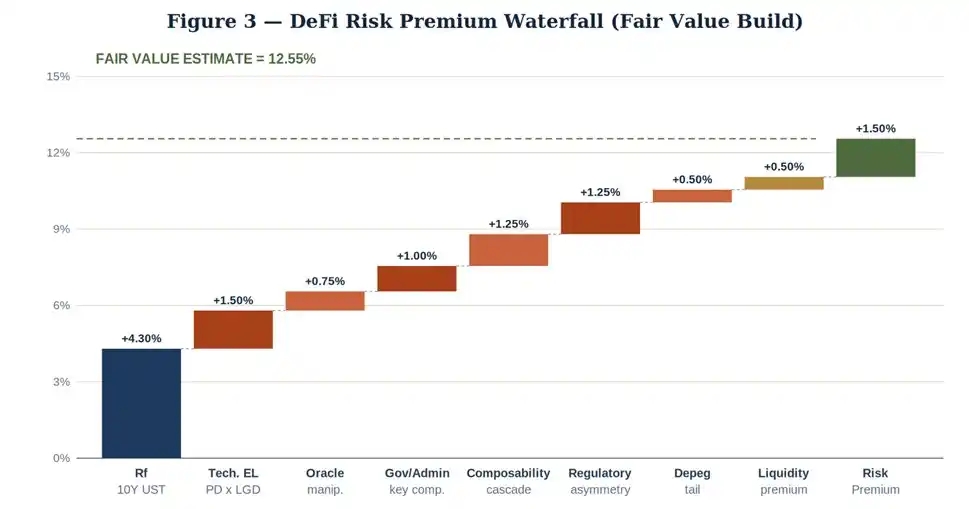
Building fair value yield rate from a 10-year Treasury bond yield benchmark
Using the 10-year Treasury bond as a benchmark, layering on premiums:
· Risk-free benchmark (10-year Treasury bond): +4.30%
· Expected fixed loss: +1.50%
· Oracle manipulation risk premium: +0.75%
· Governance / administrator private key risk premium: +1.00%
· Cross-protocol composability chain risk (Kelp-like risk): +1.25%
· Regulatory asymmetry risk premium: +1.25%
· Stablecoin peg tail risk: +0.50%
· Asset liquidity premium: +0.50%
· Risk premium: +1.50%
Ultimately arriving at a fair reasonable annualized yield rate of 12.55%.
Thus, ideally, for top compliant DeFi stablecoin deposits, the reasonable interest rate should not be lower than 13%. Assets with insurance coverage and protocol reserve backing can have a moderately lower rate; tail-end protocols, newly launched markets, assets involving rehypothecation, and underlying cross-chain assets require a higher risk premium.
Conclusion
First and foremost, strive for fair compensation. If you provide USDC to DeFi at a 5% yield, you are effectively pricing in BB-level credit risk, with the technical and composability risk actually higher than CCC-level. Morpho-style curated vault markets, with rates between 9% and 12%, are closer to a fair yield rate but also bring issues of manager selection and transparency.
Secondly, we need to enhance the capital structure. Overcollateralized loans backed by high-quality assets (ETH, wBTC, battle-tested LST), supported by oracle redundancy and a protocol-level insurance layer, with no cross-chain risks involved, carry a risk premium much lower than the above-mentioned framework. These are considered "investment-grade assets" in the DeFi space.
Thirdly, we must properly assess tail risks. The KelpDAO exploit was not a black swan event but rather a foreseeable failure mode of the re-collateralization primitive built on top of an increasingly fragile multi-chain architecture. The situation with Drift is similar, just with different participants.
The second quarter of 2026 has already seen $577 million in permanent losses. A DeFi portfolio with a 5.5% yield cannot possibly cover the risks of extreme market crashes and cascading liquidations.
DeFi is not uninvestable, it is just currently mispriced. There is a real institutional-grade allocation opportunity, but the precondition is that investors either demand a reasonable premium to match the risk or conduct in-depth due diligence on a single protocol following the rigorous standards of private credit.
Mindlessly depositing into top coin money markets, passively accepting low-yield farming strategies, is merely a disguise for high-risk carry trades masquerading as risk-free yield farming.
Welcome to join the official BlockBeats community:
Telegram Subscription Group: https://t.me/theblockbeats
Telegram Discussion Group: https://t.me/BlockBeats_App
Official Twitter Account: https://twitter.com/BlockBeatsAsia