Polymarket Trading Strategy Autopsy: Over 20 Avenues Explored, Only 4 Survived
Original Title: "Tried 25 Strategies, Only Survived 4: Polymarket Strategy Retrospective"
Over the past three months, I have explored over twenty automated trading strategies on Polymarket. Whale following, arbitrage, news event trading, weather arbitrage, mean reversion, market making, settlement farming... I've tried almost everything imaginable.
Of those, around a dozen have transitioned to live trading or paper trading, with many more being scrapped during the research phase.
Only 4 have survived.
This is a "post-mortem report." The deceased parts are described in detail, while the surviving parts are not—reasons you are aware of. However, these negative case studies themselves are valuable, as they can help you eliminate some seemingly attractive but impractical strategies.
Firstly, a disclaimer: The following are all experiential insights and it is highly likely that I will contradict myself in a few months. The market changes, and so does our understanding.
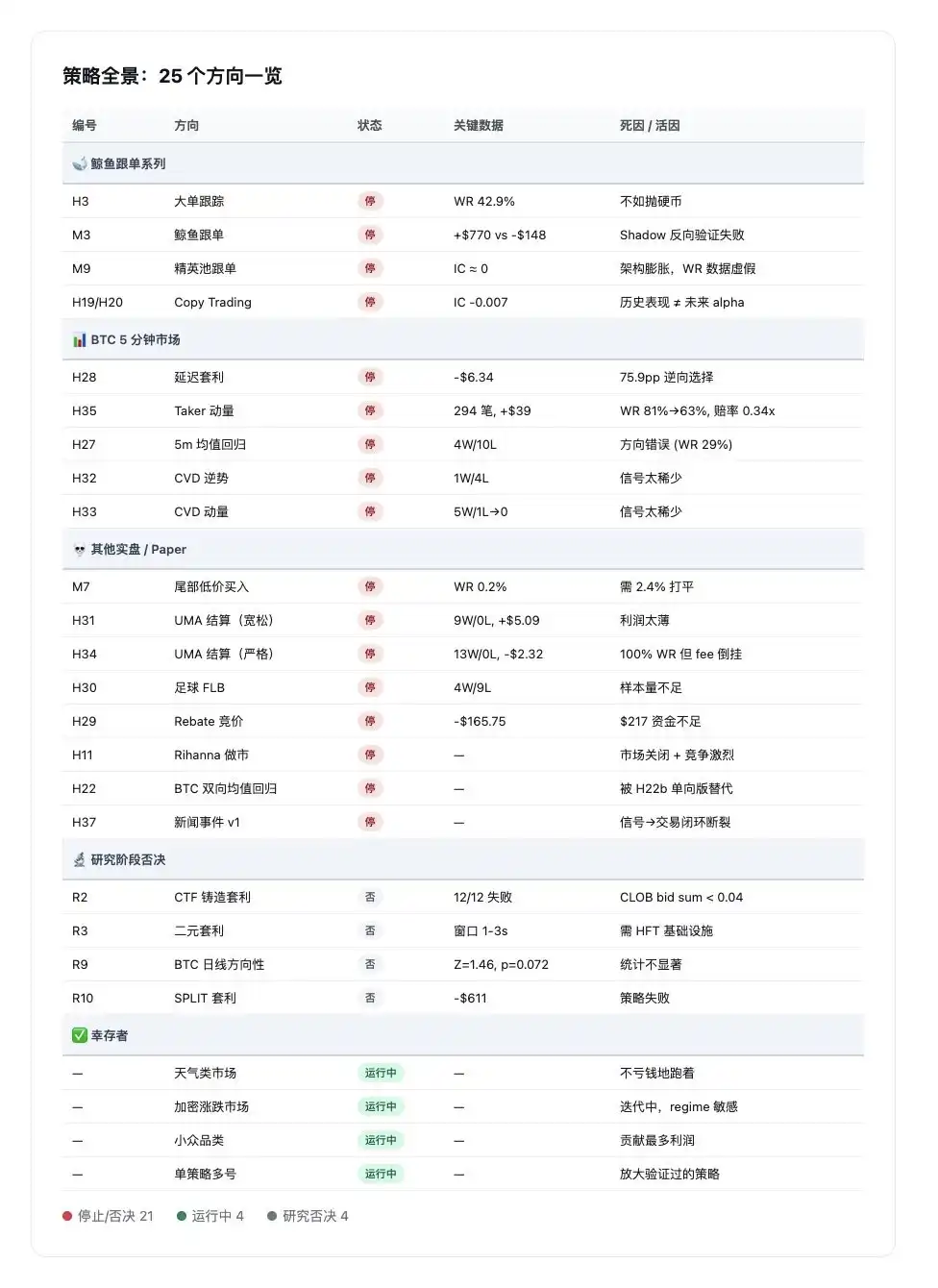
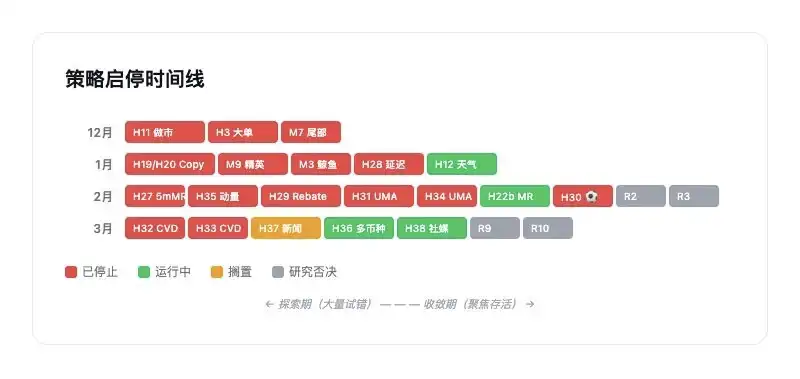
Graveyard
Whale Following: The Most Time-Consuming Foolish Idea
This was the direction where I invested the most energy, trying out five variants, all of which failed.
First Attempt: Large Order Tracking. Monitoring taker orders above $1000 and buying along. Empirical win rate of 42.9%, worse than flipping a coin.
Undeterred, I sieved out the highest historical win rate from 287,000 addresses, forming an elite pool for real-time following. Then, two fatal issues were discovered.
The first: Many third-party data sources have inaccuracies in win rate calculation. Split operations lead to underestimated costs, and redeemed positions are erroneously included in the "win." Analyzing nearly 300,000 addresses in the Elite Pool, we found that many addresses appearing to have an 80%+ win rate, when cross-verified with the Polymarket official Data API, had a significantly reduced actual win rate. A typical example: an address claiming an 83.5% win rate, validated to only have 50.9%.
The second, more fundamental issue: A considerable portion of the top "whales" are market makers. They may hold positions on both the YES and NO sides of the same market or hedge across multiple accounts. You see them buy YES, thinking they are bullish, when in reality, they are just providing liquidity. By following them, you are essentially becoming the counterparty for the market maker's other leg.
Tried another variant of Copy Trading, calculated Information Coefficient (IC), the result was close to zero. Also conducted a Shadow Control Experiment — Paper Account +$770, Shadow Account -$148, completely opposite outcomes. The historical performance of these whales is worthless for predicting the future, and you can't even see clearly what they are doing.
Five variants, one path. All lead to a dead end.
BTC 5-Minute Market: Five Ways to Fall
The 5-minute market for BTC price fluctuations is one of the most liquid categories on Polymarket. I spent a lot of effort on this, trying out five different strategies.
Latency Arbitrage. Early PM order book updates had a delay, allowing for front-running after a price change on Binance. Went live, realized a slippage of 75.9 basis points — those orders you snagged were mostly "bait" intentionally left by counterparties, the real value had already been taken. Lost $6.34, promptly stopped. Later on, PM adjusted the taker delay configuration, making this window smaller and smaller.
Taker Momentum. Following the Binance price direction using FOK orders. Ran 294 live trades, initially had an 81% win rate, later decayed to 63%. The key issue was not the win rate, but the risk-reward ratio — making a small profit when winning, but losing a lot when losing, with a profit-loss ratio of only 0.34x. Adding a 1.5% taker fee, ended up making only $39, the edge was too thin to be worth it.
Mean Reversion in the Opposite Direction. Buy the dip after a 5-minute rise. Results were 4 wins and 10 losses, a 29% win rate. The direction was completely wrong — on a 5-minute scale, momentum effects are stronger than mean reversion.
CVD Signal. Used Cumulative Volume Delta deviation as a signal, tried two versions: momentum and countertrend. One had a record of 5 wins and 1 loss before never triggering again, the other had a record of 1 win and 4 losses before also going silent. Signals were too scarce, with no sufficient sample to validate.
Five strategies, none survived. The participants in this market are too clever — a large number of professional market makers and quantitative bots are competing inside, leaving a tiny space for retail traders.
Bottom Fishing: 0.2% Win Rate
Buy contracts below $0.05, bet on low-probability events. With odds of 20x or higher, the temptation is strong.
Actual win rate: 0.2%. Break-even requires 2.4%. The market prices tail events much more accurately than you think.
Settlement Harvesting: 100% Win Rate, Losses Incurred
Many markets settle on PM via the optimistic UMA arbitration process. The market outcome is almost certain, the contract price is close to $1.00 but not quite there yet. Buy and wait for settlement to profit from the difference.
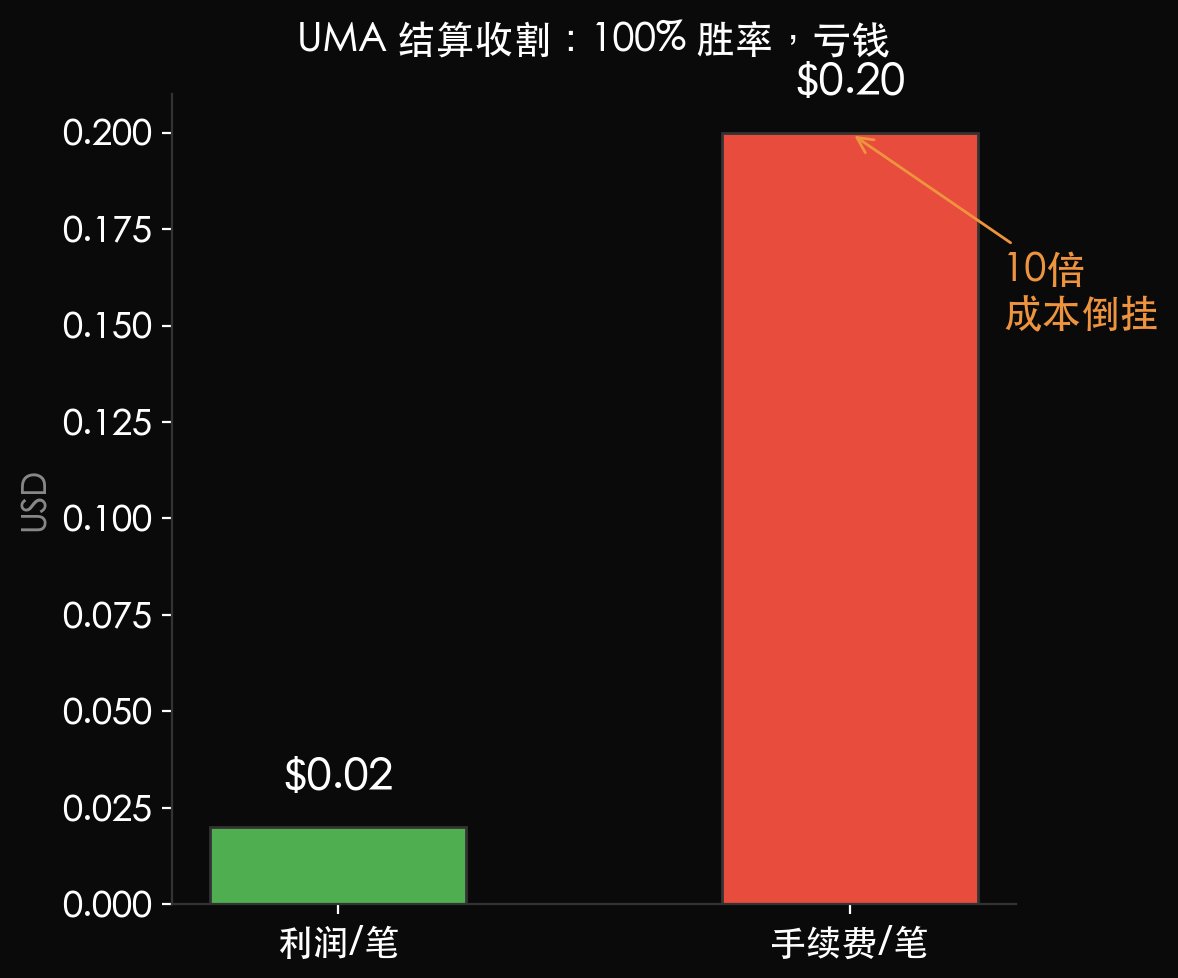
Tried two versions. Loose entry above $0.97, 22 trades, 9 wins, 0 losses, earned $5.09. Strict entry above $0.9975, 20 trades, 13 wins, 0 losses — ended up losing $2.32 instead.
100% win rate, every trade a win, yet still at a loss. With an entry price of $0.9975, profit per trade was less than 3 cents, and the 2% taker fee flipped the trade. This is my favorite kind of "corpse": Winning rate and making money are two different things.
Soccer FLB: The Curse of Sample Size
Favorite-Longshot Bias is a classic pricing inefficiency in sports betting — favorites are undervalued, underdogs are overvalued. Using data from the top five European leagues, buy favorites in the 0.50-0.85 range.
116 signals, 86 positions, 4 wins, 9 losses.
The issue may not lie with the strategy itself. Soccer has a weekly round, and over three months, the sample size is simply not enough to determine if there's an edge. Cryptocurrency markets operate on 5-minute cycles, two orders of magnitude less efficient. Moreover, PM sports markets have their own peculiarities: liquidity, settlement mechanisms, and traditional betting differ, raising questions about whether FLB can be applied here.
Rebate Auction: If You Can't Afford It, Don't Play
Polymarket offers makers zero fees plus rebates. Implemented a strategy to place frequent orders in 5-minute markets to earn rebates.
Redemption cooldown of 30 minutes, 5-minute candle period, $217 initial capital couldn't withstand continuous betting. Orphan order rate soared. Minimum requirement $400, ideally $800+. Ended up losing $165.75.
Running out of money is the simplest reason.
Liquidity Provision: Skinny Dipping in the Red Sea
One of the earliest directions. Placing a two-sided quote on the Rihanna album release prediction market.
It could run, but the liquidity provision competition was too intense—professional market makers were faster, had more capital, and priced more accurately than you. Eventually, the market closed, and the strategy stopped with it. Subsequent research confirmed: 45% of the products in the PM category are bot-involved, and liquidity provision is purely an arms race.
Event-Driven Trading: The Chain is Too Long
Monitor news → AI assess impact → Auto-trade. One of the sexiest directions.
Two versions were attempted. The core issue was the chain being too long from news release to signal generation to risk management to execution. By the time your order reached the CLOB, the market had already priced it in. Speed and accuracy need to be addressed simultaneously, which the current tech stack cannot achieve.
This direction is not completely dead, but it requires a more foundational infrastructure overhaul. It has been put on hold.
Shot Down in the Research Stage
There were some directions that were vetoed even before the code was fully written:
CTF Minting Arbitrage. Theoretically, arbitrage could be achieved through token minting and splitting. 12 markets were validated, with the bid total on the CLOB side all below 0.04, resulting in a 97%+ loss in taker mode.
Binary Arbitrage. Someone wrote an article claiming an arbitrage window of 4-8%. However, the actual window was fleeting (1-3 seconds) and required HFT-level infrastructure.
BTC Daily Directional. Analyzed 5036 transactions from a specific address, with a 52.6% win rate, Z=1.46, p=0.072. The statistics were not significant, and the edge did not hold up.
SPLIT Arbitrage. SPLIT→SELL→REDEEM strategy, reversed a wallet claiming a $38K profit. Leaderboard validation: actually lost $611.
Survivor
Survival strategies, specific parameters, and methods are not elaborated here. Just a few directional feelings.
Weather Market: Currently running without losses. After stepping on the pitfall of season changes leading to model failure and fixing it, it has been running smoothly.
Crypto Bull and Bear Market: Tried several approaches and is currently iterating. The biggest lesson is regime dependence: the win rate looks good under certain market conditions, but becomes completely invalid under a different regime. Knowing when to stop is more important than knowing when to enter.
Niche Market Categories: Such as social media-related prediction, which is currently the most profitable direction. Few participants, low pricing efficiency, limited but stable capacity.
Currently also trying the "single strategy, multiple accounts" mode, running validated strategies on multiple accounts to amplify returns.
Have made some small profits, a long way from "making a living off of this." But the direction has been validated, and the next step is expansion.
The Law Between Death and Survival
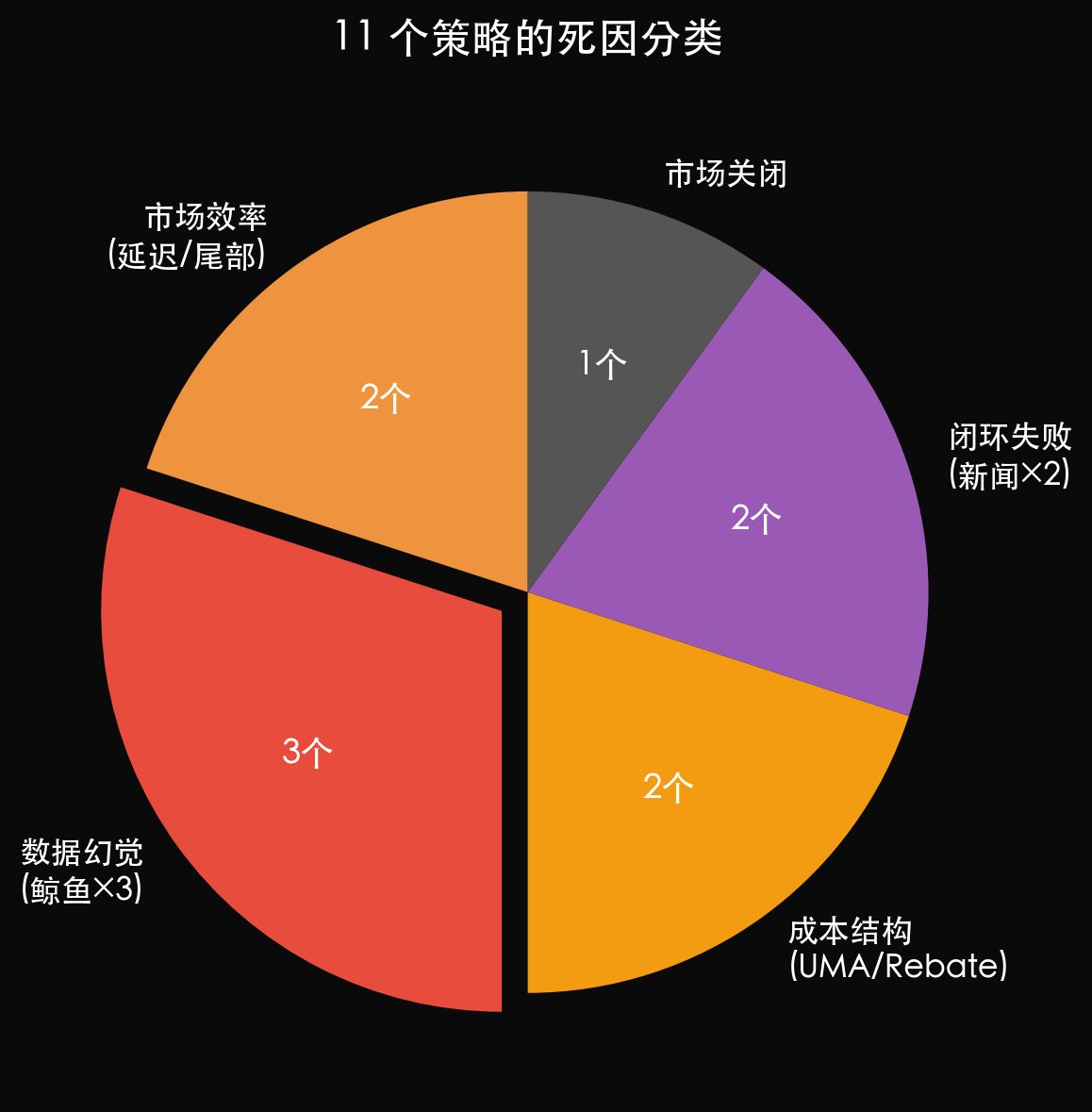
Looking at these twenty or so "corpses," the causes of death can be broadly divided into five categories:
Market Efficiency Trap: Delayed arbitrage, whale tailing, low-price tail-end—essentially gambling on market errors. As the market evolves and Bots become smarter, the "inefficiency" you discover may only be temporary.
Incorrect Odds Structure: The UMA settlement is a classic example. No matter how high the win rate, if the earnings do not cover the costs, it's slow bleeding. Don't just look at the win rate; look at the odds.
Insufficient Sample Size: Football FLB, CVD signals—some directions may be correct, but three months are simply not enough for validation. Time granularity and capital efficiency do not align.
Signal Loop Failure: News event trading—the chain is too long, and speed and accuracy cannot be guaranteed simultaneously.
Data Illusion: Whale tailing—your perceived "alpha" may only be a statistical illusion created by the settlement mechanism.
The surviving strategies have one common point: the opponent is not the overall market but manual traders and a few players in certain categories. It is more important to find a group of opponents weaker than you than to find a smart strategy.
One more thing: There is no "set and forget" strategy. Without monitoring and regime detection, it's a ticking time bomb.
A Few Final Words
92% of traders on Polymarket lose money, with Bots capturing 73% of arbitrage profits.
I explored over twenty directions, most of which were abandoned. The time cost over three months far exceeds the current returns.
But compared to the beginning, it's already much better. Initially, not even a single strategy could be executed properly. Now, at least a few directions can run stably. These "carcasses" have taught me things — about market efficiency, cost structure, data illusions — that cannot be found in textbooks. With each strategy shut down, it becomes clearer than the last time what can be done and what cannot.
The direction has been validated. With the accumulation of data and experience, I believe this can be scaled. The prediction market is still in its early stages, pricing efficiency is improving, but it is far from being a highly efficient market. The opportunities exist; they're just not where you think they are.
Original Article Link
Welcome to join the official BlockBeats community:
Telegram Subscription Group: https://t.me/theblockbeats
Telegram Discussion Group: https://t.me/BlockBeats_App
Official Twitter Account: https://twitter.com/BlockBeatsAsia