Not Just USDT: Tether Wallet is Trying to Take Over the Average Person's Payment System

Original Title: "Beyond Printing Money, Tether Attempts to Take Over the Ordinary Person's Payment Gateway"
In the power structure of Web 3, Tether has long played the role of a silent yet powerful shadow USD minting machine.
On the evening of April 14, Tether announced the official launch of the Tether Wallet, self-proclaimed as "The People's Wallet." The emergence of this product is essentially a "sinking interface" by this stablecoin giant, directly reaching end users.
From the asset issuer to the user gateway. Previously, Tether was only responsible for "printing money," but now it wants to define how people transfer and hold assets. By directly controlling the consumer-side traffic, Tether is transforming into a closed-loop ecosystem with traffic sovereignty.
This is also a defense of its shadow USD status. In emerging markets, USDT has become a de facto substitute for fiat. However, as Circle continues to strengthen its compliance narrative, squeezing the market, Tether must lower the physical barrier to usage, locking billions of users abandoned by traditional finance firmly into its official gateway.
What is the true core of the Tether Wallet?
In the product logic of Web 3, user experience has always been a false proposition. When you ask a user on the streets of Latin America trying to transfer $10 to hand-copy 12 illogical English words and instruct them that "losing it means bankruptcy," financial inclusivity has already died at the starting line.
The key highlight of the Tether Wallet is that it attempts to use a white-labeled transparency, removing the three major barriers of self-custody wallets: addresses, fees, seed phrases, and focusing on "simplicity" and "convenience," simplifying the experience to the utmost.
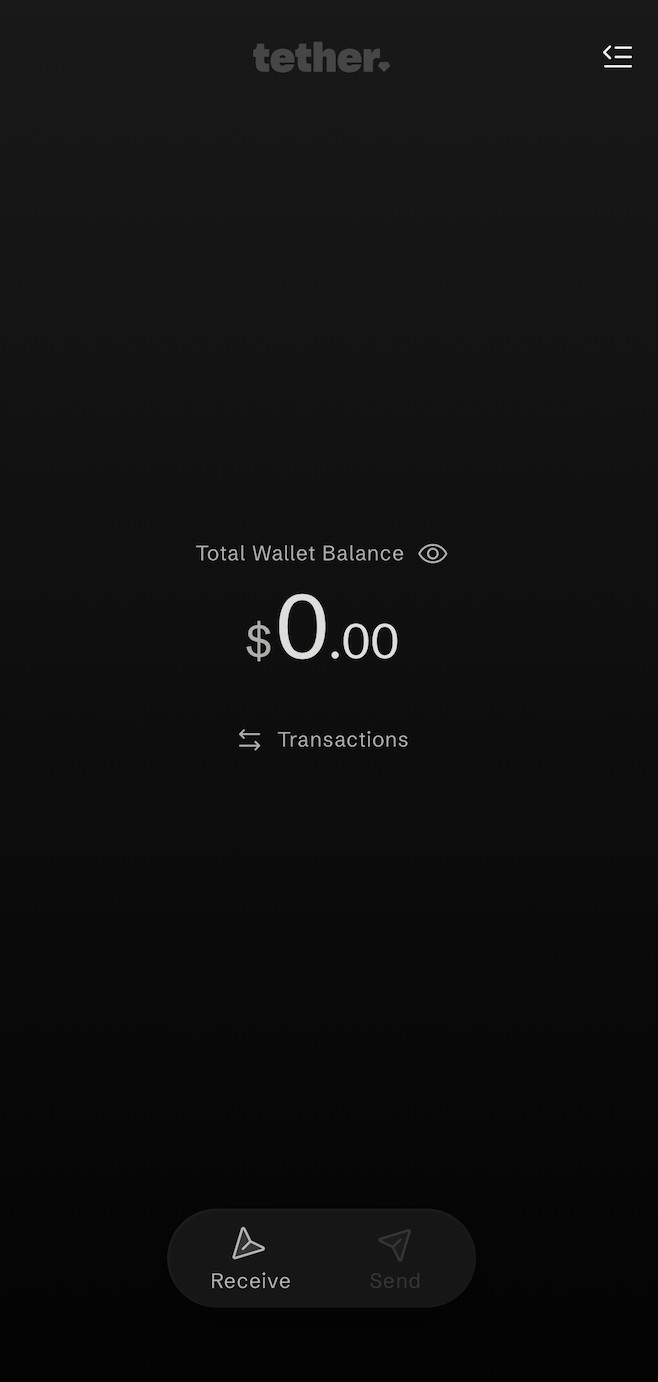
First, personalize on-chain addresses.
For a long time, the hexadecimal long string address has been the biggest obstacle to mass adoption. Tether Wallet introduces a payment username system (e.g., name@tether.me). This means that in cross-border transfer scenarios, USDT completely sheds the cryptic nature of digital assets, becoming as simple as sending an email or message.
Through testing, the Tether Wallet requires registration with an email address. The current payment username must consist of and only support lowercase letters and numbers, with a length limit between 4 and 15 characters.
Secondly, Gas abstraction directly deducts the transaction fee with the transferred asset.
The Tether Wallet itself does not charge a fee and supports directly deducting network fees using the transferred asset.
The technology is not particularly innovative, but being natively integrated by Tether changes the significance completely: it has completed the payment experience loop at the protocol level. This "Gas abstraction" natively integrated by the issuer means that it has completed the payment experience loop at the protocol level. Users only need to care about how much to transfer and not worry about gas fees.
Thirdly, self-custody design and cloud backup solution
The Tether Wallet adopts a self-custody design, where all transactions are signed and confirmed on the user's own device before being sent to the blockchain. The Tether Wallet also provides an encrypted cloud backup solution, where wallet data is encrypted and stored on Tether's servers, while the keys are stored on the user's iCloud / Google Drive. Neither party can unlock it individually, and they only come together when the user logs into the device. If a wallet needs to be restored on a new device, simply log in with the email address.
Of course, users can still choose manual backup.
Currently, the Tether Wallet supports assets and networks including:
· USDT: Ethereum, Polygon, Plasma, Arbitrum
· XAUT: Same as above
· USAT: Ethereum
· Bitcoin: On-chain + Lightning Network
It is worth noting that currently 45% of the circulating USDT supply is on Tron, but the Tether Wallet does not currently support Tron.
When Stablecoins Transform into High-Frequency Payment Assets
When the payment threshold is as low as just needing an email and a username, USDT is no longer just a value anchor in the crypto world; it begins to exert a terrifying gravitational pull, attempting to engulf the entire real-world small-value cross-border settlement.
First is the blow to traditional cross-border payment intermediaries. Before tether.wallet, workers in emerging markets who wanted to remit money to their families had to pay high fees and endure settlement periods of up to several days. The logic of Tether Wallet is: Since USDT is already the de facto currency in these regions, instant and low-cost transfers can be achieved through the Lightning Network or other blockchains.
Another aspect is the squeeze on competing stablecoins' survival. In the past, Circle (USDC) or PayPal (PYUSD) tried to capture the market through compliance and institutional endorsements.
However, Tether realizes that, on the retail end, liquidity inertia is paramount above all else. When a user is accustomed to seamless transfers using @username in Tether's official wallet, they have no incentive to switch to a higher-fee, smaller-circle payment tool. Tether is turning its first-mover advantage into irreversible usage inertia.
On a deeper level, Tether is redefining financial inclusivity. This self-custodial wallet is granting equal and unilaterally non-closeable access in the global financial infrastructure to Southeast Asian farmers and Latin American merchants who have never had a bank account.
Power Boundaries and Protocol Viability in the AI Era
In the tether.wallet documentation, there is a word mentioned twice: Left behind. However, as these forgotten by the traditional financial system flock into the new infrastructure built by Tether, a series of unresolved questions about power also come to light.
First is the regulatory shadow war under the guise of self-custody. While Tether emphasizes user ownership of private keys, the native integration of cloud backup and support for the @username system inherently leaves nodes open to regulatory intervention.
If regulations demand the tagging of specific accounts or pressure on cloud data, Tether will have to choose between the "decentralization creed" and "business survival." This will be a crucial battleground in the future crypto-state sovereignty game.
Secondly, AI Agents represent the second growth curve. Paolo Ardoino's statement is highly visionary: this wallet is also designed for AI Agents. In a future of ubiquitous connectivity, human biological identity may no longer be the core of a financial account.
When an AI agent needs to make instant payments for computing power, a stablecoin wallet that can be easily interfaced with will become the “lifeblood” of the machine civilization.
Ultimately, we are forced to confront this ultimate paradox. Tether is a complex entity: it has a centralized core but is wielded as a tool for extreme decentralization.
This paradox may very well reflect the current global financial evolution. The old order is hard to disrupt, and the new order only grows in the crevices. The Tether Wallet is not trying to build a utopia; it has merely opened a window in the walls of reality, revealing that transferring dollars can be as simple as sending a text message.
We are witnessing the dawn of a silent yet powerful global era of value transfer led by stablecoin giants. However, the premise of all this is that we must soberly realize that convenience is never free. We cannot evade a fundamental question: in the pursuit of efficiency and inclusivity, how can we find a truly sustainable balance between the walls of the old order and the untamed growth of the new order?
Original Article Link
Welcome to join the official BlockBeats community:
Telegram Subscription Group: https://t.me/theblockbeats
Telegram Discussion Group: https://t.me/BlockBeats_App
Official Twitter Account: https://twitter.com/BlockBeatsAsia