A four-page internal memo, what is OpenAI up to?

According to Anthropic's ledger, its annualized revenue is $300 billion, but according to OpenAI's conversion, the same set of sales figures is only worth $220 billion. Neither number is falsified. This was the first blow thrown by OpenAI's Chief Revenue Officer Denise Dresser in that four-page internal memo exposed by the media on April 13.
The starting point of the matter was an employee memo obtained by The Information. In the memo, Dresser did three things at the same time: praised the "amazingly high demand" of Amazon's new partnership, acknowledged that the Microsoft partnership "restricted our customer outreach," and then spent a considerable amount of space breaking down Anthropic's revenue figures. The timing of the leaking of this memo happened to be just one week after Anthropic had announced breaking the $300 billion annualized revenue milestone.
On the surface, it was internal company communication, but in essence, it was a carefully constructed information war. To understand it, the most direct approach is to start from three dimensions respectively: revenue calibre, enterprise-side competitive landscape, and computing power arms race, and then put them into the same cloud cooperation framework.
Where Does the $80 Billion Accounting Discrepancy Come From?
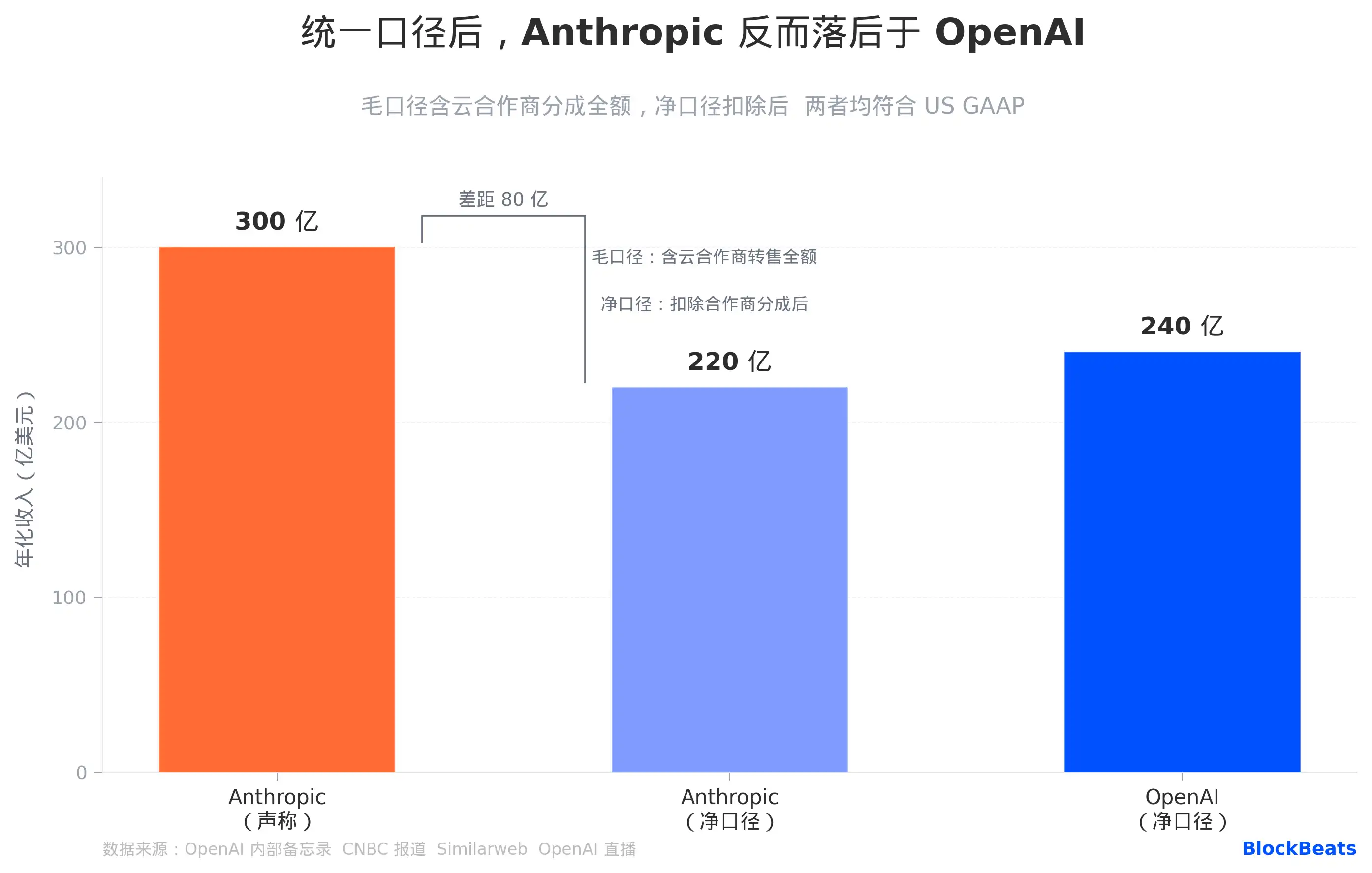
Anthropic reported a $300 billion annualized revenue, while OpenAI said the actual number was $220 billion. The $80 billion difference comes from the drastically different choices the two companies made in their revenue accounting caliber.
Anthropic uses a Gross caliber for accounting: when an enterprise purchases Claude's usage credits through AWS, Anthropic records the full amount of this money as top-line revenue and then treats the payment to Amazon for platform fees as a cost. OpenAI, on the other hand, only records the net amount actually received from Microsoft, with Microsoft's share not entering the headline.
Both methods comply with Generally Accepted Accounting Principles (GAAP) in the U.S. Anthropic's logic is that it is the "principal party" in customer transactions, with the cloud provider merely acting as a distribution channel. OpenAI's logic, on the other hand, is that it views Microsoft as the "agent," and only accounts for the portion actually received. The root of the difference lies not in who is falsifying information, but in who is more aggressively asserting their dominant position in the sales chain.
In the memo, Dresser wrote that Anthropic "used an accounting method that made the revenue figures look larger," including grossing up AWS and Google's revenue share to the full top-line revenue. The implication of this statement is not hard to understand, and when Anthropic submits its S-1 prospectus to the SEC, auditors will make a ruling on this caliber, which may require disclosure adjustments for uniform caliber. Converted on the same caliber, Anthropic is $220 billion, OpenAI is $240 billion, with the leading party switching places.
It is worth noting that Anthropic's revenue growth rate itself is already at a historic level. According to data from Bloomberg, Sacra, and other media, its annualized revenue has grown from around $9 billion at the end of Q4 2025 to the current $30 billion, more than tripling in less than five months. Moreover, this growth is mainly driven by real customer purchases, not explainable by bookkeeping adjustments. The core of this accounting dispute is not Anthropic shrinking but OpenAI resetting boundaries using "caliber."
The Corporate Side's Catch-up Speed Is Faster Than Most Expected
Ramp, tracking the actual AI spending behavior of thousands of enterprises, is a firsthand data source to assess genuine corporate choices.
Ramp AI Index April Data: Anthropic's share in enterprise paid customers has risen to 30.6%, while OpenAI is at 35.2%, narrowing the gap from 11 percentage points in February to 4.6 percentage points. Based on Anthropic's average monthly growth of +6.3 percentage points over the past two months (already the largest monthly increase in this index), it will surpass OpenAI in this index in approximately two months.
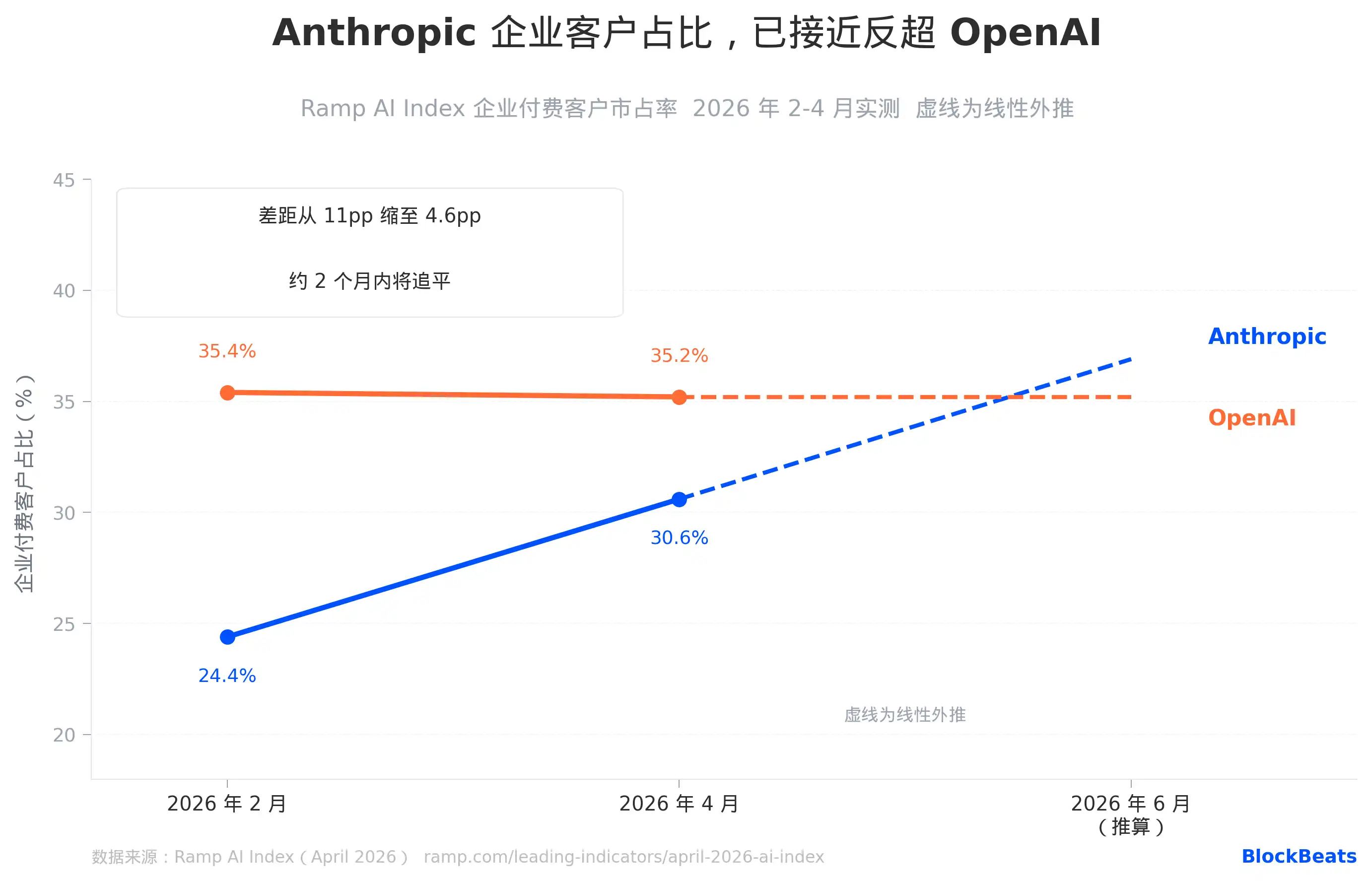
What is even more noteworthy are structural signals. In three high purchasing power industries, Anthropic's lead has become a fact, surpassing OpenAI in information technology/software (63% to 54%), financial services (52% to 46%), and professional services (47% to 44%). These three industries happen to be the most concentrated in enterprise AI budgets and have the most professional procurement decisions. This means that the companies with the most say in the AI procurement chain have collectively started tilting towards Anthropic.
In a rare admission in a memo, Dreiser acknowledged that Anthropic has a "significant leadership position among enterprise clients," citing programming ability as the reason. This statement, coming from within OpenAI, carries a weight entirely different from external evaluations; it is a company telling its own employees that the other side has won on a core battlefield. She added a warning at the same time: "You do not want to be a single-product company in a platform war." This is a reminder to employees that if Claude's advantage in programming cannot extend to the platform level, it will ultimately be just a ticket, not a ticket for a ship.
Compute Disparity: Close Today, Fourfold by 2030
Compute capacity is the most challenging dimension of competition between AI companies to shorten in the short term, as its construction cycle is in years and the funding threshold is in tens of billions.
The current numbers don't seem far apart: OpenAI at around 1.9 gigawatts, Anthropic at around 1.4 gigawatts, a difference of about 35%. Dreiser described Anthropic as "operating on a meaningfully smaller curve" in the memo, but this statement is not exaggerated in the current capacity comparison; the gap is real but has not reached a decisive level.
The true fork happens after 2027. OpenAI plans to reach 30 gigawatts of compute by 2030, backed by a $30 billion five-year cloud computing contract with Oracle, the entire Stargate infrastructure project, and a total commitment of $1.4 trillion in construction.
Anthropic's path dependency is a Broadcom custom chip agreement, with a capacity of 3.5 gigawatts, deployed through Google Cloud, effective from 2027. Along with AWS's existing training cluster, the target by the end of 2027 is 7-8 gigawatts.
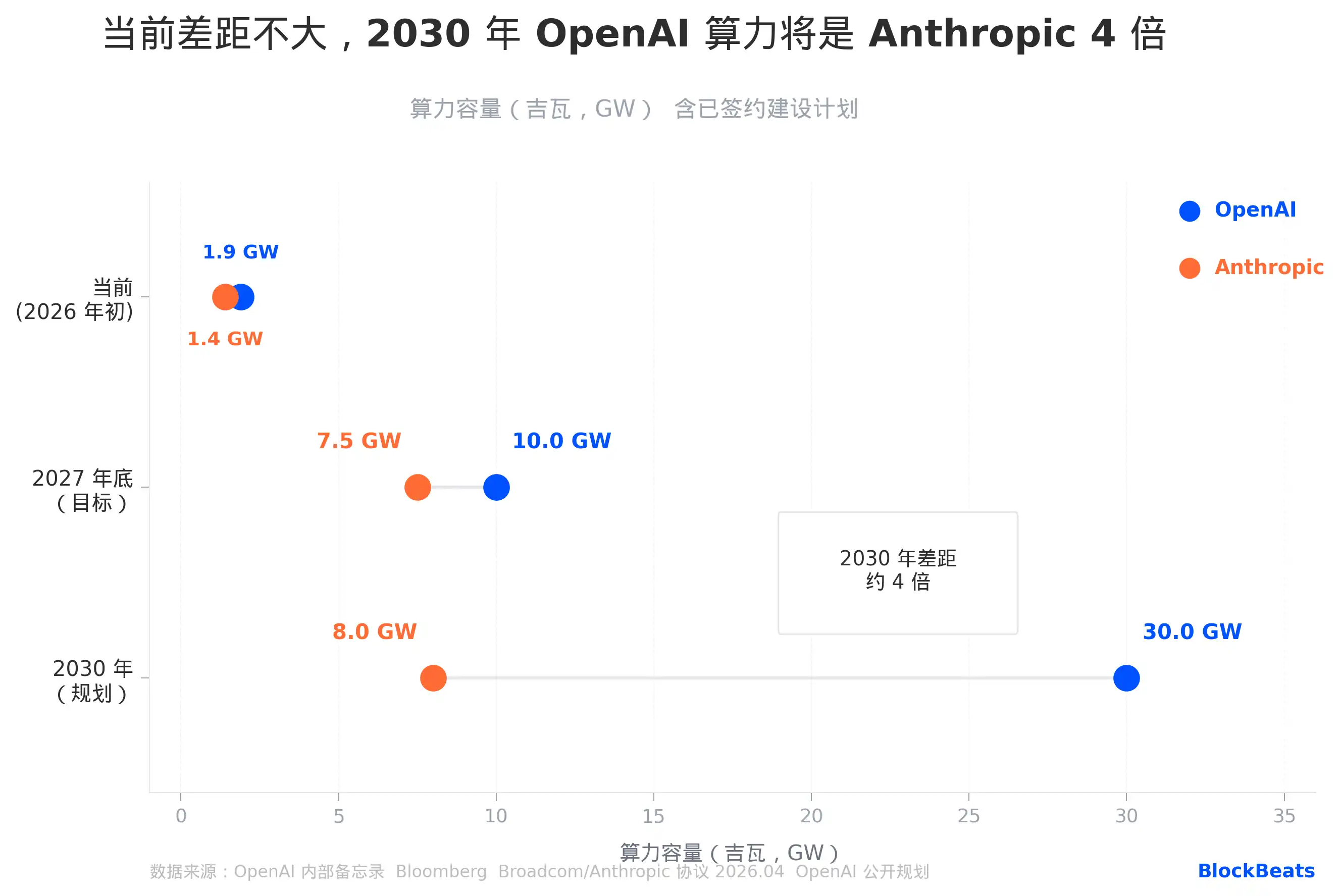
Even if Anthropic fully achieves its 2027 target, it still has a fourfold gap with OpenAI's 2030 plan. This gulf is not insurmountable technically; if the model efficiency improves enough to make each unit of compute generate more revenue, Anthropic can deliver a good enough product with less compute.
However, it must sustain its compute acquisition costs through continuous subscription revenue, assuming Claude continues its momentum in the enterprise: according to Sacra's estimates, Anthropic will pay cloud partners about $1.9 billion this year, rising to around $6.4 billion by 2027.
Amazon, Betting on Two Competitors Simultaneously
The most intriguing statement in this memo is Dreiser's direct characterization of the Microsoft partnership, where she writes that this collaboration "also limits our reach to where they are in the enterprise."
OpenAI's move towards Amazon has been very evident: according to CNBC, in February of this year, Amazon announced a $50 billion investment in OpenAI, while also gaining exclusive third-party cloud distribution rights to OpenAI's Enterprise Agent management platform, Frontier.
This is a proactive transition from the Microsoft track to the Amazon track, and the logic behind it is very straightforward. Many enterprise customers' AI infrastructure is already built on AWS's Bedrock platform, and Microsoft's exclusivity clause makes it difficult for OpenAI to sell directly there.
But the other side of Amazon in this competition is equally noteworthy. It is currently Anthropic's largest cloud infrastructure partner and strategic investor, with a total investment of $8 billion. The Project Rainier collaboration between the two has deployed around 500,000 Trainium 2 chips. Amazon's total wager in the AI competition amounts to $58 billion, flowing to two opponents actively engaged in the enterprise market.
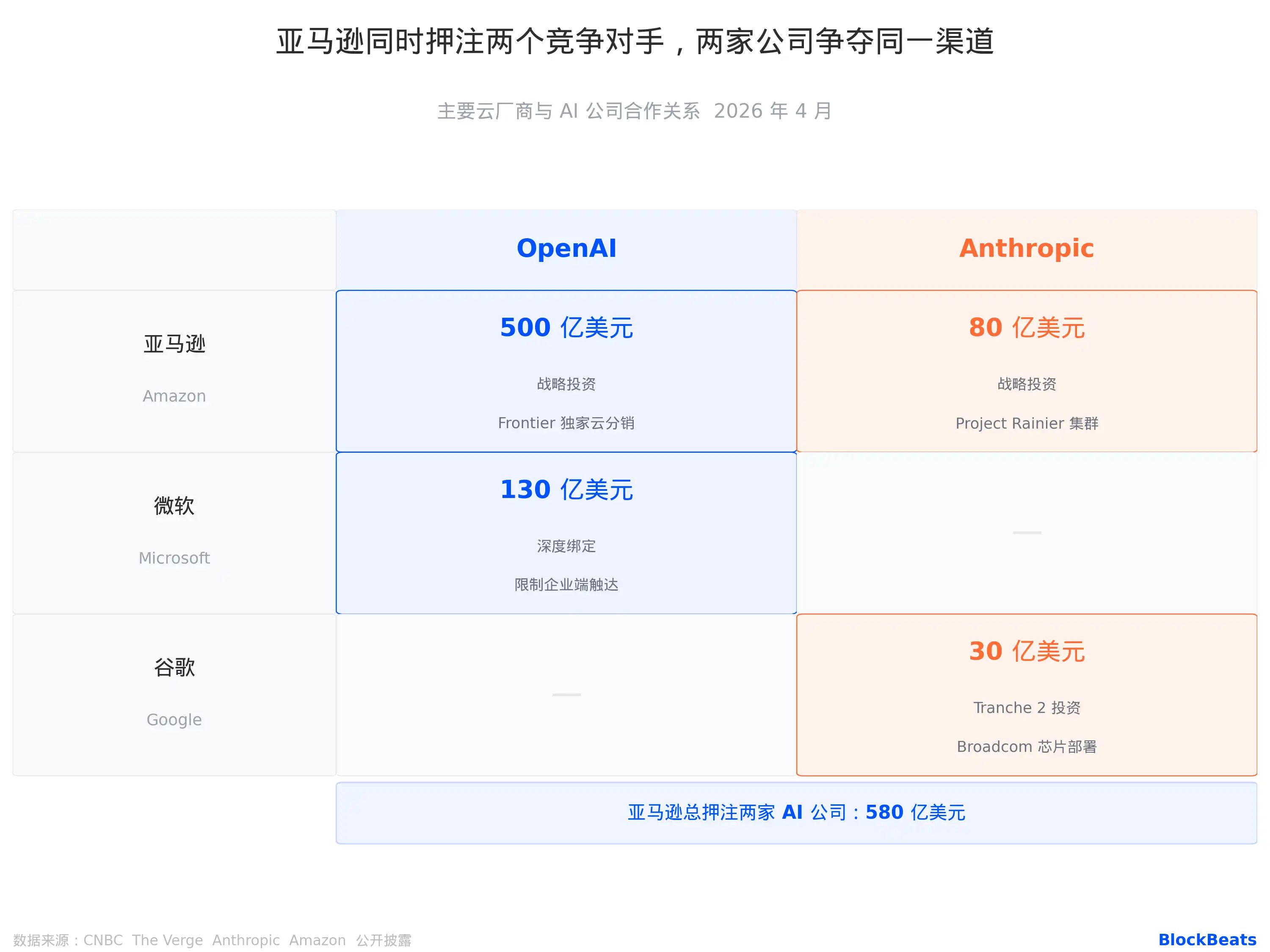
This is not a diversified bet by a mega-scale cloud provider, but a more precise structure: Amazon is both Anthropic's "strategic ally and largest benefactor" and OpenAI's new cloud foundation to "replace Microsoft."
When two companies compete for the same batch of enterprise customers, the channel of competition happens to be Amazon's Bedrock platform, which simultaneously distributes models from both companies. Amazon earns regardless of which company has a higher conversion rate on Bedrock, but both OpenAI and Anthropic lose out on each other.
Under the pressure of continuous erosion of enterprise market share and structural cracks in Microsoft's collaborations, OpenAI has chosen to rebuild the narrative with a carefully calculated digital battle, while leveraging Amazon to restructure the distribution pipeline. The three sets of numbers each unfold independently, making this competition more complex than either party wants you to see.
Welcome to join the official BlockBeats community:
Telegram Subscription Group: https://t.me/theblockbeats
Telegram Discussion Group: https://t.me/BlockBeats_App
Official Twitter Account: https://twitter.com/BlockBeatsAsia

 Related Articles