HTX Research's Latest Research Report Interprets OpenClaw: Execution Entry Battle and Huobi HTX's AI Strategic Path
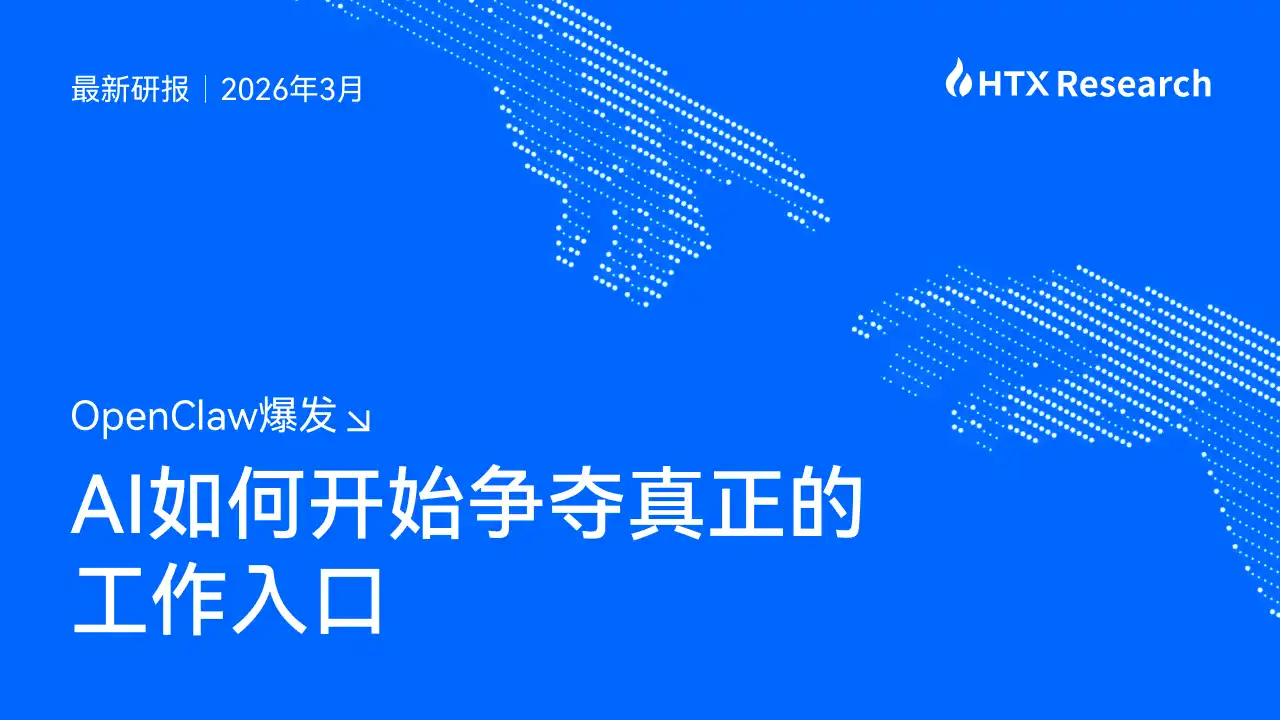
Recently, Huobi's HTX Research department released the latest research report "How AI Begins to Compete for the Real Entry Point to Work: A Case Study of OpenClaw", focusing on the rapidly emerging open-source project OpenClaw. The report systematically analyzes the industrial trend of AI evolving from a question-and-answer tool to a hostable execution layer and elaborates on Huobi HTX's product layout and differentiated competitive strategy in the AI direction.
The core theme of the report is who will control the next stage's entry point to work when AI transitions from "answering questions" to "executing tasks." To address this issue, the research report analyzes from five dimensions: product form, market driving force, human-machine division of labor evolution, Chinese market opportunities, and risk thresholds.
The Emergence of AI Execution Layer: From "Better at Chatting" to "Actually Getting Things Done"
OpenClaw has attracted widespread market attention because it focuses not on answer quality but on execution capability. It is defined as a personal AI assistant running on the user's device, capable of receiving tasks through various messaging platforms such as WhatsApp, Telegram, Slack, Feishu, Teams, and executing actions by interacting with files, browsers, calendars, emails, and terminals. The report points out that it is competing not for a new chat interface but for the execution entry point in the AI era—where humans are gradually stepping back to target definition and key judgments, and part of the execution chain is starting to be undertaken by digital agents.
Five trends have matured simultaneously behind this transformation: model capabilities have entered the "sufficient stage" to support moderately complex multi-step tasks; the high-frequency nature of message entry points allows AI to be embedded in existing work interfaces without requiring user migration; the open-source distribution mechanism enables projects to quickly break through developer circles; the self-hosted mode addresses data sovereignty concerns; and the reality of small teams needing to "do more with less" provides the most direct traction.
The Unique Adaptability to the Chinese Market
The report specifically points out that the momentum of OpenClaw in the Chinese market should not be overlooked. A large amount of work in Chinese small and medium-sized teams occurs between message-driven interfaces such as WeChat Work, Feishu, and customer service backends, naturally suited for the penetration of such execution layer tools. Cities like Shenzhen and Wuxi have introduced subsidies, office space, and entrepreneurship support policies around the OpenClaw ecosystem, linking it with the narrative of the "one-person company." Content teams, agent operations, investment research monitoring, customer service diversion, and other high message-density scenarios are seen as the first landing directions that have proven successful.
Safety and Governance: Three Thresholds from Hot Projects to Infrastructure
However, OpenClaw is still facing three thresholds to become infrastructure. The first is the safety threshold — there have been recent cases of spreading malicious installers through fake GitHub repositories and search ads; the second is the governance threshold, where enterprises need clear permission audits, action replay, and manual approval mechanisms; and the third is the template threshold, as a general platform lacking industry-level access templates will struggle to bridge the gap between "trial" and "long-term use."
Huobi HTX's AI Path: From Model Aggregation to Platform-Level Service Entry
As a globally-focused encrypted exchange platform deeply rooted in the AI field, Huobi HTX's AI path complements the trend represented by OpenClaw. OpenClaw represents the direction of "AI as the execution layer," while Huobi HTX is advancing the realization of "AI as a platform service entry point and ecosystem connector."
The self-developed AINFT product launched within the Huobi HTX system aggregates mainstream large-scale model capabilities, including those from OpenAI, Anthropic, and Google. Users can access different models through a single entry point without the need to switch between multiple platforms. At the login level, AINFT adopts TronLink wallet signatures, eliminating the need to bind a phone number or credit card, aligning with crypto-native user habits. On the payment side, it adopts a "pay-as-you-go" mechanism, breaking the traditional monthly subscription logic of AI products, better suiting the characteristics of on-chain user high-frequency, low-value, and flexible usage.
This product design reflects that Huobi HTX's understanding of AI has evolved from an "efficiency tool" to "platform capability extension" — in the future, users entering the platform may not only be for trading but also to use AI and intelligent services, ultimately flowing back to trading and platform activities.
At the competition strategy level, against the backdrop of mainstream trading platforms launching AI Skills, Huobi HTX has taken a more focused differentiation approach: HTX AI Skills initially cover spot and contract trade execution, with plans to subsequently add market analysis, market intelligence, and an in-app AI assistant, establishing a closed-loop around "trade execution, risk assessment, market intelligence, and user entry" at four key levels. The report points out that the core of competitiveness lies not in the quantity of Skills stacked, but in who is the first to link execution, risk, intelligence, and entry into a complete user experience.
The Track is Still in Its Early Days, but the Direction is Clear
The evolution of AI from the tool layer to the execution layer is still in a very early stage, with security, governance, and ecosystem maturity still far from in place. However, the emergence of OpenClaw has already made the market see more clearly that the next competition in AI may no longer be just a comparison of parameters and answer quality, but will extend to the comprehensive level of entry control, permission governance, skill ecosystem, and organizational trust. Huobi HTX's early layout in this direction provides an industry sample worth paying attention to on how a crypto platform can transform AI from an external capability into a self-operable, scalable long-term asset.
About HTX Research
HTX Research is the dedicated research department under Huobi HTX, responsible for in-depth analysis of a wide range of fields such as cryptocurrency, blockchain technology, and emerging market trends, writing comprehensive reports, and providing professional evaluations. HTX Research is committed to providing data-based insights and strategic foresight, playing a key role in shaping industry views and supporting wise decisions in the digital asset field. With rigorous research methods and cutting-edge data analysis, HTX Research always stands at the forefront of innovation, leading industry thought development, and promoting a deep understanding of the constantly changing market dynamics. Visit us.
Welcome to join the official BlockBeats community:
Telegram Subscription Group: https://t.me/theblockbeats
Telegram Discussion Group: https://t.me/BlockBeats_App
Official Twitter Account: https://twitter.com/BlockBeatsAsia

 Related Articles