《The New York Times》: Predicting the First Wave of Professional Gamers in the Market Have Already Earned Seven Figures

Even so, Joel Holsinger remains extremely cautious with his wager amount. "The sample size is only four times," he referred to the four Thanksgiving speeches during Trump's first term, "I'm not going to make any crazy moves."
On Joel Holsinger's preferred platform, Kalshi, the odds for Trump not saying "stuffing" have dropped to 81 cents, with the market's expectation of him saying the word continuing to rise.
"Does someone have an exclusive advantage on this 'stuffing' bet?" Joel Holsinger asked into his headset. Clad in sweatpants and a T-shirt, he sat cross-legged in an office chair in a four-story walk-up apartment in South Williamsburg, Brooklyn, conducting a live stream, with over 1,000 viewers tuning in to listen to the commentary analysis of this blogger known as PredictionMarketTrader. He and his fiancée had recently moved here from Los Angeles, with Home Depot boxes still piled up in the corner of the room.
The main event he was eagerly anticipating was which of the two turkeys would receive the ceremonial pardon, Gobble or Waddle? Joel Holsinger had wagered $2,500 on Gobble.
Initially reluctant to bet, finding the whole thing nonsensical and without any clues to gain a betting edge, he had previously told his audience, "I really don't see any reason for Waddle to be bullish" and "There are many supporters of Gobble, but I might just be in an information bubble."
However, just 30 minutes ago, his friend stumbled upon a new video clip from the Associated Press, which seemed to confirm Gobble as the winner: in a White House press briefing, an off-camera voice stated that although "both turkeys will be granted a pardon," Gobble "will be the official Thanksgiving turkey for the nation."
Such subtle wording nuances would go unnoticed by the average person but were invaluable information for a trader. Settlement criteria for elite platform betting projects often hid in the details, focusing on the fine print. Other traders seemed not to have discovered this video clip yet, and the certainty contract for betting on Gobble's victory was still selling at around 82 cents. Joel Holsinger immediately purchased 2,475 contracts, poised to make around $425 if successful.
In the live feed from the Rose Garden, a turkey appeared on the screen, its wattle wobbling comically. "Is that the Gobble on stage?" Joel Holsinger loudly asked, prompting the audience in the live stream for a discussion, "Can someone find a photo to compare?"
Trump's speech was all over the place, mentioning plenty of trader-bait words like "affordable," "Walmart," and "egg."
"Now, let's give a pardon to Gobble. By the way, Waddle is missing, but that's okay, we'll just pretend it's here..." Trump said.
Joel Holsinger's eyes widened instantly. He had bet on Gobble winning big, bet on Trump not saying "stuffing" and "cheaper," which would earn him an additional $250, and true to form, the president did not mention either of those words.
But as the 55-minute livestream came to a close, Joel Holsinger was filled with regret, kicking himself for not doubling down with conviction.

"I'm too deep into the web, I don't even recognize my own neighborhood. I probably spend 16 hours a day on the computer. I should get out more," Holsinger said.
"At least we were right on the prediction, and we entered early enough. But in the end, we still entered too early, should've doubled down. But hey, everyone, it's been a good start to the week, from Sunday until now, we've already made $1300."
Will this be the signature job of the 2020s?
Prior to 2020, the only platform for making a living off predicting current events was PredictIt in New Zealand, which had an individual bet limit of $850 and capped the number of traders for each market. But with the rise of the two major prediction market platforms, Kalshi and Polymarket, in the United States, everything has changed.
Today, thousands of real-time betting questions on the platforms are available 24/7, allowing anyone to pick a side and place a bet: Will Iran's Supreme Leader Ayatollah Ali Khamenei step down by the end of July? Will the U.S. confirm the existence of aliens?
Prediction markets have firmly entered the cultural mainstream. CNN has partnered with Kalshi, and Google Finance has integrated real-time data from Kalshi and Polymarket. This month, during CBS's broadcast of the Golden Globe Awards, real-time betting odds from Polymarket were displayed before the awards, with Polymarket's founder and CEO Shayne Coplan even attending the ceremony.
This industry has also seen political winds. In 2024, Polymarket traders wagered over $3.6 billion on the outcome of the election between Trump and Harris. As the election vote concluded, the prediction markets favored Trump, while the average polls showed Harris with a slight lead. Trump's second administration has been friendly to this industry, with Trump's eldest son, Donald Trump Jr., serving as an advisor to both Kalshi and Polymarket and being an investor in Polymarket. In November of last year, the U.S. Commodity Futures Trading Commission approved Polymarket to operate legally in the United States. Other investment and betting platforms like Robinhood and FanDuel have also entered the prediction market scene.
Relying on prediction markets for a living may become one of the iconic professions of this era, much like Wall Street traders in the '80s, Internet entrepreneurs in the '90s, and social media influencers in the 2010s. Various social and cultural backgrounds that have given rise to this profession have previously sparked numerous in-depth discussions: an increasing number of young men addicted to screens and online communities; traditional career paths crumbling, leading to a rise in high-stakes speculative investments; a post-trust, post-expertise era where people are more willing to trust mathematical probabilities and crowd wisdom; and a growing tendency for all things to take on characteristics of a "casino." The emergence of full-time prediction market traders may be the intersection of all these trends.
One successful insider in the industry goes by the alias Domer, who prefers not to disclose his real name. He acknowledges that TV commentators can speak recklessly without consequences, while prediction markets involve "commentary analysis bet with real money," as the trading outcomes directly impact financial gains or losses. Like Domer, many traders prefer to operate anonymously to avoid scrutiny from the IRS or to prevent disgruntled losing opponents from seeking revenge. As Domer puts it, "If I made $2.5 million last year, someone lost $2.5 million."
“We are exploring better ways to predict what might happen in the future, and that is crucial,” Domer continued.
Potential insider trading opportunities are evidently appealing to prediction market traders. Last December, an anonymous Polymarket user made over $1 million in 24 hours, partly because they placed an extremely contrarian bet that the singer D4vd would become the most searched person on Google last year. This month, a mysterious account accurately predicted the time of Venezuelan President Nicolás Maduro's ousting, earning over $400,000. Domer believes that the player who correctly predicted the Nicolás Maduro event has an 85% to 90% probability of being an insider, while the player who hit the Google trending event has an incredibly high probability of 98% to 99% of being an insider. Polymarket did not respond to a request for comment.
Most users on the two major head platforms are losing money, while losing money on sports betting has become a new option for a group of young men. Many of them are unemployed, burdened with student loan or credit card debt, yet they make futile bets on sports events through user-friendly, gamified platforms. At 18 years old, one can place bets on the prediction market, while most U.S. states' sports betting platforms require users to be 21. Furthermore, due to the federal approval received by Polymarket and Kalshi, even gamblers in states where sports betting is prohibited can place bets on events through these two platforms.
"We are nurturing a generation like this: they will abandon the principles of financial prudence, a personal bankruptcy wave is sure to come, and the mental health crisis will be even more severe than it is now," commented the CEO of a private lending platform recently. A study published last month found a correlation between convenient sports betting channels and a significant drop in personal credit scores, an increase in bankruptcy rates, rising debt, and an increase in loan delinquency rates.
Those who call themselves "master traders," mostly quick-thinking men, willing to take risks, possessing quantitative analysis skills, and above-average information processing capabilities. Nowadays, the trading volume and liquidity of prediction markets are significant enough that top traders like Domer can earn millions of dollars a year as long as they can find those inefficient spots in the prediction market that bring an advantage. Full-time traders say, the current number of full-time professionals in the industry ranges from "50 to several hundred people." An analysis shows that on Polymarket, less than 0.04% of accounts took away 70% of the profits.
Betting projects with high trading volumes and large profit margins often attract the same group of master traders in droves. Recent examples include: Will Zelensky wear a suit before July last year? The settlement process of this bet was very tricky because the clothing Zelensky wore at the NATO summit in June looked like a suit, yet it was not a standard suit style. Who will win the Romanian presidential election? In this betting event, many master traders bet on the right-wing candidate, but in the end, this candidate lost, causing these traders to suffer losses, proving that their collective judgment is not reliable.

Ukrainian President Zelensky arrives at The Hague for the official dinner prior to the NATO Summit
"This is the worst loss of my life." said a master trader using the pseudonym Iabvek. The trader, based in Arizona, lost $350,000 in the Romanian election bet. He requested not to disclose his real name, partly out of fear of being extorted. But at the same time, he revealed that since November 2024, he has made $2.5 million. His trading career began with a $20 bet in high school, when he used his mother's account to bet on Liz Cheney's victory in the 2016 Wyoming House election as he was not of legal age.
Finding a Niche Market
Every master trader has their own winning strategy. Many of them could have made a name for themselves on Wall Street, but found market prediction more alluring. Some delve into legislative processes, some specialize in climate models, and some read niche industry newsletters. Iabvek suggests that, despite the relatively low number of professional traders in the industry, simple statistical models can still be profitable in the market.
Within exclusive Discord communities, many master traders exchange information, such as insider tips on 'Conservative Bets.' This is their term for low-risk, low-return bets that, while not as guaranteed as U.S. Treasury bonds, are considered 'sure-win projects' in the prediction market. When all 12 tracks of Taylor Swift's latest album dominated the charts last year, many master traders made money on this bet. "All the master traders I know said this is the safest bet of the year," said 34-year-old Long Island trader Jonathan Zubkoff.
Jonathan Zubkoff's trading career began with a $100 bet, which he claims turned into $1.03 million by 2025. He once called a congressional office as a voter to inquire about a lawmaker's attendance at a particular vote. During the 2021 California gubernatorial recall election, Iabvek personally traveled to California, knocking on 'thousands of doors' for field research, ultimately concluding that the polls underestimated Governor Gavin Newsom's support. When Elon Musk hosted "Saturday Night Live" in 2021, a betting market opened on whether he would mention "DOGE." According to two master traders, there were traders stationed outside Rockefeller Center, asking the audience watching the rehearsal for information.
Some master traders prevail with their superior analytical skills. In January last year, trader Caleb Davies began betting against the crowd, wagering that Bad Bunny would beat the frontrunner Taylor Swift to become Spotify's most-streamed artist of the year. Caleb Davies currently works full-time in information technology and noticed that in October 2023, Bad Bunny released an album but failed to surpass Taylor Swift; however, in January last year, Bad Bunny dropped a new album, allowing more time to accumulate plays. As he anticipated, on December 3rd, Spotify confirmed Bad Bunny's title, and Caleb Davies made over $20,000.
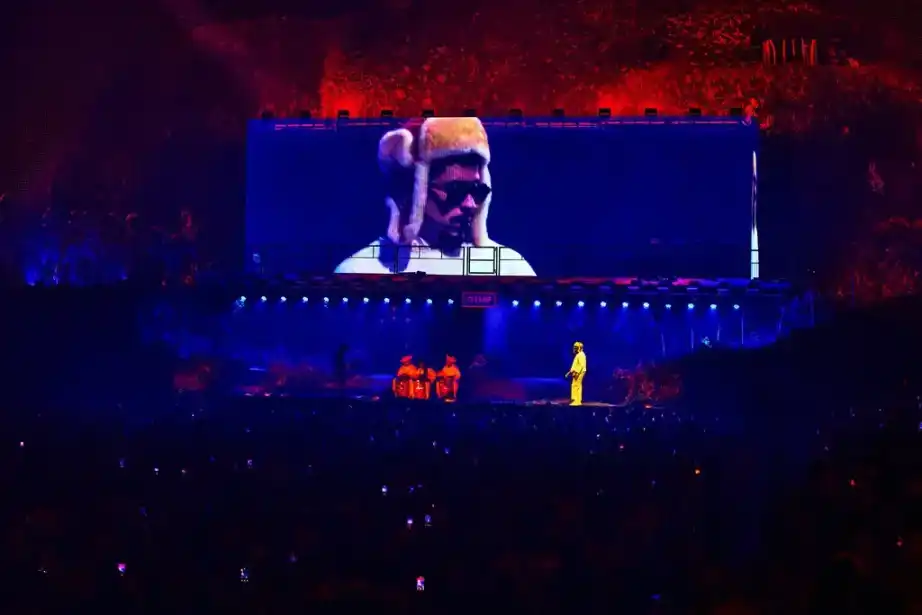
Bad Bunny performed in Puerto Rico last summer
Some people specialize in certain areas. Jonathan Zubkoff not only bets on political and weather events, but also built what he calls his "Rotten Tomatoes Bloomberg Terminal" — a custom data dashboard that integrates entertainment news sources and other relevant information. With this tool, he consistently predicts the Rotten Tomatoes score of movies each week. He said that even if someone were to replicate this dashboard, "I would bet that I process the information faster than anyone else."
For savvy traders, last year was a profitable one, and this year's outlook is even more promising. The various variables brought by Trump mean that the market is full of uncertainty, and also means that there are more topics to bet on. There is a group of political fanatics who, like Taylor Swift's fans, will bet on their idol no matter what. The attention to prediction markets has also seen explosive growth. According to blockchain media outlet The Block, Polymarket saw a record high of 491,000 monthly active traders last month. A large amount of newbie funds have entered the market, including both gamblers from other fields such as sports betting and regular people who enjoy placing bets.
Profitable Beyond the Web
From January 2022 to the present, Domer has earned $2.6 million on the Polymarket platform alone. Twenty years ago, just out of college, he made a living as a full-time online poker player, but he was frustrated by the illogical ups and downs in the game. "If you play the optimal strategy for 40 hours straight and still lose money in the end, you start to question life." You never know if your opponent is bluffing, so you can't analyze why you failed.
Once, while bored waiting for a poker game to end, he started thinking about what else he could bet on and stumbled upon the Irish platform Intrade, where you could bet on Oscar winners. He thought film critic Roger Ebert had a keen eye, and Roger Ebert had once said that in 2006, "Crash" should and would beat "Brokeback Mountain" to win the Oscar for Best Picture. Domer bet $10 on "Crash" to win and ended up earning $80. "This opened up a whole new world for me: I didn't know you could bet on this."
In 2008, Senator John McCain planned to announce his presidential running mate in Dayton, Ohio, Domer and a friend tracked all flights to a nearby airport. When they saw a flight coming from Alaska, they immediately placed a large bet that Sarah Palin would be the running mate, raking in a huge win. It was around that time that Domer gave up poker, fully dedicating himself to prediction market trading. He found this job to be less stressful and more logical.
Today, Domer has over 1000 unsettled bets at any time, involving a risk amount of over $2 million. He once wagered nearly $260,000 that Pope Leo would not become Time's Person of the Year, which also became his most profitable bet in 2025.

In a park near downtown Greenville, South Carolina, there is a trader named Domer
As the market size continues to grow and competition becomes fiercer, trading has become more time-consuming. Domer's trading desk is set up with four monitors and a TV, and he often orders Uber Eats. During the Israeli election, his schedule completely followed the rhythm of Israel's time zone.
In 2017, Domer met his current wife, who at the time could not imagine marrying someone leading this kind of life. Back then, the mainstream betting platforms were still Betfair and PredictIt, with fewer events available for betting, less competition, and smaller amounts of money involved. Kalshi and Polymarket hadn't even been established yet. "Imagine being married to someone like me, whose phone is constantly buzzing with notifications, various things that are distracting. We were just sitting down to dinner, and I might suddenly say, 'I need to go upstairs, Eric Adams just tweeted.'" The Eric Adams he mentioned is the former mayor of New York City.
He then said, in the chaotic election year of 2024, "I told her, 'Just wait until July, we'll go to Ireland and Basel, it will be so much fun,'" Basel is a city in Switzerland, "I've always wanted to go."
But at the end of June last year, U.S. President Joseph R. Biden Jr. performed poorly in a debate, triggering what Domer called the "biggest political betting event in history": Would Biden drop out? "I bet big on this." Ironically, in the weeks leading up to Biden's withdrawal, Domer was overseas "getting off the grid, touching grass," not deeply immersed in the frenzy of the "Will Biden drop out" bet, but holding a firm position, ultimately netting over $1 million.
Joel Holsinger, the mastermind behind the successful Turkey Pardon event bet, sees Domer as his role model, harboring the same dream. This month, Joel Holsinger's total profit has exceeded $144,000, and he is contemplating his next goal, perhaps $500,000.
He wanted to take on more risk in the transaction: "My win rate shouldn't be this high, which means I missed out on many opportunities to act."
Relying on citrus-flavored Zyn nicotine pouches and Celsius energy drinks to stay alert, Joel Holsinger is fully seizing the current opportunity. "My only thought now is: go all out, take the plunge."
Welcome to join the official BlockBeats community:
Telegram Subscription Group: https://t.me/theblockbeats
Telegram Discussion Group: https://t.me/BlockBeats_App
Official Twitter Account: https://twitter.com/BlockBeatsAsia