When the Traffic Dividend Peaks: Insights from the Annual Reports of Binance, OKX, and Huobi HTX, Exploring the Future of CEX Competition
If we were to summarize the competition among cryptocurrency exchanges over the past decade, the narrative has mainly revolved around transaction volume and listing speed, almost constituting the entire core of the traffic competition. However, as the crypto market matures, the competitive logic of centralized exchanges in 2026 is undergoing a transformation.
Looking through the annual reports of top platforms, competitive differentiation is particularly evident. On the one hand, the decline of the traffic dividend has become an industry consensus. The natural growth of the crypto user base has slowed down, the customer acquisition cost for new users continues to rise, relying solely on subsidies and trading rebates in exchange for transaction volume is becoming inefficient and unsustainable. On the other hand, regulatory normalization is reshaping the operational boundaries of centralized exchanges, where compliance costs, regional licenses, and asset transparency are gradually shifting from bonus points to entry tickets. Meanwhile, the asset supply cycle has significantly lengthened, whether it's a new public chain or a meme narrative, their outbreak frequency and duration are decreasing.
Relying on a user base of 300 million, Binance is attempting to reshape itself as the global standard for trading through licenses like ADGM. OKX, by deeply integrating with Web3 wallets and the CeDeFi market, emphasizes a 20-microsecond low latency and decentralized freedom of self-custody wallets at a technical level, trying to use technological determinism to combat market volatility.
In between the two extremes, Huobi HTX, in 2025, through a series of precise strategic moves, chose to return to the essence of trading, focusing on "asset discovery rights" and "smart trading tools," successfully establishing a new industry image of "long-termism."
Amid the industry's widely held belief that the traffic peak has been reached in the stock game period, Huobi HTX's market share growth ranks first among mainstream CEXs. According to Huobi HTX's annual report, in 2025, trading volume increased by 39% year-on-year, and new registered users increased by 85%. Observing its strategic trajectory alongside mainstream exchanges such as Binance and OKX can provide a clearer understanding—different CEXs are choosing vastly different user strategies: some are expanding broadly to the left, and some are deepening their focus to the right.
Refuse to be a bargain hunter, enter the market on the eve of consensus formation
With the emergence of on-chain DEXs and meme narratives, CEXs are facing a severe asset diversion crisis. In the era of traffic-driven growth, faced with new assets, CEXs have adopted a highly homogenized strategy, rushing for early access and competing in operational activities. However, after 2025, this logic began to show signs of fatigue. A large number of pump-and-dump projects quickly eroded user trust, and platforms instead need to bear the dual costs of liquidity depletion and user attrition.
In 2025, Binance's listing strategy tended more towards being a liquidity endpoint. Although its Alpha 2.0 brought in over $1 trillion in trading volume, its new coin listing review period was extremely long, taking on more of an amplifier role after the assets matured.
OKX focuses on the integration of Web3 wallets, guiding users to discover on-chain assets through its DEX aggregator.
Huobi HTX, on the other hand, provides users with continuous asset first issuance and early pricing through its rapid asset discovery capability. This means not waiting to go live until market consensus is formed, but rather accelerating consensus formation through early intervention. This addresses the pain point where users want to capture early on-chain alpha opportunities but do not want to endure the cumbersome on-chain operations.
In fact, Huobi HTX's strategy has shown a high degree of reflexivity on the asset side. In 2025, a total of 166 new coins were listed. The coin TRUMP, launched in January, saw a maximum increase of 10 times, while DONKEY, listed in May, rose by 69 times, M issued in July surged 42 times, and AI Meme PIPPIN released in November soared 95 times.
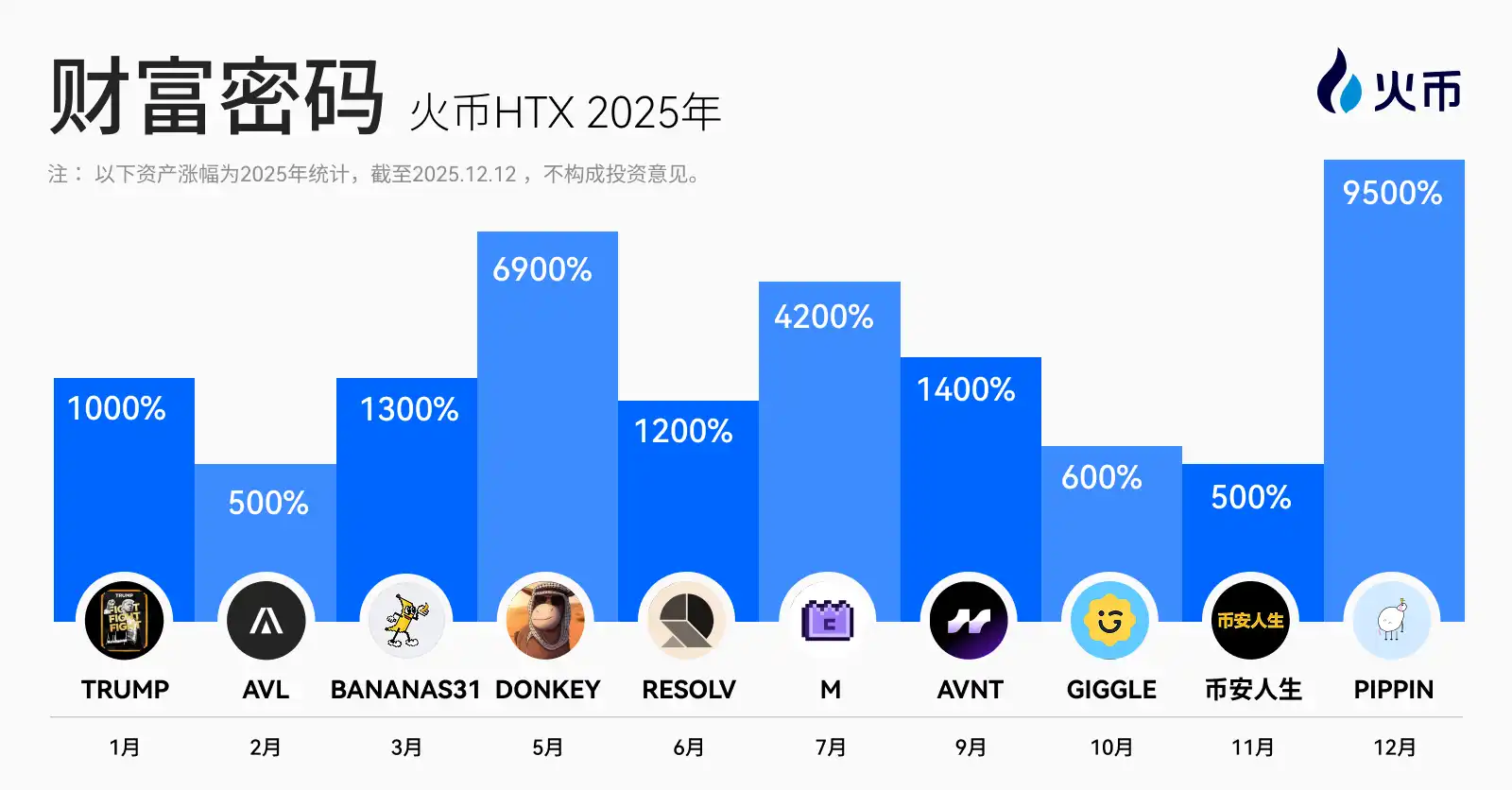
Huobi HTX has almost perfectly timed the eve of every Meme and niche track explosion. Moreover, beyond purely speculative assets, its initial launch of USD1 and WLFI, associated with the Trump family, demonstrates a keen sense of the narrative of compliant finance.
Retailers Institutionalization, the Survival Weapon of PVP Stock Market
As the new user dividend fades, retention has become one of the core metrics of CEXs. If the discovery of quality assets is the bait for CEX to attract users, then smart trading tools are the key to help CEX retain users. A simple matching engine is no longer enough to satisfy users; what users need is an intelligent solution that can help them profit from volatility and even execute trades automatically while asleep.
Facing the upgraded user demands, major platforms have added enhancements to the tool side, attempting to build differential advantages. Binance has launched multi-strategy trading bots and a deep API interface for institutions. OKX provides highly customizable strategy trading modules. KuCoin is trying to integrate an AI investment assistant to help users make investment decisions.
However, among the many CEXs, only Huobi HTX's investment in tool intelligence has received particularly significant market feedback, becoming the best example to observe trends in this race. In particular, a series of intelligent trading tools based on AI and automation, such as contract grid trading, contract grid 2.0, and contract 4.0, have further enhanced user trading experience and efficiency.
According to data released by Huobi HTX, in 2025, the trading volume of its spot trading bots increased by 97% year-on-year, while stablecoin grid trading volume surged by 352%. This exponential growth illustrates a fact: faced with market uncertainty, ordinary users are no longer satisfied with manual chasing highs and lows but are starting to use strategy tools to combat volatility. The evolution of tools has enabled retailers to have trading capabilities similar to institutions; retail investors are undergoing institutionalization transformation, further strengthening PvP capabilities.
The effectiveness of the Huobi HTX strategy lies in the fact that its tool design does not pursue extreme complexity, but rather lowers the barrier to entry. Through tools such as Grid Trading, Martingale, and Smart Follow, Huobi HTX effectively empowers retail investors with quasi-institutional trading capabilities. Particularly, the high proportion of its contract cross-margin mode means that users can optimize fund allocation between different positions, greatly improving fund efficiency.
In other words, the stickiness brought by the product power of Huobi HTX, compared to simply competing on fees, enables users to make money even in a volatile market, making this ability the platform's deepest moat.
Surviving the Black Swan: Where Smart Money Went
Security and compliance are the baseline for all trading platforms, and also the most difficult-to-perceive slow variable.
Against the backdrop of the industry experiencing several hacking attacks and trust crises in 2025, funds often flowed to the safest havens. In 2025, Huobi HTX maintained a 0 security incident record, kept its reserve ratio above 100% in the long term, and continued to disclose information through the publication of Merkle Tree Asset Proofs. Data shows that the USDT reserve scale of Huobi HTX grew by approximately 150% throughout the year, increasing from about 695 million coins at the beginning of the year to 1.765 billion coins by year-end, indicating that during the industry reshuffle, a large amount of funds flowed into Huobi HTX for hedging and custody.
Furthermore, Huobi HTX has steadily promoted its global compliance layout, having formally obtained the No Objection Certificate (NoC) from the Pakistan Virtual Asset Regulatory Authority (PVARA) during the year, becoming one of the first two global digital asset platforms to meet the conditions for applying for a virtual asset license in Pakistan, and accelerating license applications in the Middle East and Australia. To further enhance the sense of fund security for institutional users, Huobi HTX has integrated offline settlements with top custodians such as BitGo and Fireblocks.
It can be said that both zero incident data and progress in fund reserves and compliance have provided a solid endorsement for Huobi HTX's long-termism image. Binance also emphasizes transparency and regulation, with its report pointing out the enhancement of governance and risk management under the ADGM regulatory framework, while significantly reducing the risk of illegal funds on a global scale and offering convenient services to legitimate users. Overall, Huobi HTX, OKX, and Binance have responded to users' demands for security and compliance with tangible results.
True Growth Comes from Respecting Time
After experiencing several rounds of intense volatility and narrative shifts, the crypto industry is entering a new stage. In its "2026 Year Opening Report," Huobi HTX made an accurate judgment on industry trends, indicating that the industry is transitioning from a "fast variable" period dominated by price speculation to a "slow variable" stage that focuses more on security, liquidity, and long-term value.
The market no longer rewards the fastest response time, but is beginning to reassess those platforms that can sustainably deliver value over time.
In a time where traffic is no longer cheap and trust requires time accumulation, all shortcuts have become ineffective. Binance has moved towards building a large and comprehensive financial empire, OKX towards a technology-driven geek fortress, while Huobi HTX, through a combination of "asset discovery," "smart tools," "security and compliance," and "community building," has always positioned itself closest to real trading opportunities and closest to user core needs. Unlike traditional one-way management, Huobi HTX considers the community and users as the platform's most core digital assets. Through the flexible service of the "IP Customer Service Team" and the decentralization of governance rights through HTX DAO, the platform has achieved a logical transition from serving users to user co-governance.
As Huobi HTX Global Advisor Justin Sun has said, "a day, a building," its growth logic does not come from a single burst, but from a structural advantage formed by long-term accumulation.
Amidst the continuous emergence of industry narratives, Huobi HTX has not chosen to continually expand the boundaries of new concepts, but has repositioned its strategic map on the three most basic yet long-term deterministic core scenarios: spot, derivatives, and C2C.
On the spot side, Huobi HTX is consciously driving value back. Unlike the early listing logic mainly driven by traffic and emotions, its asset selection is gradually focusing on tracks such as RWA and PayFi with real business models and long-term demand. This change means that spot trading is no longer just an entry point for short-term speculation, but plays a dual role of asset discovery and value screening.
The evolution of the derivatives market more clearly reflects Huobi HTX's understanding of risk and time. The derivatives market has long been seen as an emotional amplifier with high volatility and high elimination rates, but in the 2026 strategic plan, Huobi HTX chooses to redefine the use of derivatives trading through an intelligent copy trading system and a multi-currency margin system. Through fund subsidies and risk control mechanism designs including the "Common Destiny Plan," its goal is not to stimulate higher-frequency speculation, but to provide traders with greater room for error in extreme market conditions, gradually returning derivatives to the essential nature of risk management tools.
In contrast, the strategic significance of the C2C scenario is often the most underestimated but best able to test a trading platform's true commitment to long-termism. In this area, Huobi HTX continues to advance the acceptance system centered on the "Selection Station," attempting to fundamentally address the industry's long-standing trust gap issue through outstanding records of zero freezes throughout the year and a "100% full compensation" mechanism.
Alpha capture from spot, amplifying gains through tools like leverage, and finally exiting securely through acceptance. The CEX competition in 2026 may no longer be a battle of traffic, but a competition of 'certainty'. Binance has chosen breadth, OKX has chosen technology, and Huobi HTX has chosen the purest trading experience — getting users a little closer to 'earning' at every step.
Welcome to join the official BlockBeats community:
Telegram Subscription Group: https://t.me/theblockbeats
Telegram Discussion Group: https://t.me/BlockBeats_App
Official Twitter Account: https://twitter.com/BlockBeatsAsia