Arthur Hayes: Why Bitcoin Will Underperform Gold and the NASDAQ in 2025?

Original Article Title: Frowny Cloud
Original Article Author: Arthur Hayes, Co-Founder of BitMEX
Original Article Translation: Bitpush News
(Disclaimer: All views expressed in the article are solely those of the author and should not be taken as investment advice or as a recommendation to engage in investment transactions.)
All the deities I worship have taken the form of adorable plush toys.
During the prime skiing season in Hokkaido in January and February, I would pray to the "Frowny Cloud," the deity in charge of snowfall. The local climate dictates that during the peak of the snow season, snowflakes fall incessantly almost day and night, with hardly a glimpse of the sun. Fortunately, I also pray to the god of vitamins — a cute little horse plush toy — who bestows upon me Vitamin D3 tablets and various other blessings.
While I love snow, not all snow is high-quality and safe. The carefree and exhilarating skiing experience I enjoy requires a specific type of snow: low wind speed at night, with temperatures between -5 to -10 degrees Celsius. Under these conditions, new snow can effectively bond with old snow, creating bottomless powder snow. During the day, the frown cloud blocks specific wavelengths of sunlight, preventing south-facing slopes, among others, from being "baked" which could lead to potential avalanches.
Sometimes, the Frowny Cloud abandons us fearless skiers at night. Cold, clear nights cause the snowpack to undergo warming and cooling, leading to "layering," creating a persistent weak layer. This phenomenon persists in the snowpack for an extended period, and once triggered by the energy transfer due to a skier's weight, it can cause deadly avalanches.
As always, the only way to understand what kind of snow layer Frowny Cloud has created is through studying history. On the slopes, we conduct studies by digging massive pits and analyzing the different types of snow that have fallen over time. But since this is not an article on avalanche theory, our approach in the market is to study charts and the interactions between historical events and price movements.
In this article, I aim to explore the relationship between Bitcoin, gold, stocks (especially U.S. tech giants in the Nasdaq 100 index), and U.S. dollar liquidity.
Those who are gold bugs or part of the financial establishment wearing Hermès scarves and red-soled shoes (who firmly believe in "buying and holding stocks long-term" — my GPA wasn't high enough at the Wharton School to get into Professor Siegel's class) (Bitpush Note: Jeremy Siegel is a prominent figure at the Wharton School, one of Wall Street's most respected economists) are ecstatic about Bitcoin becoming the worst-performing mainstream asset by 2025.
These gold bugs have been mocking Bitcoin enthusiasts: since Bitcoin is touted as a vote against the existing order, why hasn't its performance matched or exceeded that of gold? Those filthy fiat currency stock pushers have also sneered: Bitcoin is nothing but Nasdaq's "high beta" (high-risk) plaything, yet in 2025 it hasn't even kept up, so why consider cryptocurrency in asset allocation?
This article will present a series of exquisite charts, accompanied by my annotations, to untangle the interrelationships of these assets.
I believe Bitcoin's performance is entirely as expected.
It has followed the tide of fiat currency liquidity downward — especially dollar liquidity, as the credit pulse of the "American Peace" (Pax Americana) is the most important force in 2025.
Gold's surge is because price-insensitive sovereigns are madly hoarding, fearing staying in U.S. treasuries will be looted by America (as Russia experienced in 2022).
The recent U.S. actions against Venezuela will only further strengthen the desire of nations to hold gold rather than U.S. debt. Lastly, the AI bubble and its related industries will not disappear. In fact, Trump must double down on national support for AI as it is the biggest contributor to imperial GDP growth. This means that even as the pace at which dollars are created slows, Nasdaq can continue to rise because Trump has essentially "nationalized" it.
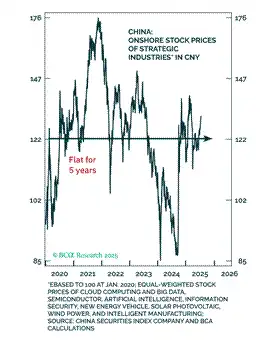
If you look at China's capital markets, you will see that stocks perform very well in the early stages of nationalization but then massively underperform as political objectives take precedence over capitalists' returns.
If the price movements of Bitcoin, gold, and the stock market in 2025 confirm my market architecture, then I can continue to focus on the fluctuations in dollar liquidity.
To remind readers, my prediction is: Trump will insanely inject credit to make the economy "roaring hot." A booming economy helps the Republicans win in the November elections this year. With central bank balance sheet expansion, commercial banks extending loans to "strategic industries," and mortgage rates declining due to money printing, dollar credit will expand massively.
In conclusion, does this mean I can continue to "surf" carefreely — that is, deploy aggressively what I've earned in fiat currency and maintain maximum risk exposure? I leave it to the audience to judge.
A Bird's Eye View Graph
First, let's compare the returns of Bitcoin, gold, and Nasdaq in the first year of Trump's second term. How did the performance of these assets compare to the changes in dollar liquidity?
I will explain in more detail later, but the basic assumption is: if the US dollar liquidity decreases, these assets should also fall accordingly. However, gold and the stock market have risen. Bitcoin performed as expected: as poorly as dog feces. Next, I will explain why gold and the stock market are able to rise against the trend in US dollar liquidity reduction.
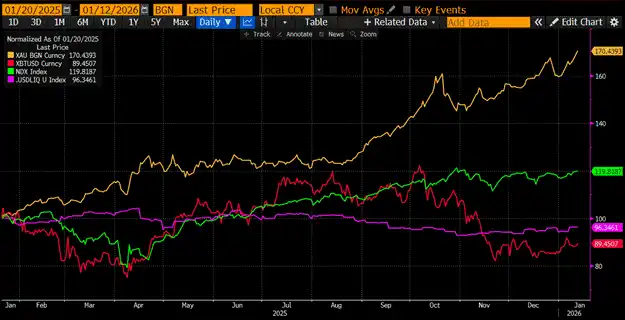
[Chart: Bitcoin (red), Gold (gold), Nasdaq 100 (green), and US Dollar Liquidity (purple) comparison]
All That Glitters Isn't Necessarily Gold, But Gold Is Indeed Glittering
My cryptocurrency journey started with gold. In 2010 and 2011, as the Federal Reserve ramped up quantitative easing (QE), I started buying physical gold in Hong Kong. Although the absolute amount was pitifully small, the proportion of my net worth at the time was astonishingly high.
Eventually, I learned a painful lesson about position management as I had to sell my gold at a loss to buy Bitcoin for arbitrage in 2013. Luckily, it turned out well. Nevertheless, I still hold a significant amount of physical gold coins and bars in vaults around the world, and my stock portfolio is also dominated by gold and silver mining stocks. Readers may wonder: since I am a devout follower of Satoshi Nakamoto, why do I still hold gold?
I hold gold because we are in the early stages of global central banks selling US Treasuries and buying gold. Furthermore, countries are increasingly using gold to settle trade imbalances, even when analyzing the US trade deficit.
In short, I buy gold because central banks are buying. Gold, as the true currency of civilization, has a history of 10,000 years. Therefore, no important central bank reserve manager will store Bitcoin in a system currently distrustful of the US dollar; they are and are buying gold. If the proportion of gold in global central bank reserves returns to the level of the 1980s, the price of gold will rise to $12,000. Before you think I'm being delusional, let me prove it to you in a tangible way.
In a fiat currency system, the traditional view of gold is as an inflation hedge tool. Therefore, it should roughly track the CPI index manipulated by the empire. The chart above shows that since the 1930s, gold has roughly followed that index. However, since 2008 and accelerating after 2022, the rate of increase in the gold price far exceeds inflation. So, is gold in a bubble, ready to harvest gamblers like me?
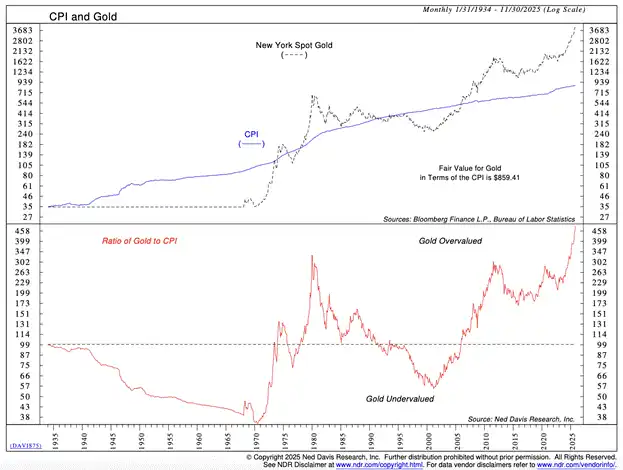
[Chart: Gold Price vs. US CPI]
If gold were in a bubble, retail investors would flock to it. The most popular way to trade gold is through ETFs, with GLD being the largest. When retail investors buy gold feverishly, the circulating shares of GLD increase. To compare across different time periods and gold price systems, we must divide GLD's circulating shares by the physical gold price. The chart below shows that this ratio is decreasing rather than increasing, indicating that true gold speculation frenzy has yet to arrive.
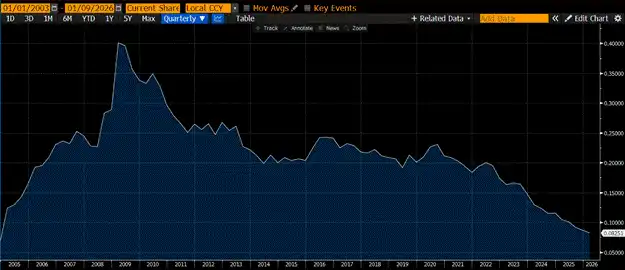
[Chart: GLD Circulating Shares Divided by Gold Spot Price]
If it's not retail investors driving up the gold price, who are those insensitive buyers? They are central bank governors from around the world. In the past two decades, there have been two crucial moments that made these people realize that the US dollar is only fit for toilet paper.
In 2008, US financial bigwigs created a global deflationary financial crisis. Unlike in 1929 when the Fed stood by without intervention, this time the Fed went against its obligation to maintain the purchasing power of the dollar, frantically printing money to "rescue" specific large financial players. This marked a turning point in the sovereign holdings of US debt and gold.
In 2022, President Biden shocked the world by freezing a significant amount of US debt held by a country with a massive nuclear arsenal and the world's largest commodity exporter (Russia). If the US is willing to disregard Russia's property rights, it can do the same to any country that is weaker or less resource-rich. Not surprisingly, other countries can no longer comfortably increase their exposure to US debt facing the risk of confiscation. They began accelerating gold purchases. Central banks are insensitive buyers. If the US president steals your money, your assets are immediately worth zero. Since buying gold eliminates counterparty risk, what does a higher price matter?
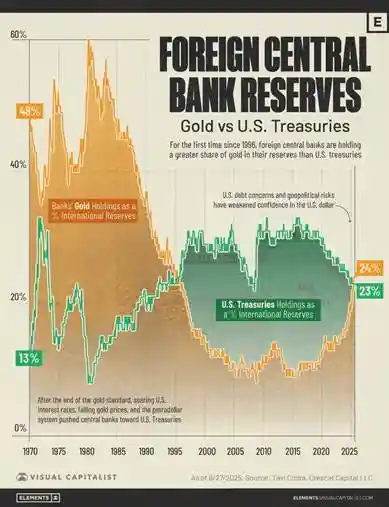
The fundamental reason why sovereign nations have an insatiable appetite for this "barbaric relic" is that an increasing amount of net trade settlements are being conducted through gold. The record contraction in the US trade deficit in December 2025 is evidence of gold reclaiming its position as the global reserve currency. In the change of the US net trade balance, over 100% is attributed to gold exports.
“According to data released by the US Department of Commerce on Thursday, the goods trade deficit decreased by 11% from the previous month to $52.8 billion. This reduced the deficit to its lowest level since June 2020… August exports grew by 3% to $289.3 billion, driven mainly by non-monetary gold.” — Source: Financial Times
Gold's flow path is as follows: the US exports gold to Switzerland, where it is refined and recast before being shipped to other countries. The following graph shows that mainly China, India, and other emerging economies that manufacture physical goods or export commodities have been purchasing this gold. These physical goods eventually flow to the US, while the gold flows to more productive regions in the world.
When I talk about “productivity,” I'm not referring to these places being better at writing verbose reports or tagging emails with complex signatures, but rather that they export energy and other critical industrial goods, their people make steel and refine rare earths. Gold continues to rise even as US dollar liquidity declines because sovereign nations are accelerating the restoration of a global gold standard.
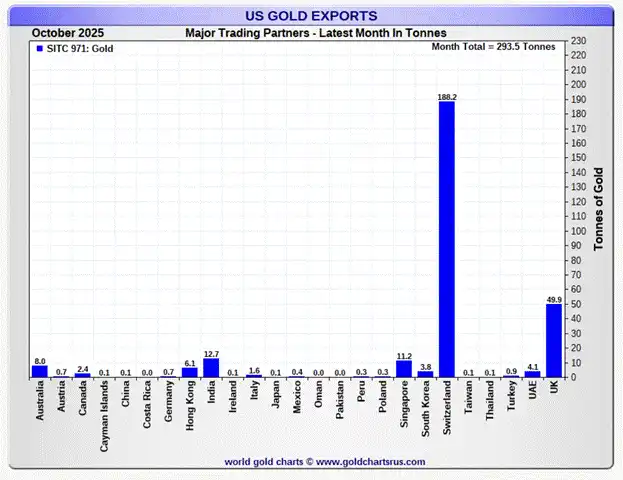
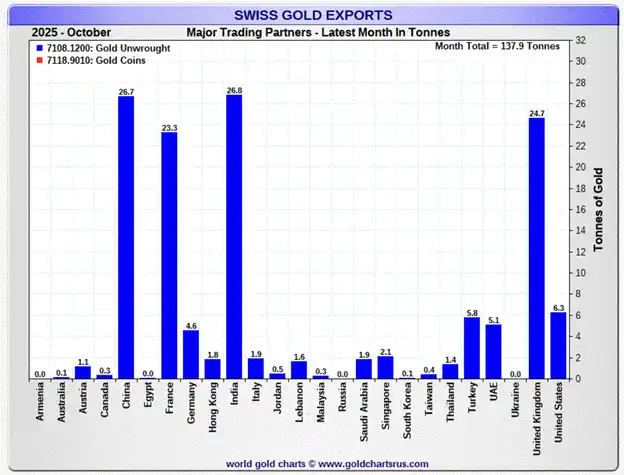
[Chart: International Gold Import/Export Flow]
Long-Termists Favor Liquidity
Every era has its soaring tech stocks. In the roaring US bull market of the 1920s, radio manufacturer RCA was the tech darling of the time; in the 1960s to 1970s, IBM making new large computers took the spotlight; and today, AI hyperscale service providers and chip manufacturers are all the rage.
Humans are naturally optimistic. We are eager to predict a brilliant future: every dollar spent by tech companies today will bring a social utopia tomorrow. To materialize this vision in the minds of investors, companies burn cash and take on debt. When liquidity is cheap, betting on the future becomes easy. Therefore, investors are happy to splurge cheap cash today to buy tech stocks, banking on the opportunity for future massive cash flows, thus driving up the price-earnings ratio. Hence, in a period of excess liquidity, tech growth stocks skyrocket exponentially.
Bitcoin is currency technology. The value of this technology is only relative to the depreciation of fiat currency. The advent of Proof of Work (PoW) blockchain is remarkable, guaranteeing that Bitcoin's value is greater than zero. However, to drive Bitcoin's value close to $100,000, continuous devaluation of fiat currency is required. Bitcoin's asynchronous growth is a direct result of the explosive growth in the US dollar supply post the 2008 global financial crisis.
Therefore, I say: as the U.S. dollar liquidity expands, both Bitcoin and the Nasdaq will rise.
The only current point of contention is the recent deviation between the price of Bitcoin and the Nasdaq.
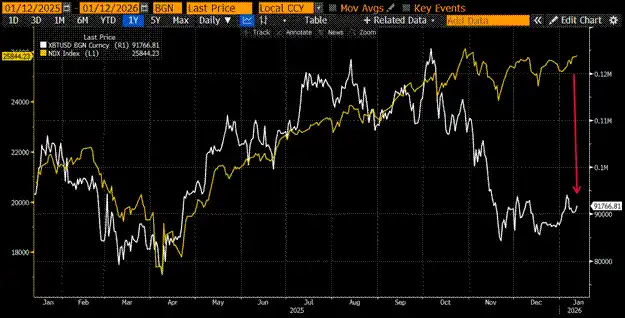
[Chart: Bitcoin vs. Nasdaq Price Trends]
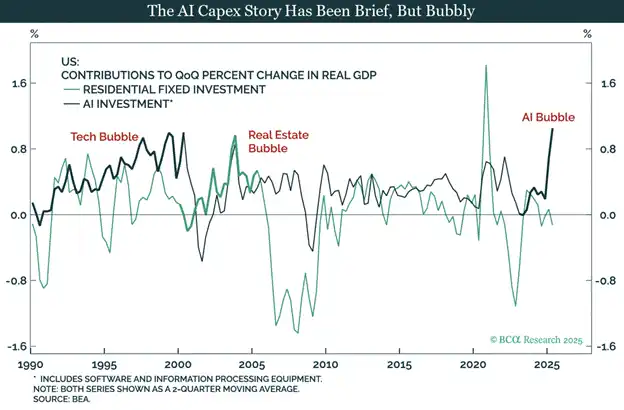
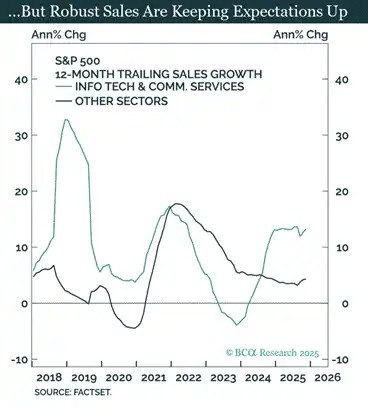
My theory on why the Nasdaq did not experience a pullback in 2025 along with the U.S. dollar liquidity is this: AI has been “nationalized” by both the U.S. and China.
The AI titans have sold the world's two leaders on the idea that AI can do it all. It can drive labor costs to zero, cure cancer, boost productivity, and most importantly, establish global military dominance. Therefore, whichever country “wins” the AI race rules the world. China bought into this long ago, aligning perfectly with its five-year plan.
In the U.S., this analysis is a novelty, but industrial policy is as deeply rooted as in China, just marketed differently. Trump drank the AI “Kool-Aid,” making “winning the AI competition” a cornerstone of his economic agenda. The U.S. government has essentially nationalized any part deemed essential to “winning.” Through executive orders and government investments, Trump is blunting market signals, causing capital to flow into AI-related areas regardless of returns. That's why the Nasdaq decoupled from Bitcoin and the U.S. dollar liquidity decline in 2025.
[Chart: Nasdaq vs. U.S. Dollar Liquidity Decoupling]
Whether there is a bubble or not, spending to “win” at AI is driving the U.S. economy. Trump vowed to keep the economy running hot and cannot afford to stop just because the ROI on these expenditures might fall below the cost of capital in a few years.
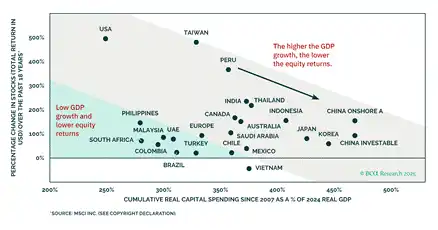
U.S. tech investors should proceed with caution. Industrial policies aimed at “winning at AI” are a fantastic way to burn cash. Trump (or his successor) will have political goals diverging from the interests of strategic corporate shareholders. This is a lesson Chinese stock investors have learned the hard way. As Confucius said, “Study the past if you would define the future.” Clearly, given the Nasdaq's stellar performance, this lesson has yet to be learned by American investors.
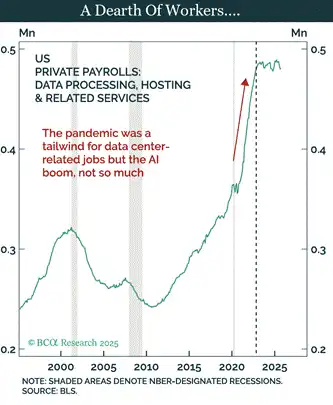
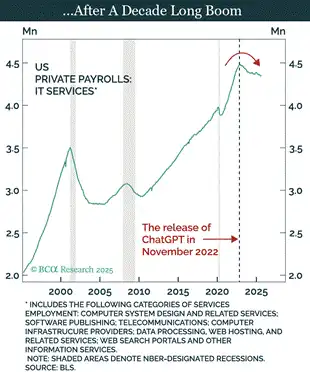
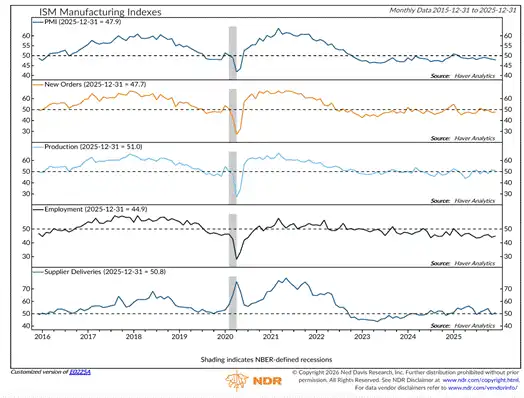
[Chart: US PMI vs. Economic Growth Data]
A PMI reading below 50 indicates contraction. Not all GDP growth has led to a manufacturing renaissance. Thought Trump was for the white working class? No, buddy, Clinton sold your job to China, Trump brought back the factories, but now the factory floor is all Musk-owned AI robot arms. Sorry, you got played again! However, US Immigration and Customs Enforcement (ICE) is hiring (hell of a joke)!
These charts clearly show that the NASDAQ's rise is government-supported. Therefore, even with overall weak US dollar credit expansion, the AI industry will have all the capital it needs to "win." The NASDAQ has thus decoupled and outperformed Bitcoin. I don't think the AI bubble is ready to burst. This extraordinary performance will continue to be a feature of global capital markets until it isn't anymore, or most likely until the Blue Team loses the House in 2026 (as predicted by Polymarket). If the GOP is "The Jetsons" (the tech crowd), then the Democrats are "The Flintstones" (the retro crowd).
If both gold and the NASDAQ have momentum, how will Bitcoin regroup? US dollar liquidity must expand. Clearly, I believe this will happen in 2026, so let's discuss how to make it happen.
Igniting the Economy
As I said at the beginning, the three pillars supporting this year's dramatic expansion in US dollar liquidity are:
· The Fed's balance sheet will expand due to money printing.
· Commercial banks will lend to strategic industries.
· Mortgage rates will decrease due to money printing.
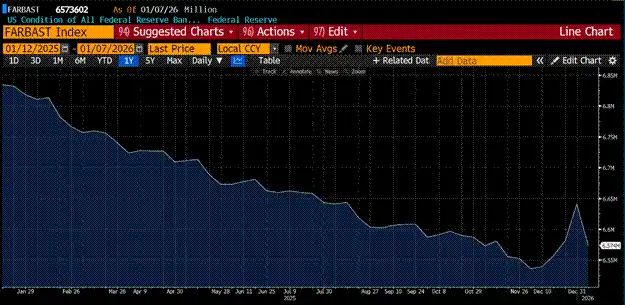
[Chart: Federal Reserve Balance Sheet Size]
The Federal Reserve's balance sheet contracted in 2025 due to Quantitative Tightening (QT). QT concluded in December, initiating a new money printing program called "Reserve Management Purchases" (RMP) at that month's meeting. I have discussed this extensively in a previous article. The chart clearly shows the bottoming out of the balance sheet in December. RMP injects a minimum of $400 billion monthly, with its scale set to expand as funding needed to support the U.S. government increases.
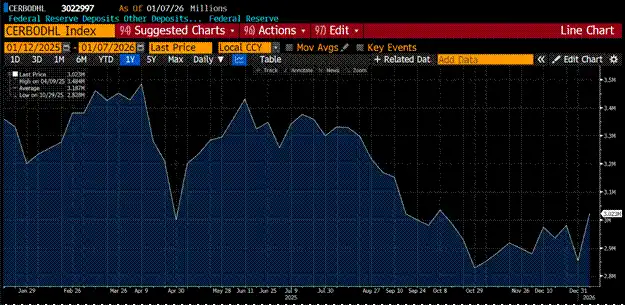
[Chart: U.S. Bank Loan Growth (ODL)]
The above chart depicts the Fed's indicator for Bank Loan Growth (ODL). Starting in the fourth quarter of 2025, banks have been issuing more loans. When a bank issues a loan, it creates deposits out of thin air, effectively creating money. Banks like JPMorgan Chase are eager to lend to government-supported businesses. JPMorgan Chase has launched a $1.5 trillion loan program for this purpose. The process goes like this: the government invests in a company, the bank sees reduced default risk with government backing and is willing to create money to fund that strategic industry. This is precisely what China has been doing. The credit creation has shifted from the central bank to the commercial banking system, with a higher initial money multiplier, thus generating supra-trend nominal GDP growth.
The U.S. will continue to showcase its might, with the production of weapons of mass destruction requiring financing from the commercial banking system. This is why bank credit growth will see a structural rise in 2026.
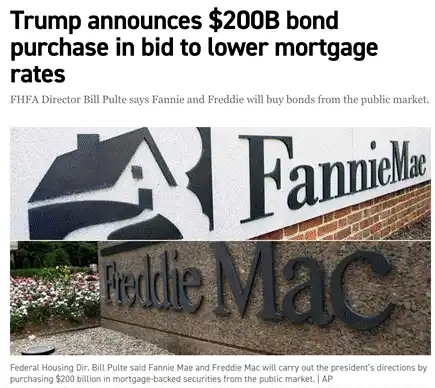
Trump is a real estate developer who knows how to finance properties. His new directive is for Fannie Mae and Freddie Mac ("the two houses") to utilize capital on their balance sheets to purchase $200 billion in Mortgage-Backed Securities (MBS). This represents a net increase in U.S. dollar liquidity. If successful, Trump won't stop there. By lowering mortgage rates to boost the housing market, Americans will be able to tap into home equity through cash-out refinances. This wealth effect will leave voters in a good mood on election day, supporting the Republican Party instead. More importantly, this creates more credit to purchase financial assets.
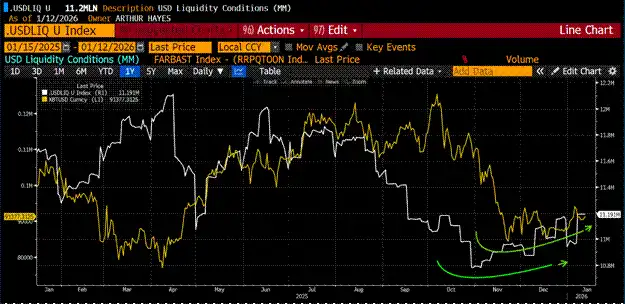
[Chart: Bitcoin and USD Liquidity Bottom Convergence Chart]
Bitcoin and USD liquidity bottomed almost simultaneously. As USD liquidity rapidly expands for the reasons stated above, Bitcoin will take off with it. Forget about 2025 performance; that was due to illiquidity.
Trading Strategy
I am a hardcore speculator. Despite my fund Maelstrom being almost fully invested, I want to increase risk exposure further as I am extremely bullish on USD liquidity growth. Hence, I am gaining leveraged exposure to Bitcoin by longing MicroStrategy (MSTR) and Metaplanet (3350 JT) without dealing with complex options or perpetual contracts.
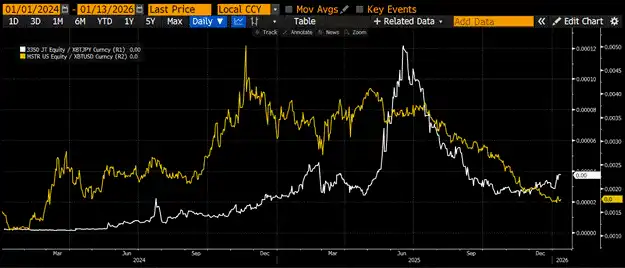
[Chart: MSTR and Metaplanet Price Ratio to Bitcoin]
I have divided the stock prices of these two companies by the Bitcoin price, and they are currently at the bottom of their two-year range.
If Bitcoin can reclaim $110,000, investors will be tempted to long Bitcoin via these instruments. Given the leverage embedded in the balance sheets of these corporate entities, their performance on the upside will far exceed that of Bitcoin.
Furthermore, we continue to accumulate Zcash (ZEC). The departure of ECC developers is not bearish; I believe they can deliver more impactful products within their for-profit entity. I am grateful for the opportunity to buy discounted ZEC from the "weak hands."
Onward, crypto adventurers. This world is fraught with danger, so stay vigilant. May peace be with you all— and, pray to the "Sad Cloud Fairy."
Welcome to join the official BlockBeats community:
Telegram Subscription Group: https://t.me/theblockbeats
Telegram Discussion Group: https://t.me/BlockBeats_App
Official Twitter Account: https://twitter.com/BlockBeatsAsia

 Related Articles