a16z Raises $15 Billion in New Funds: Long Criticized, How Did It Become the "Best Storyteller" in Venture Capital?
Original Title: a16z: The Power Brokers
Original Source: Not Boring
Original Translation: Saoirse, Foresight News
Editor's Note: This article is written by Packy McCormick, the founder of Not Boring Capital and current a16z crypto advisor. The article focuses on the venture capital giant a16z, leveraging the opportunity of its newly raised $15 billion fund to dig deep into its "non-traditional venture capital" core — laying out the future with an engineer's mindset and betting on high-potential companies (such as Databricks) with unwavering conviction. The article intersperses performance data and classic cases, dissecting its advanced logic from startups to managing over $90 billion in assets. If you want to understand how this "tech believer" is reshaping industry rules, it's worth delving into the article.
When a16z announced the $15 billion new fund, the entire venture capital circle was once again stirred up — some questioning its model after many years, some curious about where this money will flow.
In order to understand this constantly controversial institution, I chatted with its GPs (General Partners) and LPs (Limited Partners), deep-dived with founders of post-investment companies valued at over $200 billion, and combed through its fund return data since its inception.
But rather than fussing over "where a16z went wrong," I am more interested in asking: What are those smart people who have always been able to make the right judgments in the past really aiming at now? Of course, I must admit, I was once an a16z crypto advisor, listed alongside key figures as a shareholder, so I am not a completely objective observer.
But I don't want to judge whether this $15 billion investment is worth it — institutional LPs have already voted with real money, and the answer will not be revealed until ten years later. I want to show you why a16z can become the "best storyteller" in the venture capital circle? What kind of unconventional ambition is hidden in its vision of the future?
"I live in the future, so the present is my past. My presence is a present, kiss my ass."
—Kanye West, "Monster"
"Too ostentatious," "Should speak less and do more in politics," "Don't agree with one or two recent investment projects," "Using the Pope's words to launch a social platform is inappropriate," "With a fund size so large, it's impossible to bring reasonable returns to LPs"...
These voices, a16z has been listening to for nearly 20 years.
For example, in 2015, New Yorker writer Tad Friend, in his piece "Tomorrow's Advance Man," had breakfast with Marc Andreessen (co-founder and general partner at a16z). Prior to that, Friend had just heard skepticism from a peer VC: a16z's fund size was too large but its ownership percentage was too low [1], to achieve 5-10x total returns for the first four funds, the portfolio's total valuation would need to reach $240-480 billion.
Friend wrote in the article: "As I tried to fact-check these numbers with Andreessen, he made a dismissive gesture, saying, 'Nonsense. We have a full deck model—we are here to hunt elephants, go after whales!'
Remember this scene, as you may have similar doubts next, and Andreessen will most likely have the same reaction."
Today, a16z announces that all its investment strategies have raised a total of $15 billion, surpassing $90 billion in Regulatory Assets Under Management (RAUM).
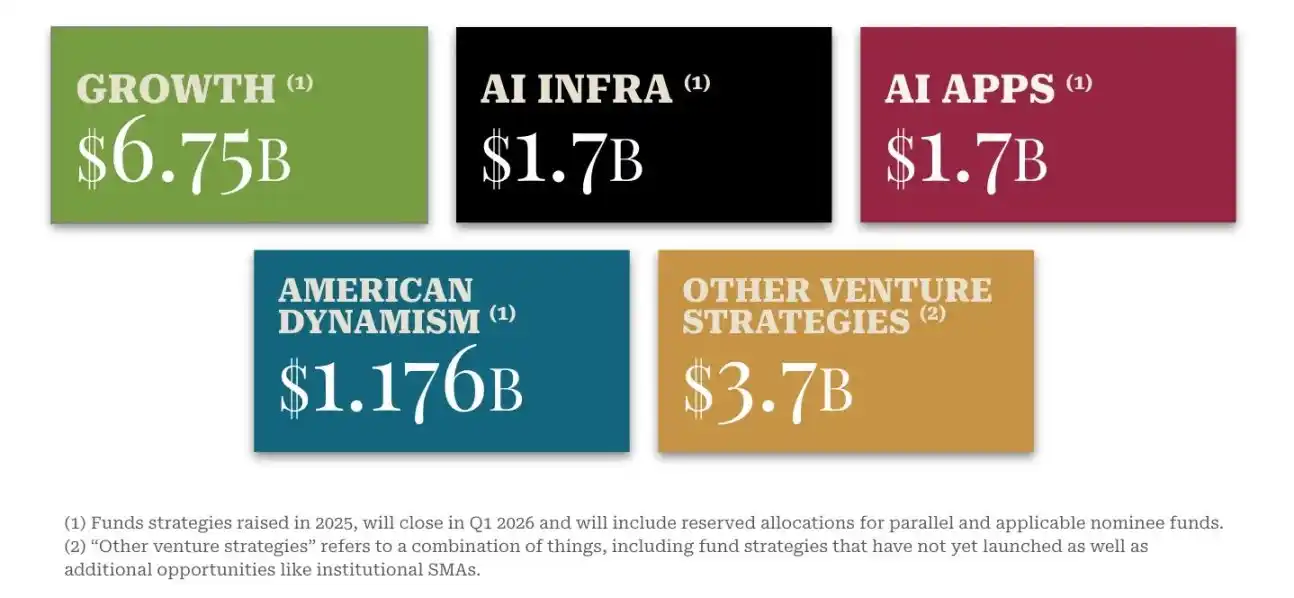
a16z Funds' Strategies and Corresponding Fund Sizes Raised in 2025
In 2025, the VC fundraising market was dominated by a few top institutions, and a16z's fundraising amount exceeded the combined total raised by second-ranked Lightspeed ($9 billion) and third-ranked Founders Fund ($5.6 billion) [2].
In the worst VC fundraising environment in nearly five years, a16z's 2025 fundraising amount accounted for over 18% of the total VC fundraising in the U.S. [3]. Typically, a VC fund takes an average of 16 months to complete fundraising, whereas a16z took just over three months from start to finish.
Breaking it down, a16z had four funds make it to the "Top 10 Fundraising in 2025 across all industries": Late-Stage Venture Fund LSV V ranked second, AI Infrastructure Fund X and AI Application Fund X tied for seventh, and the "U.S. Thrive Fund" AD II ranked tenth.
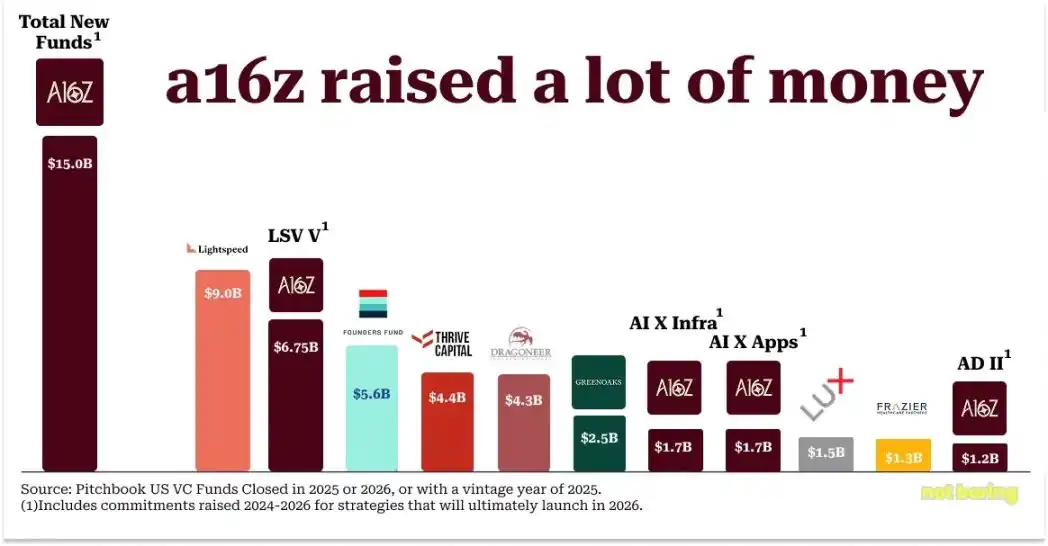
Comparison of Fundraising Scale of US Venture Capital Firms in 2025-2026
Some may say, with so much money, venture capital firms simply cannot allocate it sensibly to achieve outsized returns. But I guess a16z's response would probably be: "Nonsense." After all, they have always been about "Hunting Elephants, Chasing Whales"!
Today, among all of a16z's funds, its portfolio includes 10 of the "Top 15 Private Companies by Valuation": OpenAI, SpaceX, xAI, Databricks, Stripe, Revolut, Waymo, Wiz, SSI, and Anduril.
Over the past decade, a16z has invested in 56 unicorn companies through its funds, surpassing any other institution in the industry.
The total valuation of unicorn companies in its AI portfolio accounts for 44% of the entire industry [6], also ranking first.
From 2009 to 2025, a16z led early-stage rounds for 31 "eventually valued over $5 billion companies," 50% more than the sum of the second and third-ranked institutions.
They not only have a full set of models, but now they also have solid performance to back it up.
As mentioned earlier, peers once questioned whether the combined valuation of a16z's first four funds needed to reach $240-480 billion to meet the mark. The fact is, the total valuation of a16z's Funds I-IV (based on exit or latest post-money valuation) has already reached $853 billion [7].
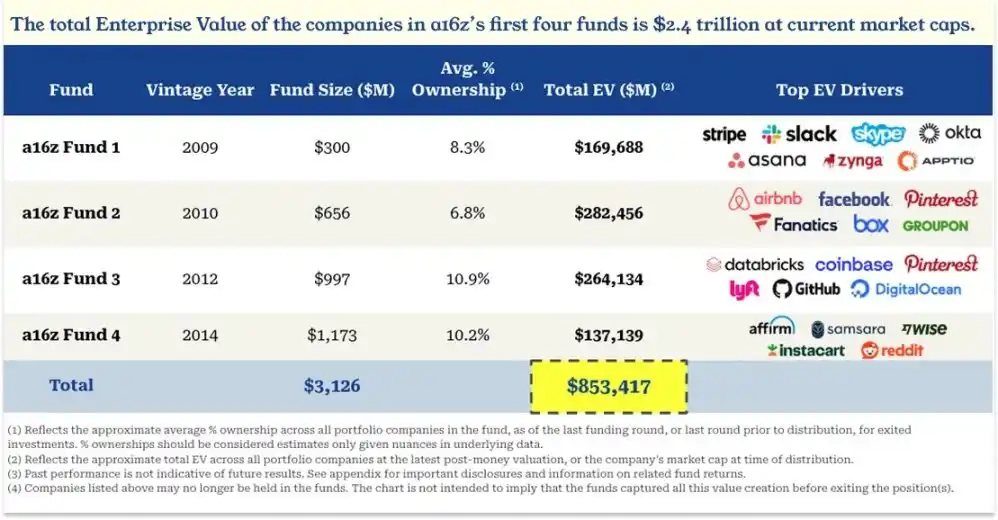
Total Investment Portfolio Value of a16z's First Four Funds
And this is just the exit valuation—only Facebook alone added another $15 trillion to its market value later!
This kind of plot unfolds repeatedly: a16z makes a seemingly crazy bet on the future, industry insiders call it "stupid," but a few years later, they realize it wasn't stupid at all!
After the global financial crisis of 2009, a16z raised its $300 million Fund I and introduced the concept of "providing operational support platform for founders." Ben Horowitz (a16z's Co-Founder and General Partner) recalled: "We talked to many VC peers, most of them said it was a dumb idea, advised us not to do it, and even said this model had been tried before and simply wouldn't work." And today, almost all top VCs have similar platform teams.
In 2009, a16z pulled $65 million from this fund to join Silver Lake and other institutions in a $2.7 billion acquisition of Skype from eBay. At that time, "everyone said this deal wouldn't happen because the intellectual property risk was too great" — after all, during the transaction, eBay was in a legal battle with Skype's founders over the technology ownership. In less than two years, Microsoft acquired Skype for $8.5 billion, and Ben reminisced about the doubts in a blog post [8].
In September 2010, Marc and Ben raised a $650 million Fund II, then made large late-stage investments in companies like Facebook ($50 million, post-money valuation of $34 billion), Groupon ($40 million, post-money valuation of $5 billion), Twitter ($48 million, post-money valuation of $4 billion), betting that the IPO window was about to open. The Wall Street Journal wrote in an article titled "New Guard Rattles Silicon Valley" that their peers were quite displeased, believing that "trading equity in private deals was fundamentally not what venture capitalists should do" (at that time, this now common practice was still very new and not even called "secondary trading"). Benchmark Partner Matt Cohler once remarked, "You can make money trading pork bellies and oil futures, but that's not what we should be doing." The results? In November 2011, Groupon IPOed at a $17.8 billion valuation; in May 2012, Facebook IPOed at a $104 billion valuation; and in November 2013, Twitter closed its first day at a $31 billion valuation.
In January 2012, Marc and Ben raised a $1 billion Fund III, along with a $540 million parallel opportunity fund. The doubts at that time had turned into the now common "the fund is too large": a16z's fundraising amount that year accounted for 7.5% of the total U.S. venture capital fundraising, while the overall venture capital industry was underperforming. A 2014 Harvard Business School case study on a16z mentioned a report from the Kauffman Foundation in 2012 stating, "The venture industry has been terrible for over a decade." Cambridge Associates data showed that in 2012, the average venture capital return rate was only 8.9%, far below the S&P 500 index's 20.6%. Legendary venture capitalist Bill Draper once said, "The consensus in the Silicon Valley venture capital business is that too many funds are chasing too few really great companies." This statement still holds true today.
In 2016, The Wall Street Journal published an article where David Rosenthal of the Acquired podcast called it a "hit piece clearly sanctioned by rival VCs," titled "Andreessen Horowitz (a16z) Fund Lags Elite Venture Capital Returns." At that time, a16z's three funds were 7, 6, and 4 years old, with the article stating: Fund I could break into the top 5% of the industry, Fund II only in the top 25%, and Fund III didn't even make it to the top 25%.
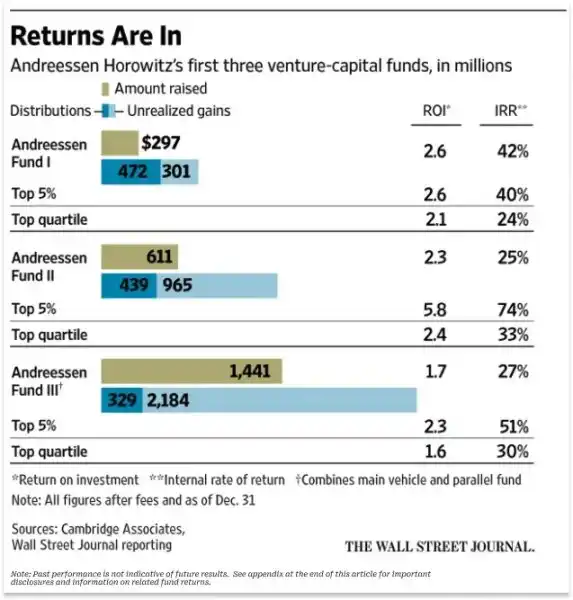
Performance of a16z's Top 3 Funds and Comparison with Industry Leaders
But in retrospect, this Fund 3 can be called a "legend": as of September 30, 2025, its net TVPI (Total Value to Paid-In capital) after fees reached 11.3x; including parallel funds, the net TVPI is 9.1x.
Fund 3's portfolio includes: Coinbase (bringing a total allocation of $7 billion to a16z LP), Databricks, Pinterest, GitHub, and Lyft (missed Uber, but a one-time omission "sin" ultimately cannot overshadow the "achievement" of multiple precise investments). I believe this fund can be called "one of the most successful large venture capital funds in history." By the end of Q3 2025, Databricks (currently a16z's largest position) has reached a valuation of $134 billion, indicating that Fund 3's performance is still rising (assuming other positions have not depreciated). From Fund 3 and parallel funds alone, a16z has already distributed a net $7 billion to LPs, with nearly an equivalent amount of unrealized gains yet to be realized.
A significant portion of these unrealized gains comes from Databricks. When the Wall Street Journal was pessimistic about a16z in 2016, this big data company was still small, a few months away from a valuation of $5 billion. Today, Databricks accounts for 23% of a16z's total Net Asset Value (NAV).
Anyone who has interacted with a16z will frequently hear the name "Databricks." Not only is it a16z's largest position (perhaps also one of the top three in terms of investment amount in the entire venture capital industry), its development path is a vivid example of a16z's "best operational model."
Databricks and a16z's Operational Formula
Before discussing Databricks, there are several key points about a16z that need to be understood.
First, a16z was founded and is run by engineers—not just founders, but "founder-engineers." This has influenced the institution's design logic (pursuing economies of scale and network effects) and also determines their standards for markets and companies.
Secondly, at a16z, being the "industry second" is perhaps the biggest "original sin of investing." If you miss out on the winner early on, you can still make a follow-on investment later; but if you invest in the second-place player, you will completely lose the opportunity to invest in the winner—even if the winner has not emerged yet.
Thirdly, once a16z identifies a company as a "category king," the classic move is to "invest far more money than the competition expects." This approach is often ridiculed in the industry, but they always stick to it.
These three points have never changed since the early days of a16z.
In the early 2010s, just a few years after a16z was founded, "big data" was the trend at the time, and the industry's mainstream big data framework was Hadoop. Hadoop adopted Google's MapReduce programming model, distributing computing tasks to a cluster of inexpensive commodity servers rather than expensive dedicated hardware, making it a promoter of "democratizing big data." Subsequently, a group of enterprises built around Hadoop emerged, and in 2014, the industry's investment fervor peaked: Cloudera, founded in 2008, raised $900 million, and the total funding for Hadoop-related companies that year increased fivefold compared to previous years, reaching $1.28 billion; Hortonworks, spun off from Yahoo, also held its IPO the same year.
While the big data trend was booming and funds were pouring in, a16z remained inactive.
The "z" in a16z—Ben Horowitz—simply did not believe in Hadoop. Prior to serving as the CEO of LoudCloud/OpsWare, with a background in computer science, he thought Hadoop would not become a mainstream architecture: "It's complex to program, difficult to manage, and not suited for future needs—every step of MapReduce computation must write intermediate results to disk, which is infuriatingly slow for iterative computing tasks like machine learning."
So Ben chose to steer clear of the Hadoop craze. Jen Kha told me that Marc even "complained" to Ben about this:
"'We definitely missed it! We messed up big time, made a major mistake!' Marc was extremely frustrated at the time.
But Ben said, 'I don't think this is the direction of the next architectural shift.'
Later, when Databricks emerged, Ben said, 'This might be it.' And then, of course, he went all in."
The birth of Databricks was timely and right near the University of California, Berkeley.
During the 1984 Iran Revolution, Ali Ghodsi's family fled Iran and relocated to Sweden. His parents bought Ali a Commodore 64 computer, and he taught himself programming on it. His skills were so advanced that he even received a visiting scholar invitation from the University of California, Berkeley.
In Berkeley, Ali joined the AMPLab research laboratory, where he, along with 8 researchers including mentors Scott Shenker and Ion Stoica, worked together to operationalize the ideas in PhD student Matei Zaharia's paper, developing Spark — an open-source big data processing engine.
The design philosophy behind Spark was "to replicate the functionality achieved by tech giants with neural networks without the need for complex interfaces." It once set a world record for data sorting speed, and Zaharia's paper was even awarded "Best Computer Science Paper of the Year." However, following the academic tradition, after they open-sourced the code, hardly anyone used it.
Starting in 2012, these 8 individuals had numerous dinner discussions and eventually decided to form a company around Spark, naming it Databricks. Seven of them became co-founders, with Shenker serving as an advisor.
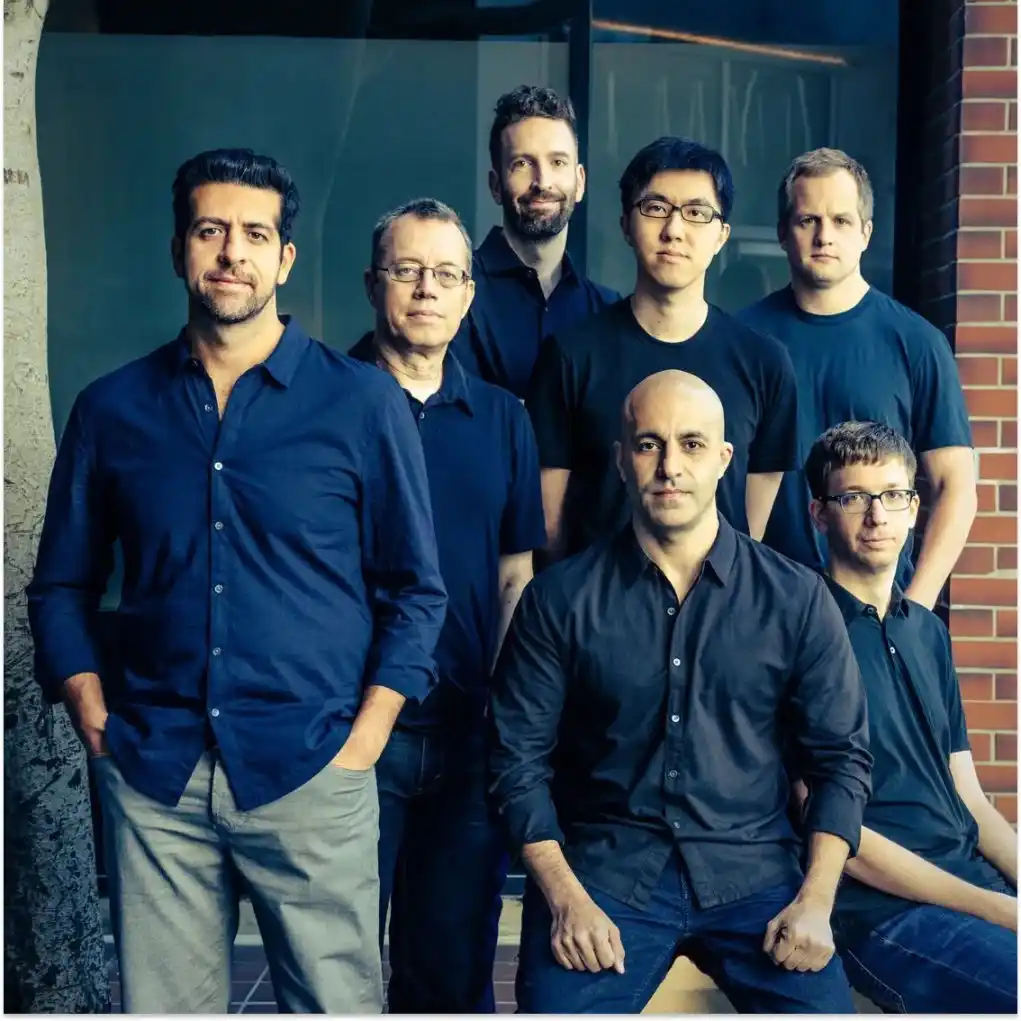
Databricks co-founder Ali Ghodsi seated front and center, Forbes
The team initially thought they "needed some money, but not too much." Ben recalled in an interview with Lenny Rachitsky:
"When I met with them, they said, 'We need to raise $200,000.' And at that moment, I knew that they had Spark, and their competition was Hadoop companies with significant funding already. Besides, Spark was open source, and time was of the essence."
Ben also realized that as scholars, this team was "easily satisfied with small goals." He told Lenny, "Usually, if a professor's startup reaches a $50 million valuation, they are already a 'hero' on campus."
So, Ben delivered some "bad news" to the team: "I can't write a $200,000 check."
Next came the "good news": "I can write a $10 million check."
His reasoning was: "If you want to start a business, you have to take it seriously and go all in. Otherwise, you might as well stay in school."
The team decided to drop out. Ben further increased the investment, with a16z leading Databricks' Series A funding round, post-money valuation of $44 million, with a16z holding a 24.9% stake.
This initial encounter—Databricks asking for $200k, a16z investing $10 million—set the tone for the partnership: once a16z backs you, they will "completely believe in you" and push you to "aim for bigger goals."
When I asked Ali about the impact of a16z, his attitude was very clear: "I think if it weren't for a16z—especially Ben—Databricks wouldn't even exist today. I don't think we would have made it this far. They genuinely believed in us."
In the company's third year, revenue was only $1.5 million. "At that time, we had no idea if we would succeed," Ali recalled. "The only person who truly believed this company would be worth a fortune in the future was Ben Horowitz. His confidence was stronger than anyone else's, honestly, even stronger than my own. He deserves great credit for that."
Having faith is great, but its value becomes even greater when you have the ability to make that faith self-fulfilling.
For example, in 2016, Ali was trying to strike a deal with Microsoft. In his view, the market's demand to "integrate Databricks into the Azure cloud platform" was very urgent, and this partnership should have been a natural fit. He had asked a few VC partners to help facilitate introductions, hoping to get in touch with Microsoft CEO Satya Nadella—they did help, but those introductions ultimately "got lost in the executive assistant process and went nowhere."
Then, Ben personally intervened to establish a formal communication channel between Ali and Satya. "I received an email from Satya saying, 'We are very interested in establishing a deep partnership,'" Ali recalled. "He also cc'd his deputy and the deputy's subordinates. Within a few hours, my inbox was flooded with 20 emails, all from Microsoft employees I had previously tried to contact with no success, all asking in the emails, 'When can we meet to discuss further?' That's when I realized: 'Things are different now, this collaboration will definitely happen.'
For example, in 2017, Ali was trying to recruit a senior sales executive to drive the company's accelerated growth. This executive proposed adding a "change of control provision" to the contract — essentially, if the company were to be acquired, his shares would vest more quickly.
This became a sticking point in the negotiations, so Ali asked Ben to help convince this executive that he believed Databricks' valuation could "at least reach $10 billion." After Ben communicated with this executive, he sent Ali the following email:
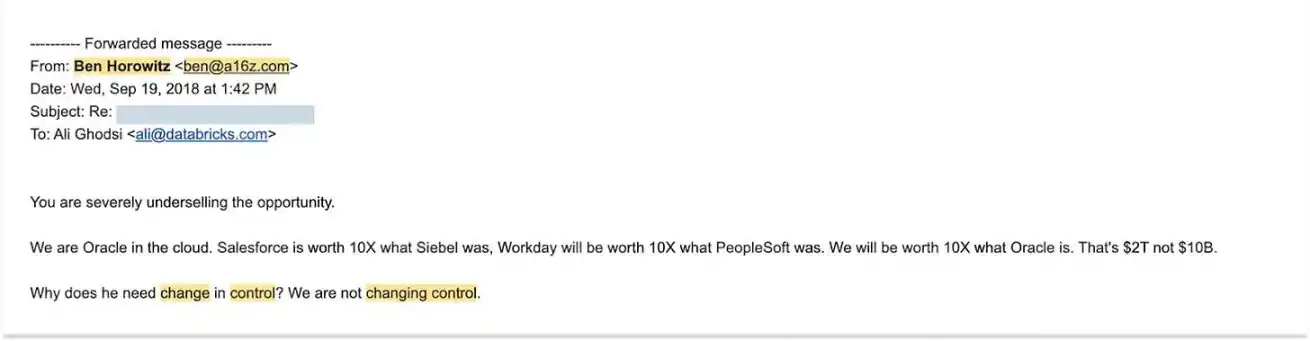
Email from Ben Horowitz to Ali Ghodsi, September 19, 2018, provided by Ali Ghodsi
"You are significantly undervaluing this opportunity.
We will become the Oracle of cloud computing. Salesforce's valuation is 10 times Siebel's, Workday's valuation will be 10 times PeopleSoft's, and our valuation will be 10 times Oracle's — this means our target is $2 trillion, not $10 billion.
Why does he need a 'change of control provision'? We will not experience a change of control."
This is perhaps one of the most emphatic corporate emails in history, especially considering that at the time Databricks' revenue run rate (annualized revenue) was $100 million, with a valuation of only $10 billion; whereas today, the company's revenue run rate has exceeded $480 million, and the valuation has reached $134 billion.
"They could see the full potential of something," Ali told me. "When you're in it, dealing with day-to-day operations every day, facing various challenges — deals not closing, competition pressuring you, running out of funds, nobody knowing your company, employees leaving constantly — it's hard to take such a long-term view of the issues. But they would show up at board meetings and tell you, 'You will eventually conquer the world.'"
Their judgment was correct, and this belief brought them rich rewards. In conclusion, a16z participated in all 12 rounds of Databricks' financing, with 4 rounds led by a16z. It was because of investment targets like Databricks that a16z's initial investment in the AH 3 fund performed so well; at the same time, Databricks was also a key driver of return growth for the larger "Late Stage VC funds 1, 2, 4."
“First and foremost, they really care about the company's mission,” Ali remarked. “I don't think Ben and Marc see this primarily as a return-chasing investment; the investment return is secondary. They are true believers in technology, hoping to change the world with technology.”
If you can't understand Ali's assessment of Marc and Ben, you will never truly understand a16z.
What Exactly is a16z?
a16z is not a traditional venture capital fund. At first glance, this is evident: the company's latest fundraising is the largest in its entire strategy coverage since SoftBank's $98 billion Vision Fund in 2017 and Vision Fund II in 2019. This completely defies the characteristics of traditional VC. But even so, SoftBank's Vision Fund fundamentally remains just a "fund," while a16z is not.
Of course, a16z has raised funds and needs to create returns for its investors. It must excel in this aspect, and so far, its performance has been outstanding. Not Boring has obtained the return data for a16z's funds to date, which we will share below.
But first, we need to be clear: What is a16z really?
a16z is a "tech-belief community." Everything it does is to drive the emergence of more advanced technology to create a better future. The company firmly believes: "Technology is the glory of human ambition and achievement, the vanguard of progress, the realization of human potential." All actions stem from this core belief. It holds a strong conviction about the future and places this belief at the stake of the entire company's resources.
a16z is an "institution." It is a business, a company built to achieve scalable growth and continuously improve itself in the process of scaling. I believe that an "institution" possesses many traits that a traditional "fund" does not have, which will be explained below. I think that positioning an "institution> fund" perfectly unravels the most contradictory aspect of self-awareness in the venture capital industry: providing the most scalable product (funds) to the most scalable potential enterprises (tech startups) while being considered as an industry that "should not scale."
This "institution> fund" distinction arises from a16z's General Partner (GP) David Haber. He is the team's most "Wall Street" individual and describes himself as a "student of investment institution business models." He explains: "The fund's objective function (core goal) is to earn the most significant side returns with the least manpower in the shortest time possible; whereas, the institution's goal is to create outstanding returns while building a competitive advantage that generates compounding effects. What we should be thinking about is: How do we make the company stronger, not weaker, in the scaling process?"
a16z is run by engineers and entrepreneurs. The typical approach of a traditional asset management firm is to compete for a larger share of a fixed “cake”; whereas engineers and entrepreneurs will make the “cake” itself larger by building a more robust system and driving system-level scale.
a16z is a “time-domain powerhouse,” an “institution built for the future.” In moments of grander ambition, this institution sees itself on par with the world’s top financial institutions and national governments. It has stated its goal is to become the “(first-gen) JPMorgan of the information age,” but in my view, this description still underestimates its true ambitions. If governments serve a “specific spatial realm,” then a16z serves the “broad time dimension of the future.” Venture capital is just one way it has found—through which it can have the greatest impact on the future, aligning with a logic of profiting by driving the future forward.
a16z creates and “sells” influence. It builds its own influence through scaled development, cultural construction, networks, organizational architecture, and past successes; it then bestows this influence upon the tech startups in its portfolio—primarily through support in sales, marketing, talent recruitment, government relations, and more. However, as put by its founders, a16z will “help in every way it can,” and it seems it can do far more than just that.
If you were to design such an institution—one that believes “technology is permeating markets far beyond traditional tech industry boundaries,” that “everything will eventually be tech-driven”—what you would ultimately create is a company that sells “capabilities to win,” targeting thousands of companies that could be at the core of the future economy. And I believe the institution you would end up creating would bear a striking resemblance to a16z.
Because those companies that could be at the core of the future economy are often small in scale and weak in foundation at the outset. They start off dispersed across various fields, each with different goals and competitors, often even competing with each other; meanwhile, they must face the giants dominating current markets, unwilling to yield to new entrants. A startup, not matter how promising, may struggle to attract top recruiters (thus failing to draw the best engineers and executives); may fail to advocate for policies that create a fair competitive environment; may lack a sufficient audience to have its ideas heard; may lack the necessary credibility to sell its products to government departments and large enterprises inundated with sales pitches promising to bring the next big thing.
For any single startup, investing billions to build the above capabilities, only to serve itself, is illogical; but if these capabilities can be spread across “all these startups,” covering a “future market value in the trillions,” then these small companies suddenly have the resources of larger companies. Their success will then depend solely on the quality of their products, and they can rightfully drive the future forward.
What would be the result of combining the agility and innovation of a startup with the influence and power of a "time domain master"?
This is exactly what a16z has been striving to do — starting from when it was a startup itself.
Why Did Marc and Ben Found a16z?
In June 2007, Marc wrote a blog post titled "The Only Thing That Matters," [11] which was part of the "Pmarca Guide to Startups" [12]. At first glance, this post offered advice to tech startups, but looking back now, it reads more like an "operations manual for starting a16z." The core of the post answered a question: among the three core elements of a startup — team, product, and market — which is the most important?
Entrepreneurs and venture capitalists often say "the team is most important;" engineers usually say "the product is most important."
"I, personally, subscribe to the third theory," Marc wrote, "I believe that the market is the most important factor determining the success or failure of a startup."
Why? He explained in the post:
"In a great market — a market with lots of real potential customers — the market pulls product out of the startup...
Conversely, in a lousy market, even with the best product in the world, the best team, you're going to fail...
In honor of Benchmark Capital's former partner Andy Rachleff, I hereby present 'The Rachleff Rule for Startups' :
The #1 company-killer is lack of market.
Andy says:
Good team, bad market = market wins;
Good market, bad team = market wins;
Good team, good market = magic happens."
I believe that what Marc and Ben saw in the venture capital industry was a "great market" (though no one realized how great it was at the time), filled with "bad teams" (again, no one realized how bad they were).
Between 2007 and 2009, Ben and Marc had been contemplating their next move. They were already very successful tech entrepreneurs—despite their success, they were still itching for more; and it was precisely because of this success that they had the capital to "not have to kiss ass" and could afford to take risks without any hesitation.
But what specifically to do?
Whether as entrepreneurs or later as angel investors, Marc and Ben had dealt with many unprofessional venture capitalists, and they felt that "competing with these people might be fun."
"To me, Marc doing this was never about the money," David Haber told me. "He was already very wealthy by the time he was around 20 years old. Initially, he probably did this more to 'show Benchmark or Sequoia a bit of color.'"
The venture capital industry had another quirk at a time when the global financial crisis (GFC) triggered the most severe economic downturn: hardly anyone realized this—it might be the best market in the world. And for Marc, this was crucial.
Of course, not all venture capital firms were terrible. The two companies Marc wanted to "show some color to"—Sequoia and Benchmark—were actually very excellent (Marc even quoted Andy Rachleff's perspective!), but they tended to have a "founder replacement" bias. And for founders who wanted to retain control, Peter Thiel had founded Founders Fund as early as 2005, which was in the investment period of "2007 Vintage Fund II" at that time. As Mario wrote, this fund eventually achieved a performance of "an 18.60x DPI."
But compared to today, the venture capital industry at that time was still a "reluctant, closed, labor-intensive industry."
Marc often tells a story: In 2009, when he and Ben were considering starting a16z, they met with a GP from a top venture capital firm, who likened investing in startups to "picking sushi off a conveyor belt." According to Marc's recollection, this GP said to him:
"Venture capital is like eating at a conveyor belt sushi restaurant. You just sit on Sand Hill Road, and startups will naturally come to you. Even if you miss one, it's okay because the next sushi will come around quickly. You just sit there, watch the 'sushi' go by, and occasionally reach out to grab one."
In the Uncapped podcast, Marc explained to Jack Altman, "If the goal is just to 'keep the good times going,' as long as the industry's ambition is limited, this approach is feasible."
But Marc and Ben's ambitions go far beyond that. In the company they are about to found, "missing out on a high-quality project"—that is, not being able to invest in an outstanding company—would be the biggest mistake. This is no small matter because they clearly see: as the market size expands, the scale of those large tech companies will become unimaginably large.
"Ten years ago, there were about 50 million Internet users, even fewer with broadband connections," Ben and Marc wrote in the April 2009 memorandum for the "a16z Fund I," "Today, there are about 1.5 billion Internet users, many of whom have broadband connections. Therefore, whether on the consumer side or the infrastructure side, the most successful companies in the industry may have far greater potential than the most successful tech companies of the previous generation."
At the same time, the cost of starting a company has significantly decreased, and processes have become simpler—meaning that there will be more startups in the future.
In a letter to potential limited partners (LPs), they wrote, "Over the past decade, the cost of developing a new technology product and bringing it to market at least in beta form has dropped significantly; today, this cost is usually only $0.5 to $1.5 million, compared to $5 to $15 million a decade ago."
Finally, as startups transition from being "tool providers" to "players directly competing with industry giants," their own ambitions are also constantly expanding—meaning that all industries will eventually become tech industries, and the scale of all industries will therefore become larger.
This is why at that particular juncture, the "market" was so prime. Marc then continued:
"From the 1960s to around 2010, the venture capital industry had a fixed 'script'... The companies at that time were essentially 'tool providers,' that is, 'companies selling picks and shovels'—mainframes, desktop computers, smartphones, laptops, internet access software, SaaS (Software as a Service), databases, routers, switches, disk drives, word processing software, all of these were tools.
Around 2010, the industry underwent a permanent transformation... The most successful companies in the tech sector are increasingly those that directly enter traditional industries and compete with existing giants."
In the early days, was a16z guilty of "overpricing" companies? Or was the pricing actually reasonable relative to the future potential they foresaw in these companies?
Looking back now, it's easy to argue the latter; but what's impressive about a16z is that they held this view even before events unfolded.
As they wrote in their post: about 15 tech companies each year eventually hit $1 billion in annual revenues, and these companies, in total market value created, represent 97% of all market value created that year across all companies—this is the well-known "Power Law." And so, they had to do whatever it took to invest as much as possible in companies "that had the potential to be one of those 15"; then, within those companies, double down and triple down on the winners.
And to execute on that, it wasn’t enough to have just two investing partners—a16z had to construct the firm in a way that was "fundamentally different from every other peer."
So, after outlining the basic terms of the "AH Fund I" (which targeted to raise $2.5 billion with LPs committing $15 million each), Ben and Marc summarized the core strategy of the firm in a sentence.
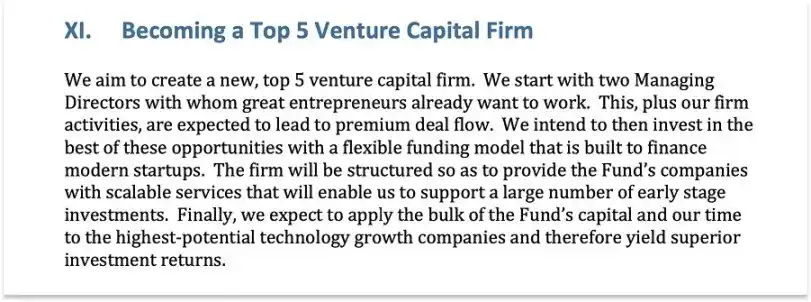
AH Fund I Memo
Even as the firm has grown far beyond "two partners" and its ambitions are no longer bounded by simply "getting into the top five," they continue executing on this strategy to this day.
a16z's Three Phases of Development
Since the inception of their first fund, looking at the entirety of the firm's arc, I see a16z's extraordinary belief in the future, its asymmetric conviction, as its enduring core competitive advantage. It is this differentiating trait that spawns all other competitive advantages.
As the firm's ambition, resources, fund sizes, and influence have grown, the ways in which they apply this advantage and achieve differentiation have evolved.
Phase One (2009 - Circa 2017)
In a16z's Phase One (2009 - Circa 2017), the core insight was: if "software is eating the world," then the value of top software companies would vastly exceed everyone's valuation expectations at the time.
With this belief, a16z took three actions and successfully went from being a newcomer to a top 5 investment firm in the industry:
Placing High-Bid Orders: As mentioned earlier, some of the early deals made by a16z's funds were seen by many peers at the time as overpriced or deviating from the usual track. In the "Acquired" podcast, Ben Gilbert stated, "Critics widely criticized them for 'spending money to buy reputation,' squeezing into high-quality projects through high-priced investments," but at the same time, he pointed out that this approach was reasonable at the time and asked, "Would anyone still think that any project a16z invested in between 2009 and 2015 was actually valued too high? The answer is definitely no." As explained by Ben Horowitz in a 2014 Harvard Business School (HBS) case study, "Even in the face of multi-billion-dollar valuations, investors may still underestimate the potential of these companies." And this "underestimation" is exactly where a16z found its opportunity.
Building Operation Infrastructure Others Deemed as "Waste": Establishing a full-service team, hiring recruiting partners, setting up an executive briefing center... To fund managers at the time, these initiatives seemed like "additional expenses" that would drag down costs. But if one believes that the companies in the portfolio can grow to become the industry benchmarks of a "category-defining" nature and need enterprise-level strength to achieve this goal, then these investments are justified. a16z's move was a strategic setup for the future—where startups must present an "enterprise-like" image in the future to win cooperation orders from Fortune 500 companies.
Viewing Technical Founders as a Scarce Resource: This was also a gamble—due to the reduced cost of founding a company and the lower barriers, even without traditional management experience, technical geniuses have the ability and will inevitably create more influential enterprises. Therefore, a16z did everything possible to attract and support these founders, bringing the innovation artist management company CAA's model into the venture capital industry. Today, being "founder-friendly" has become a popular industry concept, but at the time, this was undoubtedly a highly innovative move.
It is worth noting that in the first phase, a16z's core goal was to invest in the "right companies" and profit as these companies grew to their expected successful scale. Of course, they also focused on supporting founders, but fundamentally, the core of this phase was seizing the opportunity for "valuation arbitrage."
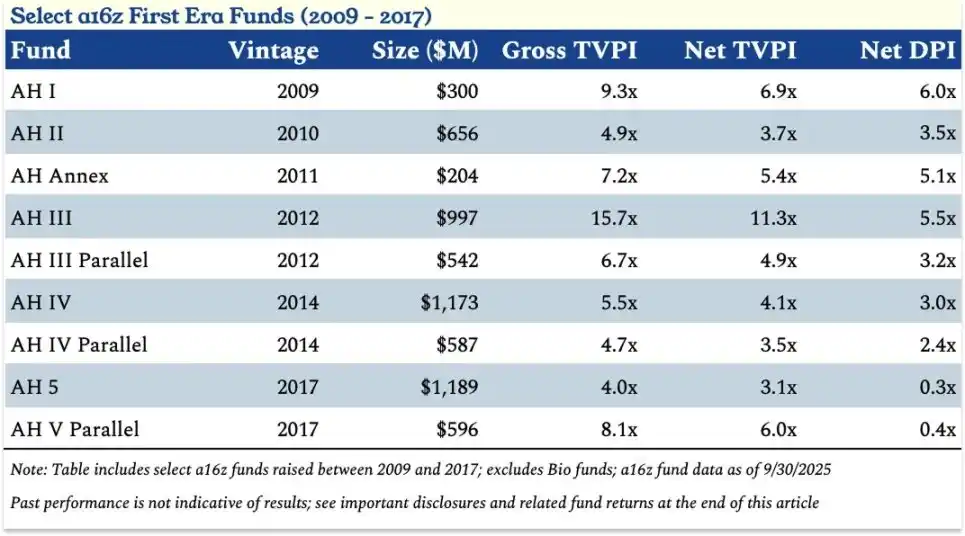
a16z Core Data for Partial Funds in Phase One (2009-2017)
a16z Fund III (AH III) stood out due to its simultaneous investments in Coinbase and Databricks, but what is more noteworthy is the "sustainability" of its performance.
“As a Limited Partner (LP), we are pleased to see a fund sustainably achieve a 3x (net) Total Value to Paid-in Capital ratio (TVPI), occasionally showing performance of over 5x (net) TVPI, and a16z has done just that,” said David Clark, Chief Investment Officer at VenCap (who has been an LP since a16z Fund III), “a16z is one of the few companies that can consistently deliver such performance at scale over the long term.” This can also be seen from the performance data mentioned above.
If in this phase a16z was willing to "pay a high price" and "cross over into investing like pork belly futures" to build brand reputation and wait for long-term returns, then in the short term, the cost of this "effort" seems relatively low.
Phase Two (2018-2024)
In a16z's second phase (2018-2024), its core belief shifted to: the scale of leading companies will far exceed everyone's expectations, they will remain private for longer, and the scope of technology's impact on the industry is wider than most realize.
Based on this belief, a16z took three steps to ascend from the "Top 5" to industry leaders:
Raising Larger Funds: In the first phase, a16z raised $6.2 billion through 9 funds; whereas in the second phase over five years, it raised $32.9 billion through 19 funds. The traditional VC industry consensus is "the larger the fund size, the lower the return," but a16z proposed the opposite view: if the ultimate value of leading companies will become higher, then more capital is needed to maintain a meaningful stake through multiple funding rounds. For VCs, the worst-case scenario is "missing out on leading companies" or "having insufficient ownership in already invested leading companies." Marc often says, "You can lose at most the capital you put in (i.e., 1x loss), but the upside is almost limitless."
Breaking the "Single Fund" Model, Achieving Diversified Layout: In the first phase, a16z mainly raised core funds, complemented by subsequent late-stage funds. Although each General Partner (GP) has their own focus area, all GPs invest from the same pool of funds. Furthermore, a16z has also raised a biotech fund - because the biotech sector is vastly different from other sectors. This article will focus on a16z's venture funds in non-biotech and healthcare sectors.
Upon entering the second phase, a16z began to implement a "decentralized" layout: In 2018, under the leadership of Chris Dixon, a16z launched its first cryptocurrency-focused fund, CNK I; in 2019, the company hired David George to establish a dedicated Late Stage Ventures (LSV) team and raised the largest fund at the time — LSV I with a size of $2.26 billion, approximately twice the size of any of a16z's previous funds. During this period, a16z raised multiple new funds focused on core tracks, cryptocurrency, biotech, LSV, and in 2021, introduced a dedicated seed fund (AH Seed I, $478 million), in 2022, launched a dedicated gaming fund (Games I, $612 million), as well as the first cross-strategy fund (2022 Fund, $1.4 billion) — allowing LPs to invest proportionally across all funds raised in the same year.
Importantly, although each fund can leverage the company's centralized resources (such as the investor relations team), each fund has built a dedicated platform team covering areas such as marketing, operations, finance, event planning, policy research, etc., to meet the needs of founders in specific verticals.
Extended Holding Periods: In the second phase of a16z's development, leading companies began to stay private for longer and raise more funds in the private markets — including both "primary market financing" for company operations and "secondary market transactions" to provide liquidity to employees and early investors. When a16z purchased late-stage Facebook shares in the secondary market, Matt Cohler likened this practice to "investing in pork belly futures," and today, this model has become an industry norm — companies like Stripe, SpaceX, WeWork, Uber, etc., can obtain liquidity in the private markets that was previously only available in public markets.
This trend has posed challenges for the industry: LPs find it difficult to easily obtain liquidity, disrupting the capital allocation cycle. However, for institutions that firmly believe "technology companies will significantly scale," such as a16z, this is a golden opportunity — it not only provides the opportunity to invest more capital in high-quality private companies but also shifts the returns that originally belonged to public market investors to the private markets. I believe this shift is one of the key reasons why a16z and other VC firms can significantly expand their scale without suppressing returns.
To address this trend, a16z took two key measures: first, becoming a Registered Investment Advisor (RIA), allowing for investments in cryptocurrency, public stocks, and secondary market transactions; second, under the leadership of David George, launching the aforementioned LSV I fund [9]. In the second phase, of the $32.9 billion raised by a16z, the LSV series of funds contributed $14.3 billion. Additionally, the cryptocurrency fund was also split — the fourth cryptocurrency fund (CNK IV) was divided into a seed fund ($1.5 billion) and a late-stage fund ($3 billion).
Below are the top 10 investments of each LSV fund sorted by either "Latest Round Post-Money Valuation" or "Current Market Value":
LSV I: Coinbase, Roblox, Robinhood, Anduril, Databricks, Navan, Plaid, Stripe, Waymo, Samsara
LSV II: Databricks, Flock Safety, Robinhood (exited in the public market, funds reinvested in Databricks), Stripe, Deel, Figma, WhatNot, Anduril, Devoted Health, SpaceX
LSV III: SpaceX, Anduril, Flock Safety, Navan, OpenAI, Stripe, xAI, Safe Superintelligence, Wiz, DoorDash
LSV IV: SpaceX, Databricks, OpenAI, Stripe, Revolut, Cursor, Anduril, Waymo, Thinking Machine Labs, Wiz
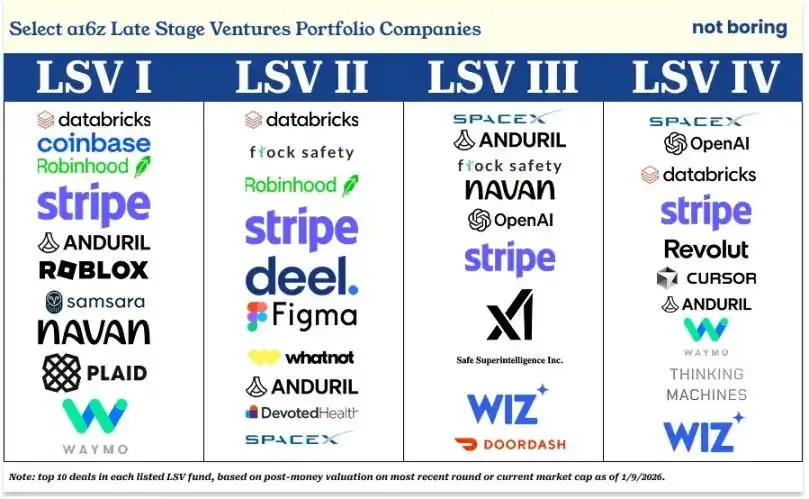
If, as previously accused, a16z's investments were for "riding the coattails of known companies," then the above investment portfolios are undoubtedly a "high-quality coattail list." More importantly, according to the Cambridge Association's Q2 2025 data, LSV I ranks in the top 5% among the same vintage funds, while LSV II and LSV III are also in the top 25% (i.e., the first quartile) of the same vintage funds.
As of September 30, 2025, LSV I has a Net TVPI of 3.3x; LSV II has a Net TVPI of 1.2x (however, following recent financings by Databricks and SpaceX, this number may have increased); LSV III has a Net TVPI of 1.4x (in addition, there are reports that SpaceX is about to complete a large-scale secondary market transaction, with a valuation possibly reaching $800 billion, more than double the previous valuation, so LSV III's Net TVPI is likely to further increase).
Due to the firm belief that the ultimate value of these top companies will far exceed most people's (though not everyone's — for example, Founders Fund's assessment of SpaceX, Thrive's assessment of Stripe align with a16z's), a16z has been able to invest more in these high-quality private tech companies while they are still in the private stage.
The key is that a16z has proven: under the right conditions, growth funds can also achieve venture-capital-level returns. Specifically, based on analysis data I obtained from a16z's LP, if a venture firm has strong early-stage investment capabilities and continues to add investments in the growth stage, it can not only achieve venture-capital-level returns (multiples) but also obtain a higher Internal Rate of Return (IRR). Of course, establishing a deeper partnership with these companies can further enhance a16z's industry influence.
In the second phase, a16z believes the most important goal is to "hold as much ownership of the leading companies as possible" — if it can deeply understand a company through early investments and continue to add investments through a dedicated late-stage fund (or correct early investment errors), this goal is easier to achieve (although its ownership stake has not yet reached the common "controlling" level seen in other asset classes).
The core of this phase is still "arbitrage," but unlike the first phase, a16z puts in more effort during this phase to help individual portfolio companies succeed.
Although the return period of the second-stage fund has not yet fully concluded, the performance of the second-stage fund currently outperforms that of the first-stage fund at the same time (when its performance was reported as poor by The Wall Street Journal).
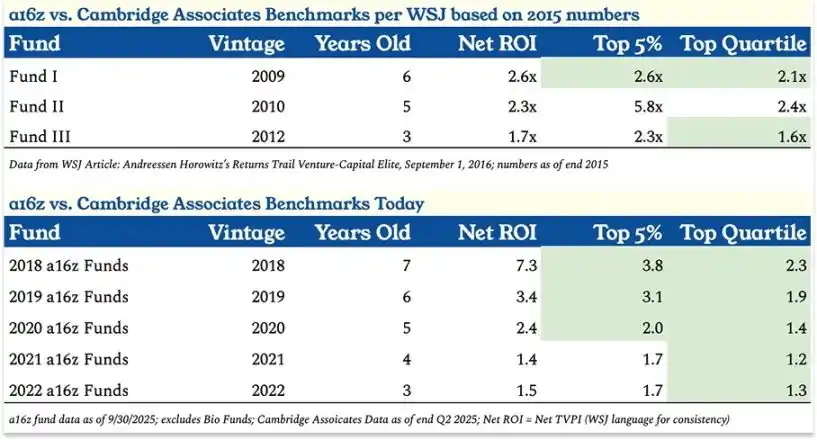
a16z Fund Investment Return Performance vs. Cambridge Associates Industry Benchmark
Specifically: the 2018 vintage fund had a net TVPI of 7.3x; the 2019 fund had 3.4x; the 2020 fund had 2.4x; the 2021 fund had 1.4x; and the 2022 fund had 1.5x.
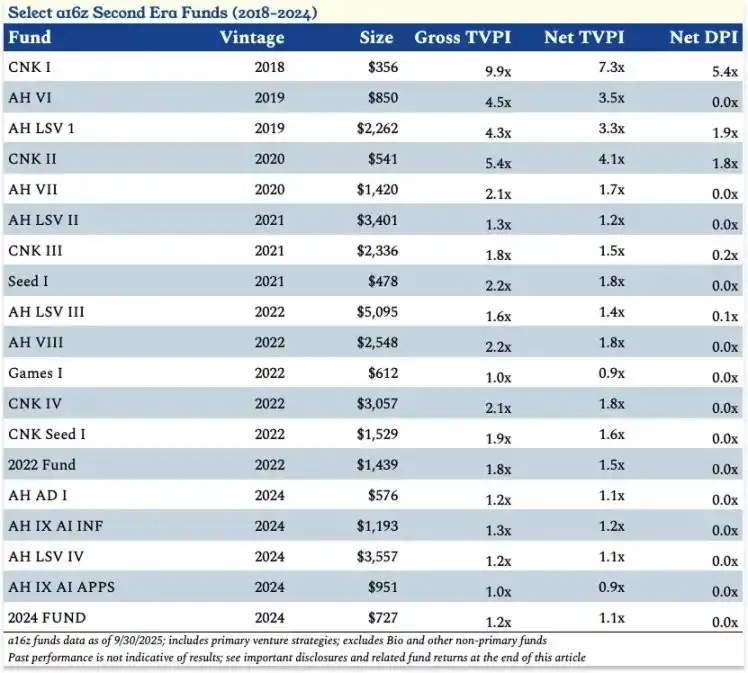
Core Performance Data of a16z's Funds from 2018 to 2024 (Second Stage)
The most noteworthy highlight of this phase is the outstanding performance of the cryptocurrency funds (CNK 1-4 and CNK Seed 1) — where CNK I has already delivered a 5.4x Net Distribution to Paid-In (DPI) return to LPs.
What's even more surprising is that despite some questioning whether a16z had "mistimed the market and overcapitalized on crypto funds" in 2022, as of now, the firm has achieved a net TVPI of 1.8x with the $3 billion raised for its Crypto Fund IV.
The two core stories of the second phase—the LSV series funds and the Crypto Fund—perfectly reflect a16z's two beliefs about the future: LSV is a response to the trend of "enterprise private cycle extension and increasing demand for private market financing," while crypto represents an idea that innovation (and returns) may come from entirely new areas outside the traditional investment track.
These two stories also highlight a16z's need to further expand its service scope—to provide support to portfolio companies while empowering the entire industry. For example, to help late-stage portfolio companies grow, a16z needs to replicate some of the public market advantages in the private market; and to ensure the survival space of the crypto industry in the U.S., and to ensure that various new technology companies can compete fairly with existing giants, a16z must move into Washington (engage in policy lobbying).
This leads to a16z's third phase (2024 onwards). In this phase, its core belief is that with a conducive environment for equitable development, new technology companies can not only reshape various industries but also succeed in all industries; and a16z must lead the industry and even the entire country in the right direction.
This belief once again changes a16z's positioning. When the company reaches a certain threshold in size (as evidenced by the $15 billion new fund raised this time), "picking winners" is no longer sufficient—
To create winners, you must shape an environment conducive to their competition.
As Ben puts it: "It's time to lead the industry."
a16z's Third Phase: It's Time to Lead the Industry
At this moment, you might be able to imagine a scenario: an analyst from a rival venture capital firm sends a message to journalist Tad Friend saying, "To achieve 5-10x returns on these two $150 billion new funds, 'you have to expand the scale of the entire U.S. tech industry by several times the existing base.'"
And you can probably guess that Marc and Ben would respond like this: Yes, that's exactly what we intend to do.
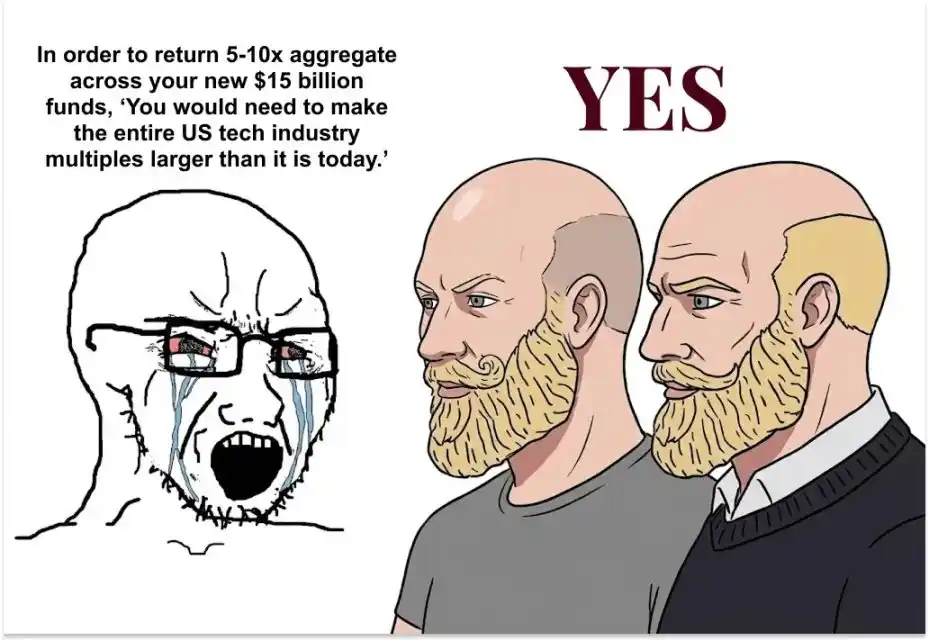
This is precisely the plan a16z has laid out, the logic being as follows:
Since 2015, a16z has backed more early-stage unicorns than any other investor, and the gap between it and the second-ranked investor (Sequoia Capital) is akin to the gap between second place and twelfth place.
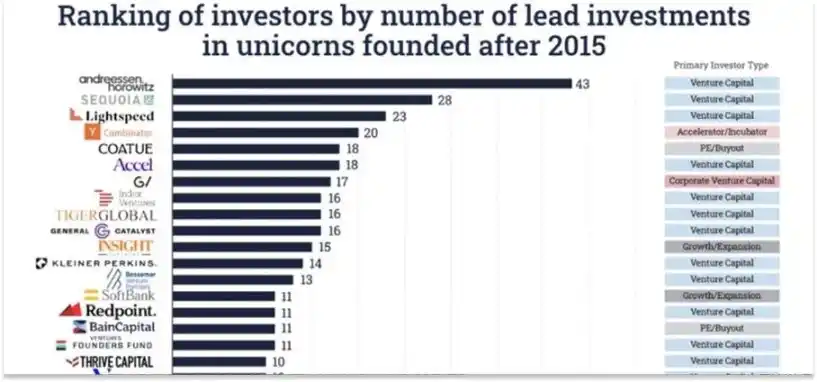
Source: Stanford University Professor Ilya Strebulaev
Clearly, the metric of "number of unicorns emerged among early-stage investments" serves as a very specific and convenient measure of the "top investor." While more common evaluations involve looking at returns—whether in terms of multiple returns, internal rate of return (IRR), or simply cash returned to limited partners (LPs). Some may focus on investment hit rate or performance consistency. The ways to assess venture capital industry rankings are diverse, each with its own perspective.
But this evaluation criteria centered around "unicorn count" appears to align closely with how a16z views the industry. In my conversations with the a16z crypto team, I’ve repeatedly heard a perspective like this: if many great entrepreneurs are building in a particular area, it makes sense to make bets in that area, even if the specific judgment turns out to be wrong; but missing out on the top investment in a sector, for any reason, is unforgivable. As Ben put it:
“We fully acknowledge the extremely high risks of founding a company, so as long as we follow the right process in our investments and make a reasonable risk assessment, we won't be overly concerned if some investments don't pan out. On the contrary, if we fail to accurately identify whether an entrepreneur is the best choice for their field, we take that very seriously.
Selecting the wrong emerging field is not a big deal; selecting the wrong entrepreneur is a serious issue; missing out on a great entrepreneur is equally problematic. Whether due to conflicts of interest or active decision, as long as we miss out on a company that defines the era, the consequences are far more severe than investing in the best entrepreneur in a misjudged field.”
From the "core measurement standards" that a16z itself defines, it has indeed become a leader in the venture capital industry.
“So, what's next?” Ben poses the question, “What does leading an industry truly entail?”
In a lengthy post announcing the raising of $15 billion, the X Platform provided an answer: “As a leader in the U.S. venture capital industry, the future of American new technology to some extent lies in our hands. Our mission is to ensure that America wins the technological dominance of the next 100 years.”
For a venture capital firm to say such a thing is truly rare.
However, if you agree with the following premise — that technology is the engine of progress, the U.S. must maintain its leading position by having technological superiority, a16z is the largest and most influential investor in U.S. emerging technology companies, and has the ability and resources to provide these companies with a level playing field against industry giants — then this statement is not entirely unreasonable.
Furthermore, he pointed out that to win the technological dominance of the next 100 years (which, in a16z's view, is equivalent to winning the overall leading position of the next 100 years), one must master key new technological architectures — AI and cryptocurrency — and apply these technologies to the most critical fields such as biotechnology, defense, healthcare, public safety, education, and even integrate them into government operations.
These technologies will greatly expand the market size. As I discussed in my articles “The Significant Expansion of the Tech Industry” and “Everything Can Be Technologized,” industries and tasks that were not originally within the scope of the tech industry are now included. This means that the Value Capture from Venture investment (VCAV) will also see a significant increase.
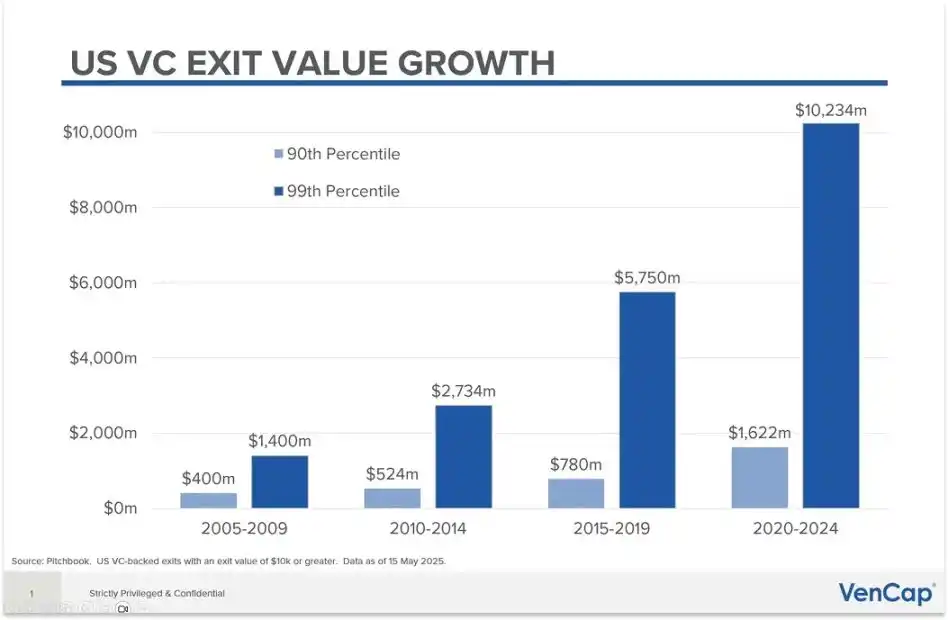
The U.S. venture capital exit scale is growing significantly, chart source: VenCap Chief Investment Officer David Clark
This is a continuation of a16z's long-standing investment strategy, but with a key ideological shift: as long as a16z fulfills its leadership responsibilities, this value can be unlocked, and the future of America (and even the world) can be secured.
Specifically, this means doing five things:
1. Reshaping U.S. technology policy to bring it back to its peak;
2. Bridging the gap between private companies and publicly traded companies;
3. Driving the marketing model towards the future;
4. Embracing new modes of corporate founding;
5. While enhancing its own capabilities, continually shaping corporate culture.
a16z's seemingly obscure moves are almost all in service of these five key goals.
Most notably, over the past two years, a16z has increasingly spoken out in the political arena, with Marc and Ben publicly supporting President Trump in the last election. This move has sparked dissatisfaction among many, with some arguing that venture capital funds should not interfere in national politics.
However, a16z would strongly oppose this view. It aims to "reshape American tech policy to put it back on top."
Marc and Ben outlined their position in the "Small Technology Business Development Agenda," with the core view being:
Emerging technology businesses are crucial for national development.
To win the future, there is a need for laws, policies, and regulatory systems that are conducive to innovation, while also preventing resource-rich industry giants from hindering competition through "regulatory capture."
However, the current situation is quite the opposite: "We believe that bad government policy has become the number one threat faced by small technology businesses."
Currently, no one is speaking up for emerging technology businesses at the government level or in the process of countering industry giants: industry giants will not do it, and startups should not invest limited resources in such affairs.
The financial gains of venture capital firms are closely tied to the success of emerging technology businesses, so the venture capital industry should rightfully carry this banner; and as a leader in the venture capital industry, a16z has an even greater responsibility.
a16z's political stance is "single-issue driven," focusing only on the development of small technology businesses and holding a bipartisan principle.
Its public positions include: "We will not participate in political disputes unrelated to small technology businesses" and "Whether we support or oppose a politician depends solely on their attitude toward small technology businesses, unrelated to their political party affiliation or positions on other issues"—from what I have seen and heard at a16z, these are not empty slogans but their true action principles.
a16z's foray into politics is not because they find it interesting (although at least Marc seems to enjoy this kind of "buzz"; he seems to be passionate about many things and can find humor in absurdity—an ability that is an underestimated competitive advantage, but we don't have time to discuss it today). In the short term, a16z is willing to endure criticism of being "foolish" and criticism from all sides just to allow emerging technology to thrive in the long term.
As former Benchmark partner Bill Gurley pointed out in "2581 Miles," for a long time, the tech industry could basically ignore Washington (referring to the U.S. government), and Washington could basically ignore the tech industry. But a few years ago, things changed, in part for the reasons I mentioned earlier—the tech industry's position has shifted from "building tools" to "competing with industry giants." And the cryptocurrency industry is the first to face "life-or-death" level regulatory pressure.
When a16z first waded into the waters of Washington, the "small tech company" was not yet a influential force in the nation's capital. Large tech companies had their own lobbying teams and government relations networks; industry titans—whether in banking, defense, or other sectors—also had their own lobbying resources and contacts. However, small tech companies, including cryptocurrency firms, did not have such support. At that time, apart from Coinbase, which may have had the capability, no small tech company could bear the cost and groundwork required to establish a representation mechanism in Washington (and in state legislatures across the U.S.).
Therefore, in October 2022, a16z's cryptocurrency team hired Collin McCune as Head of Government Affairs to lead efforts in educating U.S. policymakers about cryptocurrency. Collin, Chris Dixon, a16z's General Counsel for Crypto Miles Jennings, other team members, as well as entrepreneurs from a16z's portfolio and the entire cryptocurrency industry, made multiple trips to Washington to explain to policymakers how cryptocurrency works, its potential for development, and most importantly, the risk that overregulation could stifle emerging technologies.
These efforts have paid off. Largely due to their advocacy and the bipartisan political action committee "Fairshake SuperPAC," the cryptocurrency industry is no longer at risk of being "snuffed out" by legislation. Last year, President Trump signed the GENIUS Act, which for the first time brought stablecoins into the regulatory fold; simultaneously, a comprehensive cryptocurrency market structure bill passed the House with overwhelming bipartisan support and is currently being considered by the Senate, with prospects for passage and enactment later this year.
This experience has been instrumental as artificial intelligence has become a focal point in Washington. Today, McCune leads all of a16z's government affairs efforts, establishing a permanent presence in Washington working across multiple domains including AI, cryptocurrency, and American Dynamism. Currently, a16z is advocating for the establishment of unified federal AI regulatory standards to avoid regulatory policy fragmentation across states and to push for other innovation-friendly policies.
Although the term "lobbying" may carry negative connotations, the current reality is that competitors of small tech companies have mature government affairs and policy teams that are seeking to make it difficult for new entrants to compete fairly through "regulatory capture."
In order for the tech industry to win the future, and for a16z's funds to see returns, staying out of politics is no longer a viable option. The good news is that a16z's survival depends on the founding, growth, and success of emerging companies, making it more incentivized than any entity to uphold a fair competitive environment conducive to innovation.
Because even a16z itself acknowledges that, standing here today, no one can predict what future companies will emerge, nor how they will emerge.
The idea of "embracing a new model of company creation" means recognizing the possibility that, with the help of AI technology, the number of employees needed for a founder to start a company in the future may be only 1/10 or even 1/100 of what it was in the past, and the elements needed to build a great company may also be drastically different from before. This also means that a16z itself needs to adjust.
For example, a16z has launched an internal accelerator program called "Speedrun": providing up to $1 million investment to startups and conducting a 12-week incubation program. Through this initiative, a16z can gain early insights into the founding models of these new types of companies, thoroughly examine each participating company, and thus more wisely make follow-on investments in potential companies.
However, this move also comes with risks: increasing the number of companies that can claim to be "backed by a16z," lowering the investment threshold, may dilute a16z's brand credibility. For instance, a16z sparked controversy on Platform X for investing in a company called Doublespeed through the Speedrun program — the company claimed to provide "synthetic creator infrastructure," but others accused it of being a "phone farm" and "trash information as a service."
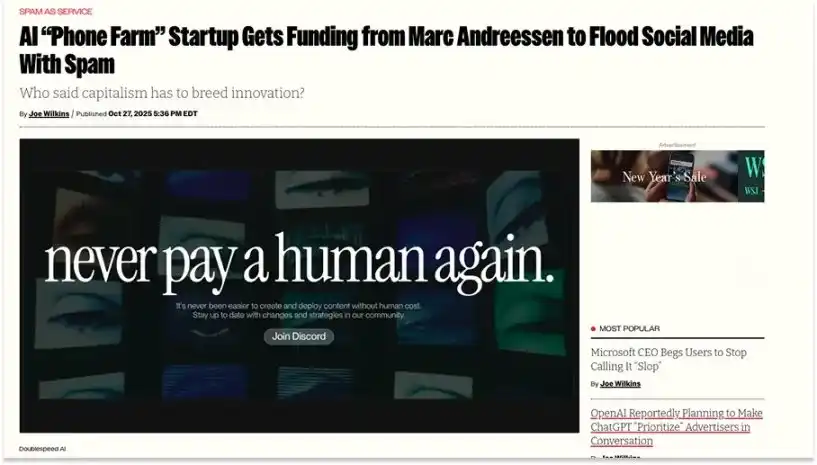
Source: Futurism
Some argue that "the company received investment from Marc Andreessen," which is rather ironic — because Marc does not participate in individual decisions for Speedrun projects of less than $1 million, considering each Speedrun investment accounts for only about 0.001% of a16z's assets under management (AUM). But this precisely highlights the core issue: I have seen many references on Platform X to this "a16z-backed company," until later assuming it might be a project from Speedrun incubation and then verifying it. However, most people will not take the time to fact-check this.
Another more controversial similar case is the startup Cluely, which claims to "help users cheat in various transactions," and a16z led a $15 million investment in the company through its AI application fund.
People have reason to question: as an institution dedicated to shaping the future of America, why would a16z invest in a company that prioritizes "viral spread" over "ethical standards"? In the eyes of those active on the internet, does having a company like Cluely in the portfolio weaken the credibility of all other invested companies?
The answer is likely yes. Personally, I do not agree with this investment decision—it gives off a "lowbrow" and "undignified" feeling.
However! From a16z's own logic, this decision is consistent.
Because setting aside the product itself, the core message conveyed by Cluely is: in the age of artificial intelligence, the enterprise founding model is undergoing a fundamental shift—its premise being that the ability of underlying models is trending towards convergence and commodification, thus "spreadability" will become the sole key factor; and in order to achieve spread, a little controversy is inconsequential.
If a16z is truly committed to "embracing a new model of enterprise founding," then using $15 million and a minor X platform controversy to exchange for a "front-row seat" to observe an extremely innovative enterprise founding model is actually not a high price.
More broadly, in the industry where a16z operates, occasionally "appearing foolish" is a necessary cost to avoid repeating Kodak's mistakes. Enterprises must be willing to take risks, and these risks go far beyond the financial aspect. For a company of a16z's scale, investing a small amount of money is actually the lowest-risk way to take a gamble.
However, there is also a view that, from a global perspective, these minor controversies on the X platform (which is also an a16z portfolio company) are irrelevant. In fact, when I asked a16z General Partner Katherine Boyle (who is also a co-founder of the company's "American Renaissance" business) about this issue, she expressed this view:
"You might say, yes, we do receive some criticism on the X platform because of certain companies—like people in a certain circle in San Francisco or New York not liking a particular company, they might say 'We don't like them doing 'American Renaissance' business! We don't like them doing cryptocurrency!'
But in terms of the overall scale of our system, these momentary minor controversies are inconsequential.
The top-tier institutions all have a scaled system, just like a country such as America. When America makes some embarrassing moves on the global stage, do we care? No, because it doesn't have a substantial impact on America, just like similar events do not affect the Catholic Church."
Our unit of analysis is the 'century', not a 'single tweet'."
You may not agree with all of a16z's practices, but you have to admire the guts of this firm.
Notably, when I asked some of a16z's LPs about these controversial X-platform-triggering businesses, their reaction was often a blank face asking, "Who?"—evidently, they had never heard of these companies.
For a16z's returns, what truly matters has always been the "flagship companies": spotting them early, successfully participating in their financing transactions, and holding onto as much equity as possible in the long run. If you were to ask any a16z LP about Databricks, they would surely be familiar with it.
Now, in the "leading the industry" third phase, there is another equally crucial thing: even as these flagship companies have significantly expanded, helping them continue to grow.
I believe this is the essence of what Ben calls "filling the gap between private and public company development"—this is also the key perspective reshaping our current understanding of a16z's positioning and how it is poised to deliver 5-10x returns on its $15 billion fund.
Ben stated: "In the past, venture capitalists would help companies achieve $100 million in revenue, then hand them over to investment banks to take the company public." But those days are gone. Today's companies not only stay private longer but are also much larger—meaning the venture capital industry, represented by a16z, needs to enhance its capabilities to meet the development needs of larger companies.
To that end, a16z recently hired former VMware CEO Raghu Raghuram, giving him a "triple role": serving as a general partner for the AI infrastructure team led by Martin Casado, a general partner for the growth investment team led by David George, and also serving as a managing partner as Ben's "advisor to help operate the firm." Raghu will co-lead a series of new initiatives with Jen Kha to "meet the needs of large companies in their growth stages."
Specifically, these initiatives include: collaborating with governments worldwide to help portfolio companies achieve scale and market expansion locally; forming strategic partnerships with companies like Eli Lilly (who have jointly launched a $500 million biotech ecosystem fund); expanding the number and depth of limited partner (LP) relationships globally; and expanding the services of the a16z Executive Briefing Center—a center that offers customized services to large companies, allowing them to directly connect with companies in a16z's portfolio in relevant areas.
Even for large corporations, some resources, if each company were to build them from scratch individually, would be neither realistic nor cost-effective. However, having a16z centrally build these resources and distribute them across the entire portfolio is a reasonable choice. And these resources happen to involve government-level matters, trillion-dollar-scale companies, and trillions of dollars in capital.
All of these measures could allow companies to stay private without sacrificing the credibility, partnerships, or financing channels that public companies have.
This means that companies can grow to a larger scale in the private markets—a core coverage area for a16z.
It also means that a16z has the opportunity to deploy more capital with a reasonable probability of receiving generous returns; and more returns can then translate into more resources to enhance its capabilities, strengthen its industry influence—these capabilities and influence can further empower its portfolio companies, and even gradually empower the entire emerging tech industry, thus driving more and higher-quality new technologies to be applied in more areas of the economy, ultimately enabling everyone to have a better future.
Of course, there are bound to be many risks in the process. "More money, more problems," leaders always have to endure more criticism, and so on.
In my opinion, a16z is engaging in industry competition at an unprecedented breadth and scale, which presents both opportunities and risks.
For example, the broader the business coverage, the more potential risk points there naturally are. In theory, the longer a company remains private, the more challenging it is to create liquidity for limited partners (LPs); the difficulty for LPs to invest in new funds will also increase, and these new funds are the financial foundation for a16z to invest in future potential giants.
However, in the end, two core groups determine everything: founders and LPs—they are both the company's clients and investors.
The Two Key Groups: LPs and Founders
Founders' choices of which institution's investment to accept and LPs' choices of which institution to fund, their attitudes toward a16z, precisely encapsulate all the core logic I discussed earlier.
My analytical logic is as follows:
If the top founders believe that the system a16z has built can help them create a larger company than through other means, then they will prioritize a16z's investment (or at least ensure that a16z is one of their funding sources).
If LPs believe that a16z will continue to invest in the best founders, then even in the face of a liquidity crisis, they will prioritize funding a16z and hold its fund shares for the long term.
During my conversation with Jen Kha, she shared a story that clearly illustrated: in the venture capital industry, "investing in the very best companies" (assuming you pick the right race) is the only key thing.
A few years ago, during a brief venture capital downturn, the market faced both liquidity concerns and uncertainty due to the Trump administration's unclear stance on the tax status of donation funds. At that time, a16z took the initiative to offer liquidity support to LPs. Looking back at the news coverage from that time—including rumors about top donation funds selling off their venture portfolios—it's easy to see that a16z's move was like offering a drink of water in the desert.
Specifically, a16z's Fund I held Stripe's seed round shares, and Fund III acquired a large stake in Databricks' Series A financing. a16z told LPs, "We know you are facing a liquidity crisis. If you're willing, we can buy back your shares in these companies to create some liquidity for you."
"Packy, here's the situation," Jen recalled, "All 30 LPs replied 'absolutely not considering.' They said, 'Thank you for your kindness, but we don't want to cash out from these companies' shares; we want to cash out from shares of other companies.'
As an LP of a16z, David Clark, Chief Investment Officer of VenCap, explained, "The essence of venture capital is not short-term liquidity but long-term compounding growth. We do not want the fund manager to sell off the highest-quality company shares too early."
Anne Martin of Wesleyan University was one of these 30 early LPs, and her investment experience also confirms the power of compounding. Since the establishment of a16z's Fund I in 2009, she has been supporting the organization—back then she was working at the Yale endowment; now as Chief Investment Officer of Wesleyan University, she has participated in 29 of a16z's funds. The latest fund raised by a16z will make this number exceed 30.
"In the portfolio I lead investments in, a16z not only has a significant position size but also is the longest-held asset," Anne said last month when I spoke with her, "At the first investment committee meeting I hosted after joining, I recommended two new fund managers to the committee members, and a16z was one of them."
Initially, Anne invested in a $300 million fund—Jen said, "She directly negotiated the Limited Partner Agreement (LPA) terms with Ben." Anne agrees with a16z's view that the "market opportunity is sufficient to support a larger fund size."
「The special thing about a16z is... Taking their $1.6 billion AI infrastructure fund as an example, you can simply set up a matrix calculation: 'Assuming they hold 8% ownership at exit... What exit valuation is needed to return the fund?' Holding an 8% ownership stake would require the company to exit at a valuation of $20 billion. While such a scenario is not common, a16z seems to hit many of these. What is more noteworthy is whether the 8% ownership stake is reasonable for them? Because many times, their ownership stake is much higher.」
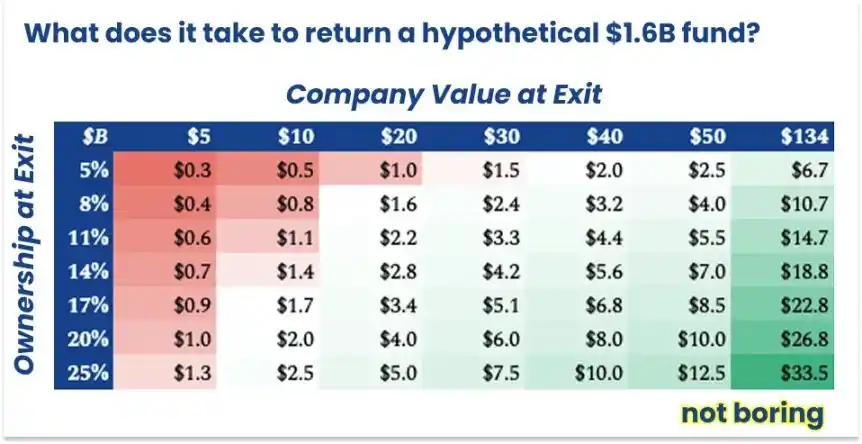
For illustrative purposes only... but indeed feasible
「I think, for them, the key is the ownership stake and the ability to help these companies achieve massive outcomes,」 Anne told me, 「It is these two points that make LPs confident in a large fund.」
It is also this ability to 'help companies achieve massive outcomes' that even the most sought-after founders are willing to offer a16z more favorable investment terms than other competitors. In just 2025 alone, there were multiple transactions where a16z invested at a valuation lower than other top-tier firms in the round. While I can't disclose specific company names, I learned that just last year, four well-known technology companies used this model during their fundraising.
In fact, founders highly appreciate the resources a16z can provide, so they are sometimes willing to accept valuations below market levels. This is a stark contrast to a16z's early days–at that time, competitors, unhappy with a16z's frequent high-priced competitive bidding, even gave it the nickname 'A-Ho.' The change today is enough to prove that working with a16z can bring real and tangible value, and companies are willing to accept a 'higher dilution ratio' as an exchange.
This means that although I mentioned two key groups earlier, ultimately, there is only one core group: if the very best founders are willing to work with a16z, the highest-quality LPs will naturally follow suit.
Can a16z enhance the development outcomes of its portfolio companies?
This is the core question, isn't it? We can express this with a hypothetical formula:
a16z's contributed market value percentage × Total affected market value
The key challenge of this formula is: in order to significantly increase the left-hand side's "Contribution Percentage," you must provide help when the right-hand side's "Total Addressable Market Value" is at its lowest (i.e., in the early stages of the company).
However, when you truly help a small business grow into an industry giant, the loyalty you receive is priceless—the founders will actively recommend you to other founders considering funding and will also speak up for you in media coverage.
Previously, I asked Erik Torenberg to help me connect with some a16z-backed founders. Within a few hours, he introduced me to founders of companies with a total market value of over $200 billion, including Ali Ghodsi of Databricks and Garrett Langley of Flock Safety.
I specifically mentioned these two founders because within 48 hours of connecting with them, two significant events occurred: Databricks announced a $40 billion funding round, reaching a valuation of $134 billion, and Flock Safety assisted in capturing the suspect involved in the murder of individuals associated with Brown University and the Massachusetts Institute of Technology (MIT). These two events vividly demonstrate the influence of a16z-backed companies.
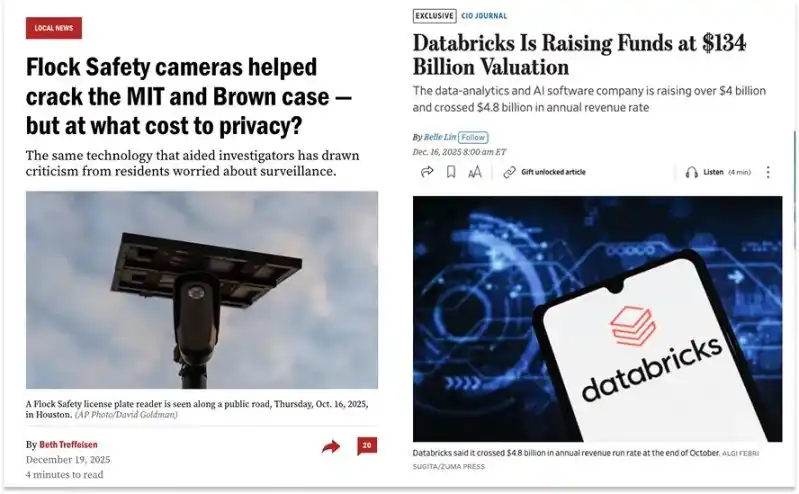
Source: Boston.com and The Wall Street Journal
But what I really want to understand is: how does a16z leverage its influence to support these companies? Has this support truly altered the trajectory of these companies? Has the resource ecosystem constructed by a16z, involving investments of hundreds of millions or even billions of dollars, really brought about significant changes for these companies?
To believe in a16z's wager in the third phase—namely, expanding the market size of tech startups, increasing the value of funded companies, and generating substantial returns for its $15 billion new fund—you may first need to believe that the answers to the above questions are affirmative.
And indeed, the answer is affirmative.
Recall that Ali from Databricks once stated: "Without a16z, there would be no Databricks today." With just this one company, it has added $134 billion (and counting) in value to the venture-investable market and brought about a net return of around $20 billion to a16z. Even if his statement is somewhat exaggerated, it is not difficult to argue: a16z's support for Databricks—from early sales assistance, facilitating collaboration with Microsoft, to helping establish specific departments—has already covered the value of all a16z's investments in platform building since its inception.
In fact, we can make an assumption: if a16z currently still holds about 15% of Databricks, a rough calculation shows that as long as a16z's contribution to Databricks' valuation reaches around 25%, it will cover the regular venture capital management fees it has charged since its inception.
All the founders I have interviewed have mentioned a consistent working model at a16z—a shadow of the innovative talent agency CAA—where no matter which General Partner (GP) you are working with, this model clearly shows: they do not intervene when not needed, allowing you to autonomously run your business; once you express a need, they will "all hands on deck" to provide support.
This is also the key way a16z wins investment deals: each fund's GP is responsible for deciding on investment targets, and when needed, they will mobilize all company resources—including Marc and Ben themselves—to vigorously pursue the deal.
"The ideal state of the company is 'delegated authority, shared belief, collaborative determination,'" David Haber told me, "Marc will basically say, 'As long as you tell me this is the next Coinbase, I am willing to fly anywhere in the world. I can invite this entrepreneur to my house for dinner tonight. Act immediately, at any cost.'"
After the deal is completed, the collaboration model between the GP and the founder remains the same.
"No matter what, their support is unwavering. a16z will even over-support me and the founding team, even if our views differ, they never interfere too much," Ali said, "but as soon as you need help, they will all-in to ensure the problem is resolved."
Of course, a16z's support for Databricks is such, and I have heard the exact same sentiment from several other early-stage a16z-backed companies.
CEO and Co-founder of XMTP, a16z's cryptocurrency investment instant messaging protocol company, Shane Mac, told me via message:
"a16z has done a lot, like most venture capitalists. But I think more important is what they 'don't do':
They never micromanage; they don't engage in short-term speculation; they never let me waste time. Every resource they introduce has changed the trajectory of our company. They made me believe more in myself, made me realize that I too can build such an ambitious business, and together we can change the world."
I think this is what they do best: believe in me and push me beyond my self-imposed limits.
The founders of the "Stealth Company" (which I reported on during a16z's investment at the end of 2024), Dancho Lilienthal and Jose Chayet, had a very similar experience—although they were working with a different GP (Anish Acharya) on a different team (AI Apps).
A few weeks ago, they had a Zoom call with Anish. At the time, they were anxious about the company's growth being "exponential steady" rather than "hypergrowth like other AI companies."
"We were worried that investors would think 'this company is growing too slowly, I don't want to spend more time on them,'" Dancho recalled, "and Anish looked at us through the screen and said, 'Guys, unless I die or get fired, I will support you all the way. Whatever happens, I'm here.'"
They described this "hands-off, but there when needed" approach as:
"It's like the ideal image of perfect parents—there when you need them, taking care of you, making sure everything goes smoothly; and when you don't need them, they don't interfere, they don't disrupt you."
This approach is both excellent and has a clear design intent.
Joe Connor, founder of Odyssey (a company focused on the "school choice platform," which received investments from both a16z and Not Boring Capital), said he doesn't seek day-to-day operational advice from a16z, but "whenever I need to connect with anyone anywhere in the world, as long as I message Katherine, I can make that connection."
Although a16z can help companies connect with experts in any field worldwide, it explicitly states that it does not interfere with company operations. In a 2014 Harvard Business School (HBS) case study, Marc once said, "We are not the 'training wheels' for startups. Companies must do what they can do themselves; we won't do it for them."
The goal of a16z is to provide companies with "credibility" and "influence."
Over the years, a16z has provided various services. Alex Danco, who has delved into these issues, told me, "What is the most important service we offer now? It's recruiting support and sales and marketing support. Why these two? Because these two areas need 'credibility reserves' the most, and a16z's core role is a 'credibility bank.'"
Alternatively, as Marc put it, "What you want from venture capital is influence."
Joe gave me two examples.
Some time ago, when Odyssey was still in its early stages, they faced a Stripe-related issue that couldn't be resolved through regular channels. "a16z helped me get in touch with Patrick Collison, and the problem was immediately solved," he said. "Every time I sought help, I was never turned down. Stripe is valued at around $95 billion, while our valuation was almost negligible at the time, but we are all part of the a16z ecosystem, and everyone supports each other."
Even outside the a16z ecosystem, the name itself carries a lot of weight. Odyssey's clients are state governments, whose employees may not even be able to name three venture capital firms and simply do not care about venture capital. But Joe said, "They know a16z, they know Marc and Ben. When we didn't have a track record, and states couldn't choose us based on past experience, a16z's endorsement gave states confidence — confidence that we could deliver on our promises, confidence that we had excellent technology as advertised because an institution that invested in Stripe and Instacart endorsed us."
In October 2024, Odyssey won the $1 billion Texas Education Savings Account (ESA) program operating contract — the largest of its kind in the US. Today, Odyssey has earned credibility through its own efforts.
This is a concrete manifestation of "building credibility" and demonstrates the scalability of credibility. For the vast majority of market participants who do not closely follow Silicon Valley's dynamics, establishing credibility requires "scale support." The more successful a16z's self-promotion is, the stronger the credibility of its portfolio companies in the eyes of potential customers, partners, and employees.
"If our company does all sorts of amazing things but no one knows," Ben asked in his article "It's Time to Lead the Industry," "did we really achieve them?" Clearly, a16z's marketing targets founders — they need to understand what help a16z can provide. But at the same time, a16z's marketing targets all the entities that founders may collaborate with in the future.
Marketing
For this reason, investing in building a top-tier in-house media team is itself entirely rational.
Some attention is cheap and lacking in novelty, while the goal of the media team is to make attention have tangible value. The team operates a comprehensive internal media system: building and operating high-quality owned channels (covering X platforms, YouTube, Instagram, and Substack), planning product launch events and timeline takeover events (referring to concentrating platform content dissemination within a specific timeframe), and directly deploying personnel to support portfolio companies at key stages of development.
「We've recently been facing some PR challenges.」 said Garrett Langley of Flock Safety to me a few weeks ago — back when his company hadn't yet helped solve the murders at MIT and Brown, nor quickly turned around its PR situation. 「While most of the firms on the investor list just suggested ideas, a16z took real action. Erik and his team got directly involved, no beating around the bush. They are now part of our Slack workspace, participating in crafting our positioning and brand documents. Just this week, we also recorded a podcast with Ben. Having a reputable and prestigious brand like a16z speak up for our business is crucial for market awareness and employee morale.」
During times of smooth company development, such as the dynamic early startup days, they also provide support. Legendary computer scientist and World Labs founder Fei-Fei Li said: 「Four weeks before the launch of our 'Marble' product, their new media team proposed a creative idea I had never seen before — shooting a launch video on a 3D LED virtual stage, while generating the scene environment in real-time through our own product. From cinematic video production, behind-the-scenes documentary filming, launch event planning, to liaising with thought leaders in the visual effects (VFX) field, they collaborated deeply with us throughout. The final product launch received wide attention. At that time, we had not yet built our own marketing capabilities, and they helped us lay the foundation for our marketing system. This kind of comprehensive support that extends from creative conception to enterprise building is simply unparalleled elsewhere.」
I admit I may be somewhat biased, after all, these people are my friends and long-term partners, but they are indeed the top practitioners in the industry.
For a long time, Erik has been dedicated to building a new media institution, which is why I initially invited him to participate in the production of "Era of Miracles." He also consistently believes that venture capital firms can have structural advantages.
I remember one time when Erik and I discussed his team-building approach, I never expected that he could recruit talent like Alex Freaking Danco.
If "writing is a technology of influence delivery" — a belief I wholeheartedly subscribe to, then having Alex Danco and the newly joined Elena Burger write for you and collaborate with you is undoubtedly a superpower that money can't easily buy. Nowadays, every company is scrambling to hire a "Chief Storytelling Officer," yet a16z keeps on absorbing such talent and radiating their capabilities throughout the entire portfolio of invested companies.
Additionally, I first met Erik and David Booth during my participation in the On Deck program in 2019. In the tech community, no one understands the value of "community building" as deeply as David does. Now, with more abundant resources and the opportunity to connect with top talent globally, he is putting his experience into practice—dedicated to transforming a16z into a more efficient "priority access" machine (note: referring to a positive feedback loop that attracts high-quality resources through resource tilt) and enabling the venture capital business to have network effects.
I realize my tone at the moment may be a bit too enthusiastic, and a16z has previously tried to lead industry narratives through projects like "Future," which unfortunately did not materialize. But two points need to be clarified: 1) From the economic logic mentioned above, a16z should indeed undertake 100 attempts like "Future"; 2) This platform team is the team I am most familiar with—after all, I am also engaged in related work myself, and I never thought I could tap into this talent. If other teams could reach this level as well, I would be more convinced: a16z is indeed building a machine with a compounding advantage, an advantage that is difficult for a single company to independently construct.
Every fund used to narrate the stories of the company itself and its portfolio companies radiates its value across multiple dimensions, with the cost ultimately spread so thin across each dimension that it is almost negligible. Moreover, regardless of how much a16z invests, as long as these investments help them capture more companies like Databricks, Coinbase, Applied Intuition, Deel, Cursor (or other a16z portfolio companies you recognize), all investments are worthwhile.
This is the economic logic that a16z follows in all its operations. This logic is identical to the logic the company applies to investing in startups—"you will at most lose the amount of capital invested, but the potential returns are almost limitless"—and it is now applied to every decision the company makes.
For a16z, building a system that most portfolio companies need (but is not their core business) makes much more sense than having a single company construct it independently—at least until the company has developed to a scale large enough.
Talent Recruitment
From practical feedback, every founder I interviewed mentioned that a16z's support in two areas was particularly crucial: talent recruitment and sales.
Since its inception, talent recruitment has been a core part of a16z's services. Initially, Marc and Ben recruited Shannon Callahan from Opsware; subsequently, Shannon convinced Ben to hire Jeff Stump as the head of talent, and together they built an early-stage venture capital field's "invaluable" talent team.
"In terms of scale and quality, they are not even in the same ballpark." Ali, when comparing a16z to other VC firms' talent teams, said, "Other organizations might just be 'helping out on the side'—like hiring a few people to assist with your recruiting; whereas a16z has a professional recruiting department whose core responsibility is to achieve recruiting goals, with KPIs focused on successfully attracting candidates and curating a top talent pool for you."
Founders at different stages of development have all told me that this talent team can support a company from its early stages to maturity.
Cursor Co-founder and President Oskar Shulz mentioned in an email: "a16z's scale allows them to provide assistance across multiple functional areas," with the most critical ones being "engineering/research recruiting, executive recruiting. Other smaller-scale organizations simply do not have the resources to offer us a comprehensive view of the talent landscape."
Here, "resources" also include General Partners (GPs). In a recent conversation between a16z AI Infrastructure team GP Martin Casado and Cursor CEO Michael Truell, the two mentioned that Martin would use his evenings and weekends to recruit talent for Cursor. "Get your board members involved in communication until they 'raise their hands in surrender'," Truell joked, "make full use of their time."
Qasar Younis, Co-founder and CEO of Applied Intuition, valued at $15 billion, said, "Many of our early employees, including the company president, come from a16z referrals. The number two person in the finance department also comes from a16z. Even several a16z employees have joined Applied Intuition, such as Matthew Colford—he was an early member of a16z's government affairs team."
Deel Co-founder and CEO Alex Bouaziz mentioned that as the company expands and gains more weight in the a16z portfolio, they are receiving increasing support:
"Since we started working with a16z, Shannon Barbour (Executive Talent Partner) has been like a member of our recruiting team. We worked closely with her and Jeff Stump on executive recruitment—like when hiring a CFO, Ben personally interviewed all the candidates, which was amazing. The CFO we targeted (Joe Kauffman) is extremely capable and demanding, and Ben and Anish helped me successfully persuade him. Anish would message him, and Ben would also message him."
Today, Deel's Annual Recurring Revenue (ARR) has surpassed $1 billion, and the board is preparing for an IPO. "a16z helped us recruit two out of three independent directors—Francis deSouza (former COO of Google Cloud, board member at Disney) and Todd Ford (former CFO of Coupa, board member at HashiCorp). They are responsible for talent scouting, deep due diligence, background checks, and referrals, dedicating significant time to become our true strategic partners."
Sales Support
Whether in the early or late stages of company development, a16z's sales support is equally important, including both direct support and indirect empowerment.
Astro Mechanica, a portfolio company of a16z's "American Dynamism" practice and Not Boring Capital (which I reported on in April 2024), highlights the criticality of both direct and indirect support in expanding the company's presence in the defense sector.
"When introducing to government partners, no other fund has the credibility and brand recognition like a16z—especially within the Department of Defense (DoD)," said the CEO and Founder Ian Brooke. He emphasized the value of indirect support. In terms of direct support, "a16z ensures they establish influence within government bodies to facilitate key introductions for us, such as connecting us with entities like the U.S. Air Force Rapid Capabilities Office."
"The core of working with the government is building relationships with the right people and departments," he further explained, "and a16z intentionally fosters these relationships and proactively shares them with us. A senior executive at the Defense Innovation Unit (DIU) once explicitly told me, 'We highly value a16z's recommendations and actively ask them, "Which companies should we engage with?"'"
Qasar's company primarily sells products to automobile manufacturers but has also gradually expanded into the defense and other "American Dynamism" related industries. He believes a16z helped the company successfully enter the defense sector: "Our first defense customer was connected through their Executive Briefing Center (EBC) activities." Applied Intuition receives precise referrals regardless of the industry. "Whenever I want to reach someone, Marc can connect me," Qasar said, "whether it's in defense, automotive, construction, or mining, he can establish the connection."
Of course, a16z can also provide support in software sales — this is precisely the company's core strength, where network effects and economies of scale shine.
Cursor's COO Jordan Topoleski stated that a16z invested in Cursor during its Series A round, and their sales support was demonstrated as follows: "In the first year of our partnership, the platform team introduced us to nearly 200 key target customers' Chief Technology Officers (CTOs). They held daily stand-ups with us, came to our office late at night to assist, and even dedicated a team to organize strategic meetings for us. When we were expanding into the financial services sector, they scheduled 34 executive meetings for us in their office within a week. They were like an extension of our Go-To-Market (GTM) team."
Taking Databricks as another example, 50% of the company's early sales were attributed to EBC support; and their transformative partnership with Microsoft was particularly reliant on Ben's drive.
Alex from Deel also mentioned that it was challenging to penetrate the enterprise market in the company's early days, but they are now acquiring large customers and facilitating partnerships through a16z's enterprise market platform and GTM team. Today, enterprise customers account for 10%-15% of the company's total revenue.
Alex and Garrett from Flock Safety both stated that in the early stages of company development, a16z indeed followed a "hands-off, but there if needed" approach; however, as the company scales, a16z's platform team embeds within the corresponding departments of the company — this approach allows founders to retain operational autonomy while effectively supporting business growth.
"For me, many times it's challenging to clearly tell investors what help I need," said Alex. "But when dedicated platform members embed within the team — like aligning the recruiting and GTM teams with our internal counterparts — the impact is much better than me actively articulating specific needs."
Garrett used the "VC Barbell Model" to describe a16z's support system:
"With some VC firms, you choose a specific GP (General Partner), and the institution itself becomes secondary. But I think a16z is the opposite — you choose the institution, not an individual GP. Although, technically, DU (a certain GP) is our board member, I communicate with Ben, David George (responsible for growth investments), Alex Immerman (also part of the growth team), Erik Torenberg (responsible for communications/branding), Stump (responsible for executive recruiting), and more — I could go on, but I think you get my point."
And this is just my personal touchpoint. Each member of our management team has a dedicated contact at a16z with a corresponding role. This level of support is crucial."
Deep involvement in the operational details of top-funded companies means a16z can, in various tangible and quantifiable ways, help companies grow at every level.
But more importantly, it also means that a16z knows these companies well enough to provide both "belief support" and "financial support" at critical moments.
Belief Support
Qasar Younis had a great experience collaborating with a16z. Marc, as a board member, was directly involved in company affairs—this situation is not common; and whenever support is needed, Marc and the entire a16z team are there to lend a hand, opening up their network to him.
“But,” he knocks on wood for luck while admitting, “we haven't yet faced a real crisis. I think an investor's response in a crisis is the true litmus test of their value.”
From this perspective, Garrett from Flock Safety and Alex from Deel have highly compelling feedback on a16z. As mentioned earlier, the New Media team embedded support when Flock Safety faced a PR crisis; and Alex also admitted that Deel faced a similar PR challenge last year.
Source: Axios
“As an institution,” Alex told me, “whenever there's negative media coverage, they firmly stand with us.”
I vividly remember this. At that time, Rippling accused Deel of engaging in espionage, almost immediately after the news broke, I saw Ben and Anish publicly supporting Deel on Twitter—I thought that was very ‘bold’ of them at the time.
Alex said: “They said, ‘We know who you are, how you work, your background, and your ethical standards, and we will support you.’ They not only took a public stance but also responded promptly. In private conversations, they also remind others, ‘Hey guys, you know Alex.’ When someone like Ben has all the details and has been following your specific situation for the last two or three years, the weight of that support is unparalleled.”
「Other investors also provided support,」 he added, 「but a16z's support was clearly superior. They would take the initiative to help me strategize, bring in the most professional people to assist me, and even personally dive in to solve problems. During that chaotic period, I couldn't find a more reliable partner than them.」
If you can't stand up for the funded company, then what is the meaning of "hardcore credibility"?
Later, Deel's Annual Recurring Revenue (ARR) surpassed $1 billion; it then raised $300 million from new investor Ribbit Capital. Ribbit Capital must have conducted thorough due diligence and ultimately reached the same conclusion as a16z. Following this funding round, Deel's post-investment valuation reached $17.3 billion, $5 billion higher than its Series D valuation in February 2025 (pre-crisis). Of course, a16z participated in this funding round, as it has in every round, including secondary transactions.
「They are incredibly loyal investors,」 Alex stated, 「whenever there is a secondary equity transaction or other investors selling off, a16z will buy up as many shares as possible. They acquired all the floating Deel shares on the market because they are deeply involved in company operations and understand us well enough. Other investors on the market are not familiar with us—after all, Deel had never been publicly funded before.」
Furthermore, Deel once needed funding to acquire another company. 「Strictly speaking, our Series C funding was not a conventional financing round,」 Alex recalled, 「I wanted to acquire a company, needed funds urgently, so I communicated with several investors. But no other institution could act as swiftly as a16z—just tell them 'this acquisition will change the industry landscape,' and they will promptly inject $100 million for the acquisition.」
Alex revealed that thanks to this ongoing support, a16z now holds "over 20%" of Deel through several funds under its umbrella. This level of ownership is the result of a16z's unwavering belief and specific strategic support.
This precisely confirms the effectiveness of their model: deeply understanding the funded companies, working closely with them, and thus understanding these companies better than any other institution; being decisive and fully committed when others hesitate, while helping companies achieve a scale far beyond independent growth.
Engaging with founders, it is easy to see that working with a16z has had a direct and substantial impact on their business. However, similar to a16z's positioning in the policy field, its influence encompasses not only direct effects but also indirect empowerment—even founders outside a16z's portfolio can benefit from the industry changes it brings.
This means that a16z's support for its portfolio companies and the broader tech startup ecosystem is another way to push other funds to allocate management fees to "helping startup success" initiatives.
"Many of the early principles advocated by a16z have now become mainstream views in the venture capital industry," said Qasar from Applied Intuition. "For example, 'founder-centricity,' 'equipping GPs with a technical background,' 'building a platform team.' Looking back, institutions like Benchmark, Founders Fund, KP, Sequoia, Khosla, etc., all prided themselves on 'post-investment invisibility'—they would even explicitly state, 'You may never hear from us again,' and consider this model an advantage rather than a flaw. But now the situation has completely reversed: founders will actively ask, 'What else can you offer me? After all, I can get money anywhere.'"
"This is the industry imprint left by a16z."
As I wrote in the early 2024 article "Venture Capital and Free Lunch," I believe that management fees are "one of the most interesting capital categories globally" [11], and a16z holds a substantial management fee. This has also become one of the main points of criticism from the outside—the perception that a16z always wants to raise more funds because every dollar brings in management fee income annually, regardless of investment performance.
But perhaps a more worthy perspective is this: a16z's eagerness to raise large amounts of funds is precisely to invest a significant amount of resources in building a system to "help enterprise success"—a type of investment that almost no other capital is motivated to do, yet can significantly help its portfolio companies and emerging tech compete.
Initially, my collaboration with a16z's cryptocurrency team made me realize this; and in the process of writing this article, I became even more convinced: no other institution can, like a16z, use management fees in a long-term, sustained, proactive, and successful manner towards beneficial ends.
"In my view," David Haber said, "one of a16z's early structural advantages is that Marc and Ben had already achieved financial freedom and did not need to rely on salary to live. Therefore, they could focus long-term, allocate management fees to platform building, creating a compounding competitive advantage. We still adhere to this trade-off: rather than paying high wages and bonuses to employees like many funds, we choose to invest in the company itself, allowing the advantage to compound over time [12]."
You can invest $1 billion in LP (Limited Partner) funds to build a system that helps all invested tech companies succeed; with just Databricks alone, this investment can generate multiples in returns; and the subsequent successes of every company like Coinbase, Applied Intuition, Deel, Cursor (or any other a16z-backed companies you can think of) will continue to yield returns for this system.
As a result, today all major venture capital firms are attempting to build a similar system. This means that founders can access billions of dollars in funding, along with hundreds of savvy and well-connected professionals working for them — helping them replace entrenched industry giants, reduce resource waste, address existential threats, shrink the global distance, ensure security, and achieve all the goals that technology should deliver for the future.
And this is precisely the core significance of the a16z model.
The Future of the Future of Enterprise
Today, a16z has over 600 employees, with a high rate of new member additions. When anyone joins, they must sign the company's "Culture Doc."
Although everyone at the company reads this document, Katherine Boyle believes, "We haven't given it the attention it deserves."
"There is a line in the document," she says, "the third item: We believe in the future and are willing to bet big on the company. Katherine strongly agrees with this statement. In her view:
"Everyone in Silicon Valley misunderstands the meaning of this statement. It means we will never do anything that is bearish on the future. That's why sometimes, compared to other bearish organizations, we may look like 'fools.' But our Culture Doc explicitly states that no one can bet on the future to fail.
I actually think this statement should be the first item. No other organization can make such a commitment. Other organizations will send out memos saying, 'A macro crisis is looming,' but 'believing in the future and betting big on the company' is precisely the original intention Marc and Ben founded this company with.
Marc and Ben are not afraid to look 'foolish,' but if anyone bets on the future to fail in any area, they will definitely be fired."
Wholeheartedly and unreservedly believing in the future can be seen as either charmingly naive or vacuous, depending on one's perspective.
A few years ago, before I delved deep into a16z, I also thought that this statement was at least partly vacuous. Weren't they just "elephant hunters" (referring to investors focusing on potential unicorn startups)? Just wanting to win, after all. Packaging oneself as the "future," and packaging oneself as the "American flag" are no different.
From an external perspective, a16z seems to be trying to build one of the world's largest financial institutions. This impression partly stems from the fact that — the assets under its management have exceeded $90 billion, which is undoubtedly a hefty sum to me.
When comparing the fund size of a16z to large financial institutions like Apollo and Blackstone, David Haber pointed out that a16z's scale is still relatively small—Blackstone manages $1 trillion in assets, and Apollo is also about to reach this scale.
In terms of the power of compounding, economies of scale, incentive mechanisms, internal operations, and how to operate a global financial institution, there is much that a16z can learn from these giants. At first glance, these institutions today bear resemblance to what a16z aspires to become.
However, I believe there is a fundamental difference between the two.
Apollo and Blackstone don't actually "believe" in anything—they are financial institutions with the goal of creating financial returns. This is not a problem in itself: the economy needs the services they provide, and they excel in this respect.
But a16z is "believing." It is building a company that aims to create a better future through technology, with finance being just a means to that end. Like any legitimate tech company, it continues to compound and optimize during its growth. It has the ability to mobilize more and more resources and influence, striving towards a future it believes in—even though the specific form of the future is currently unclear.
Painting the details of the future is the duty of entrepreneurs. They provide specific direction, while a16z provides the support of faith.
As our call was about to end, I asked Ali: after over a decade of working with a16z, what does he think is the biggest misunderstanding the outside world has about this company? He almost hesitated.
"Ben and Marc are true believers," he said. "If you can't see it from reading their blog, then I can say that their faith in technology has even reached a 'paranoid' level. They genuinely believe that technology can fundamentally change the world, and in every startup they are involved in, they view the future from this perspective—seeing the maximum potential these companies can achieve."
Looking back at a16z's journey, it is essentially a "history of skepticism": everyone thought Marc and Ben were doing venture capital "the dumb way"; after waiting for about a decade, they saw the results and realized they were right; then everyone followed suit, but missed out on all the compounding advantages a16z had accumulated during the "decade of skepticism" from competitors.
And this cycle continues.
When the fund size was only $300 million or even $1 billion, this model's success was not surprising, but it definitely won't work at such a large scale.
It’s not surprising that early success in the social networking space would not translate to success in cryptocurrency, American Dynamism, or artificial intelligence.
However, up to this point at least, the a16z model has succeeded in the vast majority of cases.
When a16z chooses to believe in something, its conviction is greater and more enduring than that of anyone else. It has the resources to be patient and understands that such unwavering commitment will eventually pay off — a fact it also has the resources to validate.
Whether you think their judgment this time is right, whether you agree with their ideas, whether you like their methods, Marc, Ben, and the team they have built at a16z genuinely believe they are working for the future and, in the process, for all of us.
Although it may sound somewhat unusual, among all the VC models I have seen, their approach can be considered a paradigm of “humility”: if a group of extremely intelligent people are passionately interested in something, that something is highly likely to be worth the passion. Follow their lead, even raising an entire fund to follow them before others realize “there is an opportunity here.”
You may not agree with this model, and indeed you should question it! There is no one correct path in venture capital, but you must have something you believe in.
However, you may not want to pass judgment on it without understanding the “rules of the game” a16z is involved in, without understanding the “bets” it is placing.
One of a16z's core bets is: technology will occupy an increasingly large share of the economy, and when this trend occurs, the scale of emerging companies will be 10 times or even 100 times that of the traditional companies they replace. This is a foundational judgment that any bold venture capital fund can make.
But another bet by a16z is more unique: it believes it can accelerate this future through policy advocacy, platform building, and resource aggregation, making the future arrive sooner and in a more grandiose and perfected form; all while helping its portfolio companies win in the competition. Based on my conversations with a16z founders, this bet seems to be paying off now — and it is an extremely asymmetric bet in terms of risk and reward: every success adds more capabilities to the firm; the whole system grows exponentially like a snowball, achieving compound growth.
In my view, combining the first two bets, the most interesting bet placed by a16z turns out to be the most “obvious” one — as long as you shift your perspective to see it.
Venture capital firms can also, like almost all other types of companies in the world, get better as they scale.
If this assessment is correct (I believe it is), then a16z's brightest days are ahead.
This is undoubtedly a good thing, and I admire this group of people.
But the truly magical thing about a16z's "product" is this: as it scales, it actually gets better—each new tech startup that partners with it, and even many that don't, can leverage its scale to grow as it accumulates more resources, skills, connections, and influence.
If a16z succeeds, the world will see this: tech startups competing on a more level playing field with industry incumbents, ultimately letting the "best product win."
If a16z succeeds, the world will see this: from energy to AI, from cryptocurrency to autonomous vehicles—every layer of the tech stack, emerging technologies can more quickly and deeply integrate into the economy, creating greater impact.
If you, like me, believe that "emerging technology can offer humanity tools to make the world a better place," then a successful a16z world will be a world that arrives earlier and is more abundant.
a16z is working towards the future. If its assessment is entirely correct, then the best days for all of us are also ahead.
Appendix: Performance-Related Important Disclosure Statement
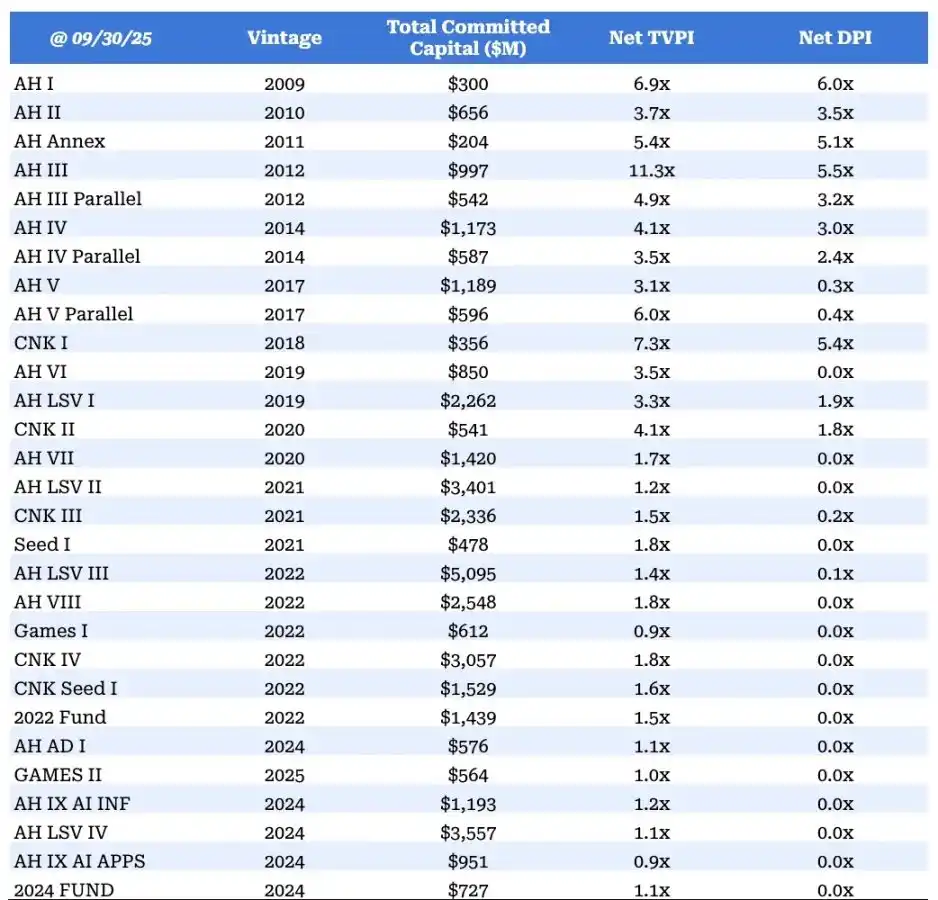
This appendix is for informational purposes only and does not constitute an offer to purchase interests in any fund managed by a16z Capital Management, LLC (hereinafter "ACM"). The information in this document should not be construed as legal, tax, investment, or accounting advice and should not be relied upon in any form. Investing in any fund managed by ACM involves high risks, including the risk of losing the entire investment amount.
Unless otherwise indicated, all data is as of September 30, 2025. All performance data, valuations, and fund summaries contained in this document are unaudited and may change. Past performance is not indicative of future results, and there is no guarantee that any fund or investment managed by ACM in the future will achieve similar performance. Additionally, due to significant differences in market environments, investment strategies, and other factors, the performance of future ACM funds is not comparable to the performance of existing funds. No individual investor or fund has achieved the investment performance shown in this document.
The gross performance and net performance data provided in this article do not represent, nor should they be a substitute for, the actual performance of the funds managed by ACM. Performance data for certain funds reflects the use of leverage, fund-level credit, capital call bridging, or similar credit facilities; if calculated using capital call bridging instead of initial capitalization as the starting point, the performance data would be different and could be lower. The performance data includes the performance of the "main fund" described in this article and all "feeder funds" (i.e., vehicles aggregating multiple independent investor capital primarily for investment in the main fund, often with no management fee or carried interest charged); excluding these feeder funds would result in lower performance data. The fund performance does not include the performance of ACM Bio and Health Strategy Fund, Cultural Leadership Fund, single-investor vehicles, or Special Purpose Vehicles (SPVs) unless otherwise noted.
The performance data includes reinvested funds; excluding the reinvestment portion would lead to different performance data. The performance data reflects fee waivers voluntarily provided by the General Partner (GP); excluding these fee waivers would result in lower performance data. The investments and portfolio companies mentioned in this article do not represent all the investment portfolios managed by ACM, and there is no guarantee that the investments mentioned will be profitable or that future investments will have similar characteristics or achieve similar results. The performance data does not encompass all the investment funds managed by ACM. To view the complete list of investments made by ACM, please visit a16z.com/portfolio.
Total Value to Paid-in (TVPI) Capital Multiple: Represents a multiple of (1) the cumulative amount distributed to all Limited Partners (LPs) of the fund and (2) the sum of the fair value of all Limited Partner capital accounts at the end of the period, relative to the cumulative capital contributions of all Limited Partners of the fund. Net TVPI has been adjusted for the impact of management fees, fund expenses, and carried interest.
Distribution to Paid-in (DPI) Capital Multiple: Refers to the cumulative amount distributed by ACM funds to Limited Partners, relative to the cumulative capital contributions of all Limited Partners of the fund.
Fund-level Gross Performance Metrics: Includes cash, other assets, and liabilities held by the fund. Gross returns have been netted up for management fees, carried interest, and fund expenses.
[1] An analyst from a competitor estimated this ratio to be 7.5%, which closely aligns with actual data. a16z holds an average ownership stake of 8% in its portfolio companies.
[2] Pitchbook data shows that Founders Fund closed its Growth III Fund ($4.6 billion) and IX Fund ($0.972 billion) in 2025.
[3] According to Pitchbook data, the total U.S. VC fundraising in 2025 was $82 billion, with a16z accounting for $15 billion of that.
[4] Source: Valuation data from Pitchbook, as of September 14, 2025.
[5] Source: Ilya Strebulaev, Stanford Graduate School of Business Venture Capital Program, April 2025.
[6] Source: Based on Pitchbook data available as of July 31, 2025, excluding AI unicorns from mainland China and Hong Kong.
[7] Past performance is not indicative of future results. For important disclosures and information on fund returns, please see the appendix.
[8] Note to Insight Partners supporters: The firm's XII fund ($20 billion) raised in 2022 includes a buyout fund.
[9] For more information on "Late Stage Venture (LSV)," refer to a recent insightful conversation between David George, Patrick O'Shaughnessy, and Harry Stebbings.
[10] The a16z's 10th AI Infrastructure Fund raised $1.7 billion, with the example calculation in this article using $1.6 billion (for ease of calculation).
[11] "The core logic is simple: if large funds are confident that they will benefit from the growth of the early-stage tech ecosystem, then they have a reason to invest in all kinds of 'ecosystem-boosting' affairs. If you believe that tech is beneficial (I am deeply convinced of this), then using management fees to strengthen the tech ecosystem is like a form of 'charitable investment that can continuously generate returns.'"
a16z recently announced that it would "support candidates who align with our tech vision and values." Additionally, it has assembled a world-class cryptocurrency research team with the core belief of "having the opportunity to build an industry research lab that helps connect academic theory with industry practice." Subsequently, this team has developed and open-sourced several practical products based on research findings, including Lasso and Jolt.
For institutions with a long-term view, they have the economic incentive to support transactions with long return cycles and high uncertainty—a support dynamic that has gradually disappeared in today's increasingly rigid and slow-moving government and academic circles. For example, I would not be surprised if more venture capital-supported fundamental research and applied research labs emerge in the future."
[12] It should be noted that the compensation for the a16z team is quite generous, and there is no need to "feel sorry" for them. The key point is that a16z has chosen not to concentrate a huge amount of funds on a few individuals (enabling them to earn an "income sufficient to buy a galaxy") but to provide generous compensation to more employees, thereby building a compounding competitive advantage.
Welcome to join the official BlockBeats community:
Telegram Subscription Group: https://t.me/theblockbeats
Telegram Discussion Group: https://t.me/BlockBeats_App
Official Twitter Account: https://twitter.com/BlockBeatsAsia