USD1 Finance Playbook: Analyzing Lista DAO's Various Yield Farming Strategies for Efficient Capital Utilization
A few days ago, Binance Savings launched the USD1 Booster Plan, where the first 50,000 USD1 coins deposited could enjoy up to a 20% APY. The event was fully subscribed within half a day and additional quotas were added the next day. After experiencing multiple rounds of high volatility and liquidation shocks, the on-chain fund's risk appetite is changing. Compared to speculating on narratives, more and more users are starting to pay attention to a more practical matter: where can they obtain stablecoins at a lower cost to hedge risks, amplify returns, or engage in structured arbitrage?
This is precisely why USD1 liquidity is becoming crucial. When the stablecoin's yield window is clear enough, the market's first reaction is often not what to buy, but where to borrow cheaper and more abundant funds.
In the Binance and BSC ecosystem, Lista DAO is one of the core places that meet this demand.
Through ample USD1 liquidity and a mature lending market, users can obtain USD1 at a lower borrowing cost and deploy it into various yield avenues to achieve risk hedging, spread arbitrage, or robust yield management. Many people may seem to be participating in a savings plan, but what they are actually doing is making a clear asset-liability decision: using USD1 as the low-cost liability side and higher certainty yield products as the asset side.
This article will revolve around the core stablecoin USD1, dissecting how to obtain funds at a lower cost on Lista DAO and efficiently deploy them into different yield avenues.
Lista is Becoming the Capital Layer of the BNB Ecosystem
By 2025, Lista's positioning has significantly expanded from being a "liquidity staking service provider" to gradually becoming a comprehensive DeFi protocol covering modules such as lending, RWA, DEX, CDP, with the most tangible scale being its volume and capital anchoring capacity. Lista's total value locked (TVL) grew from $830 million to $3.3 billion throughout the year (an increase of approximately 298%) and peaked at $4.3 billion in October.
Lista Lending, launched in April this year, accumulated a TVL of over $1 billion within three months, reaching a peak of $1.99 billion and currently around $1.43 billion. BNB liquidity staking also expanded significantly, with the highest locked BNB quantity being approximately 1.3 million coins and a TVL of around $1.5 billion, now around 1.25 million coins (approximately $1.2 billion), representing a year-on-year growth of about 112%. New modules such as Smart Lending/Swap, RWA Markets, fixed interest rate/term loans have collectively transitioned it from a "single yield product" to a more complete fund routing layer, while the veLISTA governance mechanism continues to iterate in 2025.
Size does not equal safety, but it at least explains one thing: when the market needs to borrow cheap USD1 and quickly plug into external yield, Lista naturally becomes that entry point.
Yield Pyramid: Lista's Layered Logic
Today's moneymaking opportunities are increasingly resembling a balance sheet business. With the same principal, whoever can make it work repeatedly can push the yield above the mean. Lista DAO's shift happens to coincide with this turning point, transitioning from a simple borrowing protocol to a yield strategy router on the BNB chain.
Before diving into specific strategies, we first need to understand Lista's underlying logic. Its yield system is actually a layered pyramid:
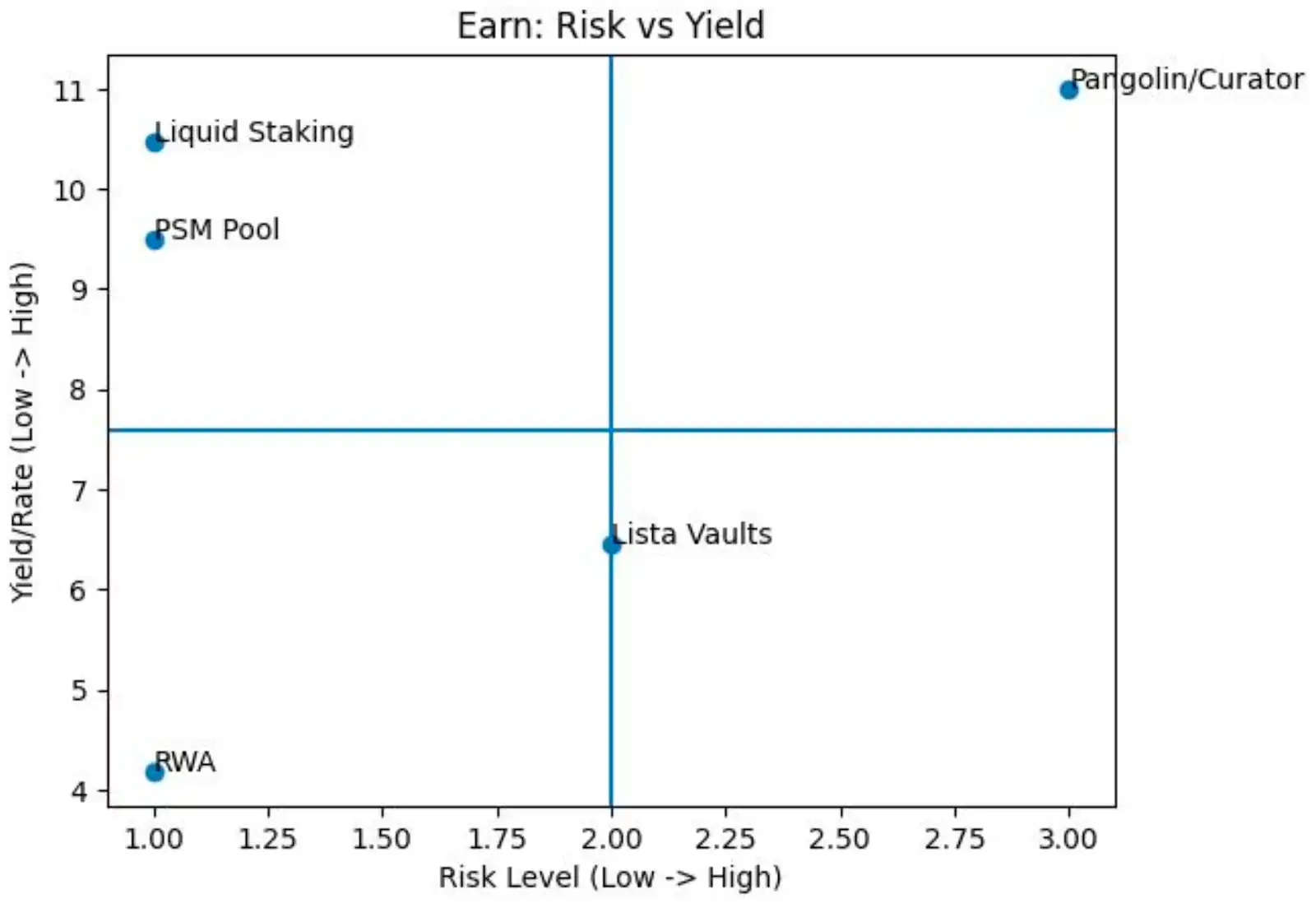
Base Layer (Low Risk): Represented by RWA and PSM (Peg Stability Module). The former provides a steady 3.5%-4.5% return, while the latter offers high yields of 7%-12% through the USDT pool.
Body (Low Risk → Medium Risk): The core is Liquid Staking represented by slisBNB, with a foundational form closer to low-risk BNB-based interest. The majority of the yield comes from staking and ecosystem incentives, with some volatility but a clear path. Moving further is the slisBNB/BNB leverage loop, which amplifies returns but also increases maintenance costs and liquidation risks. However, since it operates within the same currency system (strong price correlation, less slippage), compared to the top of the pyramid's cross-asset, cross-strategy leverage plays, the risk boundary remains more manageable.
Apex (High Risk/High Reward): Various Vaults, third-party strategies, and more aggressive looping structures. Yield doubling mainly happens here, but it also implies stronger strategy dependencies, higher liquidity constraints, and a more fragile risk transmission in extreme market conditions.
For players, the key is not what assets to buy, but how to operate the assets in hand.
Whale's Anchorage
For high-volume investors with million-dollar funds, the primary goal is not to pursue hundredfold Alpha, but rather asset preservation, inflation resistance, and stable appreciation at low risk. In the design of the Earn section of Lista DAO, a dedicated channel has clearly been set aside for these whales or institutional funds.
RWA and PSM: On-Chain High-Yield Savings
Against the backdrop of turmoil in the traditional financial markets, RWA has become the bridge connecting on-chain liquidity with off-chain stable assets. Lista DAO's RWA solution not only brings assets onto the chain but also provides a high-yield source anchored in the real world for large funds, with its historical APY maintained between 3.65% and 4.71%.
While this figure may seem low in the crypto world, considering the extremely low default risk of its underlying asset and the fact that its risk level is rated low, it is actually superior to most traditional bank large-scale deposit financial products. For those who wish to hold asset-backed assets and are averse to pure code risk, this is the ideal allocation. However, it should be noted that the redemption cycle of RWA is usually longer and not suitable for short-term high-frequency funds.
If you hold a large amount of USDT and want to maintain very high liquidity, the PSM pool is another great option, with a historical APY reaching an astonishing 7%–12%. This yield is highly competitive in stablecoin financial management, and the logic behind it is to maintain anchoring through the isUSD and USDT exchange mechanism, with relatively manageable risk.
Although the risk rating is low, investors still need to be wary of the slight possibility of isUSD experiencing minor deviation from its peg. In addition, the pool has a capacity limit, meaning it is a sought-after high-quality target, and large fund inflows and outflows need to pay attention to the depth of the pool.
Liquid Staking: A Must-Have for BNB Long-Term Holders
For long-term believers in BNB, leaving BNB in a wallet to sleep is a huge waste, and Lista DAO's liquidity staking provides a nearly perfect solution.
Historical data shows that its APY has remained stable at 8.95%–12%, with this part of the yield coming not only from node staking rewards but also highly dependent on ecosystem activities such as the BNB Launchpool.
· Target Audience: Whale holders with a large amount of BNB.
· Key Benefit: While enjoying the appreciation of BNB, you can get around 10% of coin-based compounding. Although unstaking requires a 7-8 day waiting period, for long-term holders, this is almost negligible in terms of time cost.
Third-Party Custodian Selection
When the fund size ranges from $100K to $1M and investors have a certain risk tolerance, simple coin staking is no longer sufficient to meet the demand. At this point, flexible use of lending and custodianship becomes crucial.
Lista DAO's custodian can be divided into two categories, directly corresponding to two different investment philosophies:
· Lista Curated Vaults: Managed by official selection, endorsed by a risk fund, although the yield fluctuates greatly, ranging from 0.1% to 12.82%, the advantage lies in safety and flexibility, suitable for investors who wish to earn market average returns on a capital-preserving basis.
· Pangolins, Third-party Vaults: This is a battlefield prepared for yield farmers, where third-party Curators often adopt more aggressive strategies such as leveraged yield farming, pushing historical APYs up to 4%–18%.
High yield comes with high risk, as it involves the complexity of underlying strategies. In the event of extreme market volatility, the risks of liquidity crunch and strategy failure will significantly increase. This requires investors to have the ability to discern Curator strategies.
Further reading: "How to Evaluate the Quality of a Curator?"
The Funding Efficiency Revolution of the Lending Market
In the Lending sector, Lista DAO has demonstrated high flexibility, as outlined below in order of risk level:
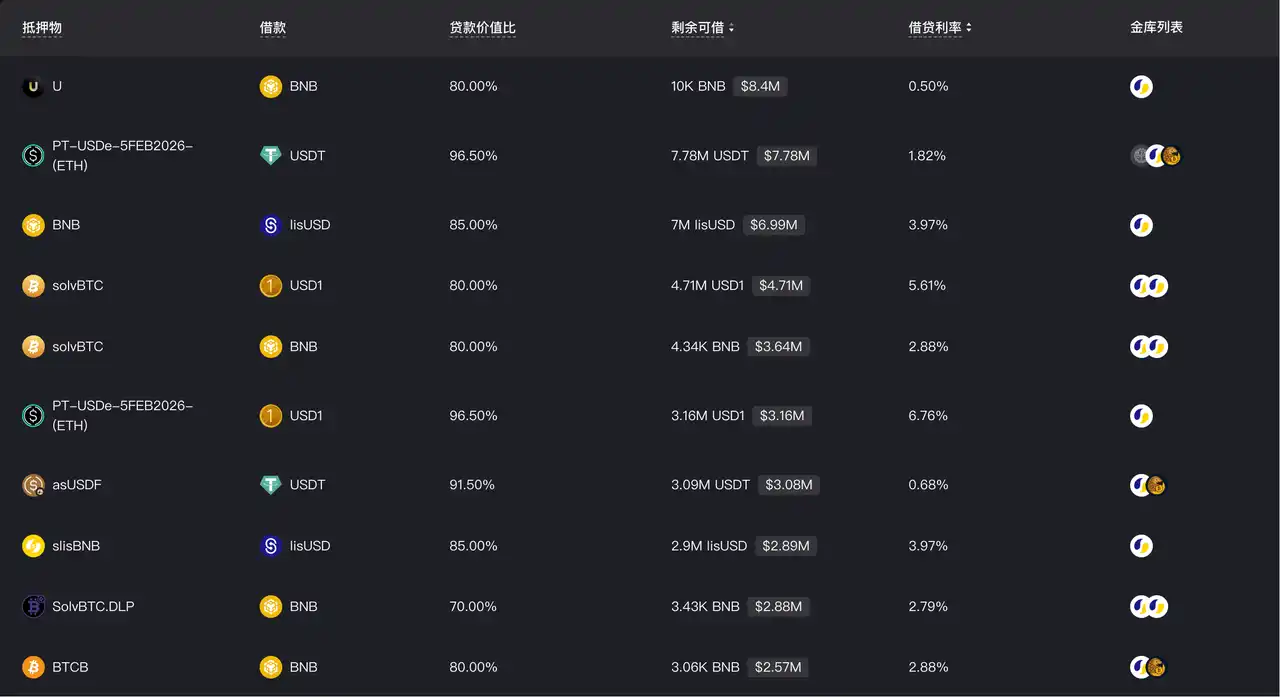
Fixed-Term Collateral
For long-term borrowers averse to market volatility and seeking cost-effective solutions, the fixed-term model is the best option due to its ability to lock in funding costs.
The current borrowing interest rates are maintained within the range of 4.93%–5.86%. Amidst the backdrop of crypto market rates fluctuating dramatically with the market, being able to lock a medium- to long-term fund at a fixed low rate is highly attractive to users engaging in cross-cycle investments or hedges.
This sector is more suitable for diamond-handed holders of mainstream assets such as BTCB, ETH, BNB, etc. If you plan to make a deterministic investment for 3-6 months, such as participating in a long-term staking mining, this model allows you to accurately calculate the interest cost, avoiding forced liquidation due to a spike in market borrowing rates.
Mainstream Collateral with Flexible Terms
If you need short-term revolving funds, or wish to adjust your position according to market conditions at any time, the flexible-term model offers extreme convenience.
The essence of this product is the ability to borrow and repay at will. With collateral in stable assets like BTC, ETH, or BNB, the system's risk rating remains at a moderate to high level. These assets have relatively small price fluctuations, so the collateralization ratio is usually healthier, leading to a lower probability of liquidation.
Suitable for day traders or hodlers, they use this portion of funds for short-term swing trading or initial coin offerings (ICOs), repay immediately after harvesting gains to minimize interest expenditure.
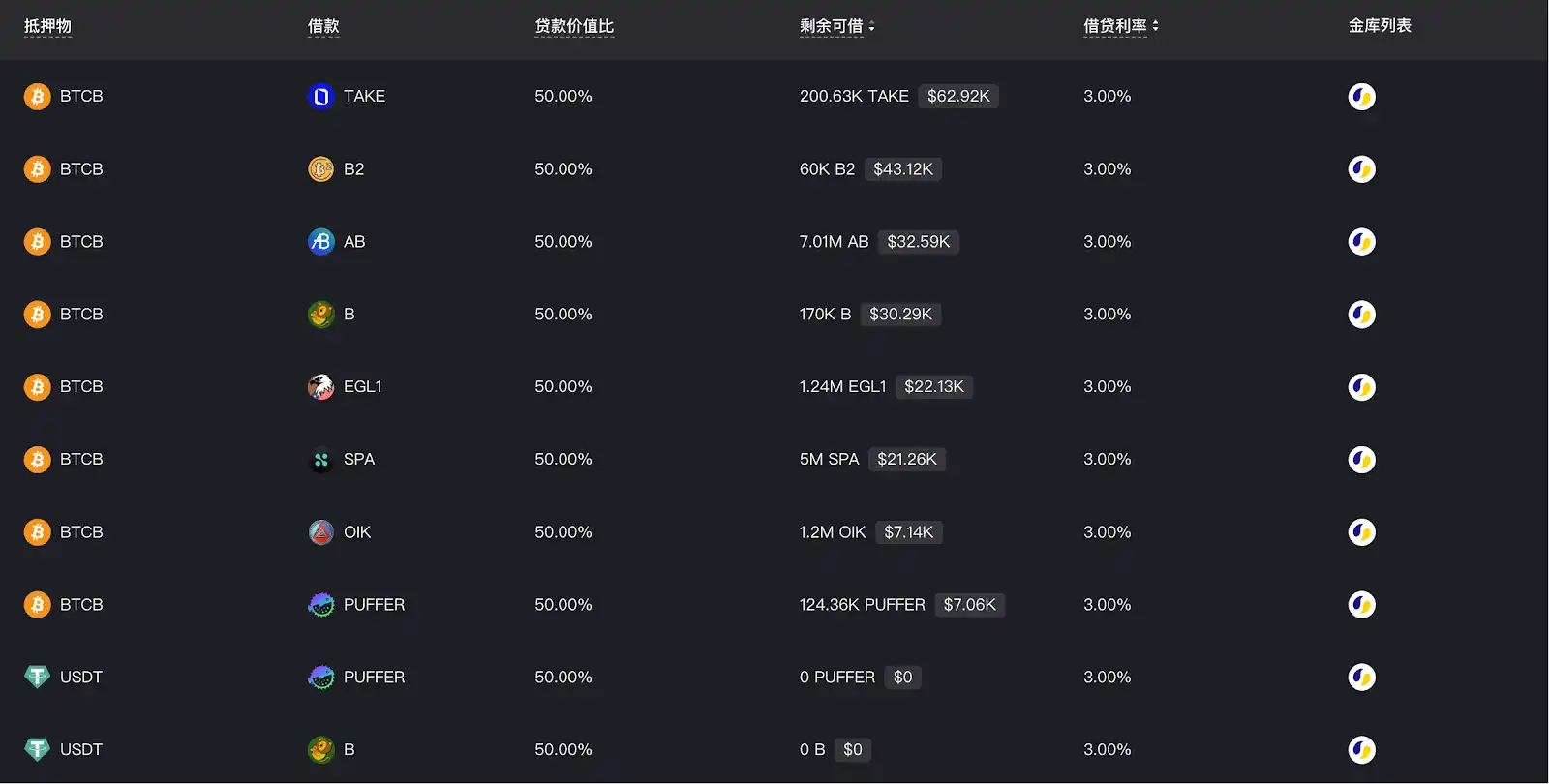
Innovative Collateral with Flexible Terms
This is the most differentiated area in the Lista DAO lending platform. This model allows users to use some tail-end assets or emerging tokens as collateral. In most DeFi protocols, these assets are usually considered illiquid and cannot be used as collateral, but in Lista DAO, they are given the ability to release capital efficiently.
The innovative section is a tool for professional players who are extremely familiar with the specific asset's volatility characteristics. They usually leverage this feature to add leverage before specific positive events or release liquidity for small-cap coins in long/short hedge strategies. For these users, due to the high volatility of the collateral itself, they must monitor the LTV ratio at all times to prevent asset liquidation caused by sharp market movements.
How to Achieve a 25% APY Through a Loop Strategy?
This is the core part of this article. For investors with medium to high risk tolerance, Lista DAO is not just a financial management platform but also an on-chain leverage tool. Through a reasonable loop lending strategy, we can artificially create a positive interest rate differential and amplify capital efficiency.
The so-called loop essentially utilizes the interest rate for borrowing lower than the yield for pledging, through the operation of repeated pledging, borrowing, and re-pledging to amplify the principal. Next, we will break down the operating modes of two mainstream assets, BNB and stablecoins, to explain how to achieve a 24% APY through a loop strategy.
Strategy 1: Binance USD Deposit Strategy (Earn 25% Yield Through One Borrowing)
Earn 28% APY on PT-USDe on Lista Lending. Currently, the estimated APY of the PT-USDe loop strategy model on Lista Lending is approximately 19.01%, achieved through low borrowing costs overlaying USD1 vault income. And any collateral can follow the strategy below.
Operation steps:
· Buy PT-USDe-9APR2026 with USDe (+5.54%)
· Deposit PT-USDe and borrow USD1 (-1.87%)
· Exchange the borrowed USD1 for USDe on any DEX, then repeat the above process
· At the end of the cycle, deposit the borrowed USD1 into Binance's mentioned USD1 Earn account (+20%)
Strategy Two: Maximizing BNB Returns (Up to 24% APY)
If you are a strong believer in BNB and optimistic about the long-term development of the Binance ecosystem, the following two sets of strategies can maximize your BNB returns.
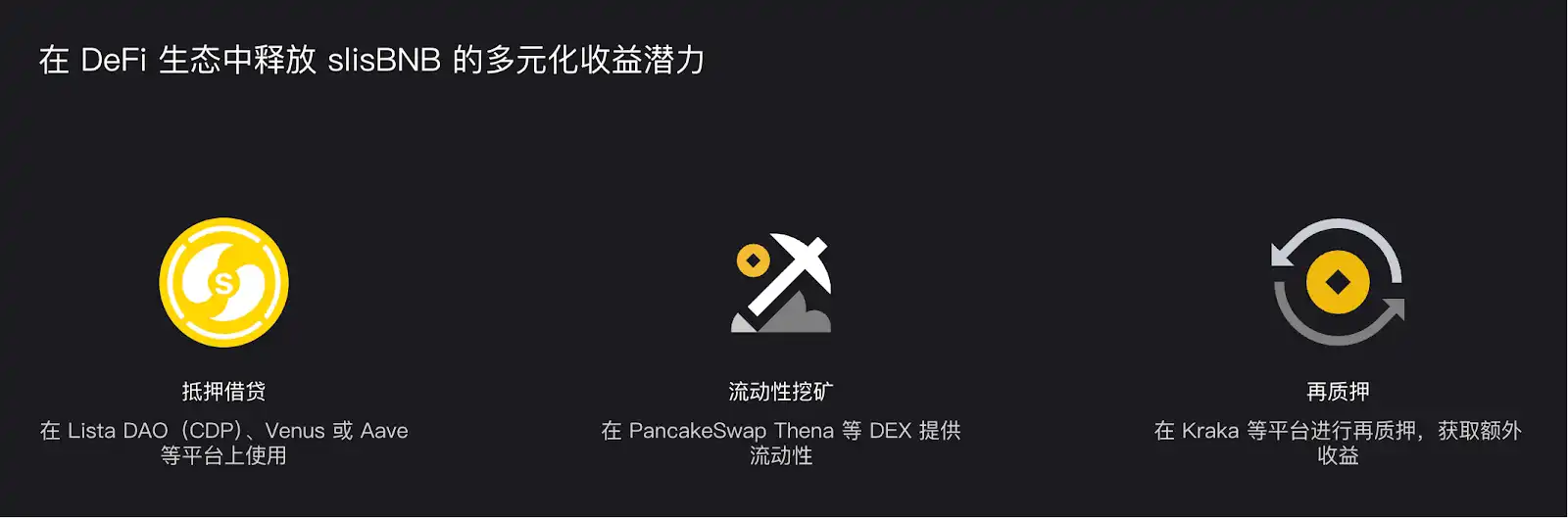
slisBNB/BNB Pure Coin Loop (Medium Risk)
Target APY: 1x 7% → 2x 14% → 3x 21%. Users pay 3.72% interest to earn over 10% in returns, with the approximately 6% interest rate differential leveraged 3 times, ultimately achieving over 20% in annualized returns.
Operational Logic:
· Staking: Stake your BNB as slisBNB.
· Borrowing: In the slisBNB/BNB market, use slisBNB as collateral. Due to the high correlation in prices between the two, the highest liquidation threshold can reach 96.5%, meaning almost an equivalent amount of liquidity can be borrowed against each BNB collateral, significantly reducing capital erosion.
· Minting and Delegating: Investors pay approximately 3.72% in borrowing interest but can earn over 10% by minting slisBNBx and delegating it to the Binance Wallet, with about a 6% net interest rate differential as profit.
· Looping: Further use slisBNBx as collateral to borrow BNB, repeating the above steps 2-3 times. The 7% return at 1x leverage is linearly amplified to 21% at 3x leverage.
LP Liquidity Loop (Medium-High Risk, Yield King)
Target APY: 1x 8% → 2x 16% → 3x 24%. Borrowing costs decrease from 3.72% to 1.6%, further widening the interest rate spread, thereby reaching the theoretical return ceiling of 24% at 3x leverage. This is one of the most capital-efficient strategies in the current BNB ecosystem.
Similar to the pure coin loop, but this strategy utilizes the LP of the slisBNB/BNB in the smart lending market as collateral.
· LP Formation: Convert BNB into slisBNB/BNB LP Tokens.
· Super Low-Rate Borrowing: The borrowing interest rate in this market can be as low as 1.6%.
· Circular Arbitrage: Lend out BNB, mint slisBNBx (10%+ APY), and then recycle.
Strategy Three: Stablecoin Neutral Arbitrage
For those unwilling to take on BTC or BNB price volatility risk and holding only stablecoins like USDT, USDF, Lista DAO, in conjunction with the Aster and Solv ecosystem, has built a multi-arbitrage model to find a yield solution of over 10%.
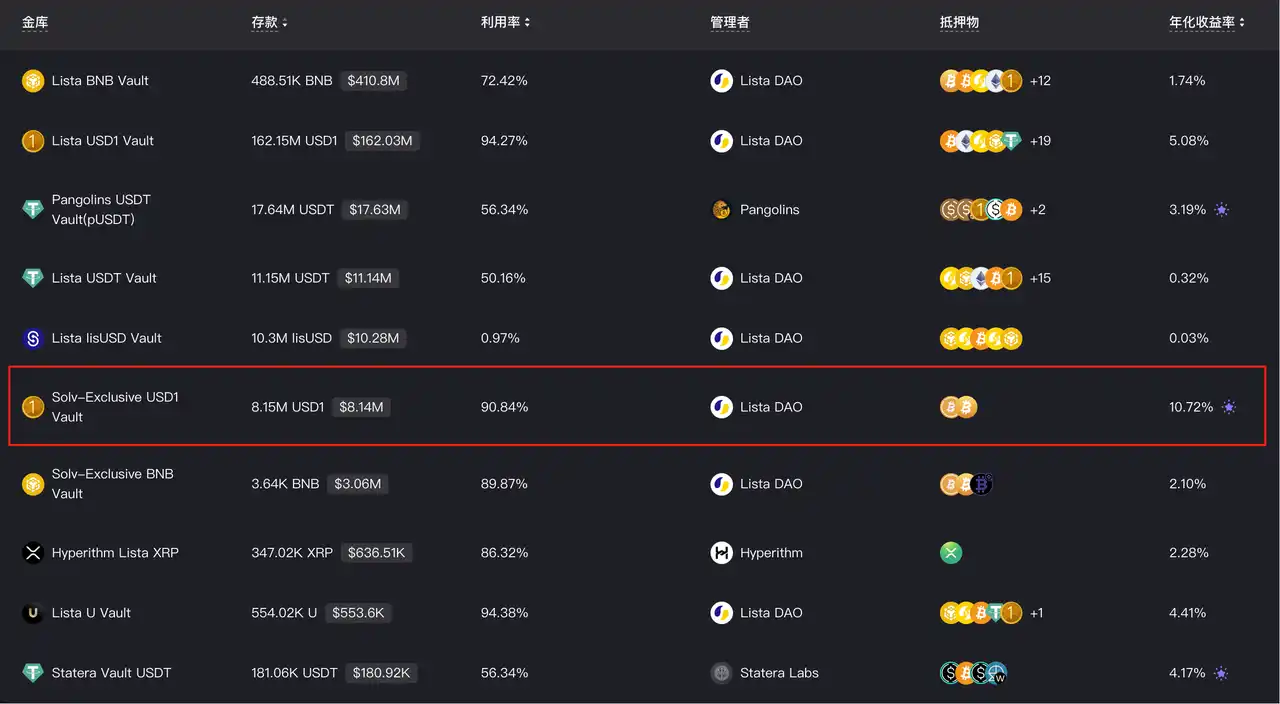
This is a classic arbitrage model where, as long as the borrowing cost (~2.5%) remains lower than the Solv treasury return (10%), each cycle earns a net interest difference of 7.5%. Through a 3x cycle operation, investors' overall return will jump from a 1x "2.6% (net spread) + 10% (treasury)" to around 17.8% (7.8% cycle spread + 10% base return).
Operation Logic:
· Base Position Pledging: Pledge USDF for asUSDF, locking in a base risk-free yield of 4.6%.
· Low-Rate Borrowing: Utilize the asUSDF/USDT or asUSDF/USD1 borrowing markets to borrow liquidity stablecoins (USDT, USD1) at a cost as low as 2%–2.5%.
· Path Selection: Deposit the borrowed stablecoins into the Solv exclusive USD1 Vault, which offers up to a 10% APY.
· Cycle: Repeat the "pledge-borrow-deposit in high-yield vault" process.
From Holding to Operating: The Divide in the Era of Capital Efficiency
After finishing the money-making strategies above, it is inevitable to ramble a few more words. Platforms like Lista DAO are not providing higher interest rates, but are driving a mindset shift, where assets are no longer just objects to hold but assets that need to be operated on a balance sheet.
Within these yields, the proportion of interest and incentives determines its sustainability. Interest comes from real cash flow, such as staking rewards, protocol fees, real demand, while incentives come from redistribution and subsidies. When the market enters a subsidy downturn, many high-yield opportunities claiming 20% will quickly return to the mean, while the leverage structure still retains liquidation and liquidity risks.
Therefore, the professional allocation is not about being conservative or aggressive, but about three types of capabilities:
1. Low Maintenance: accepting yield ceilings, prioritizing liquidity and certainty, sticking to base returns and relatively stable Vaults.
2. Position Management: willing to pay maintenance costs for capital efficiency, able to continuously monitor interest rates and collateral ratios, and adapt to compounding and leverage.
3. Strategic Understanding: able to understand strategies, accept liquidity constraints and execution friction, only then will they enter more aggressive third-party Vaults and multi-layered strategies.
In any fund operation logic, compared to the timing of entry, the strategic judgment of when to exit is often more fatal. As an investor, one should always maintain a keen awareness of the market environment, considering three key metrics as critical signals for withdrawal: when borrowing rates significantly rise, causing the positive carry trade to shrink to almost nothing, or when the collateral ratio approaches the liquidation red line but lacking 24/7 monitoring capability, or when noticing deteriorating market depth leading to a narrowed exit path, one should promptly end the strategy and withdraw funds.
After all, in the on-chain game, being able to identify risks and safely exit with profits is the ultimate loop of capital efficiency. Yield farming may seem like a skill game, but at its core, it is discipline.
Welcome to join the official BlockBeats community:
Telegram Subscription Group: https://t.me/theblockbeats
Telegram Discussion Group: https://t.me/BlockBeats_App
Official Twitter Account: https://twitter.com/BlockBeatsAsia