Bloomberg Recap: 11 Key Trades to Understand the Global Financial Markets in 2025

Original Title: The 11 Big Trades of 2025: Bubbles, Cockroaches and a 367% Jump
Original Source: Bloomberg
Original Translation: Saoirse, Foresight News
Editor's Note: After reviewing the ups and downs of the cryptocurrency industry in 2025, let's broaden our perspective: the pulse of the global financial markets often mirrors and intertwines with the logic of the crypto space. This article focuses on the 11 major key trades of the year, from cross-market trends to policy-driven asset volatility, revealing market patterns and risk insights that are equally valuable for crypto professionals to understand the full picture of the annual financial landscape.
It was yet another year full of "high conviction bets" and "rapid reversals."
From the bond trading floor in Tokyo, the credit committee in New York to forex traders in Istanbul, the market brought both windfalls and created intense volatility. The price of gold hit a historic high, shares of stable mortgage giants fluctuated violently like "meme stocks" (stocks driven by social media hype), and a textbook-level arbitrage trade collapsed instantly.
Investors made large-scale bets around political changes, inflationary balance sheets, and fragile market narratives, driving significant stock market gains, yield curve trades clustering, while cryptocurrency strategies relied heavily on leverage and speculation, lacking other solid support. After Donald Trump's return to the White House, the global financial markets first suffered a heavy blow and then rebounded; European defense stocks were ignited with enthusiasm; speculators sparked one market frenzy after another. Some positions reaped amazing returns, but when the market momentum reversed, funding channels dried up, or leverage had negative effects, other positions suffered devastating losses.
As the year draws to a close, Bloomberg focuses on the most notable types of bets in 2025 — including success stories, failures, and those holdings that defined this era. These trades left investors worrying about a series of "old issues" as they prepared for 2026: unstable companies, high valuations, and those "once effective, now ineffective" trend-chasing trades.
Cryptocurrency: The Fleeting Frenzy of Trump-Linked Assets
For the cryptocurrency space, a "massive buy-in of all assets related to the Trump brand" seems to be a highly attractive momentum bet. During his presidential campaign and post-inauguration, Trump "went all-in" in the digital asset realm (according to Bloomberg Terminal reports), driving comprehensive reform and embedding industry allies in various power structures. His family also joined the fray, endorsing various tokens and cryptocurrency companies, which traders saw as "political booster fuel."
This "Trump-Linked Crypto Asset Matrix" quickly took shape: hours before the inauguration, Trump launched a meme coin and promoted it on social media; First Lady Melania Trump then followed suit by releasing a personal token; later in the year, World Liberty Financial associated with the Trump family made its WLFI token available for retail investors to purchase. A series of "Trump-adjacent" transactions emerged—Eric Trump co-founded American Bitcoin, a publicly traded cryptocurrency mining firm that went public through a merger in September.

In a store in Hong Kong, a cartoon depiction of Donald Trump holding a cryptocurrency token with the White House in the background to commemorate his inauguration. Photographer: Paul Yeung / Bloomberg
Each asset's launch sparked a surge, but each surge was short-lived. As of December 23, the Trump meme coin performed poorly, dropping over 80% from its January peak; according to the cryptocurrency data platform CoinGecko, Melania meme coin saw a nearly 99% decline; American Bitcoin stock fell about 80% from its September peak.
Politics provided momentum for these trades, but speculative rules ultimately brought them back to square one. Even with "supporters" in the White House, these assets could not escape the core cycle of cryptocurrency: price surge → leverage influx → liquidity drought. As the industry bellwether Bitcoin, after falling from its October peak, is likely to record an annual loss this year. For Trump-linked assets, politics can generate short-term hype but cannot provide long-term protection.
—Olga Kharif (Reporter)
AI Trading: The Next "Big Short"?
The transaction was exposed in a routine disclosure document, but its impact was anything but routine. On November 3, Scion Asset Management disclosed holding protective put options on Nvidia and Palantir Technologies—these two companies are "AI core stocks" that have been driving the market higher over the past three years. Although Scion is not a large hedge fund, its manager Michael Burry drew attention with this disclosure: Burry rose to fame for "predicting the 2008 mortgage crisis" in the book and movie "The Big Short," becoming a market-recognized "prophet."
The Strike Prices of Options Are Shocking: NVIDIA's strike price is 47% lower than the disclosed closing price, while Palantir's strike price is a whopping 76% lower. However, the mystery remains unsolved: constrained by "limited disclosure requirements," the outside world cannot determine if these put options (contracts that give investors the right to sell stock at a specific price before a certain date) are part of a more complex trade; and the documents only reflect Citadel's holdings as of September 30, with the possibility that Citadel may have reduced or exited its positions after that date.
Nevertheless, the market's skepticism about the "overvaluation and high spending of AI giants" has long been accumulating like "a pile of dry wood." Citadel's disclosure is akin to a match igniting the dry wood.
Citadel's Bearish Bet on NVIDIA and Palantir
The investor made famous by "The Big Short" disclosed a put options position in the 13F filing:
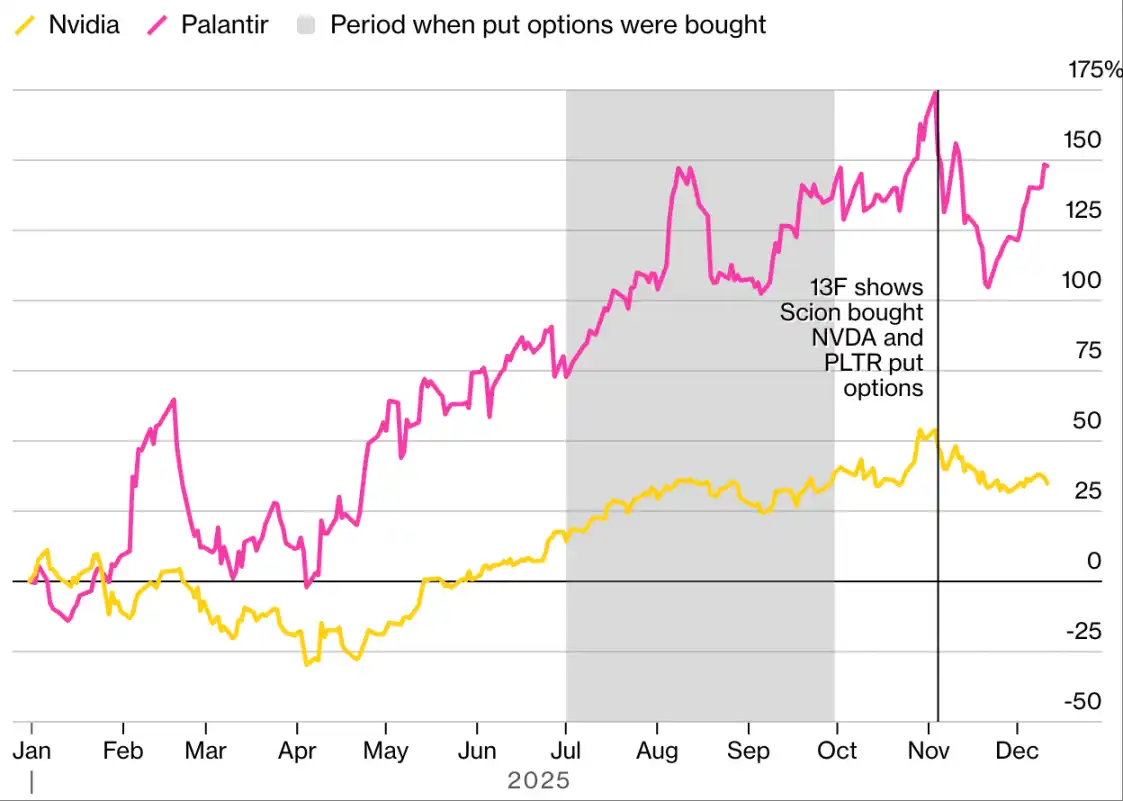
Source: Bloomberg, data has been normalized based on the percentage increase as of December 31, 2024
Following the announcement, the world's most valuable stock, NVIDIA, plummeted in response, while Palantir also fell concurrently. The Nasdaq index subsequently experienced a slight pullback, but these assets later regained lost ground.
The exact amount Citadel profited from this is unknown to the public, but he left a clue on social platform X: stating that he bought Palantir put options at a price of $1.84, with these options seeing a staggering 101% increase in less than three weeks. This disclosure sheds light on the doubts lurking beneath the market dominated by "a few AI stocks, a large influx of passive funds, and low volatility." Whether this trade ultimately proves to be "foresight" or "overeagerness," it confirms a pattern: once market confidence wavers, even the strongest market narrative can quickly reverse.
—Michael P. Regan (Reporter)
Defense Stocks: The Eruption in the New World Order
The shift in the geopolitical landscape has led to a surge in "European defense stocks," a sector that asset management companies once considered a "toxic asset." Trump's plan to reduce support for the Ukrainian military has prompted governments across Europe to kickstart a "military spending spree," causing a significant surge in the stock prices of regional defense companies: as of December 23, Germany's Rheinmetall AG has seen a gain of around 150% year-to-date, while Italy's Leonardo SpA has surged over 90% during the same period.
Previously, many fund managers shunned the defense industry due to Environmental, Social, and Governance (ESG) investment principles, considering it "too controversial"; now, they are changing their attitudes, with some funds even redefining their investment scope.
2025 European Defense Stocks Soar
The region's defense stocks surged more than during the early stages of the Russia-Ukraine conflict:
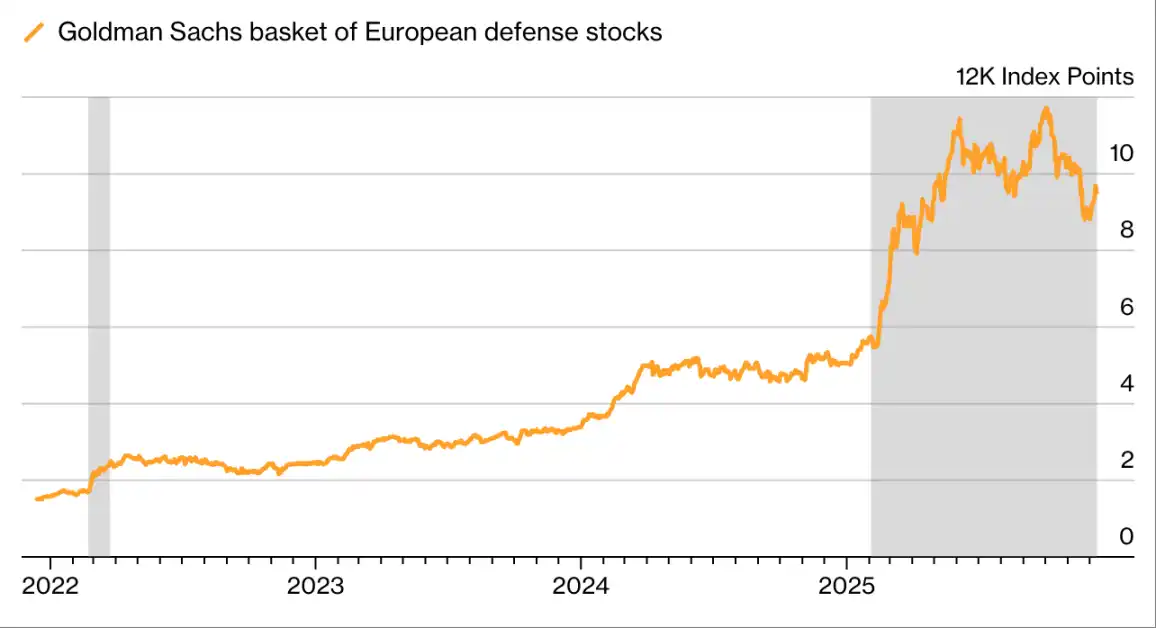
Source: Bloomberg, Goldman Sachs
"It wasn't until the beginning of this year that we reintegrated defense assets into ESG funds," said Pierre-Alexis Dumont, Chief Investment Officer at Sycomore Asset Management. "The market paradigm has shifted, and when paradigms shift, we must both take responsibility and defend our values—so now, we are focusing on assets related to 'defensive weapons'."
Stocks tangentially related to defense, from goggles manufacturers and chemical producers to a printing company, have been in high demand. As of December 23, the Bloomberg European Defense Stocks Index has risen over 70% year-to-date. This frenzy has also spread to the credit market: even companies "indirectly related" to defense have attracted many potential creditors; banks have even launched "European Defense Bonds"—following the template of green bonds, but with funds specifically used for weapon manufacturers and similar entities. This shift marks the repositioning of "defense" from a "reputational liability" to a "public good" and confirms a principle: when geopolitical shifts occur, the speed of capital movement is often faster than ideological transformation.
—Isolde MacDonogh (Reporter)
Devaluation Trade: Fact or Fiction?
The heavy debt burdens of major economies like the United States, France, and Japan, along with a "lack of political will to address debt," have led some investors in 2025 to seek shelter in assets resistant to devaluation, such as gold, cryptocurrency, while cooling their enthusiasm for government bonds and the dollar. This strategy has been labeled with the bearish tag of "devaluation trade," drawing inspiration from history: rulers like the Roman Emperor Nero diluted currency value to address fiscal pressures.
In October, this narrative reached its peak: concerns about the U.S. fiscal outlook, combined with the "longest government shutdown in history," prompted investors to seek safe havens outside of the dollar. During that month, gold and Bitcoin simultaneously reached historic highs—a rare synchronous moment for these two assets often seen as "competitors."
Gold Record
“Devaluation Trade” Drives Precious Metals to New Highs:
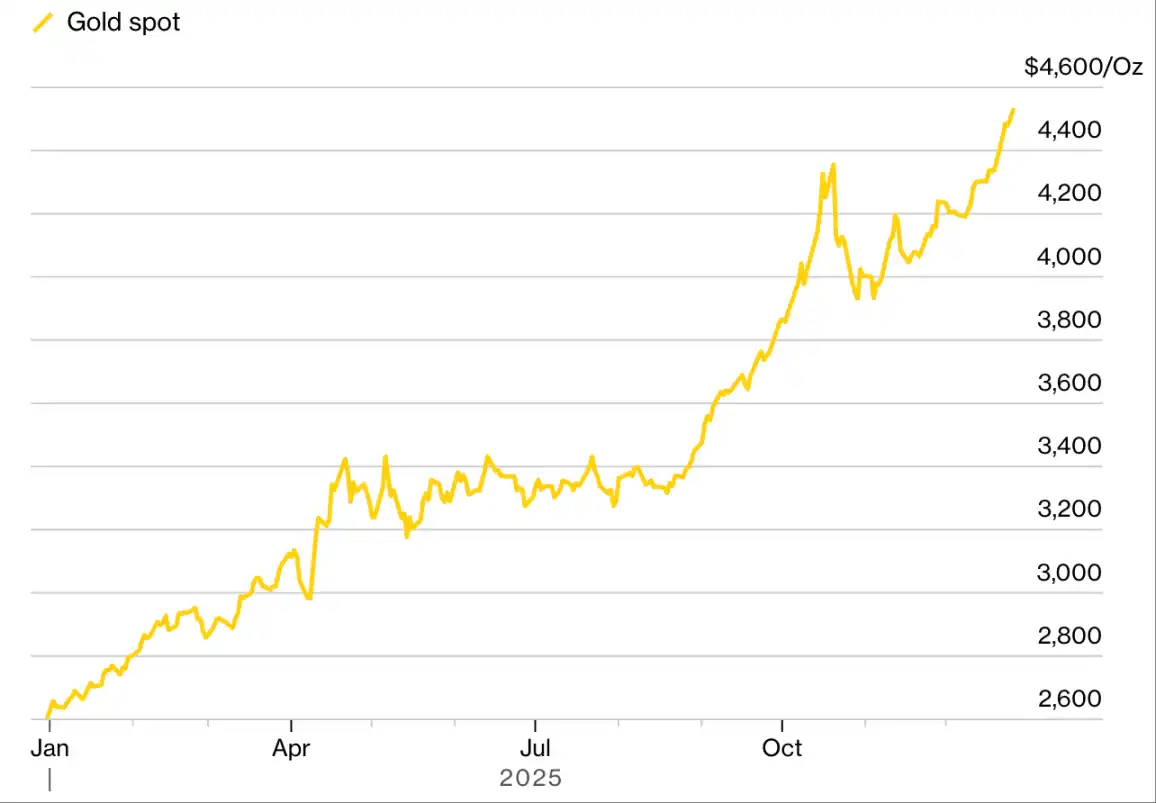
Source: Bloomberg
As a “narrative,” “devaluation” provided a clear explanation for the chaotic macro backdrop; but as a “trading strategy,” its actual effects are much more nuanced. Subsequently, the overall cryptocurrency market saw a pullback, with Bitcoin prices plummeting; the U.S. dollar stabilized somewhat; U.S. Treasuries not only did not collapse, but are poised to have their best year since 2020 — this reminds us that concerns about “fiscal deterioration” may coexist with “safe-haven demand,” especially in periods of slowing economic growth and peak policy rates.
Price movements for other assets exhibited a divergence: the volatility of metals such as copper, aluminum, and even silver was partly driven by “concerns about currency devaluation” and partly influenced by Trump's tariff policies and macro forces, blurring the line between “inflation hedge” and “traditional supply shock.” Meanwhile, gold continued its strong performance, continually hitting new all-time highs. In this space, “devaluation trading” remains effective — but it is no longer a complete rejection of “fiat currency,” but more of a precise bet on “interest rates, policy, and hedging demand.”
— Richard Henderson (Reporter)
South Korean Stock Market: “K-Pop Style” Surge
When it comes to plot twists and excitement, this year's performance of the South Korean stock market is enough to overshadow a K-drama. Driven by President Lee Jae-myung’s “capital market stimulation” policies, as of December 22, the South Korean benchmark stock index (Kospi) has surged over 70% in 2025, moving towards Lee Jae-myung’s “5000-point target” and easily topping the global major stock index gainers’ list.
It is not common for political leaders to openly set a “stock index level” as a target, and when Lee Jae-myung initially proposed the “Kospi 5000” plan, it did not garner much attention. Now, more and more Wall Street banks, including JPMorgan Chase and Citigroup, believe that this target could be achieved by 2026 — partly thanks to the global AI boom, the surge in demand for the South Korean stock market due to its status as an “Asian AI core trading target.”
South Korean Stock Market Rebound
South Korean benchmark stock index soaring:
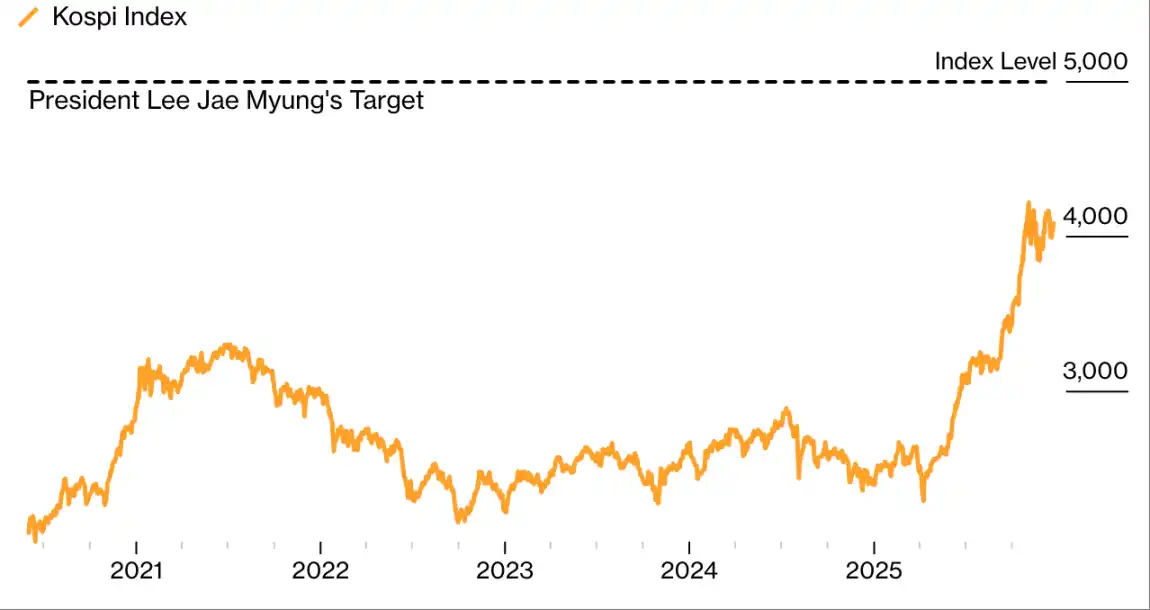
Source: Bloomberg
In this "global leading" rebound, there is one noticeable "absentee": South Korean retail investors. Despite Lee In-myeong often emphasizing to voters that he was "also a retail investor before entering politics," his reform agenda has not yet convinced domestic investors that the "stock market is worth holding long-term." Even with a large influx of foreign capital into the South Korean stock market, domestic retail investors are still "net selling": they have poured a record $33 billion into the U.S. stock market and pursued higher-risk investments such as cryptocurrency and overseas leveraged ETFs.
This phenomenon brings a side effect: pressure on the Korean won. Capital outflows have weakened the won, also reminding the outside world: even as the stock market experiences a "sensational rebound," it may mask domestic investors' "lingering doubts."
——Youkyung Lee (Reporter)
Bitcoin Duel: Chanos vs. Saylor
Every story has two sides, and the arbitrage game between short seller Jim Chanos and "Bitcoin accumulator" Michael Saylor's Strategy company not only involves two highly individualistic figures but has also evolved into a "referendum" on "cryptocurrency-era capitalism."
In early 2025, as the price of Bitcoin soared, Strategy's stock price surged in tandem. Chanos saw an opportunity: the premium of Strategy's stock price relative to its "Bitcoin holdings" was too high. This legendary investor believed that "this premium is unsustainable." Therefore, he decided to "short Strategy, long Bitcoin" and publicly announced this strategy in May (while the premium was still high).
Chanos and Saylor then engaged in a public war of words. In June, during an interview with Bloomberg TV, Saylor stated, "I think Chanos simply doesn't understand our business model"; while Chanos countered on social platform X, calling Saylor's explanation "pure financial gibberish."
In July, Strategy's stock price hit a record high, with a year-to-date increase of 57%; but as the number of "digital asset treasury companies" surged and cryptocurrency prices retraced from their peaks, the stock price of Strategy and its "imitators" began to decline, and the premium of Strategy relative to Bitcoin narrowed—Chanos's bet began to pay off.
This Year, Strategy's Stock Price Performance Lags Behind Bitcoin
As the premium of Strategy disappears, Chanos's short trade pays off:
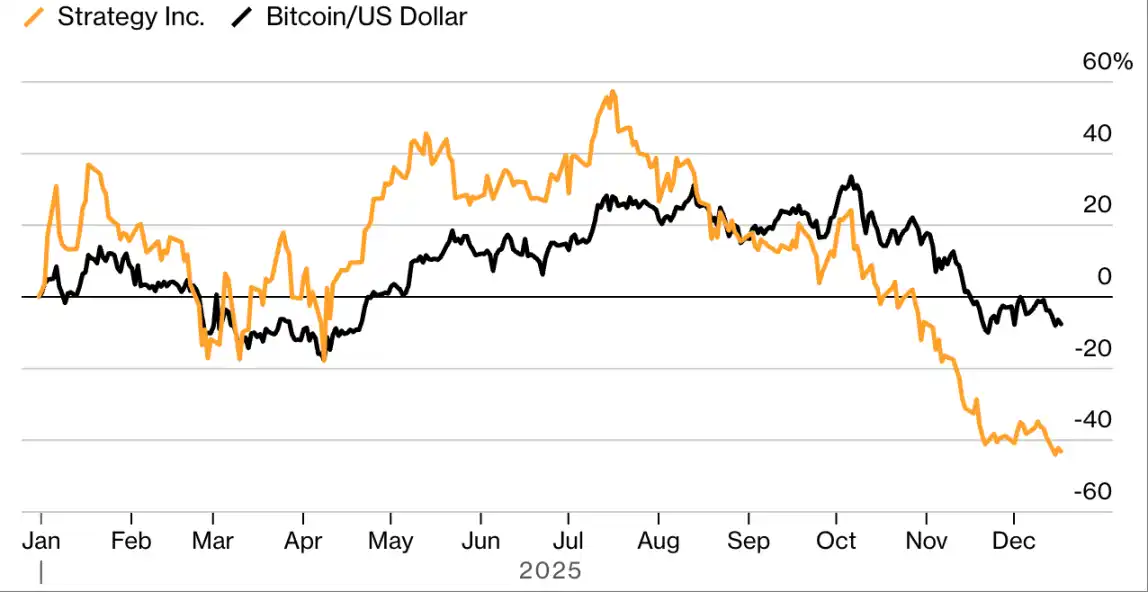
Source: Bloomberg, data has been normalized based on the percentage increase as of December 31, 2024
From Chanos publicly revealing the "short selling Strategy" to his November 7 announcement of "liquidation exit," Strategy's stock price dropped by 42%. Beyond just the gains and losses, this case also exposes the cryptocurrency's "boom and bust cycle": the balance sheet expands due to "confidence," which relies on both "price appreciation" and "financial engineering" support. This pattern continues to be effective until "belief falters" — at this point, the "premium" is no longer an advantage but turns into a problem.
——Monique Mulima (Journalist)
Japanese Government Bonds: From the "Widow Maker" to the "Rainmaker"
Over the past few decades, there has been one bet that macro investors have repeatedly stumbled over — shorting Japanese government bonds, known as the "Widow Maker" trade. The logic behind this strategy seemed simple: with Japan carrying a massive public debt, interest rates would "eventually rise" to attract enough buyers; investors would then "borrow government bonds and sell them," expecting to profit when "interest rates rise, and bond prices fall." However, for many years, the Bank of Japan's accommodative policy has kept borrowing costs low, causing "short sellers" to pay a hefty price — until 2025, when the situation finally reversed.
This year, the "Widow Maker" transformed into a "Rainmaker": Japanese benchmark government bond yields surged, turning the $7.4 trillion Japanese government bond market into a "short seller's paradise." Various factors triggered this shift: the Bank of Japan raising interest rates, Prime Minister Takanashi Wanae launching the "largest post-pandemic spending plan." The benchmark 10-year Japanese government bond yield surpassed 2%, hitting multi-decade highs; the 30-year bond yield rose by over 1 percentage point, setting a historical record. As of December 23, Bloomberg's Japanese Government Bond Return Index has fallen by over 6% this year, becoming the worst-performing major bond market globally.
Sharp Decline in the Japanese Bond Market This Year
Bloomberg's Japanese Government Bond Index is the worst-performing major bond index globally:
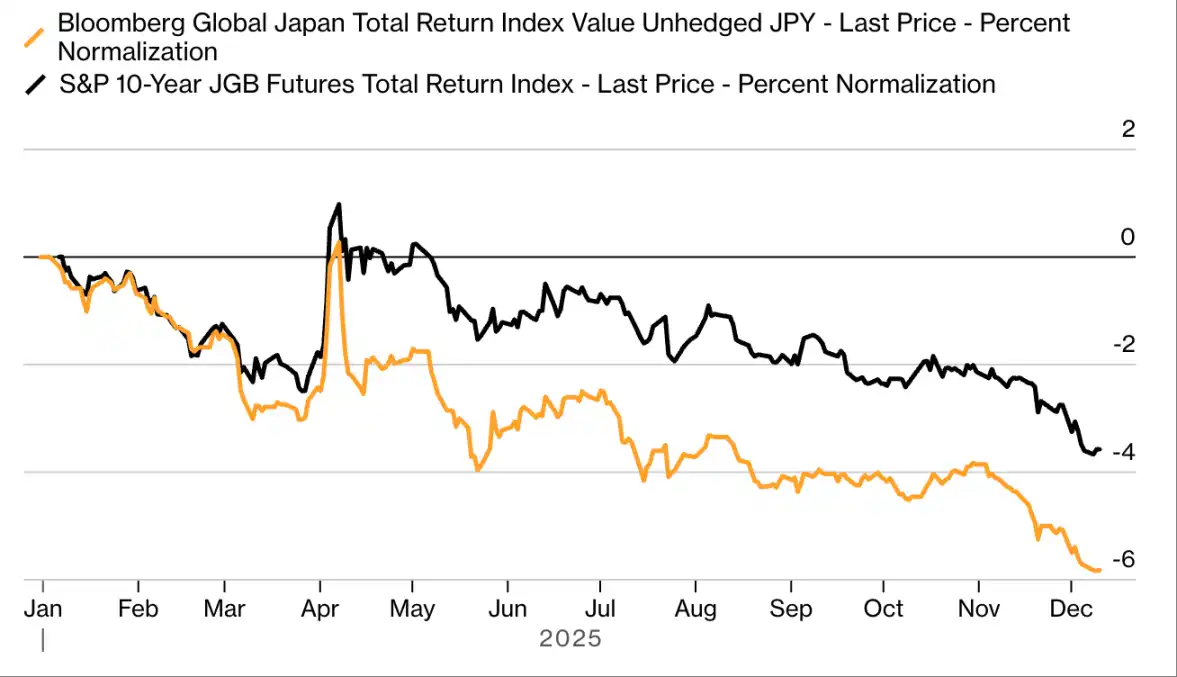
Source: Bloomberg, data has been normalized based on the percentage change as of December 31, 2024, and January 6, 2025
Fund managers from Schroders, Jupiter Asset Management, RBC Global Asset Management, and other institutions have openly discussed "shorting Japanese government bonds in some form" this year; investors and strategists believe that with rising benchmark policy rates, this trade still has room to run. Additionally, as the Bank of Japan reduces its bond-buying scale, it further pushes up yields; and Japan's government debt-to-GDP ratio is "far ahead" among developed countries, leading to a "continuation of bearish sentiment" towards Japanese government bonds.
——Cormac Mullen (Journalist)
Credit 'Skirmish': Payoff of 'Hardball Tactics'
In 2025, the most lucrative credit payoff came not from 'betting on corporate recovery,' but from 'striking back at fellow investors.' This 'creditor-on-creditor strife' model, known for letting institutions like Pacific Investment Management Company (Pimco), King Street Capital Management, etc., emerge victorious, orchestrated a precise 'game' around KKR Group's healthcare enterprise Envision Healthcare.
Post-pandemic, hospital staffing provider Envision found itself in distress, in dire need of financing from new investors. However, issuing new debt required 'pledging already pledged assets': Most creditors united in opposition to this plan, while Pimco, King Street Capital, Partners Group 'switched sides' to support— their support allowed the proposal of 'old creditors releasing pledged assets (equity of Envision's high-value outpatient surgical business Amsurg), providing collateral for new debt' to go through.

The sale of Amsurg to Ascension brought substantial returns to funds, including Pacific Investment Management Company (Pimco). Photographer: Jeff Adams
These institutions then became 'bondholders secured by Amsurg' and eventually converted the bonds into Amsurg equity. This year, Amsurg was sold for $4 billion to healthcare group Ascension Health. It is estimated that these 'backstabbing peers' institutions received around 90% return— confirming the earning potential of 'credit skirmishes.'
This case revealed the rules of the current credit market: loose document terms, dispersed creditors, 'collaboration' not being necessary; 'being right in judgment' often is insufficient, 'avoiding being outdone by peers' is the greater risk.
——Eliza Ronalds-Hannon (Journalist)
Fannie and Freddie: Revenge of the 'Toxic Twins'
Since the financial crisis, mortgage giants Fannie Mae and Freddie Mac have been under U.S. government control, and 'when, how to exit government oversight' has always been a market speculation focus. Hedge fund manager Bill Ackman and other 'supporters' have held long positions, expecting windfall profits from a 'privatization plan,' but as the situation remains unchanged, the stocks of these two companies have lingered in the pink sheet market (OTC market) for years.
The landscape changed with Trump's reelection: the market optimistically expected the "new administration to push the two companies out of government control," and the stocks of Fannie Mae and Freddie Mac were instantly surrounded by "Meme Stock-like enthusiasm." By 2025, the hype intensified further: from the beginning of the year to the September peak, the stock prices of the two companies skyrocketed by 367% (intraday surge of up to 388%), making them one of the brightest winners this year.
Fannie Mae and Freddie Mac Stock Prices Soar on Privatization Expectations
People are increasingly willing to believe that these companies will break free from government control.
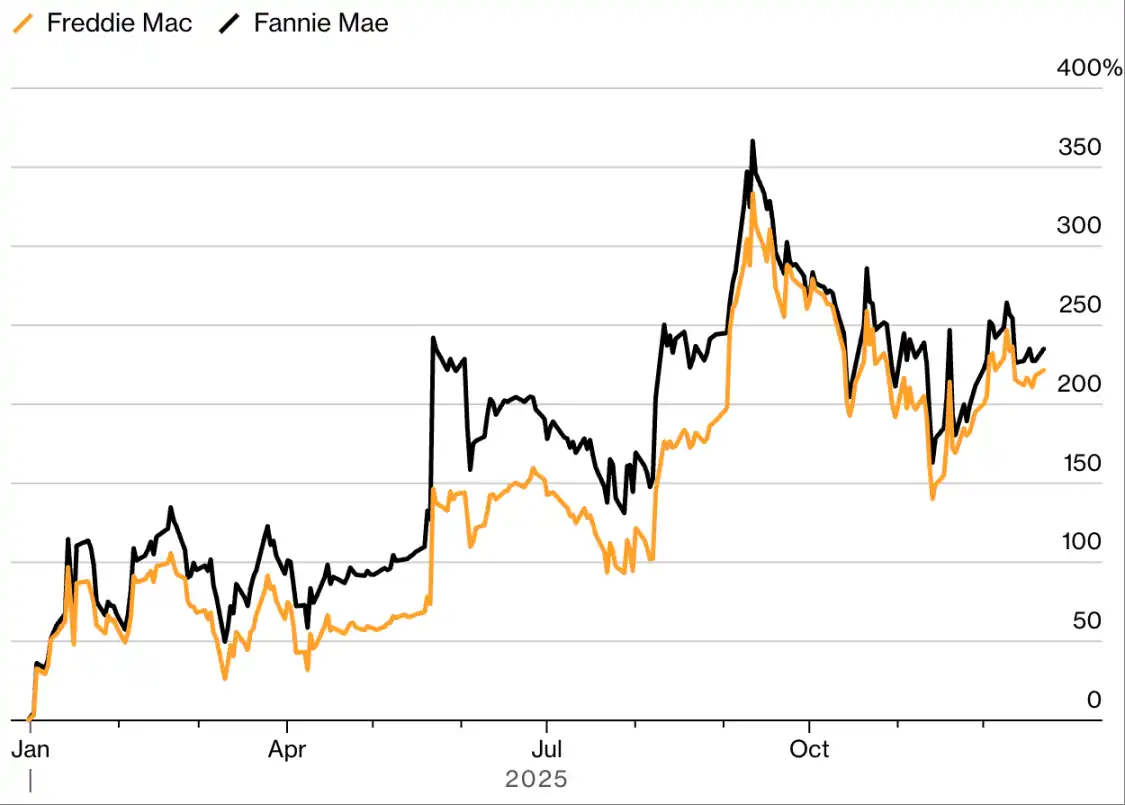
Source: Bloomberg, data standardized based on the percentage increase as of December 31, 2024.
In August, the news that the "government is considering pushing the two companies for an IPO" pushed the hype to its peak—the market expected an IPO valuation exceeding $500 billion, with plans to sell 5%-15% of shares to raise approximately $30 billion. Despite market skepticism about the specific timing of the IPO and whether it would actually materialize, causing price fluctuations since the September peak, most investors still remain confident in this prospect.
In November, Ackman unveiled a proposal submitted to the White House, proposing to relist Fannie Mae and Freddie Mac on the New York Stock Exchange, while writing down the U.S. Treasury's preferred stock holdings in the two companies and exercising government-level options to acquire nearly 80% of common shares. Even Michael Burry joined this camp: he announced his bullish stance on the two companies in early December and in a 6000-word blog post stated that these two companies, which had once needed government intervention to avoid bankruptcy, might no longer be the "toxic twins."
— Felice Maranz (Reporter)
Turkish Carry Trade: Complete Collapse
After a strong performance in 2024, the Turkish carry trade became the "consensus choice" for emerging market investors. At that time, Turkish local bond yields exceeded 40%, and the central bank promised to maintain a stable dollar-pegged exchange rate, attracting traders to borrow cheaply from abroad and then buy high-yield Turkish assets. This trade attracted billions of dollars from institutions like Deutsche Bank, Millennium Partners Fund, and Gramercy Capital, with some institution personnel still in Turkey on March 19, and on that very day, this trade completely collapsed within minutes.
The trigger for the collapse occurred that morning: the Turkish police raided the highly popular Istanbul residence of the opposition party mayor and detained him. This event sparked a wave of protests, causing a frenzy of selling in the Turkish lira, with the central bank utterly unable to contain the exchange rate's free fall. Kit Jukes, the Head of Foreign Exchange Strategy at Societe Generale in Paris, at the time, stated, "Everyone was caught off guard, and no one will dare to return to this market in the short term."

University students hold Turkish flags and banners during a protest following the detention of Istanbul Mayor Ekrem Imamoglu. Photographer: Kerem Uzel/Bloomberg
By the day's close, the outflow of funds from Turkish lira-denominated assets was estimated at around $10 billion, and the market never fully recovered thereafter. As of December 23, the lira had depreciated by about 17% against the dollar for the year, making it one of the worst-performing currencies globally. This event also served as a warning to investors: high interest rates may offer returns to the daring but cannot withstand sudden political shocks.
— Kerim Karakaya (Reporter)
Bond Market: 'Cockroach Alert' Sounds
The credit market of 2025 did not face a single 'Black Swan' event but was instead rattled by a series of 'small-scale crises' that exposed some unsettling vulnerabilities in the market. Companies once seen as 'ordinary borrowers' found themselves in consecutive troubles, causing heavy losses to lending institutions.
Saks Global restructured $22 billion in bonds after making only one interest payment, and the restructured bonds are now trading at less than 60% of face value; New Fortress Energy's newly issued exchangeable bonds lost over 50% of their value within a year; Tricolor and First Brands went bankrupt one after the other, wiping out billions of dollars in bond value within weeks. In some cases, complex fraudulent activities were the root cause of corporate collapses, while in others, the optimistic performance expectations of the companies were simply not met. But in either scenario, investors are left with a question: why did they make large-scale credit bets on these companies with little evidence of their ability to repay debt?
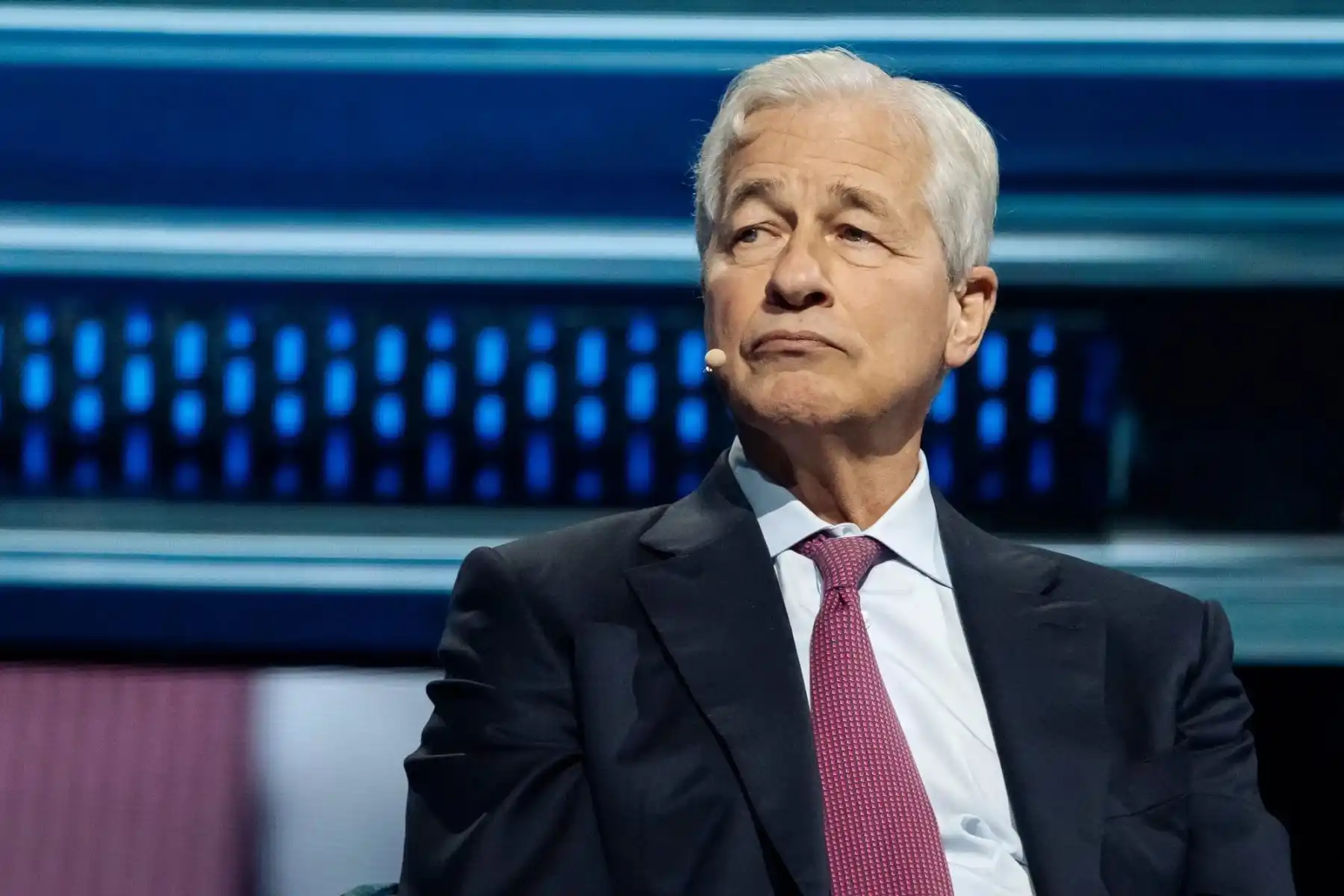
JPMorgan Chase is singed by a credit 'cockroach,' with Jamie Dimon warning there may be more to come. Photographer: Eva Marie Uzcategui/Bloomberg
Years of low default rates and loose monetary policy have eroded various standards in the credit market—from lender protection clauses to the underlying syndication processes. Lenders to First Brands and Tricolor failed to uncover violations such as 'double pledging of assets' and 'commingling collateral for multiple loans' by these two entities.
JPMorgan Chase is also one of these lending institutions. The bank's CEO Jamie Dimon issued a warning to the market in October, using a vivid metaphor to remind investors to beware of lingering risks: "When you see one cockroach, there are probably more hiding in the shadows." And this "cockroach risk" may well become one of the central themes of the 2026 market.
——Eliza Ronalds-Hannon (Reporter)
Welcome to join the official BlockBeats community:
Telegram Subscription Group: https://t.me/theblockbeats
Telegram Discussion Group: https://t.me/BlockBeats_App
Official Twitter Account: https://twitter.com/BlockBeatsAsia