Exclusive: HelloTrade Founders on Building On-Chain Wall Street After BlackRock

In 2025, the biggest story in crypto isn't about crypto at all. It's about traditional finance coming on-chain.
Crypto investors have moved on from vague narratives and technical promises. They've stopped chasing memecoins and turned their attention to real businesses with actual revenue: U.S. equities and other real-world assets.
Meanwhile, billions of people around the world still can't easily access global capital markets. Those who can often face tedious KYC requirements, clunky interfaces, and steep fees through legacy brokerage platforms.
Enter a new wave of platforms racing to bridge that gap.
Robinhood is spinning up its own blockchain for tokenized stocks. Binance and Coinbase have rolled out equity-linked products. Hyperliquid launched equity perpetuals and racked up over $2 billion in trading volume in just 10 days.
Two former BlackRock executives just walked away from the most successful ETF launch in history to not only join this race, but help onboard the next generation of on-chain users.
Kevin Tang was a Director on BlackRock's Digital Assets team, responsible for building and commercializing IBIT and ETHA.. Wyatt Raich led crypto engineering, writing the code that powered those products. Together, they helped create IBIT, now the world's largest Bitcoin ETF and the fastest fund ever to hit $100 billion in assets under management.

Kevin and Wyatt
This past summer, at the height of IBIT's momentum, they left to launch HelloTrade.
On paper, it sounds risky. But Kevin sees it differently. After more than a decade in traditional finance, he’s spent years building complex Equity and Fixed Income products. Solving after-hours and weekend trading, and turning it into a viable 24/7 on-chain market, requires engineering expertise in both TradFi and crypto. This is precisely where Kevin and Wyatt’s combination excels. And the instinct they brought from BlackRock to put clients at the center of every decision? That’s the DNA driving HelloTrade forward.
"We don't see other crypto applications as competitors but rather peers who are trying to grow the overall industry" Kevin says. "In the long-run, decentralized crypto exchange platforms are competing with legacy and traditional brokerage platforms.” At HelloTrade, we're not looking to build another crypto product. We're trying to build a Web2 user experience on Web3 rails."
But Kevin's ambition goes far beyond equity perps. He envisions HelloTrade as an on-chain trading platform that rivals the experience of traditional brokerages and centralized exchanges. His goal: to onboard millions of users who have never transacted on-chain.
In this conversation with BlockBeats, Kevin shares insights on why IBIT became the most successful ETF launch in history and why he's convinced that on-chain equity and RWA trading is the next frontier for blockchain adoption.
Following is the interview.
Leaving BlackRock
BlockBeats: Could you briefly share your journey before joining BlackRock? What kind of education and career paths led you and Wyatt to join BlackRock's digital asset division?
Kevin: I spent over ten years at BlackRock, joining right out of college after a year at State Street. I began my career in research before moving into the product innovation group, where I helped launch new hedge funds, private equity strategies, and mutual funds.
In 2017, a colleague introduced me to Bitcoin and Ethereum, and I immediately fell down the rabbit hole. I became fascinated by Bitcoin as a potential store of value asset, especially as many of our clients were already raising concerns about inflation. Then Ethereum emerged with an entirely new promise: the ability to build decentralized infrastructure and support next-generation financial applications. I saw firsthand some of the pain points in traditional finance that blockchains could meaningfully address.
Eventually, I joined BlackRock’s crypto team as the third commercial hire. Over the next four and a half years, I focused on building and commercializing IBIT and ETHA, working directly with clients, partners, and internal teams to bring those products to market.
Wyatt’s path was different. He started his career in AI and robotics at Lockheed Martin before a friend introduced him to digital assets. He quickly became immersed in the space, writing smart contracts, experimenting with protocols, and building applications. He later joined BlackRock as one of the first smart contract engineers on the digital asset team. Wyatt went on to lead the engineering efforts behind IBIT, ETHA, and BUIDL, helping architect the systems that supported billions in flows.
We came from different backgrounds but ultimately found ourselves on the same team as directors, aligned in our belief that the next generation of capital markets would be built on-chain.
BlockBeats: How did IBIT become the world's largest Bitcoin ETF? Any stories to share?
Kevin: The success of IBIT and ETHA shows how quickly investors embraced the ETF structure as a convenient and secure way to access spot bitcoin and ether. For years, individuals and institutions faced meaningful barriers when trying to invest directly in digital assets. The ETF wrapper solved many of these problems by delivering crypto exposure through a familiar and trusted investment vehicle.

Source: Trackinsight
That said, even though IBIT grew at an extraordinary pace, the broader journey of commercializing crypto products at BlackRock was not always simple. Before IBIT launched, BlackRock offered a private Bitcoin trust that grew at a much slower rate. Many clients needed significant education on the digital asset ecosystem and a foundational understanding of why bitcoin and ether might play a role in a portfolio. The entire BlackRock team deserves tremendous credit for leading that education effort.
I would also note that Bitcoin and Ethereum ETFs are still very early in their adoption curve. A large portion of wealth management platforms and institutional investors are only beginning to explore crypto exposure, and we have yet to see what widespread mainstream adoption looks like within traditional asset management channels.
BlockBeats: What made you realize that a product like HelloTrade had to be built on-chain and outside BlackRock?
Kevin: I firmly believe that the next major frontier for blockchain adoption will be bringing traditional markets such as equities, commodities, and fixed income on-chain. Even though crypto ownership has grown significantly, fewer than one percent of people in the world actually transact on-chain. We are still very early.
To build HelloTrade the right way, we needed to create infrastructure that does not fit within the constraints of traditional finance or large technology firms. What we are building goes far beyond equity perpetuals. It requires rethinking how global markets operate when settlement, custody, transparency, and access are all redesigned around blockchain technology.
The second reason is speed. To deliver on our vision, we need to move with the pace and focus of a small, mission-driven startup. We need to iterate quickly, ship new products in weeks rather than quarters, and constantly test with real users across multiple markets. That level of agility is not possible in a large organization with tens of thousands of employees.
That said, we are incredibly grateful for our time at BlackRock. The training, discipline, and client-centric mindset we developed there are foundational to how we build HelloTrade today.
Building A Global Wall Street On-chain
BlockBeats: Now let’s talk about the product. Which countries are HelloTrade's key target markets, and what types of users are you targeting?
Kevin: Let me start with user personas. Our long-term goal is to bring two groups on-chain: less experienced crypto users and, eventually, traditional investors.
When I say “less sophisticated crypto users,” I am referring to people who mainly trade on centralized exchanges and rarely interact with decentralized products.
These users are not professional traders. They need familiar Web2-style interfaces, clear risk controls, and strong security assurances before they feel comfortable transacting on-chain. Over time, there is an even larger audience we want to reach: everyday investors who currently only use traditional brokerage platforms.
On target markets, we are focused on regions where access to global capital markets is limited or expensive. Across emerging markets in Southeast Asia, Latin America, and Central Asia, people often face real barriers to investing. Access is fragmented, fees are high, and many financial products simply are not available. These are the users who stand to benefit the most from an open, global, blockchain-based trading platform.

Source:a16zcrypto
BlockBeats: That’s interesting. When I recommended on-chain DEXes to friends who mainly trade on Coinbase and Binance, they asked me: "Why do I have to open a website when I can trade anytime on my phone?" How does HelloTrade address this?
Kevin: That reaction is exactly why we’re building HelloTrade as a mobile-first platform. Most people trade on their phones, not on websites, and the reality is that many crypto applications still don’t match the UI, UX, and reliability that users are used to with Web2 applications.
Our goal is to change that. We want HelloTrade to feel as intuitive, smooth, and trustworthy as any leading mobile trading app, while still giving users the benefits of being on-chain. We will offer a web interface, but the mobile app is our flagship product and the primary way users will trade on HelloTrade.
BlockBeats: One of your core products involves perpetual contracts, a crypto-native invention. Coming from traditional finance, what is your view on it?
Kevin: Perpetual futures play a useful role for traders who want straightforward, short-term directional exposure with leverage.
For many non-professional traders, the mechanics of options (volatility, time decay, etc.) can be difficult to navigate. Perpetuals remove much of that complexity. They are linear, easier to understand, and more intuitive to manage.
For certain use cases, they can be a more practical exposure vehicle for traders who want simple and efficient leverage, provided the risks are well understood.
BlockBeats: Many companies are pushing their equity perpetual products now. What is HelloTrade's biggest edge compared to crypto-native perp products or retail brokerage platforms or TradFi neobanks like Robinhood and Revolut?
Kevin: I actually think our biggest competition isn’t other crypto-native perp platforms, it’s the traditional brokerage and neobank experience that people already trust.
Despite the impressive volumes DEXes report, dependable analytics consistently show that the number of real, active on-chain traders is still only in the thousands.
Our edge comes from bringing a true Web2-quality product experience to Web3: the standard of design, reliability, and support users expect from apps like Robinhood or Revolut, combined with the benefits only possible on decentralized infrastructure.
On HelloTrade, users maintain self-custody of their assets, avoid the settlement frictions of legacy rails, and will eventually be able to access use cases that simply cannot exist in Web2—such as trustless margining, permissionless lending markets, and on-chain collateral mobility across DeFi protocols. Over time, this unlocks a completely different universe of financial tools and opportunities that traditional brokerages cannot offer.
If we can deliver Web2-level quality with Web3-level capabilities, we believe HelloTrade can bring millions of first-time users on-chain.
The second advantage is our team. Equity capital markets differ significantly from crypto markets. Equities have corporate actions and experience trading haltages, complexities that don't exist in crypto. Additionally, our first three engineering hires were all former founders of crypto DEXes. We’ve assembled a strong team with traditional finance and crypto expertise. Usually, teams have experience in one or the other, but not both. We believe this gives us a unique advantage.
Web2 Experience, On Web3 Rails
BlockBeats: Now that we’ve discussed the product, let’s talk about the technical architecture. Why did you choose MegaETH, considering there were more mature ecosystems like Solana, Base, and Arbitrum?
Kevin: There are three core reasons.
First is performance. To build an on-chain application that matches the throughput, latency, and capabilities of the best centralized TradFi trading systems, we needed an extremely fast and highly reliable blockchain. Our team conducted extensive diligence across multiple Layer 1s and Layer 2s, and MegaETH emerged as one of the most performant options available. We have a number of features planned that rely on its throughput to enable things that were previously impossible on-chain.
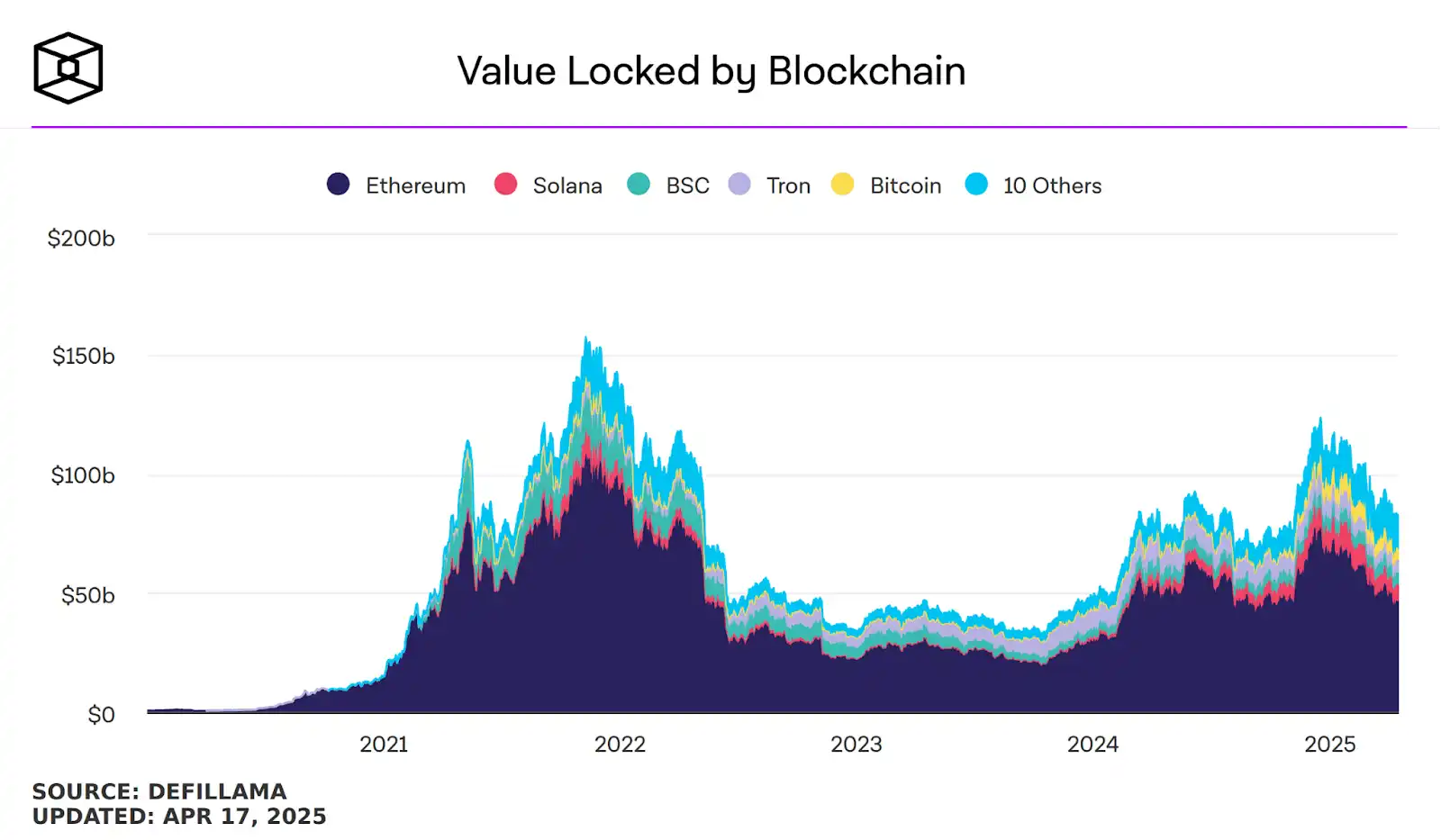
Second is our conviction in Ethereum and its network effects. MegaETH is a Layer 2 that inherits Ethereum’s security while offering a radically faster execution environment. We continue to believe that a significant proportion of DeFi will continue to anchor around Ethereum’s security, neutrality, and ecosystem. Building on an execution layer that settles back to Ethereum made a lot of sense. MegaETH gives us the performance we need without sacrificing the trust guarantees that matter.
Source: DefiLlama
Finally, the team behind MegaETH was a major factor. Many blockchain projects launch with ambitious plans but struggle to deliver. The MegaETH team are real builders with a long-term vision and the discipline to execute it.
BlockBeats: To achieve a Web2-level experience, your mobile app is described as having no wallet setup, no gas fees, and no technical jargon. How is this technically achieved?
Kevin: Our vision is to offer a Web2-quality user experience on Web3 infrastructure. Today, some of the biggest barriers to using crypto applications are wallet setup, gas payments, and the difficulty of moving money on and off platforms.
We plan to fully abstract gas costs. For users who are less familiar with Web3, we have partnered with an embedded wallet provider that allows them to create a wallet with something as simple as an email address. More advanced users will still have the option to connect their own self-custody wallets.
The remaining challenge is onboarding capital. We are working to integrate fiat on and off ramps so that the experience feels as familiar and seamless as using a traditional brokerage app. While not every feature will be live on Day 1, we have an ambitious roadmap to deliver all of this as quickly as possible.
BlockBeats: A good trading platform can’t succeed without liquidity. How do you plan to attract market makers?
Kevin: The first key to attracting market makers is building a strong product. If you create an exchange that users genuinely want to trade on that is fast, intuitive, and differentiated, liquidity naturally follows. Market makers go where the trading activity is, so our priority is delivering a product that generates real demand.
The second factor is liquidity during weekends and after hours when traditional markets are closed. This is an area where blockchains allow something new. We are developing proprietary mechanisms and incentive structures that make it economically attractive for market makers to provide liquidity during these periods. Our goal is to ensure that our markets remain deep, stable, and dependable around the clock.
BlockBeats: Last but not least, let’s talk about risk. At BlackRock, there's a saying: “you spend decades building trust, and you can lose it in a matter of minutes.” What are the "few-minute scenarios" you are most vigilant against at HelloTrade?
Kevin: The two biggest areas are customer safety and unexpected market scenarios.
The first is the safety of customer assets. We have all seen what happened with FTX and several other platforms. Protecting users through proper asset segregation, strong risk controls, and secure DeFi infrastructure is absolutely essential. This is the foundation of trust and the thing we take most seriously.
The second is preparing for edge cases. We feel very confident in our core trading model. It is the rare events, the one in a thousand scenarios like what happened on October 10, that demand extra vigilance. We are actively simulating these situations and building safeguards so that our systems remain stable and reliable even under extreme stress.
Welcome to join the official BlockBeats community:
Telegram Subscription Group: https://t.me/theblockbeats
Telegram Discussion Group: https://t.me/BlockBeats_App
Official Twitter Account: https://twitter.com/BlockBeatsAsia