ChainOpera AI Interview: How Collective Intelligence Shapes Superintelligence

In 2024, the wave of AI Agents swept through the tech and crypto world.
While everyone's attention was focused on how OpenAI's GPTs were making AI more "useful," a team led by Amazon AI scientist and USC professor Salman Avestimehr was using the power of Crypto to address a more disruptive issue: Who owns and controls AGI (Artificial General Intelligence)?
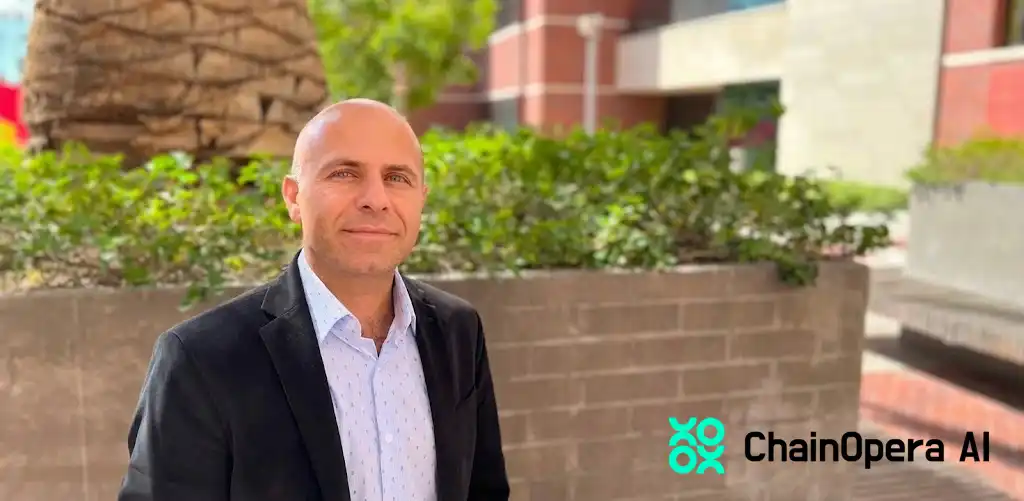
Professor Salman Avestimehr
This team is ChainOpera AI. Instead of choosing the path of "scaling up" with a single giant model, they opted for a more challenging "scaling out" approach. Through a community-created, shared decentralized intelligence network, countless specialized AI Agents collaborate to collectively emerge as a "collective super Agent."
ChainOpera AI's AI Terminal has already brought together thousands of community-built AI Agents, gradually bringing this vision into the reality of Crypto.
From PolyShard's decentralized consensus to FedML's federated learning, and now ChainOpera AI, Salman's entrepreneurial journey has always revolved around a core question, how can distributed collaboration unlock the power beyond the individual?
With curiosity and questions about Crypto AGI and ChainOpera AI, BlockBeats had a deep conversation with ChainOpera AI's co-founder, Professor Salman Avestimehr.
Below is the interview content.
From Academia to Entrepreneurship
BlockBeats: First, could you please briefly introduce what ChainOpera AI does in one sentence? What problem does it want to solve?
Salman: You can think of it as a flywheel that connects two aspects. On one hand, it empowers community-created AI by ensuring human ownership of the Agent, value alignment, and fair participation; on the other hand, through an AI-driven intelligence layer, it unlocks the potential of DeFi and tokenized markets for the average user.
BlockBeats: Your academic journey started with research in information theory and blockchain, and later transitioned to federated learning, culminating in the creation of FedML. When you were initially conducting this research, did you already envision the prototype of today's ChainOpera AI?
Salman: Since 2019, our initial vision has always been to achieve a collaborative, community-created AI. However, as AI itself has undergone significant transformation in the past few years, the point at which collaboration can create the most value has been constantly evolving.
When we started working on FedML, the biggest challenge was data – specifically, how to build better AI without compromising privacy. The core of FedML lies in addressing data privacy and collaborative training in distributed machine learning.
Today, the biggest challenge has shifted to intelligent ownership and value capture. We are transitioning from solving data privacy issues to addressing collaboration and ownership issues of AI Agents.
ChainOpera AI is a natural evolution that applies our understanding of decentralized collaboration to the new frontier of AI Agents.
BlockBeats: From PolyShard to FedML, and now to ChainOpera AI, what is the inherent logical connection among these three projects?
Salman: What ties PolyShard, FedML, and ChainOpera AI together is my ongoing focus on distributed computing.
I have always been exploring a question: How can collaboration among multiple nodes, individuals, or systems unleash a power far greater than any single entity?
In PolyShard, we decentralized the consensus mechanism of blockchain, allowing thousands of participants to collaborate securely and efficiently.
In FedML, we decentralized AI model training, enabling data owners to collectively train stronger models while preserving privacy.
And in ChainOpera AI, we are decentralizing intelligence itself, building an AI Agent ecosystem that is co-created and co-owned by users, developers, and infrastructure providers.
Therefore, the main theme running through it is clear: through decentralization and collaboration, intelligence continues to evolve and expand.
BlockBeats: What unique advantages has your academic background brought to ChainOpera AI, and what challenges has it presented?
Salman: I think a unique advantage that a professor brings to a startup is that we are accustomed to fundraising based on a vision, communicating that vision to the community, and testing its feasibility through research. This is almost all there is in the early stages of entrepreneurship: turning an idea into something credible and viable.
Of course, at some point, a startup is no longer just an idea but becomes a business, and its success is driven by clear metrics, growth, and execution, which is not really where academia trains you.
So having the right co-founder is crucial. At this point, I am fortunate to collaborate with Aiden (Chaoyang), who brings years of experience from large tech companies, knowing how to scale and execute. After working in the industry for many years, he decided to pursue a Ph.D. and joined my research group. We met through this and created FedML together, then naturally collaborated again on ChainOpera AI.
BlockBeats: Your team background is very diverse, with AI scientists from Amazon, Google, and finance experts from Goldman Sachs, JPMorgan. What does this interdisciplinary team composition mean for ChainOpera AI's development?
Salman: Our team background is a deliberate choice because we have two missions:
On one hand, we need top AI and distributed systems talent to solve technical challenges, such as how to make thousands of agents collaborate efficiently, how to ensure the security and privacy of decentralized computation.
On the other hand, our goal is to make the complex financial markets more understandable to the average person. This requires experts from the financial field who can understand the complexity of traditional finance and DeFi and translate that knowledge into strategies that AI agents can execute securely and reliably.
This interdisciplinary combination ensures that we can not only develop cutting-edge technology but also ensure that this technology can address the most valuable real-world problems and provide real-world application value.
BlockBeats: In 2022, you once judged that the "Web3 AI timing was too early." Looking back now, your judgment at that time was correct. What made you decide to fully commit to ChainOpera AI in 2024?
Salman: In 2022, decentralized AI had clear value for enterprises, but at the end-user level, the situation was different. Users did not perceive "better decentralization," but rather a better application. Just having a decentralized infrastructure layer alone cannot make AI applications more useful or attractive to ordinary users.
By 2024, the situation began to change. AI Agents, as universally available and interactive AI applications, started to rise. People were increasingly concerned about who controlled the direction of AI development and how independent developers could participate in the AI economy.
All of this clearly indicated that we needed community-driven AI.
This is exactly where ChainOpera AI's opportunity lies. By moving up a layer, we empower community co-creation of AI Agents.
As a result, end-users can experience the network effects of multiple intelligent agents collaboratively executing complex tasks seamlessly. Developers gain a way to collectively create and profit, rather than being monopolized by tech giants.
As a global community, all members have a voice on the issues of "how to build a new type of AGI" and "whose values AGI ultimately reflects."
BlockBeats: Your AI Terminal is already online and has gathered thousands of community-built AI Agents. Can you reveal what the most commonly used Agent types are by users at the moment?
Salman: Currently, the most commonly used Agent types by users are mainly concentrated in two areas:
The first area is finance and trading. This includes market analysts, arbitrage strategists, portfolio optimizers, and more. This is not surprising since the DeFi and crypto markets provide an ideal environment for AI Agents to operate autonomously and transparently.
The second area is content creation and code generation. Users are leveraging Agents to automate their daily workflows, such as generating marketing copy, writing smart contract code, or conducting complex document analysis.
As we continue to expand Agent's capabilities and toolset, we expect the users' usage scenarios to become more diverse.
Collaborative Intelligence of "Outward Expansion"
BlockBeats: The core argument of ChainOpera AI's AGI is that it will not come from a single large model but from collaborative intelligence. What is the fundamental difference between this approach and the multi-model or multi-agent architecture explored by giants like OpenAI and Anthropic?
Salman: The core difference lies in the technical path and economic model.
On the technical path, giants like OpenAI have taken the "upscaling" route, building a few huge, single models, making them smarter through scale and computing power.
ChainOpera AI, on the other hand, has taken the "outward expansion" route, building a network of many smaller, more specialized AI Agents that collaborate to form collective intelligence. This is a fundamentally different path to AGI, a path to growth through collaboration rather than centralization.
On the economic model side, we are creating a collaborative AI economic model. In a traditional centralized model, innovation is controlled by capital, and small teams are continually squeezed out.
Whereas in ChainOpera AI's system, any developer, researcher, or resource provider can contribute their efforts and share the value they create.
Developers co-build a super AI terminal by contributing their Agent. They not only receive recognition and usage but also benefit from the shared economic value generated by the adoption of the Agent by the network, thus achieving co-ownership of the AI terminal.
BlockBeats: How is the "Co-Create, Co-Own" concept you propose implemented from a technical perspective?
Salman: The "Co-Create, Co-Own" slogan is realized through our AI terminal application, which you can think of as a decentralized ChatGPT.
Within this terminal, there are thousands of AI Agents built by the community, all of which can be accessed through our super AI agent, CoCo. CoCo is responsible for coordinating and orchestrating these Agents to collaboratively perform complex tasks.
BlockBeats: Your whitepaper describes a grand four-layer architecture. Can you walk us through how these four layers work together using a specific user scenario, such as a DeFi trader wanting to create an automated trading strategy?
Salman: Certainly. Let's take the example of a DeFi trader who wants to use ChainOpera AI to build an automated trading strategy.
He starts at the application layer, which is the AI terminal application, the main interface where our users interact with thousands of Agents. The trader can either use specific pre-existing trading Agents in the terminal, such as a grid trading strategist, a limit order Agent, or a market analyst, or can combine them through our Agent Social Network to have them collaborate to execute more complex strategies.
In this case, our super Agent CoCo is responsible for orchestrating and coordinating these agents to ensure everything runs smoothly.
All of this runs on the decentralized AI and GPU infrastructure layer powered by decentralized compute nodes that can scale to perform model inference, training, and Agent deployment.
So, from the trader's perspective, it feels like using a seamless, intelligent system, but in reality, it's a network composed of AI Agents, developers, and decentralized compute providers aimed at making complex DeFi trading accessible to anyone.
BlockBeats: In this scenario, how is the user's data and strategy protected?
Salman: All communication between the user and the Agents or model servers is encrypted, ensuring that no third party can intercept or read any data during transmission.
The compute nodes isolate different Agents and models using container technology, allowing each task to run in an independent secure environment without affecting each other.
For users requiring stronger protection, we offer flexible deployment options. Agents and models can run in a Trusted Execution Environment (TEE), on a preferred cloud provider, or even on the user's own local hardware, enabling complete control over data and execution privacy.
As for the strategy itself, it depends on how you interact with the system. If you are using a community-built Agent, then the Agent's logic is public, but your specific parameters, data input, and usage patterns are still private.
If you wish to keep the strategy entirely confidential, you can create and deploy a private Agent that is not published on the AI terminal and is meant for your use only.
BlockBeats: If this trading strategy performs well, how can other users use it? How does the creator get incentivized?
Salman: If a trading strategy Agent proves to be successful, the developer can release it as an Agent and make it accessible to others through the AI terminal. This way, anyone in the community can try it out, tweak it, or even build on top of it.
As more users interact with this Agent, the creator will earn developer points, which is currently our way of recognizing and rewarding contributors to the ecosystem.
Over time, as we continue to expand, these points will evolve into a formal income and incentive mechanism, providing developers with a transparent and fair way to benefit from the adoption of their work.
BlockBeats: Your roadmap mentions many innovative concepts, such as Agent Router, Agent Social Network. These concepts sound cutting-edge, but also raise concerns about being too complex. How do you ensure that ChainOpera AI finds a balance between technical innovation and user experience?
Salman: This is precisely the beauty of building an application-driven decentralized AI ecosystem.
All these complex technologies, such as Agent Router, Cooperative Agent Framework, decentralized model marketplace, and so on, work in the background. They make our AI application experience, such as our decentralized ChatGPT, more powerful and valuable to end-users.
We recently shared an article explaining how these pieces come together to create a seamless "from prompt to response" intelligent system. Users simply interact naturally, and the Agent network takes care of all the complex heavy lifting in the background.
Community Value and Future Development
BlockBeats: Honestly speaking, the $COAI token has experienced significant price volatility in the past few months, and there are concerns in the community about the token's distribution centralization. Many are asking, where is ChainOpera AI's value anchored?
Salman: While market fluctuations are inherently unpredictable, some analysts have pointed out that COAI's price volatility has been influenced by various factors.
These factors include the early October bull market in the BNB ecosystem, the rise of perpetual contract trading, COAI being listed on Aster as one of the first tokens, and the subsequent 1011 "Black Swan" liquidity event that affected the entire crypto market.
Regarding token distribution, research has shown that some degree of centralization is typical in the early stages of a project's token issuance.
In most cases, these tokens belong to the team, early investors, and ecosystem development locked allocations, following a transparent, on-chain verifiable ownership and unlocking schedule. Many community members have pointed out that COAI's early centralization is lower than many AI tokens launched around the same time, which is a fact that anyone can verify through public channels.
As for its fundamental value, COAI is a utility token that drives the ChainOpera AI Open Collaboration AI Economy. It supports user payment of Agent usage fees, microtransaction settlements between Agents, and GPU power costs when developers deploy new Agents.
The long-term value of COAI ultimately comes from the real economic activities it empowers: a growing network of users, developers, and AI Agents collaborating to build a decentralized, community-owned, utility-driven intelligence.
BlockBeats: You have emphasized on social media that the team is still focused on development, but for many investors, such a statement is not enough. Could you specifically discuss what verifiable milestones we can expect in the next 6 to 12 months?
Salman: ChainOpera AI has always been more focused on actual building rather than empty talk. We have released and announced many new AI Agents and features that are all live on our AI terminal for anyone to try today. This is the best evidence of progress; real products are more convincing than promises.
As for the next steps, our larger plans and roadmap are outlined in the whitepaper, which details the development plans for the AI Agent Network, Agent Developer Platform, and the next phase of the decentralized computing layer.
There will be several exciting releases this quarter and the next. We will regularly share these highlights on official social channels so the community can transparently and in real-time follow each new milestone's achievement.
BlockBeats: How do you plan to involve the community in the product development and validation process?
Salman: The community has been deeply involved in shaping ChainOpera AI. Many members are creating and deploying their AI Agents, while others are actively using these Agents and providing feedback to help developers enhance them. We have also introduced a new Ambassador Program to reward those who demonstrate and promote the actual value of our ecosystem.
Looking ahead, we are exploring more ways to involve the community in the development cycle. These ways include validation pre-AI Agent release, contributing data and feedback to help these Agents become smarter and more reliable over time.
Our goal is simple: to make ChainOpera AI a truly collaborative, community-created intelligent network where everyone plays an indispensable role in its evolution.
BlockBeats: AI projects are facing fierce competition now. If you were to summarize the difference between ChainOpera AI and these competitors in one sentence, what would you say?
Salman: The key difference is that ChainOpera AI is building a truly decentralized AI infrastructure driven by applications and utility.
All underlying technologies converge into a tangible Crypto AGI application that anyone can use, benefit from, and contribute to its growth. We encourage everyone to try and experience it firsthand.
BlockBeats: How do you define COAI's success? Is it the number of users, token price, or other metrics?
Salman: To me, success lies in influence. The broader goal of Crypto AGI is to make complex financial markets accessible to ordinary people through an intelligence layer built by a community.
So, one key metric I focus on is quite simple: how many non-crypto users can we onboard into the complex worlds of crypto and DeFi through this intelligent, agent-driven, collaborative ecosystem?
From Crypto AGI to Physical AI
BlockBeats: Your roadmap outlines a grand vision from 'Autonomous AI Subnet' to 'Physical AI.' What will ChainOpera AI look like in 2030 in your vision? How will it transform our lives?
Salman: In the next one to two years, our focus is on achieving Crypto AGI, which is an intelligent layer built by the community with the goal of helping everyone participate and benefit from the complex financial markets. Through intelligent, collaborative AI agents, these markets become understandable, accessible, and rewarding for the average person.
Looking further ahead to 2030, this will evolve into a broader frontier we call Physical AI. As the agent systems mature, their role will expand from managing digital finance to coordinating elements of our physical world. This includes managing smart homes, autonomous vehicles, and personal robots that assist in daily tasks.
By 2030, we envision a world where AI agents seamlessly collaborate in both digital and physical realms, created and owned collectively by the community, transforming intelligence itself into a globally empowering infrastructure.
BlockBeats: How do you ensure that ChainOpera AI truly achieves 'co-creation and co-ownership,' rather than being like many projects where the core team ultimately still leads? Have you ever envisioned a day when you and the core team will 'step back' and let the community take full control of the project?
Salman: That is precisely our long-term goal. 'Co-creation and co-ownership' means that over time, the community becomes the primary driving force behind the ecosystem. We are already moving in this direction by open-sourcing key components, empowering the community to build agents, and introducing ways for users to directly contribute to improving the AI.
As the network matures, we will introduce governance mechanisms to gradually shift the core team's role from control to coordination, ultimately letting the community fully take ownership of steering the evolution of ChainOpera AI.
BlockBeats: If the community's decision conflicts with your vision, what will you do?
Salman: I believe that the essence of building a truly decentralized system is to trust the community. Our team's role is to help lay the groundwork and guide the early vision. If later on the community steers the development in a different direction, that is a sign of a matured ecosystem.
BlockBeats: Looking back on this journey, if you were to summarize the core narrative of this journey in one sentence, what would you say? In your mind, what kind of story is ChainOpera AI?
Salman: ChainOpera AI is a story about building a community-owned intelligence where humans and AI collaborate to make complex systems, such as the financial markets, accessible, transparent, and beneficial to everyone. It represents a fork in the road toward AGI, a path that we all create and own together.
BlockBeats: If someone writes a book about ChainOpera AI 10 years from now, what would you like the title to be?
Salman: I hope it would be titled "Collective Minds: How We Co-create Superintelligence".
Welcome to join the official BlockBeats community:
Telegram Subscription Group: https://t.me/theblockbeats
Telegram Discussion Group: https://t.me/BlockBeats_App
Official Twitter Account: https://twitter.com/BlockBeatsAsia