The Crypto Cycle Shifts Toward the Application Layer as Asian Developers Reap the Benefits

Original Article Title: "IOSG: The Age of Apps Dawns, Asian Developers Enter Golden Era"
Original Article Author: Jiawei, IOSG Ventures
In the mid-to-late 1990s, Internet investments were heavily focused on infrastructure. The capital market at that time was almost entirely betting on fiber optics, ISP providers, CDNs, and server and router manufacturers. Cisco's stock price soared, surpassing a market capitalization of $500 billion by 2000, becoming one of the world's most valuable companies; fiber optic equipment manufacturers like Nortel and Lucent also became hot commodities, attracting billions of dollars in funding.
During this boom, the United States added millions of kilometers of fiber optic cables between 1996 and 2001, far exceeding the actual demand at the time. The result was a severe overcapacity around 2000—a more than 90% drop in intercontinental bandwidth prices in just a few years, with the marginal cost of Internet access approaching zero.
While this infrastructure boom allowed later entrants like Google and Facebook to thrive on a cheap, ubiquitous network, it also brought pain to the overly enthusiastic investors of the time: the infrastructure valuation bubble burst rapidly, with star companies like Cisco seeing their market cap shrink by more than 70% over a few years.
Doesn't this sound similar to the past two years of Crypto?
1. Perhaps the Era of Infrastructure Is Coming to a Temporary Close?
From Scarcity to Abundance in Block Space
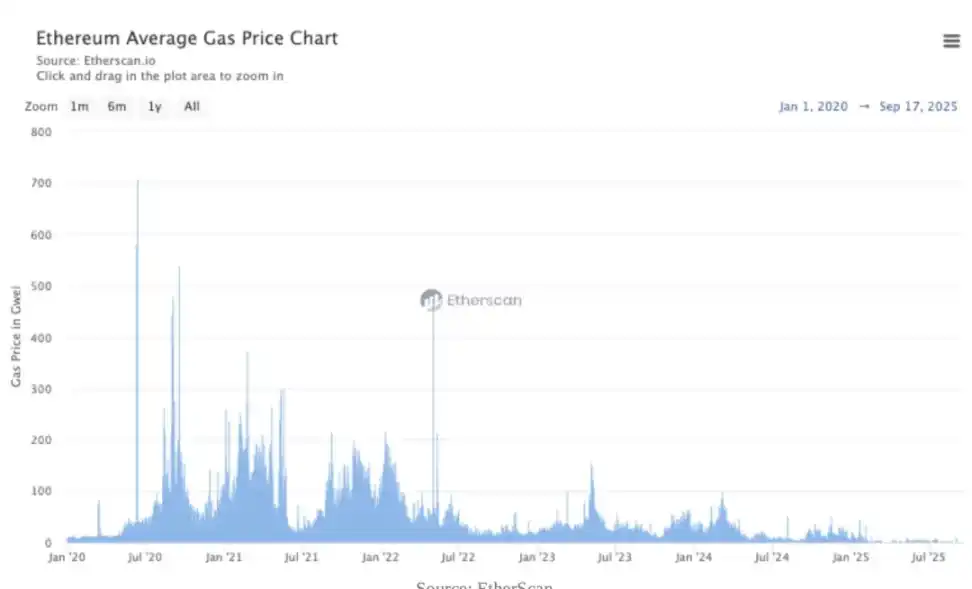
The scaling of block space, the exploration of the blockchain's "impossible triangle," largely dominated the early years of the crypto industry's development, making it a fitting theme to highlight.
▲Source: EtherScan
In terms of outcomes, key upgrades of Ethereum (such as EIP-4844) have shifted L2 data availability from expensive calldata to a lower-cost blob, significantly reducing the unit cost of L2. Transaction fees on mainstream L2 solutions have generally dropped to the level of cents. The introduction of modularization and Rollup-as-a-Service solutions has also significantly reduced the marginal cost of block space. Various Alt-L1s supporting different virtual machines have also emerged. The result is that block space has changed from a singular scarce asset to a highly substitutable commodity.
The above figure shows the evolution of on-chain costs for various L2 solutions over the past few years. It can be observed that from 23 to early 24, Calldata dominated the primary cost, with daily costs even approaching close to $4 million. Subsequently, with the introduction of EIP-4844 in mid-24, Blobs gradually replaced Calldata as the predominant cost, leading to a significant overall on-chain cost reduction. Moving into 25, the overall expenditure tends towards lower levels.
As a result, more and more applications can directly place their core logic on-chain, rather than adopting complex off-chain processing and on-chain submission architectures.
From this point onwards, we see value capture shifting from the underlying infrastructure towards the application and distribution layers that can directly handle traffic, enhance conversion, and form a closed-loop of cash flow.
Evolution on the Revenue Front
Building upon the discussion in the previous section's final paragraph, we can visually validate this point on the revenue front. During the infrastructure-centric narrative periods, the market's valuation of L1/L2 protocols primarily relied on their technical prowess, ecosystem potential, and anticipated network effects, known as the "protocol premium."
The token value capture models are often indirect (such as through network staking, governance rights, and vague fee expectations).
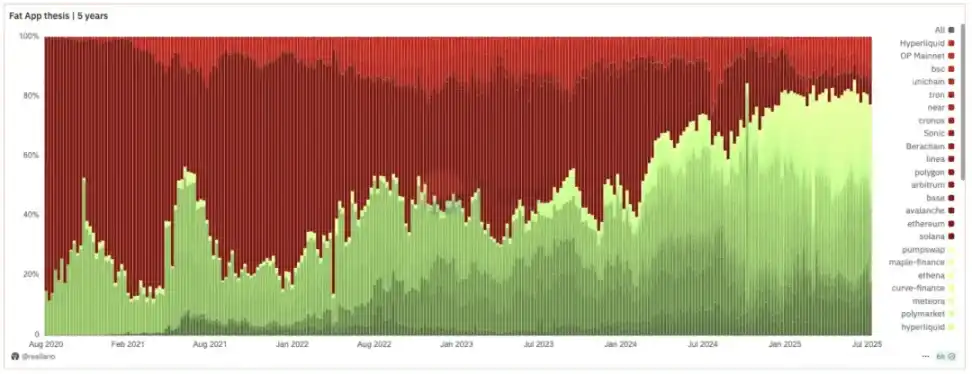
Application value capture, on the other hand, is more direct: generating verifiable on-chain revenue through means like fees, subscription charges, and service fees. This revenue can be directly used for token buybacks and burns, dividends, or reinvestment for growth, forming a tight feedback loop. The application's revenue sources become more solid—more from actual service fee revenue rather than token incentives or market narratives.
▲Source: Dune@reallario
The figure above roughly compares the revenue of protocols (in red) and applications (in green) from 2020 to the present. We can see the value captured by applications gradually rising and reaching approximately 80% this year.
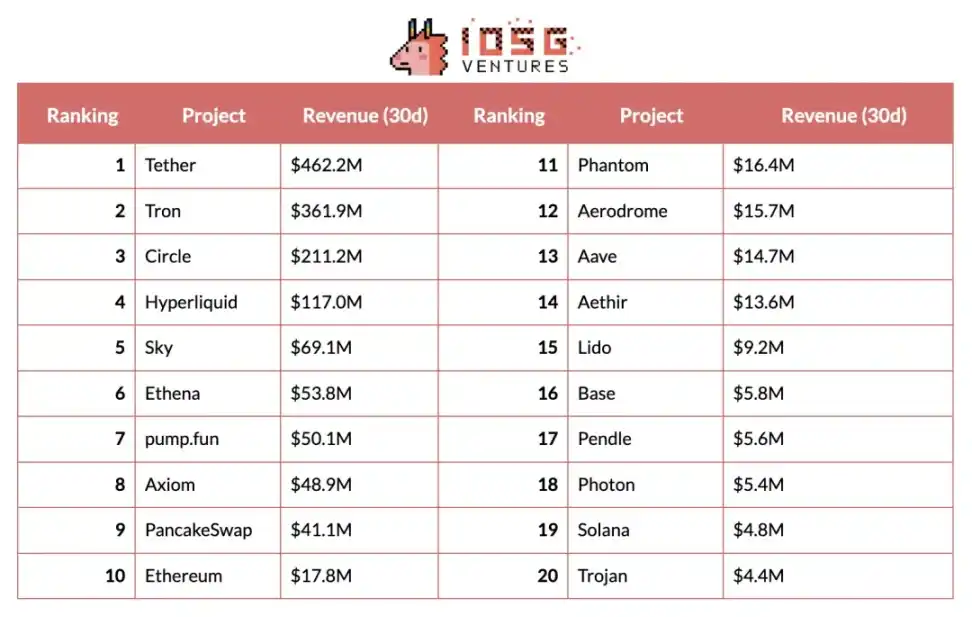
The table below lists TokenTerminal's 30-day protocol revenue rankings, with L1/L2 projects accounting for only 20% among the top 20 projects. Particularly notable are applications in stablecoins, DeFi, wallets, and trading tools.
▲Source: ASXN
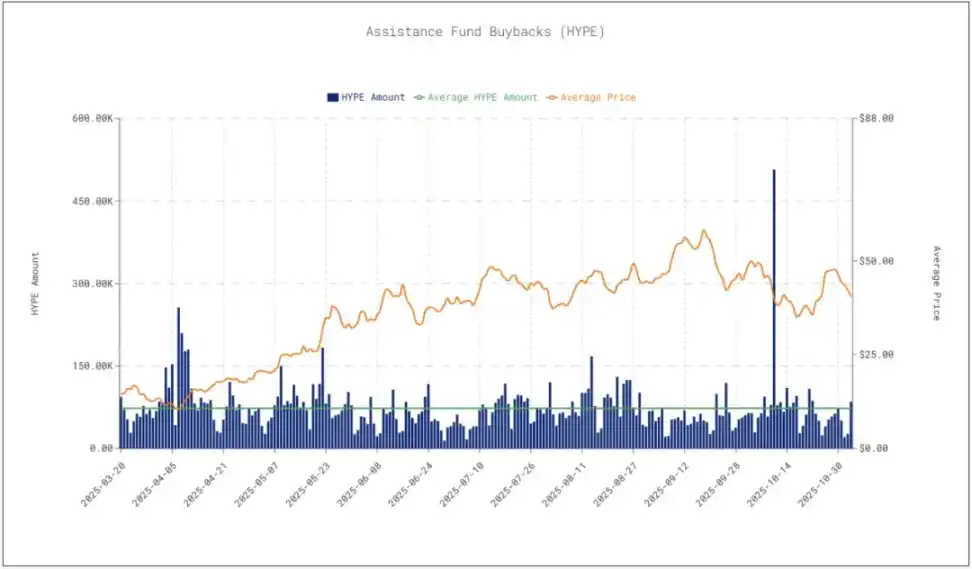
In addition, due to the market reaction brought about by buybacks, the price performance of the utility token is gradually becoming more correlated with its revenue data.
Hyperliquid conducts daily buybacks of approximately $4 million, providing clear support for the token price. Buybacks are considered to be a key factor driving price rebounds. This indicates that the market is starting to directly link protocol revenue to buyback behavior to the token's value, rather than relying solely on sentiment or narrative. The author expects this trend to continue to strengthen.
II. Embracing an Application-Centric New Cycle
The Golden Age of Asian Developers
▲Source: Electric Capital
▲Source: Electric Capital
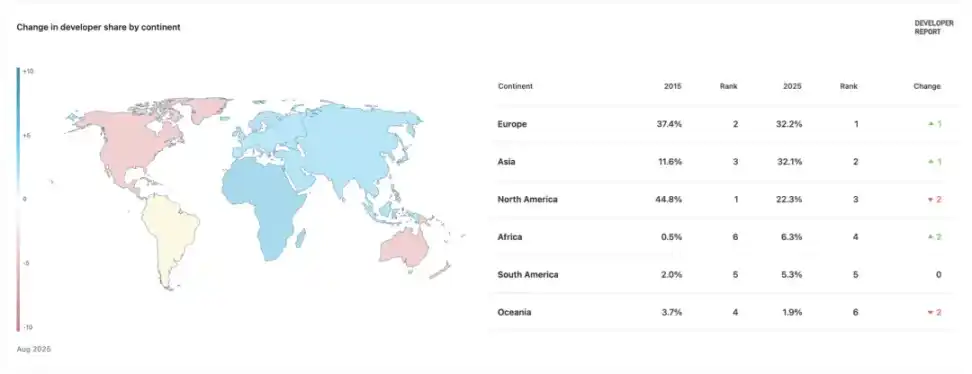
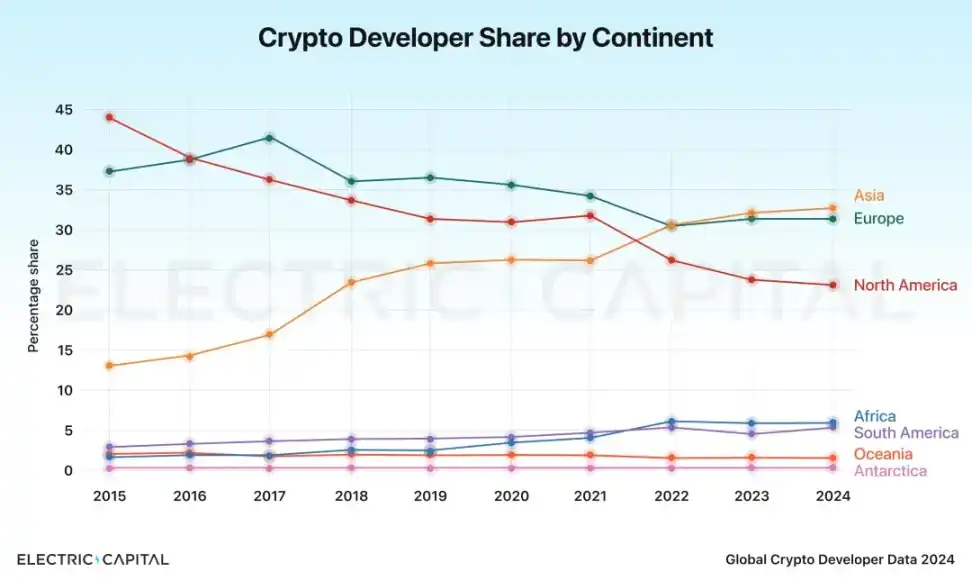
The Electric Capital 2024 Developer Report shows that the proportion of blockchain developers in the Asian region has reached 32% for the first time, surpassing North America to become the world's largest developer hub.
Over the past decade, globally recognized products such as TikTok, Temu, and DeepSeek have demonstrated the outstanding engineering, product, growth, and operational capabilities of Chinese teams. Asian teams, especially Chinese teams, have a strong iterative pace, can quickly validate demand, and achieve international expansion and growth through localization and growth strategies. Crypto aligns perfectly with these characteristics: requiring rapid iteration and adjustment to adapt to market trends; needing to serve a global user base, cross-language community, and multi-market regulations.
Therefore, Asian developers, especially Chinese teams, have a structural advantage in the Crypto application cycle: they have strong engineering capabilities and possess both market speculation cycle sensitivity and strong execution capabilities.
In this context, Asian developers have a natural advantage and can more quickly deliver globally competitive Crypto applications. In this cycle, we see representatives of Asian teams on the global stage such as Rabby Wallet, gmgn.ai, Pendle, and others.
It is expected that in the future, we will soon see this shift: the market trend will transition from the past U.S.-centric narrative to Asian product landing first, then expanding to European and American markets in a new path from point to area. Asian teams and markets will have more say in the application cycle.
Primary Market Investment in the Application Cycle
Here are some viewpoints on primary market investment:
Trading, asset issuance, and financialization applications still have the best PMF and are almost the only products that can transcend a bear market. Examples include products like Hyperliquid for perpetuals, Launchpads like Pump.fun, and products like Ethena. The latter packages funding rate arbitrage as a product that can be understood and utilized by a wider user base.
For investments in niche tracks where there is significant uncertainty, consider investing in the Beta of the track and think about which projects will benefit from the development of that track. A typical example is prediction markets—there are approximately 97 publicly known prediction market projects, with Polymarket and Kalshi being more obvious winners, making the probability of successfully betting on a long-tail project very low. Investing in tooling projects related to prediction markets, such as aggregators, chip analysis tools, etc., provides more certainty and allows for capturing the dividend of track development, transforming a difficult multiple-choice question into a single-choice question.
After having a product, the next core step is how to truly bring these applications to the masses. In addition to common access points like Social Login provided by platforms such as Privy, I believe that an aggregated trading frontend and mobile end are also crucial. In the application cycle, whether it's perpetuals or prediction markets, the mobile end will be the most natural touchpoint for users, providing a smoother experience for both a user's initial deposit and daily high-frequency operations.
The value of an aggregated frontend lies in traffic distribution. The distribution channel directly determines user conversion efficiency and project cash flow.
Wallets are also a key part of this logic.
I believe wallets are no longer just asset management tools but have a positioning similar to a Web2 browser. Wallets directly capture order flow, distribute order flow to block builders and searchers, thus monetizing traffic; at the same time, wallets serve as distribution channels, integrating third-party services such as built-in cross-chain bridges, in-house DEX, Staking, becoming a direct access point for users to interact with other applications. In this sense, wallets control order flow and traffic distribution rights, serving as the primary entry point for user relationships.
For the infrastructure of the entire cycle, I believe some public chains created out of thin air have lost their raison d'être; however, infrastructure built around applications can still capture value. Some specific points are as follows:
· Infrastructure that provides customized multi-chain deployment and application chain-building for applications, such as VOID;
· Companies providing User Onboarding services (covering login, wallet, deposits, withdrawals, onboarding/offboarding of funds, etc.), such as Privy, Fun.xyz; this can also include Wallet and Payment Layer (fiat on/off ramps, SDKs, MPC custody, etc.)
· Cross-Chain Bridge: As the multi-chain world becomes a reality, the influx of application traffic will require secure and compliant cross-chain bridges.
Welcome to join the official BlockBeats community:
Telegram Subscription Group: https://t.me/theblockbeats
Telegram Discussion Group: https://t.me/BlockBeats_App
Official Twitter Account: https://twitter.com/BlockBeatsAsia