After Zero Commission, the battlefield where talent is seized in the "Discovery and Discussion Layer" is the new brokerage.

Original Title: Why Social Trading Is The New Financial Infrastructure Layer
Original Author: Boaz Sobrado, Forbes
Translation: Peggy, BlockBeats
Editor's Note:
From the retail trading frenzy sparked by GameStop to Robinhood's announcement of a "Financial Super App" vision, social trading is evolving from a fringe phenomenon to part of the financial infrastructure. They are not replacing brokers, but building a new layer of discovery and discussion on top of them.
This article delves into how emerging platforms like Blossom, AfterHour, Fomo, among others, are reshaping the behavioral path and market structure of retail investors through real holding data, community interaction, and trade integration. As this infrastructure takes shape, whoever understands their users will define the future financial gateway.
The following is the original article:

On January 23, 2025, the famous "dogwifhat" meme dog Achi appeared at the opening bell ceremony of the New York Stock Exchange.
Dogwifhat (token code WIF) is a dog-themed meme coin based on Solana, launched in November 2023, with its mascot being a Shiba Inu wearing a knitted hat.
When Benchmark led Fomo's $17 million Series A funding round in November 2025, the Silicon Valley's most selective venture capital firm made an unusual bet on the crypto space. Benchmark rarely invests in cryptocurrency startups. The firm had previously invested in Chainalysis in 2018, among a few other projects, but the crypto space was still not part of its typical portfolio.
However, Partner Chetan Puttagunta joined Fomo's board. Fomo is a consumer-facing application that supports trading millions of crypto tokens across multiple blockchains.
What Benchmark invested in was not another trading app but social trading infrastructure—a category rapidly becoming an essential tool for retail investors, whose importance rivals that of traditional brokers.
More Than Just a Degen: A Case Study of Blossom Social

Blossom Social Team Taking a Group Photo with Community Members in Front of the Nasdaq Building
Blossom's CEO Maxwell Nicholson has a deeper understanding of "friction" than most.
When building a social platform, forcing users to link a brokerage account from the outset often creates significant resistance at the beginning of the user journey. While most consumer products choose to remove this barrier, Blossom took a different approach by making it a mandatory requirement.
At first glance, this decision may seem counterintuitive until you understand what Nicholson aims to build.
Blossom launched in 2021, amidst the retail trading frenzy sparked by GameStop. At that time, discussions about stocks on Reddit were mostly anonymous—you couldn't see real positions, only various opinions. While StockTwits had a large user base, the shared content was largely unverified.
What Nicholson wanted to build was a social network based on real investment behavior. Through APIs like SnapTrade, Blossom could link brokerage accounts to verify user holdings. The technology was already mature; the question was whether users would tolerate this "friction."
The result was: they did.
Today, Blossom has 500,000 registered users, with about 100,000 having linked brokerage accounts, representing nearly $40 billion in assets. On the platform, about half of the holdings are in ETFs rather than individual stocks, with the most popular being the S&P 500 Index ETF.
Mandatory linking of accounts shaped the platform's culture.
Nicholson observed that while StockTwits later introduced brokerage linking, it was optional. Technically, anyone could integrate through Plaid or SnapTrade, but because linking was not core to the platform's culture, users did not widely adopt it. In contrast, on Blossom, almost all active users share their real holdings and earn badges through verification. This "friction" filters out those willing to disclose their investment portfolios, thus creating a unique community atmosphere.
This culture eventually transformed into a business model.
In 2023, Blossom achieved $300,000 in revenue, reached $1.1 million in 2024, and is projected to surpass $4 million this year, with 75% of it coming from collaboration with ETF issuers.
State Street pays Blossom to boost the awareness of SPY among retail investors, preventing them from defaulting to Vanguard's VOO. VanEck promotes thematic ETFs, Global X markets its specialty funds. Currently, about 25 issuers are partnering with Blossom because the platform can precisely target retail investors who are actively selecting funds.
The reason why this model is effective is that Blossom's users are not day trading but rather building their investment portfolios for the next few decades. When they link their accounts and discuss holdings, they not only create content for other users but also generate data on real retail investor behavior.
Nicholson introduced the quarterly ETF retail fund flow report released by Blossom. These data show how users actually allocate funds, rather than what they claim in surveys. As the data are validated through brokerage accounts, they are highly reliable and therefore have commercial value. ETF issuers are willing to pay for this data to understand if their products are truly appealing to retail investors.
This $4 billion in linked assets represents real money, making genuine asset allocation decisions based on discussions on the social platform.
For ETF issuers, this is not just a content platform but a new layer of financial infrastructure.
Retail Investors Rule the World, but Which Type of Retail Investor?
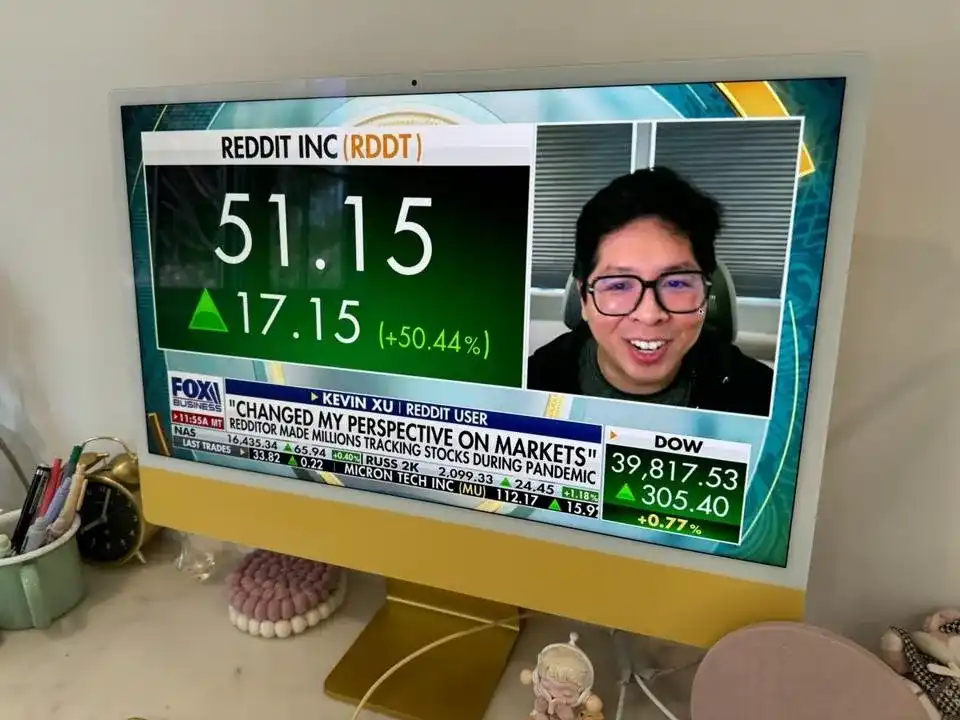
Reddit-famous investor Kevin Xu is the founder of AfterHour and Alpha Ai
The explosion of social trading has revealed a fact: retail investors are not a homogeneous group. The platforms that have truly emerged in this race track are serving entirely different user groups—their risk preferences, investment horizons, and motivations are all different.
AfterHour targets the WallStreetBets community. Founder Kevin Xu, during the meme stock craze, publicly shared every trade on WallStreetBets under the identity of "Sir Jack," turning $35,000 into $8 million. He built AfterHour to serve these types of users. The platform allows users to share holdings anonymously but must be verified through linked brokerage accounts. Users share specific amounts, not percentages. The atmosphere in the stock chat rooms is more like a trading version of Twitch livestreams.
In June 2024, AfterHour secured a $4.5 million investment from Founders Fund and General Catalyst. The platform has gained immense popularity, with reportedly 70% of users opening the app daily. They are not passive investors who check their portfolios quarterly but rather engage with the market as entertainment and community participants. The platform has pushed out nearly 6 million trade signals to users, with validated holdings exceeding $500 million.
Fomo, on the other hand, targets the crypto circle's "Degen." This group of people aims to trade any token on any blockchain. Fomo's founding team, by listing 200 ideal angel investors and leveraging their network for referrals, ultimately secured 140 of them, including Polygon Labs CEO Marc Boiron, Solana co-founder Raj Gokal, and former Coinbase CTO Balaji Srinivasan.

The team behind Fomo, who recently secured Benchmark investment
The opportunity for Benchmark to invest in Fomo arose when three different individuals recommended Fomo's two founders, Paul Erlanger and Se Yong Park, to partner Chetan Puttagunta. They had worked together at dYdX and strongly believed in Fomo's vision: to create a super app that allows users to trade all crypto assets on any blockchain, embedded with social features to track friends' and KOLs' trades in real time.
Fomo caters to those who want to trade anytime, anywhere, from Bitcoin to obscure meme coins. The app charges a 0.5% transaction fee but absorbs on-chain gas fees, making it very attractive to mainstream coin enthusiasts. For example, you can trade Solana tokens at 3:00 AM on a Sunday without worrying about network fees—the "friction" of traditional markets is particularly evident here.
By June 2025, Fomo integrated Apple Pay, allowing users to start trading upon download. The platform's revenue quickly grew to $150,000 per week, with a daily trading volume of $3 million. By the time the funding round closed in September, the daily trading volume had reached $20 million to $40 million, daily revenue hit $150,000, and users surpassed 120,000.
This wave of growth has validated Puttagunta's insight: Social trading is no longer just a feature but a new layer of infrastructure. These platforms are building a long-term architecture for retail investor discovery, discussion, and execution of trades.
On the other hand, Blossom aims to attract long-term investors. Users on the platform discuss whether their portfolios should tilt towards small-cap value stocks or the international market. Around 37% of the holdings are in S&P 500 ETF, while the remaining 63% include dividend funds, covered call ETFs, crypto ETFs, fixed income products, and thematic ETFs. Users generally follow a "core-satellite" strategy: a broad market base with specific thematic allocations.
The user bases served by these platforms are vastly different.
A user discussing SCHD's dividend yield on Blossom is clearly not the same type of person as a user on Fomo trading Trump meme coins in the middle of the night. They are both retail investors, but they have different goals, risk preferences, and market attitudes.
The success of these platforms lies in precisely targeting their audiences.
Blossom enforces linking a brokerage account, filtering out serious investors willing to share real holdings; AfterHour's anonymous transparency mechanism attracts those looking to build reputation without revealing their identity; and Fomo's multi-link-in feature caters to the crypto natives accustomed to round-the-clock trading. In theory, these platforms could serve all retail investors, but they choose not to do so.
Logic of Financial Super Apps
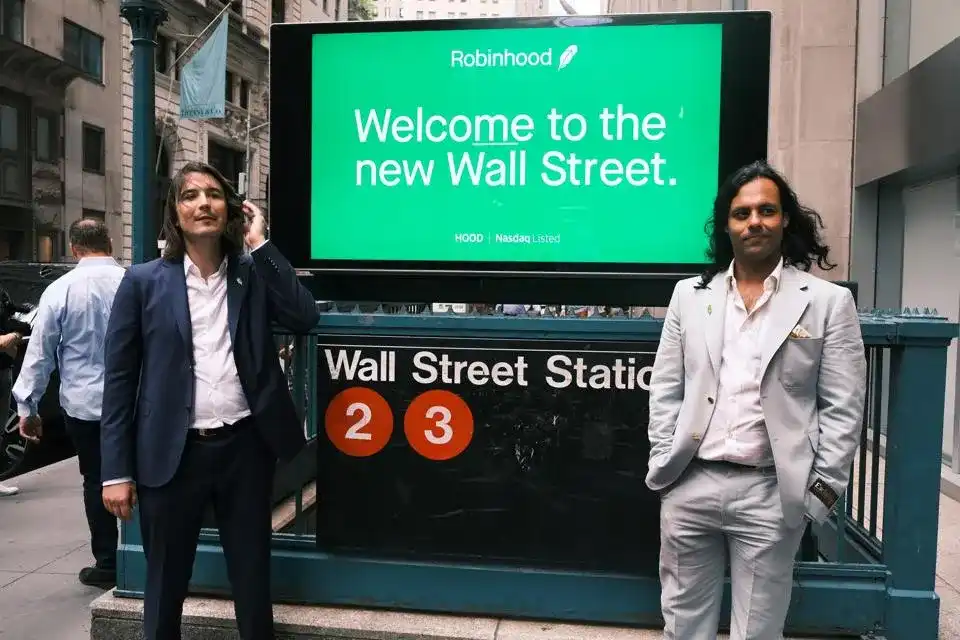
On July 29, 2021, online brokerage Robinhood went public on the New York Stock Exchange.
That day, founders Baiju Bhatt and Vlad Tenev appeared on Wall Street, and Robinhood's stock price dropped approximately 5% on its first day of trading on the Nasdaq.
By September 2025, Robinhood announced the launch of "Robinhood Social," validating the trend of social trading from an unexpected direction. When the platform that once "commoditized" trading commissions begins to integrate social features, it indicates a fundamental shift in the entire brokerage industry's logic.
Robinhood CEO Vlad Tenev stated at an offline event in Las Vegas, "Robinhood is no longer just a trading platform; it is your financial super app."
This release includes AI-driven custom indicators, futures trading, shorting mechanisms, overnight index options, and support for multiple separate broker accounts. However, the most core update is Robinhood Social—an in-app trading community that supports real trade validation and verified profiles.
These features nearly replicate the core experience of standalone social trading platforms: users can see real-time entry and exit points, discuss strategies, follow other traders, and execute trades directly within the feed. They can view one year of P&L, daily returns, and historical trade records. Each profile undergoes KYC verification to ensure authenticity. Users can even follow publicized trade histories of politicians, insiders, and hedge funds, even if these individuals are not active on Robinhood.
Robinhood has made social features "invite-only," indicating their recognition of the significance of this track. With 24 million funded accounts, the platform has strong distribution capabilities. It once led zero-commission trading and long defended the "order flow payment" profit model. Now, it is venturing into the social layer as brokerages themselves face the risk of "commoditization."
Zero commissions have become an industry standard, mobile experience is a basic requirement, and fractional share trading is now widespread. Robinhood's differentiating advantages in 2015 can now be found on Charles Schwab, Fidelity, and TD Ameritrade. The next round of competition focuses on "community" and "conversation."
Robinhood's move demonstrates that social trading is not just an add-on feature but a foundational layer. When the most user-heavy retail brokerage joins social features, it indicates that this track has been validated by standalone platforms and proven its worth.
The timing of this move also reveals a defensive posture. Blossom, AfterHour, and Fomo are vying for different types of retail investors. They don't need to be brokerages themselves but rather connect to existing brokerages via API. However, they control the layer of "discovery" and "discussion"—where investors decide what to buy. If trading happens on Robinhood while discussions occur elsewhere, Robinhood might be reduced to a "pipe."
The user stickiness brought by the social layer is irreplaceable by the execution layer. If your friends are all trading on AfterHour, and the investors you follow are on Blossom, not on Robinhood, then the migration involves not only assets but also community, discussions, and decision-making context. Robinhood recognizes this and is beginning to address it, but it is following rather than leading in this track.
Social Media is Becoming Market Infrastructure
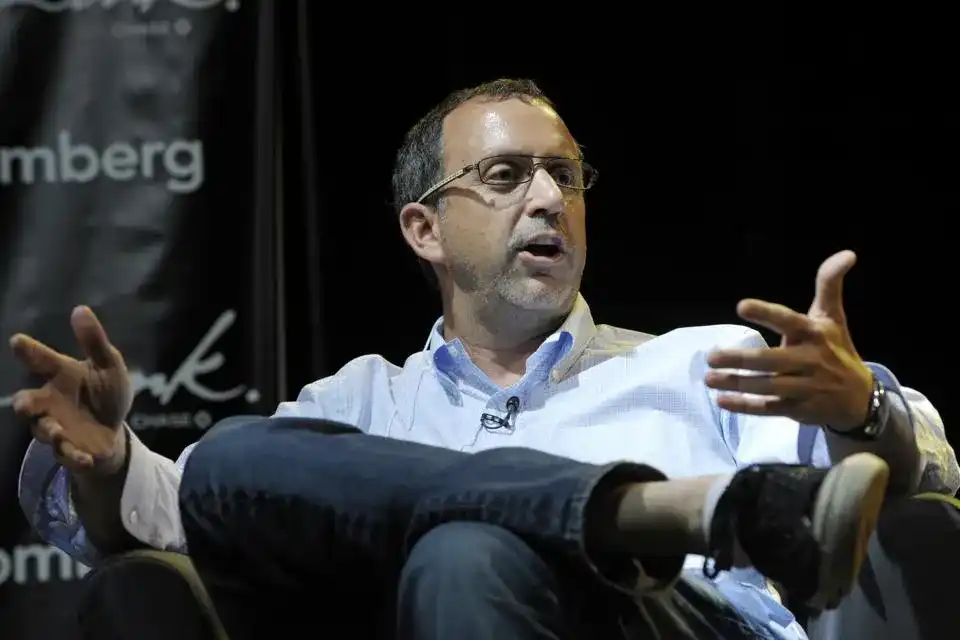
StockTwits CEO Howard Lindzon spoke on April 14, 2011 (Thursday) at the Bloomberg Link Empowered Entrepreneur Summit in New York, USA.
The summit brought together the most innovative entrepreneurs to spend a day with other entrepreneurs, investors, and potential business partners, engaging in in-depth discussions on startups, funding, and business growth.
Social trading platforms are integrating two previously separate functions in retail investing: financial media and market infrastructure, creating a unified user experience.
Imagine how Wall Street professionals work. They spend $24,000 a year on a Bloomberg Terminal subscription. The value of the terminal lies not only in its data or trading capabilities, but in its integrated workflow: professionals can view the market, read news, analyze charts, chat with other traders, and execute trades all in one interface. Bloomberg's instant messaging system is still widely used today because it is embedded in the trading process, rather than forcing users to switch between different platforms.
Social trading platforms are building a similar experience for retail investors. StockTwits has 6 million users discussing the market in real-time. Founder Howard Lindzon (also the creator of the "Degen Economic Index") launched this platform as early as 2008, long before the retail trading frenzy. This community focuses on "what is happening now," rather than what CNBC reported three hours ago. During the 2021 GameStop frenzy, discussions took place on Twitter, StockTwits, and Reddit, rather than traditional financial media.
Blossom combines this concept with real holding data. When users link their accounts and discuss their actual positions, the generated content not only serves other users but also becomes a data source for the platform. ETF issuers are willing to pay for exposure because retail investors discover funds in the social feed rather than through Morningstar ratings or financial advisor recommendations.
AfterHour's mechanism is this: when people you follow make trades, the platform instantly sends out trade signals. The sense of immediacy this brings is unmatched by traditional media. When an investor you respect buys a stock, you see it in real-time instead of waiting to hear about the day's hot picks on CNBC at the close.
Fomo, on the other hand, allows users to trade hundreds of different cryptocurrencies while seeing what assets others are holding. A social feed will display which tokens are gaining attention, sometimes even before mainstream crypto media coverage. The discovery process is community-driven rather than determined by centralized editors deciding what is worth reporting.
This integration explains why traditional financial media struggles to attract young investors. CNBC still operates in broadcast mode: hosts explain, and the audience passively watches. The disconnect between media consumption and trade execution creates "friction." Young investors don't watch cable TV or wait for market summaries. They consume content in real-time on their phones and make decisions.
Social trading platforms address this issue by making content creation "participatory." Users create content through trading and discussions, making the platform both a media company and a community generating signals through user activity. This structure reflects the media consumption habits of the younger generation—they don't differentiate between "creating" and "consuming," and social trading platforms embody this behavior in the financial market.
These platforms' business models also reflect the fusion of media and infrastructure. Blossom's revenue comes from ETF issuers buying exposure, similar to media companies selling advertising. But these ads are combined with real holdings data, allowing issuers to assess if their product is genuinely engaging users and pay based on actual effectiveness. AfterHour and Fomo profit from transaction fees, similar to brokerage execution revenue, but the trades occur in a social context driven by community discovery.
These platforms are not trying to replace CNBC or Bloomberg but are replacing the experience of "media consumption and trade execution disconnect." The true innovation lies in integration: when discovery, discussions, and execution are completed in one workflow without the need to switch platforms, the platform itself ceases to be just an app but becomes a new layer of financial infrastructure.
Trade Data Becoming the Product Itself

Blossom Social once held a 1400-person offline event at the Toronto Rogers Centre—where the Blue Jays lost in the World Series Game 7.
Social trading platforms are creating an unprecedented dataset, where this data itself is the product, independent of the social functions that generate it.
Blossom is currently connected to around $4 billion in assets, revealing genuine retail behavior rather than their stated preferences. Traditional market research relies on surveys asking investors what assets they hold or plan to buy, but such surveys are often affected by selection bias, recall errors, and idealized responses. Blossom, through brokerage account connections, directly verifies users' actual holdings.
Every quarter, Blossom releases a report on retail money flow into ETFs, revealing which categories are attracting funds and which are seeing outflows. This data is important because retail trading now holds a significant market share. In 2021, the active participation of retail traders compelled institutional investors to adjust their strategies, and this activity did not dissipate with the GameStop frenzy.
ETF issuers are willing to pay for this data because it can show whether their products are truly resonating with retail investors. State Street and Vanguard compete for retail funds in S&P 500 ETFs, while VanEck and Global X vie for flow in thematic ETFs. They need to know if retail investors are truly buying into their funds, not just hearing about them.
Blossom can provide answers. When 37% of linked assets are concentrated in S&P 500 ETFs, it indicates broad appeal in this category; when covered call option ETFs experience strong inflows, it shows a genuine market demand for income-generating products; when crypto ETFs are widely adopted, it demonstrates that retail interest extends beyond speculative trading on exchanges. This data comes from actual holdings, not surveys or focus groups.
AfterHour's holdings verification mechanism reveals the stocks truly being traded by the WallStreetBets community, not just popular stocks being discussed. Many stocks generate high social media buzz but have low actual trading volume. AfterHour can differentiate between "noise" and "signal" through users' verified holdings. The platform's $500 million in linked assets represent real funds making trade decisions based on community discussions.
Fomo's trading data, on the other hand, shows which cryptocurrencies are genuinely adopted among retail investors, not just hyped up. The platform promises to support trading millions of tokens on all blockchains, with most eventually failing. However, identifying which tokens sustain trading volume versus those that are merely short-term hype is crucial for understanding retail behavior.
As retail trading's share of the market continues to rise, the value of this data increases as well. Social trading platforms are collecting information that traditional data providers struggle to access. Retail investors do not submit 13F filings or disclose holdings publicly. Brokerage data is usually siloed, but social trading platforms aggregate data across brokerages through user connections, breaking down traditional data silos.
These platforms' business models are also built on this premise: they do not profit from trade volume but from information flow. Blossom does not require users to trade frequently; they only need them to authentically share holdings for the data to be valuable. This model differs from traditional brokerage logic based on commissions or order flow payments, leading to a shift in incentive mechanisms.
Data products have also built moats. Once ETF issuers start relying on Blossom's quarterly reports to inform their strategies, they become reliant on data; once AfterHour shows hedge funds retail investors' real trading behavior, that information becomes part of their investment process. These platforms are not only retail investors’ infrastructure but are also becoming tools for institutions to understand retail behavior.
Trading Has Become a Consumer Behavior
Social trading infrastructure is becoming a permanent architecture of the market. While each platform targets different user bases, they share the same underlying logic: real positions, real-time discussions, and a business model built on transparency rather than trading volume.
The technology underpinning this infrastructure is now irreversible. Brokerage account-connecting APIs already exist and will continue to be optimized. The ability to validate positions in real time can be accessed by any platform. The question is not whether social trading infrastructure exists but rather which platforms can capture which user bases.
The retail trading frenzy sparked by GameStop has not subsided. Retail investors who opened accounts in 2021 did not close them after meme stocks cooled off. Data indicates that they are still actively participating in the market. These investors need infrastructure to support their investment process—a platform that seamlessly integrates discovery, discussion, and execution.
Traditional brokerages can add social features, as Robinhood has demonstrated. However, platforms that start from a social angle and then integrate trading functionality may have a structural advantage. Blossom, AfterHour, and Fomo do not need to be brokerages themselves; they connect to all brokerages via API, allowing users to trade on their familiar platform while engaging in a social community.
The business models of these platforms also validate their sustainability. Blossom's revenue grew from $300,000 to $4 million in two years, indicating that ETF issuers are willing to pay to access retail investors; AfterHour's daily active data shows that social trading can form user habits; Fomo's increasing trade volume demonstrates that crypto natives crave a social trading experience. These are not fleeting products but infrastructure that serves real needs.
The regulatory environment is also supporting rather than hindering this architecture. Social trading platforms do not hold assets or execute trades; they provide communities and discussions around real positions. This structure bypasses most of the regulatory complexities that brokerages face. Platforms collaborate with compliant brokerages rather than compete with them.
The future development path will continue to specialize. More platforms will emerge, serving specific groups of retail investors: some focusing on options trading, some catering to dividend income investors, some targeting emerging markets. They will build communities around real data and integrate trade execution without becoming brokerages.
The ultimate winner will be those platforms that truly understand their user base, rather than trying to serve everyone. Retail investors are not a monolithic group, and successful social trading platforms reflect this reality in their product design, business model, and community culture. Benchmark's investment in Fomo also validates this logic: they invested in a platform that is not trying to serve all retail investors, but rather one focused on serving crypto natives, supporting their transactions of millions of tokens within the community.
Social trading infrastructure does not necessarily have to replace brokers but add a layer on top of them—within this layer, community, discussion, and discovery are taking place. This layer is becoming as important as brokers themselves. Platforms building this layer are creating a permanent market structure for retail investors.
Welcome to join the official BlockBeats community:
Telegram Subscription Group: https://t.me/theblockbeats
Telegram Discussion Group: https://t.me/BlockBeats_App
Official Twitter Account: https://twitter.com/BlockBeatsAsia