Unveiling the KOL Round: When Influence Turns into Capital, How Is the Crypto Primary Market Reshaped?
Original Article Title: "Decoding the KOL Round: A Wealth Experiment Driven by Traffic"
Original Article Authors: Viee, Biteye
Once upon a time, the play in the primary market was relatively clear: VCs invested, KOLs promoted, and retail investors provided liquidity.
But today, this play seems to be disrupted.
A VC's endorsement is no longer all-powerful, and projects are beginning to redesign the game rules around "influence." KOLs are no longer just traffic contributors. They hold chips, step into the game, and can even decide the life or death of a project.
To some extent, the KOL Round is a token distribution method born in the era of "influence first" after VCs exit and retail investors lose their voice. Over the past 7 days, XHunt statistics show that there have been as many as 3860 tweets mentioning "KOL" in the crypto community, while "VC" has 3078 tweets, signaling a stealthy battle around influence.
This article does not preach grand theories but only tells the true story behind the KOL Round—where it came from, who is laughing, who is crying, who is counting money behind the scenes, and who is suffering from insomnia late at night.
01 How Did the KOL Round Step onto the Center Stage?
Let's go back to the end of 2022.
The winter of Crypto VC has arrived. Primary market valuations are inflated, exit cycles are prolonged, and the secondary market cannot absorb the selling pressure. Large institutions dare not invest, and small projects cannot raise funds.
On the other hand, retail investors have quietly returned. Blast, ZKsync, Friend.tech... Behind every liquidity surge is a sign of the return of retail investors.
What influences these people the most is not institutional research reports but those KOLs who appear to be knowledgeable and are actually "marketing" products.
Project teams also realized: VCs may not necessarily help them break into the mainstream, but KOLs can. Instead of spending money on advertisements, it's better to put low-price chips in the hands of KOLs, have them promote, and set the tone.
Thus, a new play was born:
· Projects extend credit lines to KOLs, sometimes at prices even lower than VCs;
· KOLs aggressively pump the project before the TGE, creating FOMO;
· At the moment of unlocking, there is a traffic explosion, and KOLs cash out and exit.
KOL Round is here. You can think of it as a "task-based private sale." Low price, fast unlock, and even a "guaranteed allocation clause."
The project team has it all figured out: give tokens to those with fans and influence, and after the launch, they will naturally bring people to drive up the price.
KOLs also think it's a good deal: get tokens at a low price, bring some traffic, sell a portion after unlocking at launch, sounds like a surefire way to make a profit.
But is the reality really like that?
02 The Truth About KOL Rounds: Some Strike It Rich, Some Go Bust
2.1 The Two Ends of KOL Round Returns
The profit and loss performance of KOL rounds varies greatly depending on the project and market conditions.
In a bull market, KOL rounds are often seen as a "triple win": the project receives funding, KOLs get in early at a low price, and retail investors can also make some gains. But as we enter a bear market, the script changes completely.
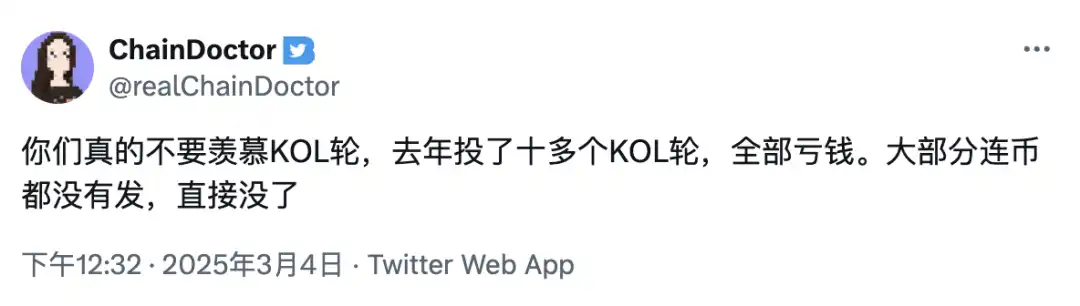
With decreasing liquidity, a post-listing price drop has become the norm, and KOLs, unable to sell due to lock-up periods, are susceptible to heavy losses. KOL @realChainDoctor once admitted that he participated in over ten KOL rounds last year, none of which were profitable, with some not even receiving their allocated tokens. Meanwhile, according to the prominent figure @kiki520_eth, there are certain systemic pitfalls in KOL rounds, where participants may not receive tokens, or if the price surges, the rules may change.
Top KOL @jason_chen998 stated that the most profitable projects he invested in were Aster and Mira. He acquired them at a discounted valuation when the market was bearish, and the projects were promising. They were launched right in the middle of a bull market. Thus, the key to making money in KOL rounds lies in lurking during a bear market and leveraging connections to access projects. However, he also admitted that most KOL rounds are like high-yield financial products — if you're lucky, you can make some gains; if you're unlucky, you end up working for free, and you may also face demands from the project team, token vesting delays, and token deductions, which ultimately lead to a falling out.
We reviewed some recent KOL round cases of projects, and some did indeed bring substantial returns, such as:
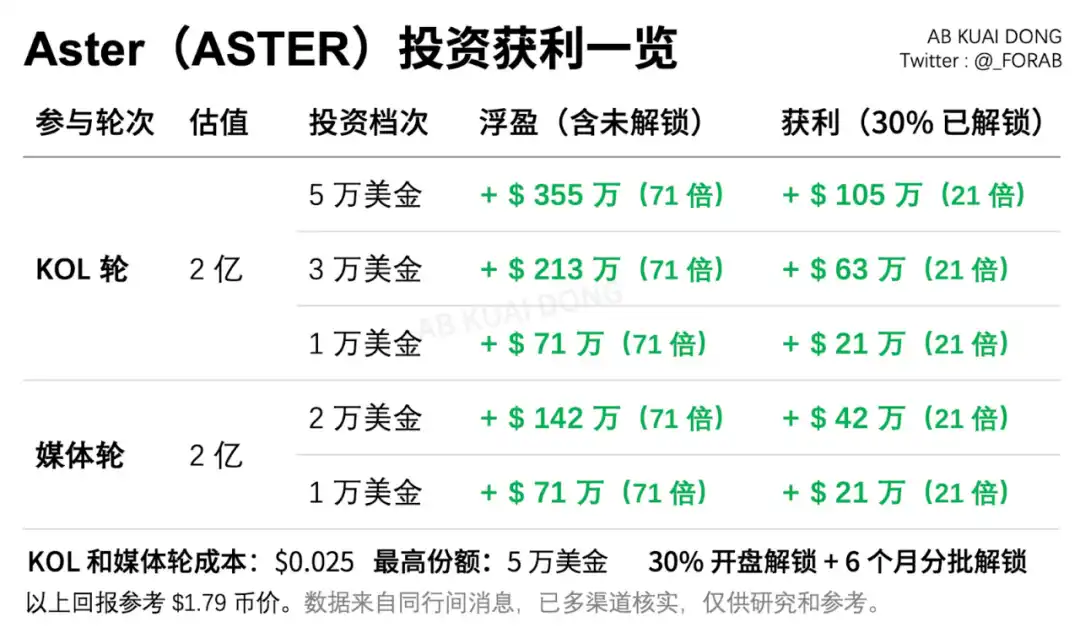
· Aster: When the token price surged above $1.79, the maximum unrealized gain from the KOL round exceeded 70x. If we only consider the 30% unlocked at listing, the profit was 21x, equivalent to a $50K entry resulting in a $1.05M gain.
· Holoworld AI: LookIntoChain monitored that the on-chain address 0x3723, suspected to belong to a KOL investor, received approximately 10.24 million HOLO tokens in September at a cost price of only $0.088. Subsequently, these tokens were gradually cashed out at an average price around $0.6, with total cash-outs exceeding $4.71M, a single-round ROI of over 444%, and a net profit of over $4M.
· WalletConnect: After the token unlocks, ICO and KOL round investors only receive about 1.5 times return.
However, there have been many cases where projects from previous KOL rounds experienced a price collapse after listing, or the project team encountered issues.
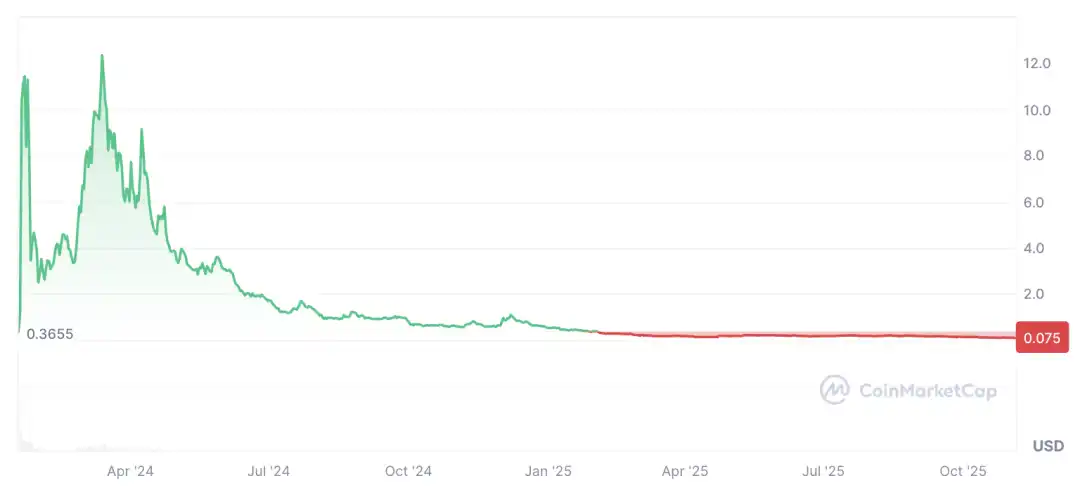
A typical example is the early 2024 project SatoshiVM, where the project's token $SAVM relied on a large number of KOLs for hype at launch, reaching a high of over $11. However, shortly after, rumors of KOLs cashing out at a high price spread, leading to a trust crisis, and the project gradually lost its momentum. Both KOLs who did not sell and retail investors are estimated to have difficulty making a profit, and currently, $SAVM has fallen to about $0.075.
Another example is ZKasino, where KOLs participated in fundraising and promoted the project, but the project team unilaterally changed the rules and took away the assets after users completed the lock-up. In this event, KOLs who participated in fundraising and promotion were condemned by fans as accomplices, suffering not only financial losses but also facing significant public opinion pressure.
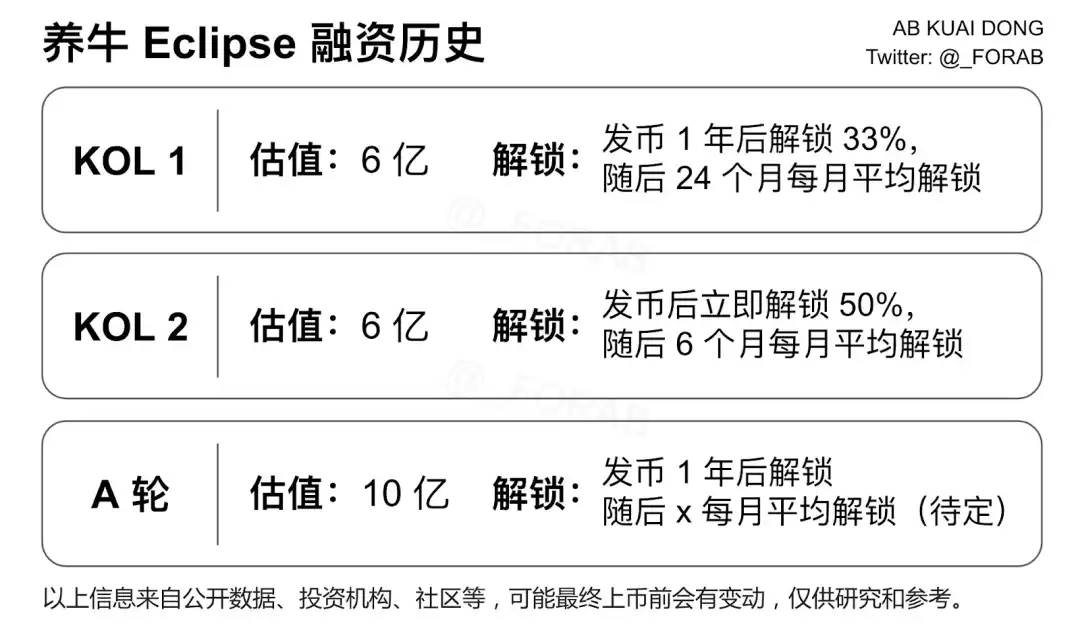
A few months ago, there was also the launch of Eclipse, where the KOL round was valued as high as $6 billion, and the Series A round was valued at $10 billion. However, after the launch, the actual circulating market cap was only about $3.8 billion, far below the rumored $6 billion valuation. Researcher KOL @_FORAB stated that some of the Eclipse KOL round allocation was distributed to the media and the community, and in the end, the project did not even launch on the Binance Smart Chain.
In response, well-known KOL @yuyue_chris once tweeted that the real problem with the KOL round is not losing money, but rather the project team and intermediaries using the KOL round to attract people in the name of promotion, allowing KOLs to use their fans to redeem their principal, which is the most irresponsible way to scam acquaintances.
2.2 Behind the Returns: The Triangular Game Among Projects, KOLs, and Retail Investors
As mentioned earlier, the KOL round reflects the change in the power structure of the entire primary market.
In the past, projects relied on VCs for funding, and VCs relied on their influence to screen projects. Now, projects have found that KOLs are cheaper, faster, and better at generating hype.
VCs are not happy: They invested millions of dollars, but the project team let in a bunch of low-priced influencers, whose influence might even surpass their own... So, some VCs choose to "exit."
Retail investors are even more unhappy: In the secondary market, they buy tokens dumped by KOLs after unlocking, thinking they are buying in when KOLs are shilling, but in reality, it's just a sell-off.
The project team may not be happy either: because KOL's promotion is often a short-term behavior, the volume, liquidity, and strong initial performance on launch day do not necessarily represent the project's long-term trend.
Thus, on the stage of the KOL cycle, a tense triangular relationship is formed.
· KOL is thinking: How can they safely exit after investing money and reputation?
· The project team is pondering: Can the allocation provided generate the expected volume and price increase?
· Retail investors are asking: Is following this time an opportunity or a trap?
The interests of these three parties, like forces acting in three different directions, pull against each other. Unless the project itself is strong enough to firmly attract the three forces like a magnet, any excessive force from any party may cause this triangle to collapse completely.
03 The "Middleman" You Can't Ignore - Agency
In the KOL cycle, the project team often does not directly engage with KOLs but distributes and manages through a third-party Agency.
They are the "resource allocators" in this game. They help the project team design KOL cycle terms (price, allocation, unlocking); select and invite suitable KOLs; monitor progress to ensure content delivery. Some reliable agencies also design mechanisms such as guaranteed income, promotional rewards, or capital return to help KOLs reduce risks.
They are the "intermediaries" in the entire KOL cycle system, controlling both traffic and resources. So, if you are a newcomer KOL and want to participate in the KOL cycle, the first thing to do is not to find a project but to find the right Agency.
You may have heard of the following Agencies:
· LFG Labs (@dubailfg): Founded by @snow949494 (XHunt Chinese Rank 134) focusing on Greater China, Japan, Korea, and the Middle East, mainly connecting with A-list projects, specializing in integrating KOL resources, content dissemination, and KOL cycle-linked financing.
· JE Labs (@JELabs2024): Founded by @0xEvieYang (XHunt Chinese Rank 244) in 2024, mainly building brands and communities for early-stage high-potential projects, connecting with the Chinese audience, helping projects go from 0 to N.
· BlockFocus (@BlockFocus11): Founded by "Er Gou" @CryptoErgou (XHunt Chinese Rank 469), one of the early players in the Chinese Agency business, BlockFocus emphasizes project value deposition and medium- to long-term operation.
· Shard (@ShardDXB): Founded by @ciaobelindazhou (XHunt Chinese Ranking 784), a marketing agency incubated by a crypto investment fund, focusing on providing strategic narratives and global growth services for Web3 infrastructure projects, covering key markets in multiple languages such as Chinese, English, Korean, Japanese, and Russian.
· XDO: Led by a well-known figure with years of market experience, primary investor @mscryptojiayi (XHunt Chinese Ranking 213), preferring to focus on a few high-quality projects, overseeing everything from mechanism design, strategic consulting, narrative shaping, to execution.
· Mango Labs (@MangoLabs_): Founded by @dov_wo (XHunt Chinese Ranking 112), focusing on Chinese marketing and KOL outreach, providing a full range of services from narrative creation to community management for projects.
· Cipher Dance (@Cipher_Dance): Founded by @Jeffmindfulness (XHunt Chinese Ranking 2178), focusing on pre-TGE stage content marketing, excelling in creatively amplifying project narratives and deploying KOLs in multiple languages.
· 4XLabs: A "Strategic Advisor + KOL Matrix" helping global projects achieve 0→1 growth in the Chinese market. Team members include @jason_chen998 (XHunt Chinese Ranking 34); @Bitwux (XHunt Chinese Ranking 24); @Phyrex_Ni (XHunt Chinese Ranking 8); @KuiGas (XHunt Chinese Ranking 31).
04 How to Get the Attention of Projects/Agencies?
Usually, projects or agencies allocate budgets based on KOL influence metrics (such as number of followers, past tweet engagement, etc.) and specify content output and unlocking requirements.
To get a KOL opportunity, the key is to enhance "Content + Data" and build a credible personal brand:
· Consistently produce professional content: Maintain a regular output of valuable content such as market analysis, on-chain data insights, or project evaluations.
· Actively engage on Twitter: Interact with projects and other KOLs, participate in AMAs, live streams, tweet discussions to increase industry engagement.
· Use tools to optimize data: Improve account visibility with analytics tools, for example, use @xhunt_ai to view your account's influence ranking, capability model, engagement, etc., and precisely adjust content output. XHunt has also introduced scoring systems like the "Soul Index," which has become an important reference for many projects and agencies to evaluate KOLs.
· Multi-channel Outreach: In addition to online promotion, you can also participate in offline industry events or hackathons to meet project teams.
05 How to Screen Projects as a KOL?
KOL rounds are not charity; every participant faces pressure to generate returns. Choosing the wrong project not only leads to financial loss but also reputation damage, which can impact the interests of regular users. Therefore, before collaboration, it is best to conduct systematic screening similar to private investment. You can focus on the following key aspects:
· Valuation and FDV: Is the overall project valuation reasonable, and is the KOL round price offered at a relative discount?
· Unlocking Mechanism: Is the TGE unlocking ratio and linear period healthy, and is there a risk of concentrated selling pressure?
· Investment Background: Check if there are top-tier VC investments and if the institutional lineup provides an endorsement effect.
· Participant Lineup: Which top KOLs have already participated, and are there signals of institutional and individual joint participation?
· Agency Source: Understand if the Agency responsible for matchmaking is professional, their past performance, and if they have participated in high-quality projects before.
· Team Reputation: Does the founding team have previous project experience or industry reputation, and is there a history of controversy?
· Terms and Conditions: Are there requirements for pre-approval of promotional content, or any special arrangements such as guarantees or coin return clauses?
Furthermore, you can also use tools like XHunt to analyze the reliability of a project, use plugins to view funding information, team information, the number of followers of KOLs in Chinese and English, community sentiment, and project influence rankings.
06 Conclusion: KOL Round, A Narrow Door to the Primary Market for Ordinary People
From a higher perspective, the KOL round is a financing tool that has naturally evolved in the crypto industry under the backdrop of traffic prioritization, narrative dominance, and community-driven initiatives.
It lowers the financial barrier to entry, accelerates dissemination, and indeed helps some small projects stand out without VC support.
Of course, the KOL round sometimes lacks standards and has issues with blurred responsibilities. However, from a different angle, this may also be one of the few opportunities for retail investors to "squeeze into the primary market." Compared to traditional private placements dominated by elite VCs with high information barriers, the KOL round at least possesses a certain level of liquidity and openness. Any ordinary person who can consistently produce content and has influence has the potential to receive an allocation and actively participate in the primary pricing game.
This is not a perfect mechanism, but it is the current "grassroots" method of the native crypto capital market. In a stage where the rules are still taking shape and trust mechanisms are being established, the KOL rotation, as a new market solution, still makes sense.
Because in this era, influence itself is a new form of capital.
Welcome to join the official BlockBeats community:
Telegram Subscription Group: https://t.me/theblockbeats
Telegram Discussion Group: https://t.me/BlockBeats_App
Official Twitter Account: https://twitter.com/BlockBeatsAsia