DeFi's Potential $8 Billion Dollar Thunderclap, Only 1 Billion Unleashed So Far

 EeeVeeand others2Authors
Fund Manager, a once trusted yet now discredited figure in the stock market, carried the wealth dreams of countless retail investors during the heyday of the A-share market. Initially, everyone was chasing after fund managers with prestigious school backgrounds and impressive resumes, believing that funds were a less risky and more professional presence compared to directly trading stocks.
However, when the market fell, investors realized that the so-called "professionalism" could not withstand systemic risk. Even worse, while holding management fees and performance bonuses, gains were seen as the manager's skill, but losses were the investors' money.
Today, as the role of "Fund Manager" arrives on-chain with a new title of "Curator," the situation becomes even more dangerous.
They do not need to pass any qualification exams, are not subject to any regulatory scrutiny, and do not even need to disclose their true identity.
All they need to do is create a "vault" on a DeFi protocol, using an outrageously high annualized yield as bait to attract hundreds of millions of dollars in funds. Where this money goes and what it is used for, investors have no idea.
$93 Million Goes Up in Smoke
On November 3, 2025, when Stream Finance suddenly announced the suspension of all deposits and withdrawals, a storm engulfing the DeFi world reached its climax.
The next day, an official statement was released: an external fund manager was liquidated during the market's intense volatility on October 11, resulting in approximately $93 million in fund asset losses. The price of Stream's stablecoin xUSD plummeted in response, collapsing from $1 to a low of $0.43 in just a few hours.
This storm did not come without warning. 172 days earlier, Yearn's core developer Schlag had issued a warning to the Stream team. At the heart of the storm, he was particularly blunt:
"Just one conversation with them and spending 5 minutes browsing their Debank can make you realize that this will end in a bad way."
In the eye of the storm, previous conversations between Yearn Finance and Stream Finance were revealed.
Stream Finance is essentially a yield aggregation DeFi protocol that allows users to deposit funds into a vault managed by the so-called Curator to earn yield. The protocol claims to diversely invest funds into various on-chain and off-chain strategies to earn returns.
This recent rug pull was caused by two main reasons: first, an external Curator used user funds for opaque off-chain transactions, and their position was liquidated on October 11th.
Second, on-chain analysts further discovered that Stream Finance engaged in recursive borrowing with the Elixir protocol's deUSD, leveraging a small amount of real capital to take on multiple times the leverage. This "left foot stepping on the right foot to reach the sky" pattern, while not the direct cause of the losses, greatly amplified the protocol's systemic risk and set the stage for a subsequent chain reaction collapse.
These two issues combined led to a catastrophic chain reaction: $160 million in user funds frozen, the entire ecosystem facing $285 million in systemic risk, the Euler protocol facing $137 million in bad debt, and Elixir's deUSD, 65% of which is backed by Stream assets, teetering on the edge with $68 million at risk of collapse.
So, what is this "Curator" model that veteran developers saw through at a glance but still managed to attract over $8 billion in funds? How did it step by step push DeFi into the systemic crisis we face today?
DeFi's Fatal Transformation
To understand the root cause of this crisis, we must go back to the origin of DeFi.
Traditional DeFi protocols represented by Aave and Compound are based on the core principle of "Code is law." Every deposit, every loan must adhere to the rules written in the smart contract, openly transparent and immutable. Users deposit funds into a public pool, and borrowers need to provide excess collateral to borrow funds.
The entire process is algorithm-driven, with no human manager intervention, the risk is systemic and quantifiable, such as smart contract vulnerabilities or liquidation risks in extreme market conditions, but never the artificial risk of a "fund manager."
However, this cycle, a new generation of DeFi protocols represented by Morpho and Euler has implemented a new form of fund management in pursuit of yield. They believe that Aave's public pool model is inefficient, with a significant amount of funds sitting idle, unable to maximize returns.
As a result, they introduced the Curator model. Users no longer deposit money into a unified pool but choose individual "Vaults" managed by Curators instead. Users deposit funds into Vaults, and Curators are fully responsible for how this money is invested and earns interest.
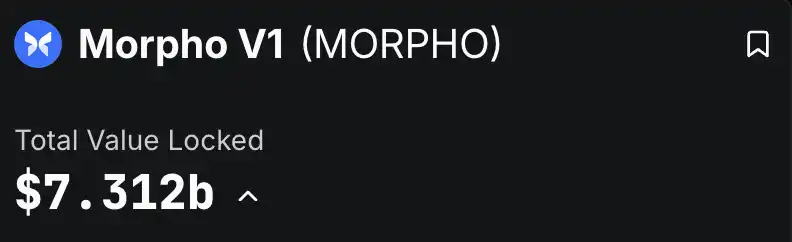
This model's expansion speed is astonishing. According to DeFiLlama data, as of now, the total value locked in just two protocols, Morpho and Euler, has exceeded 8 billion dollars, with Morpho V1 reaching 7.3 billion dollars and Euler V2 reaching 1.1 billion dollars.
This means that over 8 billion dollars of actual assets are currently being entrusted to numerous Curators with diverse backgrounds.
On the surface, this sounds great—professionals doing what they do best, allowing users to easily earn higher yields than Aave. However, peeling back the layers of this "on-chain finance," its core is actually very similar to P2P.
The core risk of P2P lending used to be that as a lender, regular users couldn't assess the true creditworthiness and repayment ability of the borrower on the other end; the seemingly attractive high interest rates offered by the platform concealed deep and unpredictable default risks.
The Curator model perfectly mirrors this. The protocol itself is just a matchmaking platform; users' funds appear to be entrusted to professional Curators, but they are actually handed to a black box.
Take Morpho, for example. Users can see various vaults set up by different Curators on their website, each vault boasting an enticing APY (Annual Percentage Yield) and a brief strategy description.
For example, the "Gauntlet" and "Steakhouse" shown in this image are the Curators of their respective vaults
Users only need to click deposit to stake their assets such as USDC in them. However, the issue lies right here. Apart from the vague strategy description and the constantly changing historical returns, users often have no idea how the vault operates internally.
The core information about vault risks is hidden in an inconspicuous "Risk" page. Even if a user has the intention to visit this page, they can only see the specific holdings of the vault. Key information determining asset security such as leverage ratio and risk exposure is nowhere to be found.
The owner of this vault hasn't even provided risk disclosures
Inexperienced users find it difficult to assess the security of the underlying interest-bearing assets in the vault
Morpho's CEO Paul Frambot once said, "Aave is the bank, and Morpho is the bank's infrastructure." However, the implication of this statement is that they only provide tools, while the actual "banking operations," such as risk management and asset allocation, are outsourced to these Curators.
The so-called "decentralization" is limited to the moment of deposit and withdrawal, while the most critical risk management link is entirely in the hands of an "unknown background unconstrained" steward.
It can be said that it is "decentralized for making money, centralized for managing money".
The reason traditional DeFi protocols are relatively secure is precisely because they minimize the "human" variable. However, the DeFi protocol's Curator model reintroduces the biggest and most unpredictable risk, "humans," back onto the chain. When trust replaces code, when transparency turns into a black box, the cornerstone of DeFi security has already crumbled.
When the "steward" colludes with the protocol
The Curator model only opened Pandora's Box, while the unspoken collusion of interests between the protocol and Curator completely released the devil inside.
The Curator's profit model usually involves charging management fees and performance-based fees. This means they have a strong incentive to pursue high-risk, high-return strategies. Since the principal belongs to the users, they are not responsible for losses, but once they win, they receive a significant portion of the profit.
This "internalize gains, externalize risks" incentive mechanism is almost tailor-made for moral hazard. As criticized by Arthur, founder of DeFiance Capital, under this model, Curators' mentality is: "If I mess up, it's your money. If I do it right, it's my money."
Even more frightening is that the protocol not only fails to play the role of a good regulator but becomes an "accomplice" in this dangerous game. To attract Total Value Locked (TVL) in the fierce market competition, the protocol needs to use astonishingly high APYs (Annual Percentage Yields) to attract users. And these high APYs are created by those Curators who adopt aggressive strategies.
Therefore, the protocol not only turns a blind eye to the Curators' risky behavior but may even actively collaborate or encourage them to establish high-yield vaults as a marketing gimmick.
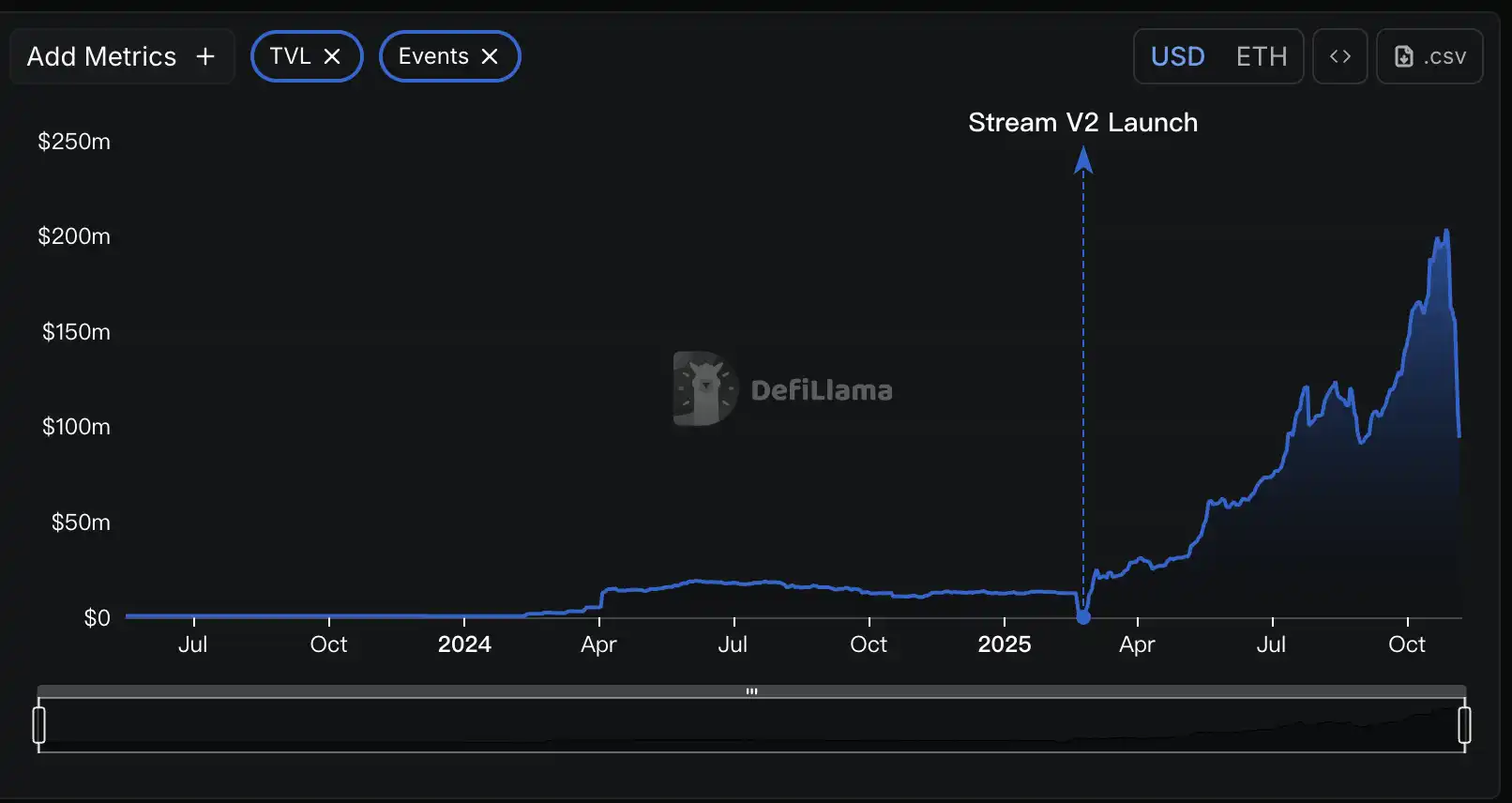
Stream Finance is a typical example of this opaque operation. According to on-chain data analysis, Stream claimed to have a total value locked (TVL) of up to $500 million, but according to DeFillama data, Stream's TVL peaked at only two billion.
This means that over three-fifths of user funds were funneled into undisclosed off-chain strategies operated by some mysterious proprietary traders, completely diverging from the transparency expected in DeFi.
A statement released by the renowned Curator organization RE7 Labs after Stream Finance's collapse laid bare this bundled interest.
They admitted that they had identified the "centralized counterparty risk" of Stream before launching the stablecoin xUSD. However, due to "significant user and network demand," they still decided to list the asset and set up an independent lending pool for it. In other words, they chose to dance with the risk for traffic and popularity.
When the protocol itself becomes an advocate and beneficiary of high-risk strategies, the so-called risk assessment becomes a mere facade.
Users no longer see genuine risk warnings but rather a carefully orchestrated marketing scam. They are led to believe that those double or triple-digit APYs are DeFi's magic, not knowing that behind it lies a trap leading to the abyss.
The Domino Effect
On October 11, 2025, the cryptocurrency market experienced a bloodbath. In just 24 hours, the total amount liquidated across the network approached $20 billion, triggering a liquidity crisis and deep-seated insolvency emerging from DeFi.
Analysts on Twitter widely believe that many DeFi protocol Curators, in pursuit of profits, tend to off-chain adopt a high-risk strategy: "Selling Volatility."
This strategy's essence is to bet on market stability; as long as the market remains calm, they can continue to collect fees and make money. However, once the market experiences violent fluctuations, they risk losing everything. The market crash on October 11 became the trigger that set off this massive explosion.
Stream Finance was the first significant domino to fall in this disaster. Although the official announcement did not disclose the specific strategy used by the losing Curator, market analysis generally points to high-risk derivative trades similar to "Selling Volatility."
However, this was just the beginning of the disaster. As Stream Finance's xUSD, xBTC, and other tokens were widely used as collateral and assets in DeFi protocols, its collapse quickly triggered a widespread industry-wide chain reaction.
According to preliminary analysis by the DeFi research firm Yields and More, the direct debt exposure related to Stream reached as high as $285 million, revealing a massive risk contagion network: the largest victim was the Elixir protocol, a major lender to Stream, which lent out up to $68 million USDC, accounting for 65% of Elixir's stablecoin deUSD total reserves.
RE7 Labs, once a partner, is now also a victim. Its treasuries across multiple lending protocols face millions of dollars in default risks due to accepting xUSD and Elixir-related assets as collateral.
The broader contagion unfolded through complex "rehypothecation" pathways, where Stream's tokens were collateralized in mainstream lending protocols like Euler, Silo, Morpho, which were then nested in other protocols. A node's collapse, through this intricate web of financial networks, swiftly propagated throughout the entire system.
The hidden thunderbolt buried in the October 11 liquidation event extends far beyond just Stream Finance. As warned by Yields and More: "This risk map is still incomplete, and we expect more affected liquidity pools and protocols to be revealed."
Another protocol, Stables Labs, and its stablecoin USDX, have recently experienced similar situations, drawing community scrutiny.
Issues with protocols like Stream Finance have exposed a fatal flaw in this new CeDeFi (Centralized Management in Decentralized Finance) model:
When transparency of a protocol is lacking, and power is overly concentrated in the hands of a few, user funds' security is entirely dependent on the business ethics of the fund managers, posing extremely high risks in the absence of regulation and rules.
You, the Yield
From Aave's transparent on-chain bank to Stream Finance's asset management black box, DeFi has undergone a deadly evolution in just a few years.
When the ideal of "decentralization" is perverted into the frenzy of "deregulation," when the narrative of "professional custody" masks the opaque reality of fund operations, what we get is not a better financial system but a worse one.
The most profound lesson of this crisis is that we must reexamine the core value of DeFi: transparency is far more important than the decentralization label itself.
An opaque decentralized system is much more dangerous than a regulated centralized system.
Because it lacks both the endorsement of centralized institutions and legal constraints, as well as the transparency and censorship resistance inherent to decentralized systems.
Bitwise's Chief Investment Officer Matt Hougan once said a famous quote to all investors in the crypto world: "There is simply no double-digit return out there that is risk-free."
For every investor attracted by high APY, before clicking the "Deposit" button next time, they should ask themselves a question:
Do you really understand where the yield of this investment comes from? If you don't understand, then you are the yield.
Welcome to join the official BlockBeats community:
Telegram Subscription Group: https://t.me/theblockbeats
Telegram Discussion Group: https://t.me/BlockBeats_App
Official Twitter Account: https://twitter.com/BlockBeatsAsia