Bitwise Chief Investment Officer: Farewell 1% Allocation, Bitcoin Is Having Its 'IPO Moment'

Original Title: The Days of 1% Bitcoin Allocations Are Over
Original Author: Matt Hougan, Chief Investment Officer at Bitwise
Original Translation: Saoirse, Foresight News
The sideways movement of Bitcoin precisely signals the end of its "IPO moment." Why does this mean a higher percentage asset allocation? The answer is below.
In Jordi Visser's latest article, a key question is explored: despite a constant stream of bullish news — strong ETF inflows, significant regulatory progress, continued institutional demand — Bitcoin's trading remains frustratingly trapped in a range.
Visser believes that Bitcoin is undergoing a "silent IPO," transitioning from a "far-fetched concept" to a "mainstream success story." He points out that typically, stocks going through such a transformation often consolidate for 6 to 18 months before embarking on a bull run.
Take Facebook (now Meta), for example. On May 12, 2012, Facebook went public at a price of $38 per share. For over a year, its stock price remained range-bound, unable to surpass the $38 IPO price for a full 15 months. Google and other high-profile tech startups showed similar patterns early in their public trading.
Visser notes that sideways trading does not necessarily mean there is an issue with the underlying asset. This situation often arises because founders and early employees opt to "cash out." Those bold investors who took a significant risk in the early days of a startup, now reaping returns of a hundredfold, naturally want to secure their gains. The process of insiders selling and institutional investors stepping in takes time — only when a certain balance is reached in this equity (or asset) transfer, will the price of the underlying asset resume its upward trajectory.
Visser points out that Bitcoin's current situation is strikingly similar to the scenario described above. Early believers who got in at Bitcoin prices of $1, $10, $100, or even $1000 now hold wealth that spans generations. Today, with Bitcoin now "going mainstream" — ETFs trading on the NYSE, large corporations adopting it as a reserve asset, sovereign wealth funds joining the fray — these early investors finally have the opportunity to realize their gains.
This calls for a celebration! Their patience has finally paid off. Five years ago, if someone had sold $1 billion worth of Bitcoin, it would likely have thrown the entire market into chaos; but today, the market has a diverse enough buyer base and sufficient trading volume to more smoothly absorb such large-scale transactions.
It is worth noting that on-chain data is not universally interpreted regarding "who is selling," so Visser's analysis is just one of the current factors affecting market trends. However, this factor is crucial, and contemplating its significance for the future market undoubtedly holds valuable insights.
Here are two key conclusions I distilled from this article.
Conclusion 1: Long-Term Outlook Extremely Optimistic
Many cryptocurrency investors felt discouraged after reading Visser's article: "Early whales are selling Bitcoin to institutions! Do they know some insider information that we don't?"
This interpretation is entirely wrong.
The sale by early investors does not mean the "end of an asset's lifecycle"; it merely signifies the asset entering a new stage.
Take Facebook, for example. Admittedly, its stock price traded sideways below $38 after the IPO for a year, but today its stock price has reached $637, a 1576% increase from the issuance price. If I could go back to 2012, I would gladly buy all Facebook shares at $38 per share.
Of course, if you had invested in Facebook during the Series A funding round, the returns might have been higher—but the risks back then were much greater than after the IPO.
Bitcoin is the same today. While the possibility of Bitcoin achieving a hundredfold return in a single year may decrease in the future, once the "asset allocation phase" ends, it still has tremendous upside potential. As Bitwise pointed out in the "Bitcoin Long-Term Capital Market Assumptions" report, we believe Bitcoin will reach $1.3 million per coin by 2035, and I personally think this forecast is still conservative.
Additionally, I would like to add one more thing: The market after early whales sell Bitcoin has a key difference from the market after a company's IPO. After a company completes an IPO, it still needs to support its stock price through continued growth—Facebook couldn't directly soar from $38 to $637 because it didn't have enough revenue and profit at the time to support such an increase. It had to gradually achieve growth by expanding revenue, exploring new businesses, focusing on mobile, etc., which still involved risks.
But Bitcoin is different. Once the early whales finish selling, Bitcoin doesn't need to do anything else to grow from its current $2.5 trillion market cap to a $25 trillion market cap equivalent to gold's. The only condition required is to "achieve widespread recognition."
I'm not saying this process will happen overnight, but it's likely to be faster than the Facebook stock price appreciation cycle.
From a long-term perspective, Bitcoin's consolidation phase is actually a "blessing in disguise." In my view, this is a good opportunity to accumulate chips before Bitcoin resumes its uptrend.
Conclusion 2: The Era of a 1% Bitcoin Allocation is Over
As Visser mentioned in the article, companies that have completed an IPO have much lower risk compared to early-stage startups. Their equity distribution is broader, they undergo stricter regulatory scrutiny, and they have more opportunities for business diversification. Investing in a post-IPO Facebook carries much less risk than investing in a startup founded by a college dropout operating out of a party house in Palo Alto (core area of Silicon Valley).
The same applies to Bitcoin today. As Bitcoin holders transition from "early adopters" to "institutional investors" and its technology matures, today's Bitcoin no longer faces the kind of "existential risk" it did ten years ago; it has become a mature asset class. This is evident from Bitcoin's volatility—since the Bitcoin ETF began trading in January 2024, its volatility has significantly decreased.
Bitcoin Historical Volatility
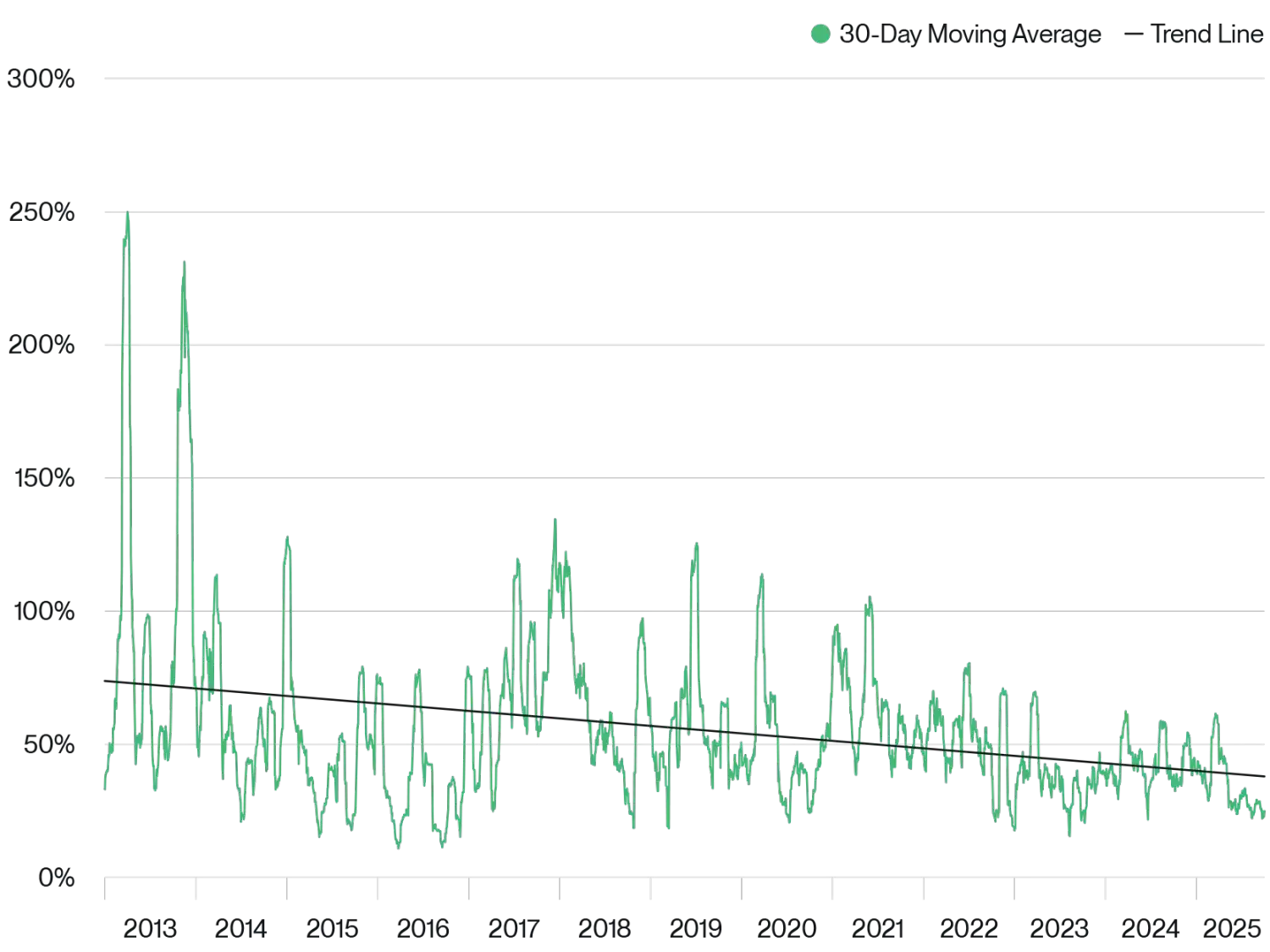
Data Source: Bitwise Asset Management. Data Range: January 1, 2013, to September 30, 2025.
This change brings an important insight to investors: in the future, Bitcoin's returns may decrease slightly, but its volatility will decrease significantly. Faced with this change as an asset allocator, my choice would not be to "sell off"—after all, we predict that Bitcoin will be one of the best-performing asset classes globally over the next decade—instead, I would choose to "hold more."
In other words, reduced volatility means "lower risk in holding more of the asset."
Visser's article also confirms a phenomenon we have long observed: over the past few months, Bitwise has held hundreds of meetings with financial advisors, institutions, and other professional investors and found a clear trend—the era of a 1% Bitcoin allocation is over. More and more investors are starting to believe that a 5% allocation should be the "starting point."
Bitcoin is going through its own 'IPO moment.' If history is any guide, we should embrace this new era through 'HODLing'.
Welcome to join the official BlockBeats community:
Telegram Subscription Group: https://t.me/theblockbeats
Telegram Discussion Group: https://t.me/BlockBeats_App
Official Twitter Account: https://twitter.com/BlockBeatsAsia