Bloomberg: $1.3 Billion Paper Loss, Is Tom Lee's Ethereum Bet on the Verge of Collapse?

Original Title: Tom Lee's Big Crypto Bet Buckles Under Mounting Market Strain
Original Author: Sidhartha Shukla, Bloomberg
Original Translation: Chopper, Foresight News
The Ethereum Corporate Treasury Experiment is now unraveling in real time.
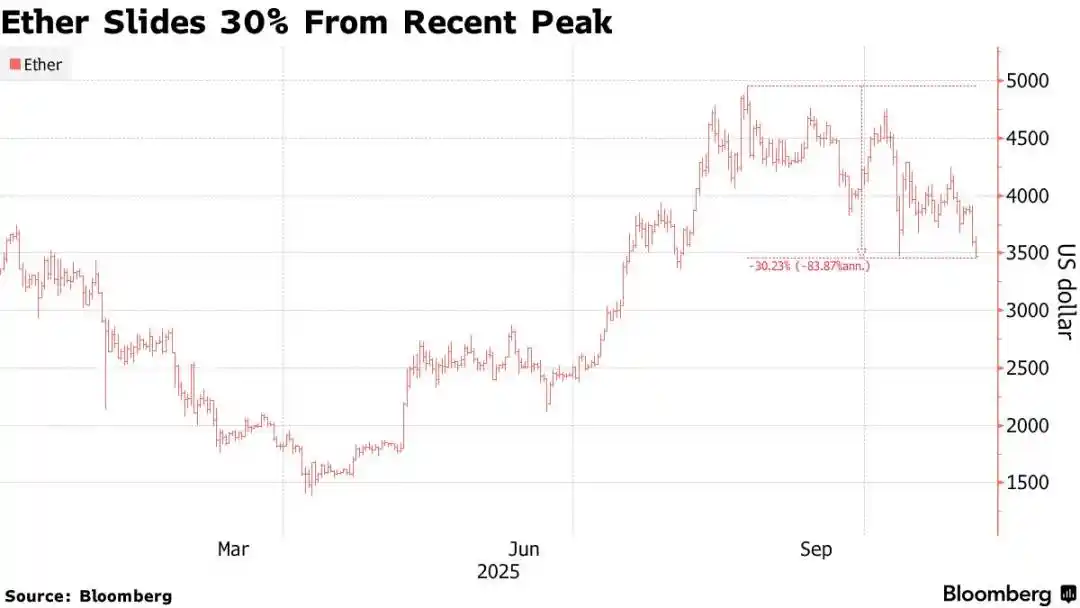
The world's second-largest cryptocurrency plunged below $3,300 on Tuesday, in tandem with the market benchmark Bitcoin and tech stocks. This drop pushed Ethereum's price down 30% from its August peak, returning to levels before the large-scale corporate purchases, further solidifying its path into a bear market.
According to research firm 10x Research, this reversal has placed the most aggressive corporate supporter of Ethereum, Bitmine Immersion Technologies Inc., at a book loss of over $1.3 billion. This publicly traded company, backed by billionaire Peter Thiel and led by Wall Street analyst Tom Lee, whose strategy mirrored Michael Saylor's Bitcoin treasury model, accumulated 3.4 million Ethereum at an average price of $3,909. Today, Bitmine's treasury is fully deployed and facing increasing pressure.
10x stated in its report: "For months, Bitmine has been driving the market narrative and capital flows. With its treasury fully deployed, the position is underwater by over $1.3 billion, with no more funds available."
The report highlighted that retail investors who bought Bitmine shares at a premium to the Net Asset Value (NAV) suffered even greater losses, and the market's willingness to 'catch a falling knife' is limited.
Lee did not immediately respond to a request for comment, and representatives from Bitmine were also unavailable for immediate comment.
Bitmine's bet was far from a simple balance sheet transaction. Behind the company's accumulation lies a grander vision: the transformation of digital assets from speculative instruments to corporate financial infrastructure, thus solidifying Ethereum's position in mainstream finance. Supporters believe that by integrating Ethereum into a publicly traded company's asset treasury, enterprises will help build an entirely new decentralized economy. In this economic system, code replaces contracts, and tokens serve as assets.
This logic drove the summer rally. Ethereum's price once approached $5000, with over $9 billion flowing into Ethereum ETFs in just July and August. However, after the crypto market crash on October 10, the situation reversed: according to Coinglass and Bloomberg compiled data, Ethereum ETFs saw outflows of $8.5 billion, and Ethereum futures open interest decreased by $16 billion.
Lee had predicted that Ethereum would reach $16,000 by the end of this year.
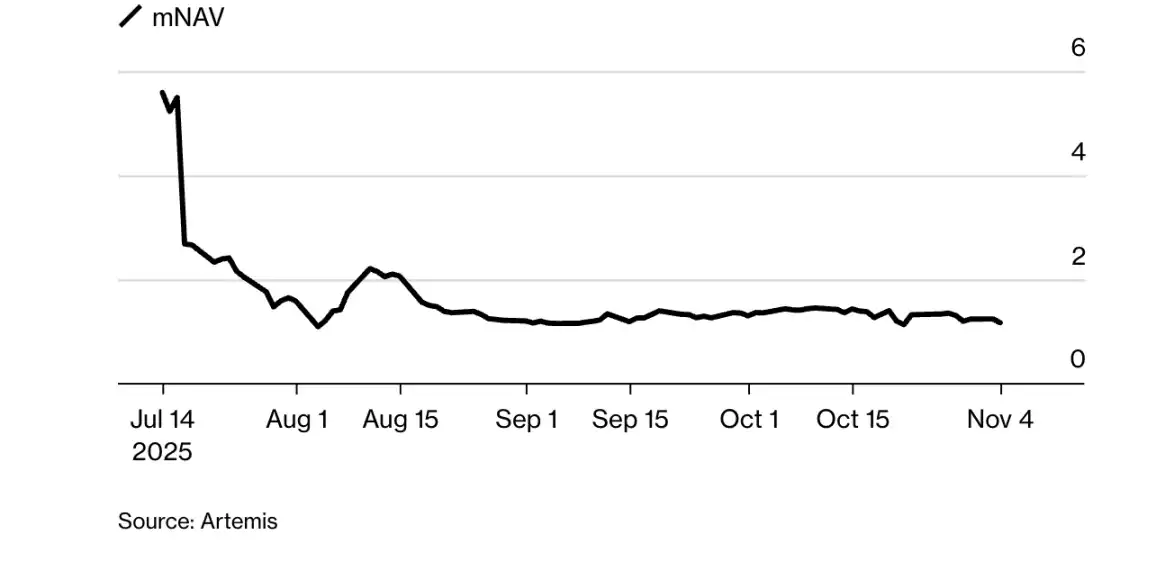
Bitmine's Net Asset Value (mNAV) Premium Declines
According to Artemis data, Bitmine's market-to-net asset value multiple has plummeted from 5.6 in July to 1.2, with its stock price down 70% from its peak. Similar to other Bitcoin-related companies before it, Bitmine's stock price now more closely aligns with its underlying asset value, as the market reassesses the once-high valuations on crypto asset balance sheets.
Last week, another publicly traded Ethereum treasury company, ETHZilla, sold $40 million worth of Ethereum holdings to buy back shares, bringing its modified net asset value (mNAV) ratio back to a normal level. The company stated in a press release at the time: "ETHZilla plans to use the remaining Ethereum sales proceeds to further repurchase shares and intends to continue selling Ethereum to buy back shares until the discount to net asset value normalizes."
Despite the price drop, Ethereum's long-term fundamentals seem to remain strong: its on-chain value transfer still surpasses all competitors in the smart contract network space, and the staking mechanism gives the token both yield and deflationary properties. However, with rising competitors like Solana, reversed ETF flows, and waning retail interest, the narrative of "corporate buying will stabilize cryptocurrency prices" is gradually losing relevance.
Welcome to join the official BlockBeats community:
Telegram Subscription Group: https://t.me/theblockbeats
Telegram Discussion Group: https://t.me/BlockBeats_App
Official Twitter Account: https://twitter.com/BlockBeatsAsia

 Related Articles