Dialogue StandX: From Binance Smart Chain to Perpetuals DEX, our consistent path of disruption
Source: ChainCatcher
Guest: Justin, Co-Founder of StandX
Interviewer: momo, ChainCatcher
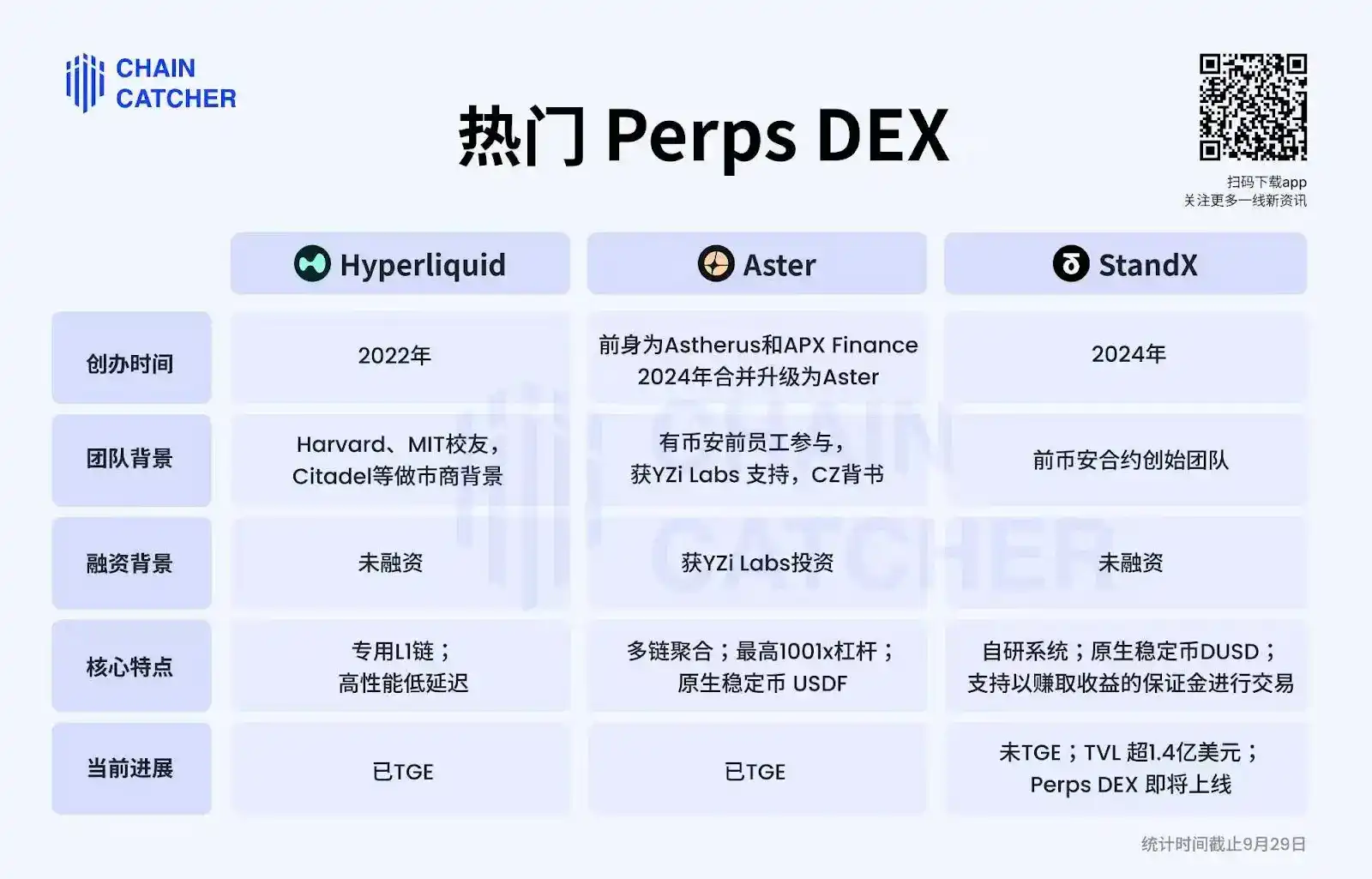
Following the explosive growth of Aster, another project founded by the former Binance Futures team, StandX, has also triggered widespread FOMO across the network. In less than a week, StandX's TVL has quadrupled, surpassing $140 million.
Founded at the end of last year, StandX was established by AG and Justin, core members of the former Binance Futures team, and AC, a senior trading system technologist with a background at Goldman Sachs. AG and Justin were deeply involved in building Binance Futures from scratch, while AC brings extensive experience in liquidity engine development at Goldman Sachs and on-chain trading management at Amber Group.
Through their six-year experience pioneering Binance Futures, their greatest insight was the need to dare to be the "first-mover." Just as Binance pioneered positive perpetual contracts when reverse contracts were widely adopted in the industry, ultimately driving a paradigm shift in the entire industry, StandX is also attempting to carve out a differentiated path in the current Perpetual DEX competition.
Justin stated that unlike most contract DEXs on the market with highly similar code, StandX's product is independently developed from the user interface to the underlying architecture, showcasing noticeable differentiation in functionality and visual experience. "We have always believed that there is room for optimization in previous solutions; the key is how to make it more reasonable for users."
At the core of StandX's mechanism is the use of their proprietary interest-bearing stablecoin, DUSD, as collateral, creating a dual-revenue model for users with "trading gains + collateral interest income" and greater arbitrage opportunities. After nearly a year of polishing, StandX's Perpetual DEX testnet will soon be open to users.
Despite the strong momentum shown by projects like Aster and Hyperliquid, Justin believes that the DEX competitive landscape will closely mimic the development path of CEXs, with leadership changes potentially becoming the norm. The key to victory is not relying on a single killer feature but continuously making the right decisions in long-term competition to gradually build a leading edge.
From Zero to Industry Leader: Key Insights from Pioneering Binance Futures
1. ChainCatcher: Could you share your core professional experience? What key projects were you involved in during your time in the Binance Futures team?
Justin: I initially worked in the traditional financial derivatives field. In 2015, I entered the cryptocurrency space, and it wasn't until 2019 that Binance's futures business was in its early stages. CZ wanted to find a team with derivatives experience to lead this effort, and that's when he reached out to AG (now StandX Founder & CEO). AG had nearly a decade of experience working at a Chicago-based commodities and futures trading platform. AG invited me to join Binance to form a small team, and my main responsibility was focused on growth.
During my six years in the Binance Futures team, we primarily built the futures business from scratch. We also explored projects such as index futures, leveraged tokens, copy trading, and more. The success of the futures business not only brought new product offerings and a larger market share to Binance but also allowed us to accumulate rich industry experience.
2. ChainCatcher: Why did you leave Binance to start your own venture, and why did you choose the Perps DEX track?
Justin: The decision to start our own venture and leave Binance was a carefully considered one last year. On one hand, we believed that we had achieved our phase goals at Binance, and on the other hand, we saw new opportunities. Decentralization has always been a major trend in the industry, and we wanted to enter the DeFi track. Contracts and stablecoins are the two major tracks in DeFi.
From a business perspective, the stablecoin business is relatively straightforward, focusing more on resource holding and compliance issues. In contrast, DEX contract business is much more complex, involving underlying risk control systems.
Our background and expertise aligned well with this direction, so we felt we could make a difference in this area. That's why we decided to start our own venture, combining the contract and stablecoin tracks.
Subconsciously, we have always believed that the Perps DEX track is bound to explode. Uniswap, as a spot DEX, achieves nearly 20% of CEX volumes, so there's no reason why Perps DEX cannot.
3. ChainCatcher: How did your experience in Binance's futures business influence your current product development?
Justin: During our time in Binance's futures business, we always emphasized the need to innovate. If you start by simply imitating others without even daring to make improvements, then it's certainly not going to work.
Back then, many exchanges such as BitMEX, HTX, OKX, had launched their futures platforms earlier than Binance. Their products were quite similar, mainly competing on fees and liquidity. However, when we introduced futures on Binance, everything from product design, API, to fees was different from others. We faced significant pressure at the launch, but we stood our ground, and the end result was very successful.
For example, at that time, when other exchanges in the market were offering inverse futures contracts, Binance was the first mainstream exchange to offer linear futures contracts. Why were others focused on inverse contracts? Because BitMEX was the pioneer in futures trading, and at that time, stablecoins were not widely available, so they had to use mainstream assets as margin. The concept of inverse contracts was a brilliant solution, and other players followed BitMEX's lead. However, what we found strange was that as stablecoins became more prevalent and the market environment changed significantly, why didn't anyone make a change.
At that time, we believed that linear contracts were more user-friendly and easier for users to understand and transition to. Later, after market validation, linear contracts were found to have a significant advantage over inverse contracts. Users no longer needed to prepare separate margins for each asset but could directly use USDT to trade multiple assets, significantly improving the liquidity of smaller assets. This allowed Binance to maintain a leading position in trading volume for smaller assets on futures and also drove the industry towards a linear contract model.
We believe that competition among exchanges is long-term, and only through continuous innovation and product optimization based on user needs can one establish a solid presence in the market. Our independently developed futures DEX is a continuation of this innovative spirit.
What is the core selling point of StandX?
4. ChainCatcher: How does this round of Perps DEX craze differ from the previous one? Why does this round, led by Hyperliquid, show a more explosive performance compared to dYdX and GMX?
Justin: dYdX and GMX did not address the usability issue of DEX products; their products were very unintuitive to use, with a particularly bad user experience.
They aimed for full decentralization, requiring users to sign for every transaction, which resulted in an extremely poor user experience. So, while these projects might attract attention initially, they are not bearable for users who engage in frequent trading and provide significant trading volume.
However, in this round, although Hyperliquid made a slight sacrifice in full decentralization, they excelled in the trading experience, solving the usability issue that has plagued DEX products.
However, Hyperliquid's approach is not the earliest in the industry; in fact, Aster did it earlier. The reason Hyperliquid can succeed is also due to their well-executed TGE, which truly incentivized long-term traders rather than quick profiteers. In general, focusing on the user is the key. Hyperliquid's success has also given us great confidence.
5. ChainCatcher: During this year-plus of entrepreneurship, what key businesses have you focused on? How large is the team now?
Justin: The team is less than 10 people. In the early stages, we focused on launching the yield-bearing stablecoin product DUSD, and then we started the development of the contract DEX. Currently, the contract DEX has been in full development for four to five months, with almost the entire technical team dedicated to the independent development of this product. The contract DEX will also be launched soon.
Unlike most contract DEXs on the market with highly similar code, our product is independently developed from the user interface to the underlying architecture, ensuring significant differentiation in functionality and visual experience.
6. ChainCatcher: I understand that the product design of many DEXs is intentionally designed to resemble CEXs to align with users' existing usage habits. How did you consider innovative design in your approach?
Justin: Many people are not willing to try new designs because they are concerned that users are accustomed to the current pattern and fear that innovation will be fruitless. However, we have always believed that there is room for optimization in previous solutions, and the key is how to make them more reasonable for users.
For example, in our design, placing market information at the top and the trade execution area at the bottom is to make the information hierarchy more in line with users' reading and operational logic. Another example is the interactive animation of clicking on the order book price to populate the order entry box. Though it may seem like a detail, smooth visual feedback can significantly enhance the user experience. Even our terminal mode strives for delicacy in animation and visual presentation.
As I mentioned earlier, our experience with Binance Futures contracts has taught us that by making continuous and reasonable innovations from a user perspective, it is possible to establish a foothold in long-term competition.
7. ChainCatcher: In addition to Hyperliquid, major CEXs like Binance and OKX are also vigorously promoting the ecosystem's Perps DEX. What are the differentiation and core selling points of StandX? How do you stand out in the squeeze between CEXs and Hyperliquid?
Justin: Our biggest selling point is that both the stablecoin and Perps DEX are fully self-developed. For the average user, using DUSD as collateral for trading not only allows them to benefit from the trading itself, but also to enjoy additional interest income from DUSD as a savings stablecoin, effectively enhancing the trading profits.
DUSD not only serves as trading collateral but is also directly used for contract pricing. For example, the BTC contract is no longer priced in USDT but in DUSD. This unique design will create spreads in the market, providing arbitrage opportunities for professional investors. Furthermore, we have made differences in contract handling compared to other platforms, further creating a differentiated operational space for professional traders.
Our revenue model is similar to Ethena's USDe, with the main revenue coming from contract funding rates. In a bear market, the annualized return is about 3%-4%; however, in a bull market, the return can significantly increase to 20%-30%, even reaching 80%-90% in a single day.
This means that in the bull market phase, when trading is most active and user growth is fastest, in the StandX trading contract, traders can not only get trading revenue, but the collateral can also bring an additional 20%-30% annualized return. This undoubtedly constitutes an attractive differentiated advantage.
8. ChainCatcher: Can this revenue mechanism be sustained?
Justin: The revenue from DUSD is sustainable and independent of StandX's own trading performance. The mechanism is standalone. The revenue comes from users using USDT and other stablecoins to mint DUSD. When users mint DUSD, the USDT we receive is deposited into a custody institution (such as Ceffu), then mapped to the trading platform, exchanged for assets like BTC, and 100% hedged in the contract market.
During this process, DUSD's revenue mainly comes from the funding rate paid by long positions in the contract. As long as the contract market's funding rate mechanism continues to operate, the source of DUSD's revenue can remain stable. This mechanism has been validated by the market for many years and is sustainable.
DEX vs. CEX Competition Revisited, Leading Exchange Rotation Becomes Normal
9. ChainCatcher: Perps DEX commonly faces skepticism about not being decentralized enough, being questioned as a CEX disguised as a DEX. How do you view this market skepticism? How will you balance trading efficiency and decentralized security in the future?
Justin: The industry was expecting Uniswap to operate entirely on-chain, with funds locked and transactions executed through smart contracts. However, due to the high complexity of the contract and high transaction frequency, this approach would impact user experience.
Projects like Hyperliquid have chosen to build their own blockchain. While this may raise questions about decentralization, it allows them to independently control on-chain TPS and execution rules, enabling deep customization.
We believe that the future development path should be gradual, as decentralization itself is a dynamic process. Requiring perfect decentralized trading from the initial stage may require hundreds of millions of dollars in investment, which is not practical without a user and business base.
This is actually similar to product development—one cannot build features for every user demand, as the product would become bloated. As a product manager, one needs to find a balance between decentralization and user experience.
A more feasible path is to start from a point that considers both aspects, gradually advancing decentralization development while accumulating users. With the expansion of revenue, one can gradually increase investment in on-chain node incentives and underlying chain performance, steadily increasing decentralization while enhancing key metrics such as TPS.
10. ChainCatcher: Recently, with the rise of Perps DEX, StandX TVL has surpassed $140 million. How did you consider community incentives, which users are concerned about?
Justin: Community feedback is core to us. So far, we have never conducted any fundraising. We believe that early VC intervention may not be particularly valuable. Moreover, the team's own investment has given us a lot of operational space. Without external investors, we don't face selling pressure from investors, meaning we can give back more benefits to the community. Our goal is to distribute tokens or rewards to true contributors and genuine traders.
11. ChainCatcher: What is StandX's long-term vision? How do you view the ultimate landscape of the Perps DEX track?
Justin: The long-term goal is definitely to become the preferred choice for user decentralized trading.
The competition in the DEX space has only just begun. Currently, Hyperliquid's leading position is not as strong as Binance's established position in the CEX field. Based on our experience during the Binance era, Hyperliquid's current development stage is roughly equivalent to Binance's rise in 2017 when Binance primarily penetrated the English-speaking core crypto community but still had a large untapped market.
More importantly, if the transition of "transactions from CEX to DEX" is recognized as a future trend, then this process has not truly started yet. Currently, the vast majority of users and trading volume are still centralized in CEXs, which means that the DEX track has enormous potential, but it also indicates that the competitive landscape is far from being shaped.
DEX itself also faces many risks and may experience Black Swan events similar to the Mt. Gox incident in the future. Therefore, the position of the current leader is not stable, and frequent changes in the frontrunner in the future track are entirely possible.
We firmly believe that DEX aligns with the decentralized spirit of cryptocurrency in the long run. This track is spacious enough to accommodate numerous participants, and the competition will be enduring and dynamic.
Looking back at Binance's development journey, even during the 2017 boom, it did not immediately create an absolute gap with OKX and HTX, and the title of the "three major platforms" lasted for a considerable period of time. Binance did not rely on a single killer move to win but made a series of key decisions correctly through ongoing competition to gradually establish a leading advantage.
The development path of DEX is likely to follow this rule as well. In long-term competition, only by continuous optimization and strategic layout can an advantage be gradually established.
This article is contributed content and does not represent the views of BlockBeats.
Welcome to join the official BlockBeats community:
Telegram Subscription Group: https://t.me/theblockbeats
Telegram Discussion Group: https://t.me/BlockBeats_App
Official Twitter Account: https://twitter.com/BlockBeatsAsia
 Related Articles