Deep Dive: In the PerpDEX Shuffle Moment, What's Next for Hyperliquid?

Original Title: "In-Depth Analysis: PerpDEX Shakeup Moment, What's Next for Hyperliquid?"
Original Author: Biteye
Global Perpetual DEX Market Overview and Industry Transformation
The decentralized perpetual trading market is experiencing an unprecedented surge in growth and a reshaping of the competitive landscape. As of September 2025, the global perp DEX daily trading volume has surpassed $520 billion, a 530% increase from the beginning of the year, with a cumulative monthly trading volume of $130 trillion. This growth is driven by breakthroughs in technological innovation, the growing demand for decentralized financial products from users, and regulatory pressure on centralized exchanges. The entire sector now holds about 26% of the cryptocurrency derivatives market, a significant leap from single digits in 2024.
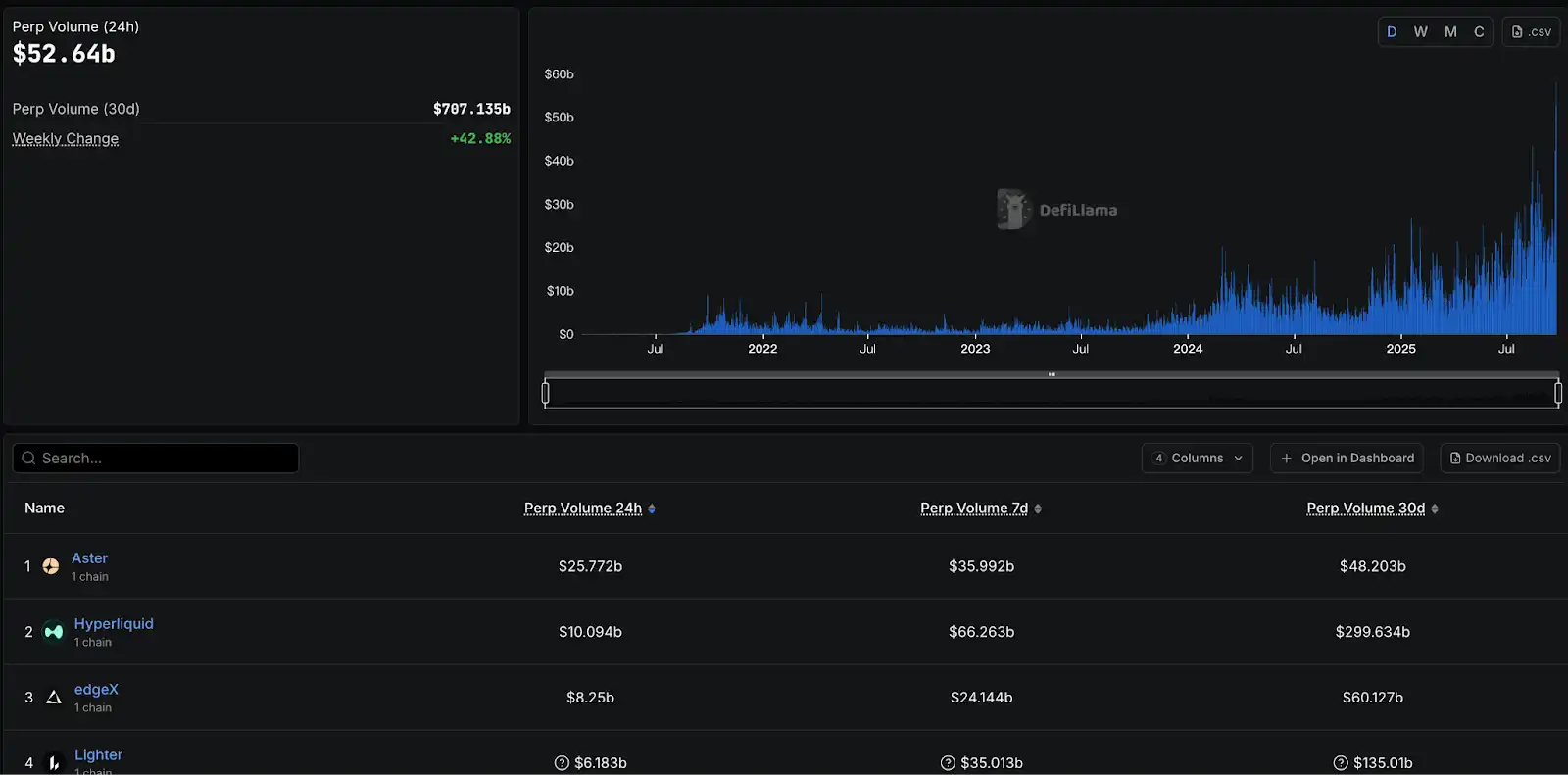
Perp DEX Total Trading Volume Change https://defillama.com/perps
The rapid differentiation of the market is reshaping the competitive landscape. Traditional order book models (such as dYdX, Hyperliquid) dominate the professional trading space with precise price discovery and deep liquidity, while AMM models (such as GMX, Gains Network) attract retail users through instant liquidity and simplified operations. Emerging hybrid models (such as Jupiter Perps) attempt to combine the advantages of both by achieving seamless switching between order book and AMM through a keeper system in a high-speed environment. From a data performance perspective, the order book model is gaining more market share, with Hyperliquid processing $2.76 trillion in cumulative trading volume through its CLOB architecture.
Aster DEX Rise and Market Impact
The protocol Aster, formed by the merger of APX Finance and Astherus, surged to the top through a multi-chain aggregation strategy and YZi Labs, especially with CZ's support, in just a few weeks. The 1650% price increase on the token issuance day of September 17, the $3.71 billion trading volume on the first day, and the influx of 330,000 new wallet addresses vividly demonstrate its strong market acquisition capabilities.
Aster's technical innovation is mainly reflected in the improvement of user experience. Its Simple mode offers leverage of up to 1001x, far exceeding Hyperliquid's 40-50x, which, although risky, is highly attractive to speculators seeking high returns. The hidden order feature borrows the concept of dark pools from traditional finance, effectively protecting large trades from MEV attacks. The yield aggregation feature allows users to use interest-bearing assets like asBNB as collateral and earn a 5-7% base yield while trading, pushing the boundaries of DeFi composability through this innovation.
In terms of data performance, Aster's TVL surged from $370 million on September 14 to $17.35 billion, a 328% increase, with 80% of the funds coming from the BNB Chain. Daily trading volume has surpassed $200 billion multiple times, temporarily overtaking Hyperliquid to become the world's largest perpetual DEX, with 24-hour fee revenue of $7.12 million. More importantly, in just a few months, Aster has accumulated $193.83 billion in cumulative perpetual trading volume. Although there is still a gap from Hyperliquid's $27.6 trillion, the growth rate is astounding.
In community discussions, traders' preferences for the two platforms have shown a clear divide. Professional traders tend to favor Hyperliquid, believing that its "one-block confirmation" and deep liquidity are necessary for professional trading. Cross-chain users and beginners, on the other hand, lean towards Aster, as its multi-chain support without the need for bridging and CEX-like user experience significantly lower the entry barrier.
Hyperliquid: Technologically Advanced but Market Share Under Pressure
As a pioneer in the perpetual DEX field, Hyperliquid has redefined on-chain derivatives trading possibilities through its innovative HyperCore architecture. HyperCore has achieved a processing capacity of 200,000 orders per second and a 0.2-second latency, performance metrics that even surpass many centralized exchanges. With a cumulative perpetual trading volume of $2.765 trillion, current open interest of $133.5 billion, and 24-hour trading volume of $15.6 billion, these data points adequately demonstrate the success of its technological architecture and user trust.
However, Hyperliquid is facing the ongoing challenge of declining market share. Its market share in the perpetual DEX market has dropped from 71% in May 2025 and 80% in August to the current 38%, primarily due to the rapid rise of emerging competitors and the success of its multi-chain strategy. Especially in daily trading volume and fee revenue, Hyperliquid has been surpassed by Aster DEX multiple times, a change that was unimaginable in the past.
Perpdex Trading Volume Statistics perpetualpulse.xyz
Despite the challenges, Hyperliquid's advantages remain evident. It boasts the deepest liquidity, with major asset spreads like BTC/ETH as low as 0.1-0.2 basis points; the most stable technological architecture, with one-block confirmation providing traders unparalleled certainty; the most mature ecosystem, with over 100 projects building a complete DeFi infrastructure on its platform. More importantly, its deflationary token model allocates 99% of protocol revenue to HYPE buyback and burn, providing strong support for the token's value with an annualized revenue scale of $201 billion.
From a user quality perspective, Hyperliquid demonstrates higher user value. Among its 825,000 daily active addresses, the monthly active users reach 3.651 million, and the Open Interest to Volume ratio has reached 287%, far exceeding the industry average. This metric indicates that Hyperliquid's users are more oriented towards genuine risk hedging needs rather than short-term speculative trading. In contrast, Aster's ratio is only 12%, indicating a higher daily trading volume but with user behavior leaning more towards short-term arbitrage.
Facing competitive pressure, Hyperliquid is also actively adjusting its strategy. The upcoming HIP-3 (permissionless perpetual market) will allow anyone to deploy custom perpetual contracts, potentially bringing innovative products such as RWA perpetuals and AI hash power futures, reigniting ecosystem vitality. The launch of the native stablecoin USDH will further enhance its financial infrastructure, expected to manage $5.5 billion in funds, with 95% of the revenue used for HYPE buyback, significantly strengthening the token's value support.
In this intense market competitive environment, Hyperliquid's true moat is not just the technology itself, but the complete ecosystem built around the core protocol. From its original pure perpetual trading platform to today's comprehensive DeFi ecosystem with over 100 projects, Hyperliquid has established a self-sustaining financial infrastructure. This ecosystem includes everything from infrastructure, DeFi protocols, to application-layer full-stack solutions, with each component contributing to the overall network's value accrual and user stickiness.
It is based on this background that this article will delve into the core projects and innovative applications within the Hyperliquid ecosystem, exploring how these projects are building a sustainable competitive advantage for Hyperliquid in fierce market competition and how they are jointly shaping the future of decentralized derivatives trading.
In-Depth Analysis of Hyperliquid's Core Ecosystem Projects
1. Kinetiq - Liquidity Staking Ecosystem Pillar (TVL: $17.57 Billion)
Kinetiq's position in the Hyperliquid ecosystem is unshakable, with its $17.57 billion TVL accounting for approximately 78% of the entire ecosystem, becoming the core hub of ecosystem fund flow. As the "Jito" of the ecosystem, Kinetiq has redefined the validator delegation mechanism through its innovative StakeHub algorithm, achieving unprecedented efficiency and yield optimization.
The core of the StakeHub algorithm lies in the precise design of a multi-dimensional scoring system. This system provides real-time scoring for over 100 active validators, based on metrics such as Reliability (40% weight), Security (25% weight), Economic Performance (15% weight), Governance Engagement (10% weight), and Operational History (10% weight), dynamically adjusting fund allocation strategies. This algorithm not only considers validators' historical performance but also predicts their future stability. Through a machine learning model that continuously optimizes weight allocation, it ensures that delegated funds always flow to the highest quality validators.
Kinetiq Node Performance https://kinetiq.xyz/validators
The protocol's reward structure is highly robust and market-leading in competitiveness. The base PoS reward provides approximately a 2.3% annual return rate, which is considered top-tier among similar LST projects. StakeHub further optimizes this by offering an additional 0.2-0.5% enhanced reward by avoiding underperforming validators. MEV income contributes to around 1% of the annual return, derived from the MEV capturing mechanism of the Hyperliquid network. Of particular attraction is the integration reward with other DeFi protocols, offering a variable bonus of 6-8%, enabling a total yield of 10-12%, which is highly competitive in the current DeFi landscape.
In terms of user experience, Kinetiq has achieved the pinnacle of simplification. Users obtain kHYPE tokens by staking HYPE, enjoying a slight premium of 1:0.996, reflecting the market's additional valuation of liquidity staking tokens and confidence in the protocol's security. The unstaking mechanism features a 7-day security delay and a 0.1% fee, providing users with a reasonable exit strategy while ensuring network security.
Kinetiq has experienced explosive growth in Total Value Locked (TVL) from $458 million in July to the current $1.81 billion, a threefold increase in just two months. This growth is mainly attributed to the integration effect of the Pendle protocol, which created additional liquidity demand and yield strategies for kHYPE through the PT/YT separation mechanism.
Kinetiq TVL Growth Chart https://defillama.com/protocol/tvl/kinetiq
The upcoming $KNTQ governance token provides a key tool for the protocol's decentralized governance and long-term value creation. It is expected that 30-50% of the token supply will be distributed to the community through airdrops, with priority given to LPs, early users, and kHYPE stakers. The core features of $KNTQ include protocol upgrade voting, MEV route strategy decision-making, and HIP-3 market planning permission. This delegation of governance will further enhance the protocol's decentralization and community engagement.
Interaction: Users stake HYPE via kinetiq.xyz to earn kHYPE, supporting instant minting and a 7-day unlock period. The protocol also offers a kPoints point system, with weekly point distributions preparing for the upcoming $KNTQ airdrop. Point acquisition methods include staked amounts, holding duration, among other dimensions.
2. Based - Mobile Super App and Ecosystem Gateway
As the highest-earning Builder app on Hyperliquid, Based24 has a 24-hour revenue of approximately $90,300, ranking first among all third-party apps. With a cumulative perpetual trading volume exceeding $16.699 billion, a 24-hour perpetual trading volume of $321 million, handling about 7% of Hyperliquid's total trading volume, these data fully reflect the high-net-worth characteristics and deep engagement of its user base. Its revenue model is based on Hyperliquid's Builder fee-sharing system, offering a maximum of 0.1% perpetual trade fee and 1% spot trade fee sharing. Through an affiliate marketing program, most of the revenue is returned to users in the form of rebates, creating a sustainable incentive structure for a three-way win-win among users, the platform, and Based. With a 7-day revenue of $2.22 million and a 30-day revenue of $6.71 million, these metrics not only demonstrate the robustness of its business model but also highlight its key role as a revenue contributor in the Hyperliquid ecosystem.
Based Trading Interface https://www.basedapp.io/
Based's tokenomics design reflects a deep understanding of user behavior and innovative incentive mechanisms. The $PUP token, as an XP bonus tool, completed its airdrop on August 22, 2025, with a total supply of 100 million tokens, 5% of which is allocated to early users and community contributors. The main function of $PUP is to enhance user XP acquisition efficiency, providing a 25-60% point multiplier bonus, allowing holders to earn more rewards through trading, consumption, and other activities. $BASED, as the main governance token, will be distributed based on the user's total XP, with a snapshot date of September 20, 2025, where perpetual trading contributes 0.06 XP per $1 nominal trade volume, spot trading contributes 0.30 XP per $1 trade volume (5x incentive), and Visa consumption contributes 4-6 points per $1 spent (converted to XP at TGE).
This dual-token mechanism cleverly combines short-term incentives ($PUP bonus) and long-term governance ($BASED allocation), with $PUP holders essentially receiving a "leveraged" airdrop of $BASED, further enhancing user loyalty and ecosystem stickiness. Within the community, $PUP's circulating market cap is around $5 million, with a price stable around $0.05, demonstrating robust demand for its utility, while $BASED has an expected total supply of 1 billion tokens, with community allocation accounting for up to 40%, expected to be fairly distributed to active users through the XP system.
Interaction: Users can download the mobile app or access the web terminal through based.markets, register an account with their email, and support cross-chain assets with one-click deposit. The trading interface is designed similar to traditional financial apps, providing spot and perpetual trading features. Users can also apply for a Visa debit card (existing users should note the November deactivation schedule) for fiat spending. The XP system dynamically displays point progress, and $PUP holders can activate bonuses in their wallets to enhance reward efficiency.
3. Pendle - Revenue Tokenization Protocol Giant
Pendle's successful deployment on HyperEVM marks the mature application of the revenue tokenization concept in the Hyperliquid ecosystem, representing a new high in DeFi product complexity and innovation. The protocol separates interest-bearing assets like kHYPE into PT (Principal Tokens) and YT (Yield Tokens), providing investors with precise tools for fixed-income investment and yield speculation. In just a few months, Pendle's TVL on HyperEVM has grown from zero to $12.3 billion, with a 30-day growth rate of 76.27%.
Pendle TVL distribution on different chains https://defillama.com/protocol/tvl/pendle
The synergy between Pendle and Kinetiq has been a key factor in Pendle's rapid success in the Hyperliquid ecosystem. This synergy is not only reflected in complementary product offerings but more importantly has created a new value-capture mechanism. By tokenizing kHYPE into PT and YT, Pendle has provided liquidity stakers with more diverse yield strategy options while creating a new way for Kinetiq's point system to accrue. Users holding YT-kHYPE can enjoy all the rewards of Kinetiq points without exposure to principal fluctuation risk, while PT-kHYPE holders benefit from the certainty of fixed income to build stable yield strategies.
Pendle's product matrix continues to expand, demonstrating its strategic intent of deep integration with the Hyperliquid ecosystem. In addition to the mainstream kHYPE market, the protocol has also gradually supported the yield tokenization of ecosystem-native assets such as feUSD, hwHLP, beHYPE, and more. Each new asset addition creates new yield farming strategies and arbitrage opportunities, further driving the activity and composability of the entire ecosystem. Especially with the emergence of more LST and yield-bearing assets, Pendle has provided standardized yield separation tools for these assets, becoming a key bridge connecting different protocols.
Interaction: Users can access the protocol via app.pendle.finance, select the Hyperliquid network, and separate their held yield-bearing assets like kHYPE into PT/YT, or directly trade these tokenized yield products on the secondary market. The protocol provides an intuitive yield curve and maturity date information to assist users in making investment decisions.
Pendle's Yield Token on HyperrEVM https://app.pendle.finance/trade/markets?chains=hyperevm
4. HyperLend - Core DeFi Lending Infrastructure
HyperLend, as the "credit bank" of the Hyperliquid ecosystem, plays a crucial role in the overall DeFi infrastructure, providing core support for the ecosystem's liquidity circulation and capital efficiency enhancement. The protocol adopts a market-proven Aave V3 forked architecture but has been deeply optimized and innovated for the high-performance environment and unique asset characteristics of Hyperliquid. Its most significant technological breakthrough is prominently featured in the HyperLoop feature, where this innovative mechanism enables one-click leverage cycling through flash loans, providing advanced users with an unprecedented capital efficiency tool while maintaining operational simplicity.
HyperLend's architectural design embodies a delicate balance between risk management and capital efficiency. The protocol ingeniously adopts a dual-pool structure: a unified liquidity pool dedicated to efficient borrowing and lending of core assets such as HYPE, kHYPE, USDC, etc., significantly reducing transaction slippage and increasing capital utilization through a shared liquidity mechanism; the isolated risk pool is specifically designed to handle assets with higher volatility or risk, supporting fully customizable risk parameter settings to ensure that a risk event for a single asset does not impact the stability of the entire system.
The technical implementation of the HyperLoop feature demonstrates the ultimate application of DeFi composability and a significant improvement in user experience. Users interact with a simple and intuitive interface, and the protocol automatically executes a complex atomic operation sequence on the backend: first, borrowing the target debt asset through a flash loan mechanism, then exchanging it through the built-in DEX aggregator for the desired yield-generating asset, supplying that asset as collateral to the protocol's corresponding pool, then borrowing more debt assets based on the newly added collateral, and finally repaying the initial flash loan. The entire complex operation sequence is atomically completed in a single block, allowing users to easily achieve 3-5x leverage without the complexity, time cost, and gas fees of multiple manual transactions.
HyperLoop's one-click loop lending interface https://app.hyperlend.finance/hyperloop
From asset composition and operational efficiency data, HyperLend demonstrates a healthy and stable development trend and good market adaptability. Its total TVL of $5.24 billion is mainly composed of wstHYPE ($2.54 billion, 48%) and native HYPE ($2.06 billion, 39%), reflecting the significance of LST within the ecosystem and strong demand for native token liquidity. The current total borrowing volume is $2.67 billion, with an overall utilization rate of 48%, placing it in a healthy operational range within DeFi lending protocols. This level ensures sufficient liquidity to meet withdrawal demands while optimizing fund utilization for reasonable yield.
HyperLend's protocol size https://hyperlend.blockanalitica.com/
HyperLend's revenue model demonstrates a clear and sustainable business value creation capability. The protocol's annual revenue is $15.89 million, with diversified and stable revenue sources, mainly including lending interest spread revenue, liquidation fee revenue, and flash loan fee revenue. Particularly noteworthy is its flash loan fee set at 0.04%, significantly lower than Aave's 0.09% standard fee rate. This competitive pricing strategy maintains market competitiveness while providing users with better cost efficiency, helping attract more high-frequency trading and arbitrage activities. The protocol has also designed a robust point system, running continuously for 22 weeks, accumulating points in preparation for the upcoming $HPL governance token airdrop, with 3.5% of the token's total supply reserved for the Aave DAO.
Interaction: Users interact with hyperlend.finance through their wallet, supporting deposit to earn interest, borrowing, and the HyperLoop one-click leverage feature. The interface is designed to be clean and intuitive, providing real-time interest rate information and risk indicators to assist users in making informed lending decisions.
5. Hyperbeat - DeFi Super App (TVL: $3.87 Billion)
Hyperbeat is positioned as an all-in-one DeFi hub, offering a comprehensive solution that includes services such as staking, lending, yield optimization, and more. The protocol recently completed a $5.2 million seed round of funding led by Electric Capital, with participation from Coinbase Ventures, Chapter One, DCF God, and other well-known institutions. This funding background reflects institutional investors' recognition of its business model and technical team.
Hyperbeat's product matrix design embodies a deep ecological integration concept. The beHYPE liquidity staking module offers a slashable security model that supports governance participation; the Morphobeat lending market is optimized based on the Morpho protocol, focusing on interest-bearing assets like LST; and the yield treasury achieves automated yield optimization through a Meta-Yield strategy, diversifying risk across multiple protocols. Its cross-chain integration capability allows it to deploy on multiple chains like Arbitrum, currently holding a $28.92 million TVL on Arbitrum, expanding its user base and asset under management.
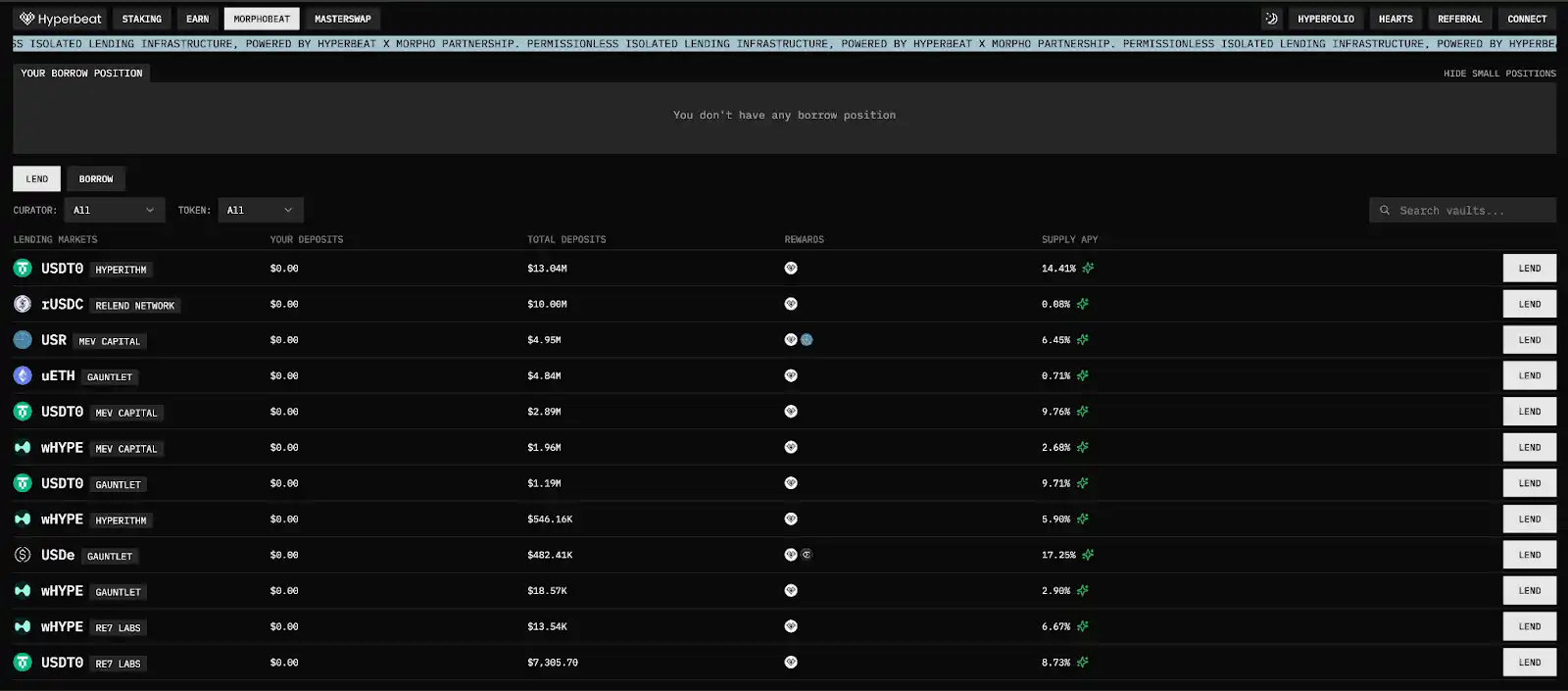
Hyperbeat's technological innovation is mainly reflected in its automated yield optimization strategy. The protocol automatically monitors the yield changes of various DeFi protocols through smart contracts, dynamically adjusting fund allocations to achieve optimal returns. This "set-and-forget" user experience significantly lowers the technical barrier to entry for DeFi participation, making it particularly suitable for users who wish to earn DeFi yields but are unwilling to engage in frequent transactions. The Meta-Yield strategy also includes a risk hedging mechanism that reduces risk by diversifying investments across multiple protocols and enhances overall returns by leveraging arbitrage opportunities.
Interaction: Users access multiple product dashboards by visiting hyperbeat.org to perform all-in-one DeFi operations such as staking, lending, yield farming, and more. The interface design focuses on user experience, providing yield estimates and risk alerts. The Hearts point system is nearing its end, with less than 12% of the remaining distribution amounting to a total of 51 million Hearts points prepared for the upcoming $BEAT token airdrop. This point system design incentivizes users to remain active across multiple product modules, earning points through activities such as staking, lending, yield farming, and other multidimensional actions.
6. USDH - Native Stablecoin Infrastructure
As the upcoming Hyperliquid native stablecoin, USDH carries the important mission of building a robust ecosystem financial infrastructure. Native Markets won the community vote on September 14, 2025, gaining the issuance rights of USDH. The launch of USDH will fill the gap in the Hyperliquid ecosystem in terms of a native stablecoin, providing a more complete and self-sufficient financial infrastructure for the entire ecosystem.
USDH's technical architecture reflects deep considerations for compliance and scalability. This stablecoin will be backed by US Treasury bonds through traditional financial institutions like Stripe Bridge and BlackRock, ensuring sufficient asset collateralization and regulatory compliance. More importantly, USDH will achieve dual compatibility with HyperEVM ERC-20 and HyperCore HIP-1, allowing the stablecoin to flow seamlessly throughout the Hyperliquid ecosystem, serving as collateral and liquidity in DeFi protocols and as margin in perpetual trades, achieving true ecosystem-native integration.
The expected launch timeframe for USDH is Q4 2025, with specific progress depending on the completion of technical development and regulatory applications. As a crucial ecosystem infrastructure, the successful launch of USDH will have a profound impact on the entire Hyperliquid ecosystem, enhancing user experience and capital efficiency, and more importantly, strengthening the ecosystem's independence and sustainability. Especially in competition with external stablecoins like USDC, USDH's native advantages and revenue-sharing mechanism will provide unique competitiveness.
Ecosystem Data Overview and Development Outlook
The Hyperliquid ecosystem demonstrates strong growth momentum and a healthy development trend. The total TVL has reached $65.35 billion, with DeFi protocol TVL at $23.7 billion, perpetual trading holdings at $41.65 billion, and a 30-day perpetual trading volume of $651.6 billion. User data exhibits high-quality characteristics: 308k monthly active users, an average holding size of $162k, and a 30-day retention rate of 67%, far exceeding similar platforms.
The ecosystem's greatest strength lies in deep protocol collaboration. Integrations between Kinetiq and Pendle, capital efficiency amplification in HyperLend, ecosystem circularity in Felix feUSD, and mobile traffic import in Based have created a powerful network effect. However, the decline in market share cannot be ignored. Hyperliquid's market share in the perpetual DEX market dropped from 48.2% in August to 38.1% in September, mainly lost to competitors adopting a multi-chain strategy and incentive mechanisms.
The launch of HIP-3 (Unlicensed Perpetual Market) will be a key turning point, allowing anyone to deploy custom perpetual contracts, expected to bring innovations such as RWA perpetuals and AI hashpower futures. The native stablecoin USDH is expected to manage $5.5 billion, with 95% of revenue used for HYPE buyback, generating $1.5-2.2 billion in annual revenue, significantly enhancing the token's value support.
The value capture mechanism of the HYPE token is well-designed: 99% of protocol revenue is used for buyback and burn, with the current annual buyback rate at around 8.7%. However, the linear release starting on November 29 will increase the supply by 71%, requiring strong fundamental performance to hedge supply pressure.
The Hyperliquid ecosystem is at a crucial development stage. Its success will depend on a combination of technological innovation and user experience, a balance of ecosystem openness and quality control, and the coordination of technical focus and diverse demands. The launch of HIP-3 and USDH will be an important test to validate its adaptability.
For investors, from the stable returns of the LST protocol to high-risk early-stage projects, the ecosystem offers a wealth of investment opportunities. The key is to understand the business models and risk factors of each protocol and develop a reasonable strategy based on individual circumstances. The value of Hyperliquid lies not only in the success of individual protocols but also in the formation of the entire ecosystem's network effect. In this era full of opportunities and challenges, its continued innovation and ability to create value for users will determine its long-term development prospects.
This article is a contribution and does not represent the views of BlockBeats.
Welcome to join the official BlockBeats community:
Telegram Subscription Group: https://t.me/theblockbeats
Telegram Discussion Group: https://t.me/BlockBeats_App
Official Twitter Account: https://twitter.com/BlockBeatsAsia