When Stablecoins Go Native, Does Ethereum Have a Chance?

Original Title: "When Stablecoins Start Building Chains, Does Ethereum Still Have a Chance?"
Original Author: Viee, Biteye
Over the past few years, stablecoins have been one of the most understated yet steadily growing players in the crypto market. From cross-border remittances to transaction settlements to regulatory pilots, stablecoins have always been a crucial gear in the flow of crypto capital.
However, this year marked a more significant milestone: stablecoin issuers are no longer content with just "being on a chain" but are starting to build their own chains. In August, Circle announced the launch of Arc, followed closely by Tempo led by Stripe, revealing more details. These two giants, deeply involved in stablecoins for years, almost simultaneously took this step, prompting intriguing questions about the underlying logic.
Why do stablecoins need their own chain? In this seemingly "B2B-focused" game, do retail investors still have a chance? With stablecoins controlling the "money road," do general-purpose blockchains like Ethereum and Solana still hold enough influence?
This article will delve into four perspectives:
1. What is a stablecoin blockchain, and how does it differ from traditional blockchains;
2. A comparison of the design paths of representative projects;
3. Whether stablecoin blockchains will pose a threat to Ethereum;
4. Opportunities for ordinary users to participate.
01 Stablecoin Blockchains: A Path Closer to the "Settlement Layer"
If Ethereum, Solana, and other blockchains focus on decentralized applications, stablecoin blockchains are closer to the settlement layer.
They have several distinct features:
· Stablecoin as Gas: Stable and predictable transaction fees, eliminating the need to hold volatile assets for "gas fees."
· Designed for Payments and Settlement Optimization: The goal is not universality but stability and usability.
· Built-in Compliance Modules: Facilitating integration with banks and payment institutions to reduce gray areas.
· Designed around "Money" Needs: Cross-currency settlements, foreign exchange matching, a unified accounting unit, aligning closer to real-world settlement systems.
In other words, a stablecoin native blockchain is more like a vertical integration model, where key steps from issuance, clearing, to applications are controlled as much as possible. Its cost involves bearing the upfront pressure of cold start, but in the long run, it can achieve economies of scale and influence.
02 Different Paths Taken by 5 Representative Chains
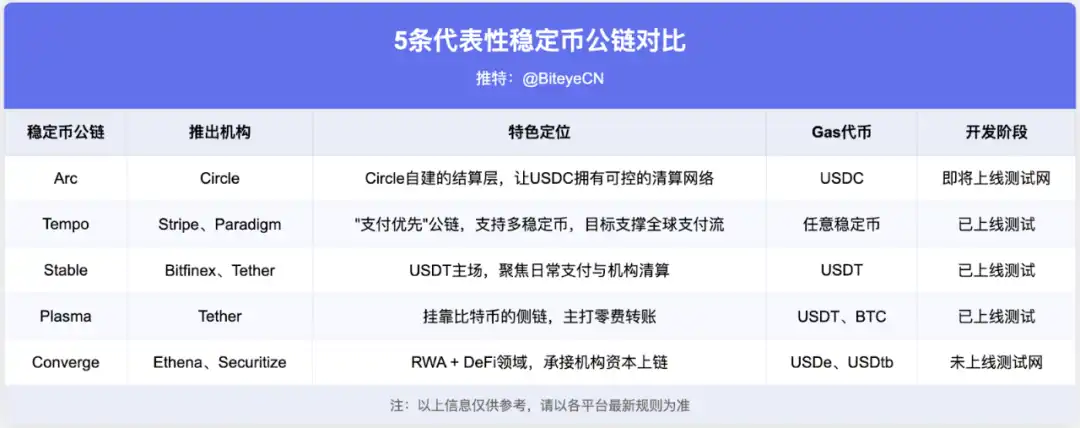
1. Arc @arc: Circle's First Self-Owned Public Chain
As the world's second-largest stablecoin issuer, it is not surprising that Circle launched Arc. Despite the large market size of USDC, transaction fees are constrained by the volatility of Ethereum or other public chains. The emergence of Arc is exactly what Circle wants to build as its "settlement layer."
Within Arc's design, there are three core points:
· USDC as Gas: Transparent fees with no exchange rate risk.
· Fast Transactions, Stable Settlement: Commits to confirming transactions within 1 second, suitable for cross-border payments and large-value clearing.
· Optional Privacy Feature: Providing necessary accounting privacy for enterprises or institutions while ensuring compliance.
This means that Arc is not only Circle's technical experiment but also a key step for it to become a financial infrastructure provider.
2. Tempo @tempo: "Payment-First" Public Chain
Tempo, jointly incubated by Stripe and Paradigm, has a very straightforward core logic: after stablecoins move towards the mainstream, there is a need for infrastructure truly suitable for payments. Traditional public blockchains either have unstable fees, inadequate performance, or are too "crypto-native" in user experience, making it challenging to support global settlement flows. Tempo aims to fill this gap.
Therefore, Tempo has several distinct features in its design:
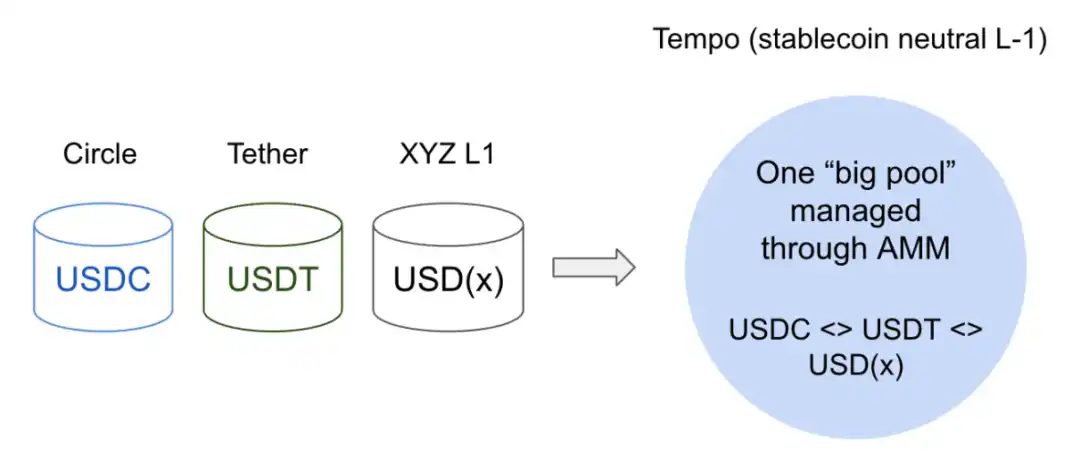
· Any stablecoin can be used as Gas: Implementing stablecoin swaps through a built-in AMM.
· Low Fees & Predictable: Equipped with payment channels, memos, whitelist functions, closer to real-world payment systems.
· Ultimate Performance: Targeting 100,000 TPS, sub-second confirmation, suitable for scenarios such as salary, remittance, micro-payments, etc.
· EVM Compatibility: Based on the Reth architecture, low developer migration cost.
Its partners are also heavyweight, including Visa, Deutsche Bank, Shopify, OpenAI... This makes Tempo more like an open USD payment network rather than a mere stablecoin subsidiary. If it can be successfully implemented, it may even become a prototype of an "on-chain payroll system."
Although Tempo focuses on "payment priority," the level of decentralization has also sparked some discussions. Currently, Tempo's design is more focused on the attributes of a "private chain" rather than a "public chain," and the nodes are not completely open, indeed making the decentralization level somewhat weaker.
3. Stable @stable: USDT's Home Field
Stable is a chain specially designed for USDT, supported by Bitfinex and USDT0, with the goal of enabling USDT to flow more smoothly in daily financial activities.
In its design, Stable has done several things:
· USDT Native Gas: Fees paid directly in USDT, peer-to-peer transfers completely gas-free.
· Sub-second Confirmation: Balancing small-value and large-value transactions.
· Enterprise-level Features: Including batch transfer aggregation, compliance privacy transfers.
· Consumer-end Experience: Wallet integration with bank cards and merchant payments.
· Developer Friendly: EVM-compatible and providing a complete SDK.
The key word for Stable is implementation, focusing on how to make USDT more seamlessly integrate into daily scenarios such as cross-border remittances, merchant acceptance, and institutional settlement.
4. Plasma @PlasmaFDN: Bitcoin Sidechain
Unlike Stable, Plasma chose a different path. As a Bitcoin sidechain, it relies on BTC's security while focusing on stablecoin payments.
Design-wise, Plasma mainly has the following features:
· Bitcoin Native Bridge: BTC non-custodial cross-chain entry into the EVM environment, directly participating in the stablecoin ecosystem.
· USDT Zero Fee Transfers: Completing USDT transfers for free is its key selling point.
· Custom Gas Token: Developers can choose stablecoins or native tokens for fees.
· Optional Privacy Features: Suitable for wage payments, institutional settlements.
· EVM Compatible: Based on Reth architecture, low developer migration costs.
In July, Plasma officially started its public sale with the token $XPL, eventually raising over $373 million, with oversubscription exceeding 7 times. The market's enthusiasm has already given it a shot in the arm.
5. Converge @convergeonchain: The Convergence Point of RWA and DeFi
The previous chains essentially revolved around "stablecoin settlement payments." Converge's ambition, however, is different. Its goal is to bring RWA and DeFi onto the same chain.
In terms of design logic, Converge focuses on three key aspects:
· High Performance: Sub-second block times, working with Arbitrum and Celestia to push performance limits.
· Stablecoin Native Gas: USDe and USDtb used as fees.
· Institutional-Grade Security: Relies on the ENA network (CVN) to provide additional protection.
In summary, Converge aims to address "how large capital can securely and efficiently enter." Its partners include familiar DeFi protocols like Aave, Pendle, Morpho, and will also support the onboarding of RWA assets such as Securitize.
03 Different Starting Points, Same Direction
From Arc to Tempo, from Stable and Plasma to Converge, although their approaches vary, they all aim to address the same core issue, which is how stablecoins can truly enter the everyday financial cycle. Arc and Stable focus on the controllability of their native assets, Tempo and Plasma emphasize multi-asset neutrality, while Converge targets institutions and RWAs. The difference lies in the path, but the common goal is to make transfers more certain, liquidity smoother, and compliance more natural.
Following this main theme, three trends can generally be seen in the future of stablecoin public chains:
· Compliance and Institutionalization: In the future, stablecoin public chains will focus more on settlement finality and regulatory interfaces, with Arc, Stable, and others striving to become a settlement layer that banks and payment institutions can directly connect to.
· Challenging Traditional Payments: Chains designed for "multi-asset neutrality," such as Tempo, with their low cost and global reach, are putting pressure on Visa and Mastercard as alternatives.
· Reshaping the Market Landscape: Currently, Circle and Tether occupy nearly 90% of the stablecoin market share, creating an almost duopoly, but "stablecoin-neutral chains" like Tempo are disrupting this landscape, potentially moving towards a multi-polar coexistence in the future.
04 Stablecoin Chain Creation: How Will It Reshape the Public Chain Landscape?
When stablecoin issuers enter the chain creation arena, the most immediate question is whether they will impact general-purpose blockchains like Ethereum or Solana?
Stablecoin chains are naturally designed for the "money road" and are indeed more suitable for high-frequency but low-risk businesses such as cross-border remittances and salary payments than the ETH mainnet or Solana. The impact on TRON may be more direct. TRON's stablecoins mainly come from USDT, accounting for over 99%, and have already become the largest issuing public chain for USDT. However, if Stable chains driven by Tether mature gradually, TRON's primary competitive advantage will be weakened.
However, some believe that these "payment-specific chains" are not truly considered blockchain in the strictest sense. This is because achieving complete decentralization inevitably leads to various unrelated projects and tokens flooding in, resulting in congestion and performance degradation. If the choice is to only serve payments, it will either be as functionally simple as Bitcoin, only capable of transfers, or it will be partially centralized, controlled by a small number of institutions. In other words, it is challenging to balance both "decentralization" and "efficient payments."
This also means that the positioning of Ethereum and Solana is actually quite secure. The former has accumulated a developer ecosystem based on security and composable general finance, while the latter has carved out its own space in high performance and user experience. The ultimate competitive landscape is more likely to see stablecoin chains handling deterministic settlement, with ETH/SOL preserving open-ended innovation.
05 Retail Investor Perspective: Where Are the Opportunities?
Frankly, this round of opportunities is not very friendly to retail investors in terms of "direct benefits." Compared to past public chains, stablecoin public chains are more skewed towards the "B end," involving payment, clearing, and custody systems.
But there are still several entry points worth paying attention to:
· Participate in Ecosystem Incentives: The launch of a new chain often comes with bounty programs, developer subsidies, transaction mining, etc., which may conduct similar activities in the future.
· Node Staking: Players with stronger technical skills can focus on node validation. For example, Converge requires staking ENA to participate.
· Testnet: Many projects airdrop rewards to early users, so you can prioritize testnets. For example, ARC may launch a public testnet this fall, and Stable, Plasma, and Tempo testnets are already live.
· Long-term Allocation: If you believe in the "stablecoin public chain" narrative, consider longer-term investments, such as keeping an eye on stocks related to Circle, Coinbase, etc.
Plasma is particularly worth mentioning. In its July public sale, the $XPL token was oversubscribed by 7 times, with a total amount exceeding $370 million. It then collaborated with Binance for an airdrop event, which was fully claimed within an hour. Even in a more "institutionalized" race track, early retail investors still have the opportunity to reap rewards.
06 Conclusion
A stablecoin public chain will not overturn the cryptocurrency market overnight. Its changes mostly occur in the background, such as shorter clearing paths, more stable fees, and smoother regulatory interfaces.
Superficially, these narratives may seem lacking in "sexiness," but at the infrastructure level, they are gradually establishing the "water, electricity, and coal" of stablecoins. When we shift our focus from "coin price" back to "how money moves," the logic becomes clearer:
· Who can ensure the certainty of settlement;
· Who can provide stable cross-border liquidity;
· Who can bridge real-world payment scenarios.
A Stablecoin Public Chain is likely to be the most solid narrative of the next bull market. If a project can truly deliver these three things, it will not just be a "public chain," but may become the infrastructure of the next generation of decentralized finance.
Welcome to join the official BlockBeats community:
Telegram Subscription Group: https://t.me/theblockbeats
Telegram Discussion Group: https://t.me/BlockBeats_App
Official Twitter Account: https://twitter.com/BlockBeatsAsia