Deep Dive into EdgeX: A DeFi Innovation for "Cost Reduction and Efficiency Enhancement"

The next promising airdrop project is highly likely to come from the Perp DEX arena. According to a partial count by Odaily BlockBeats, there are currently at least ten unreleased Perp DEX projects in the market: edgeX, Lighter, paradex, variational, Pacifica, Aster, and more. We are curious: in this arena, what exactly can the average person do to neither rush in recklessly nor miss out on the alpha of the race?
To answer this question, Odaily BlockBeats reached out to a Perp DEX expert player, anymose (@anymose96), who is the author of the books "Understanding Web3 from Scratch" and "NFT Beginner's Guide," as well as a participant who has delved deep into early-stage alpha projects.

Among these top potential players in the arena, anymose, considering factors such as trading depth, mobile experience, API experience, project background, and airdrop ROI, has chosen edgeX as his current playing field.
Next, we will delve into anymose's hands-on experience on edgeX — from point acquisition strategies to weighting amplification techniques, from TGE time prediction to point value assessment, providing readers with a replicable operational path.
The "Cost Reduction and Efficiency Enhancement" Point Strategy
In this cycle, the "point system" has become the mainstream method for calculating early-stage airdrop shares in projects. By recording points for real contributions, rewards are distributed according to the ledger at TGE or airdrop. The advantages of this mechanism are evident — more compliance, controlled timing, precise incentives, and better anti-bot effects. In the Perp DEX arena, Hyperliquid has successfully validated this logic, and edgeX has also adopted a similar mechanism.
edgeX's point distribution follows a "weekly, tiered, contribution-split" model. The specific operational mechanism is as follows: the platform distributes points every Wednesday, setting a total point pool based on the weekly cumulative trading volume of all users into five tiers. For example, the pool is 100,000 points if the volume is below $4.2 billion; 120,000 points if it reaches $4.2 billion, and so on, for a total of five pools. According to Odaily BlockBeats' observation, point pools in recent weeks have mostly fallen into the third tier (150,000 points) and fourth tier (200,000 points).
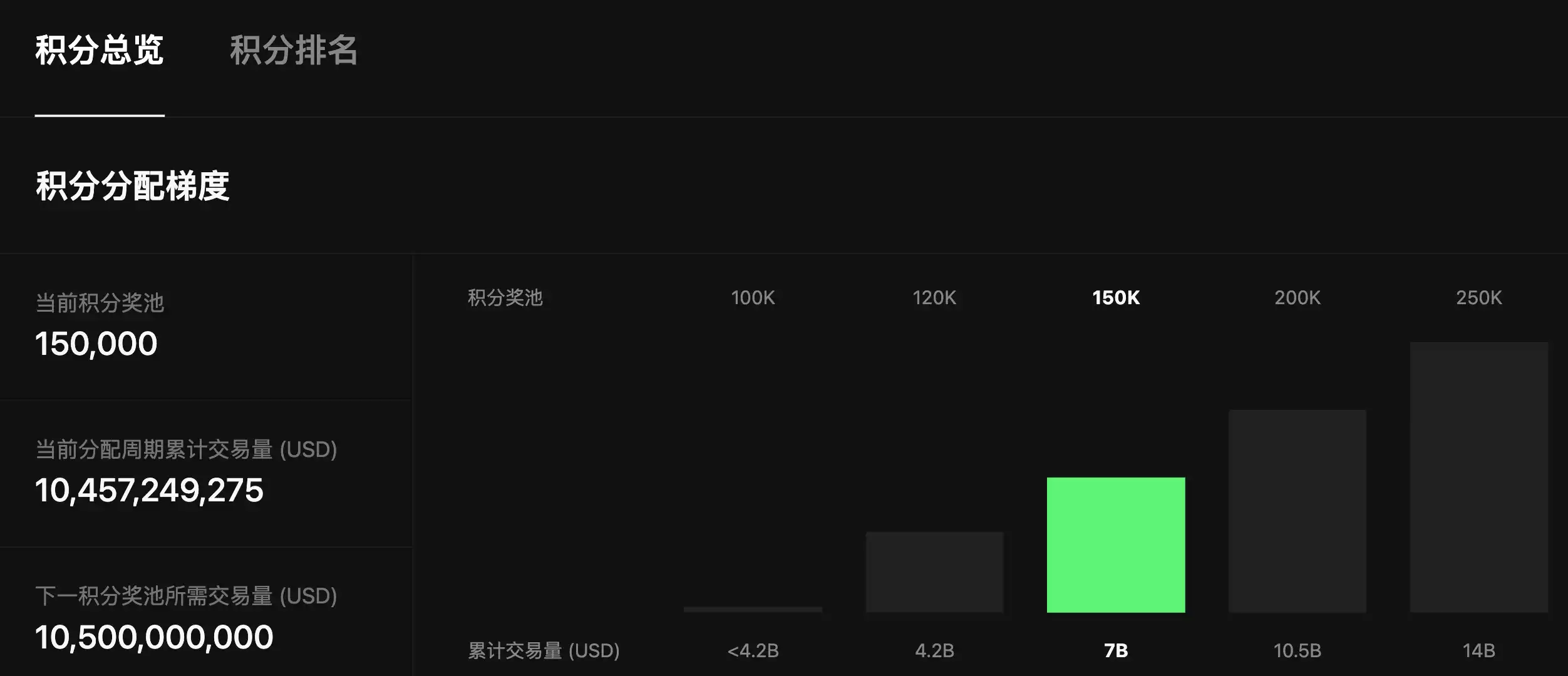
Point Pool Stepping Illustration
Once the total pool amount is determined, users can obtain points through the following 5 methods, each with a different weight.
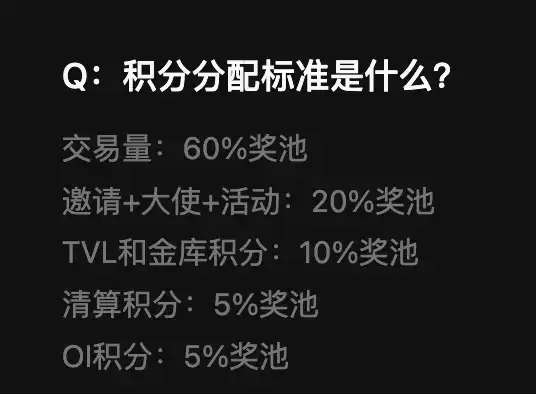
The largest source of points in the pool is from transaction volume, which aligns with Anymose's observation: "If we were to rank the weight of points, we calculated it as: Order Amount (Contribution Fee) > Holding > P&L."
This also means that transaction volume is the main way to obtain points. How much transaction volume is needed to obtain 1 point, and what is the approximate cost of obtaining points? This may also be one of the most concerning questions for users. Anymose, based on first-hand player experience, provided their answer.
"Our team contributed approximately $200,000 in fees on EdgeX trades," combined with EdgeX fee rates, we can roughly infer that Anymose's total trading volume is in the range of $830 million to $1.54 billion. Since EdgeX's current point distribution is dynamic, with the difficulty of obtaining points changing weekly, it is challenging to provide an exact value for "how much volume gets 1 point." However, according to Anymose's estimation: "The average cost of 1 point is around $10."
Due to their early and in-depth participation, Anymose's cost is relatively low. For regular users, the cost will be higher. According to community discussions, currently, every $50,000 to $70,000 in trading volume can earn 1 point, with a cost of approximately $15.
This is why Anymose no longer recommends users to focus on a single "boutique account" instead of creating multiple accounts: "Reducing costs is the best and most important strategy when playing EdgeX."
By concentrating funds in a "boutique account," reaching a certain level of trading volume and number of referrals to upgrade to VIP status, reducing fees, the cost of obtaining points will also be significantly lower. With the same amount of capital, you can obtain more points at a lower cost. As shown in the figure below, different VIP levels offer lower transaction fee discounts.
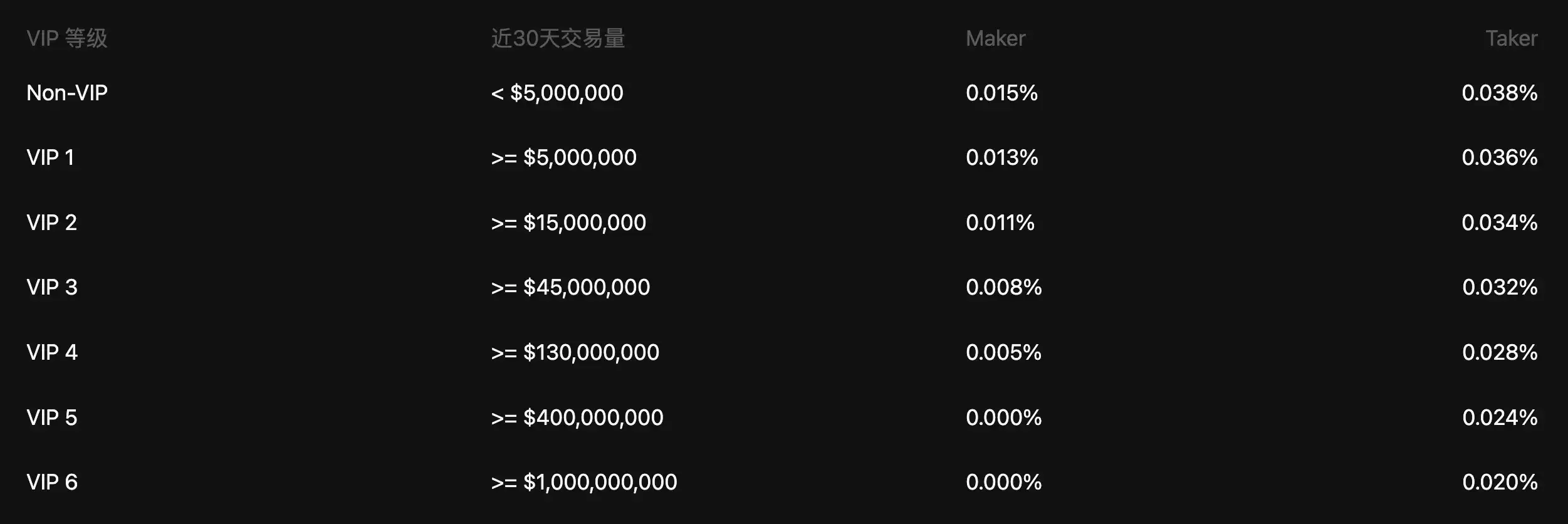
The method to reduce costs, besides upgrading to VIP level, also includes activities during the new coin listing phase, where often additional points are given out. In addition, anymose also added: "Participating in community events, as well as trading competitions, referral bonuses, becoming an ambassador, and various other methods can all earn you extra points, reducing the average cost."
API Running + Full Treasury
"From historical data, we can see that the weekly average wallet points have dropped to a historic low of 24 points for two consecutive weeks, while the number of traders has reached a new high, making it overall more challenging," stated anymose.
Some early "tricks," such as opening multiple new accounts to complete beginner tasks or exchanging liquidation amounts for points, have become less effective as the popularity of edgeX has increased, raising the cost of earning points. Therefore, real trading volume has become a key factor in earning points.
In addition to Perp trading, the eLP Treasury is another major product highlight of edgeX. According to official documentation, the APY income from edgeX eLP comes from passive market-making profits, liquidation fees, and a portion of platform trading fees. The eLP Treasury limit for each user gradually increases with Perp trading volume. The current treasury limit allocation rules are: individuals receive a $30 limit for every $50,000 in trading volume; invited users receive a $30 limit for every $300,000 traded; with a maximum of 50% recharge limit for amounts up to $100,000.
Although the eLP Treasury only accounts for 10% of the prize pool weight, it boasts high APR returns. The performance over the past month has been around 13.65% APR. Therefore, the anymose team's choice is: "Maintain a full treasury, increase the limit at any time, in order to capture points and high APY returns."
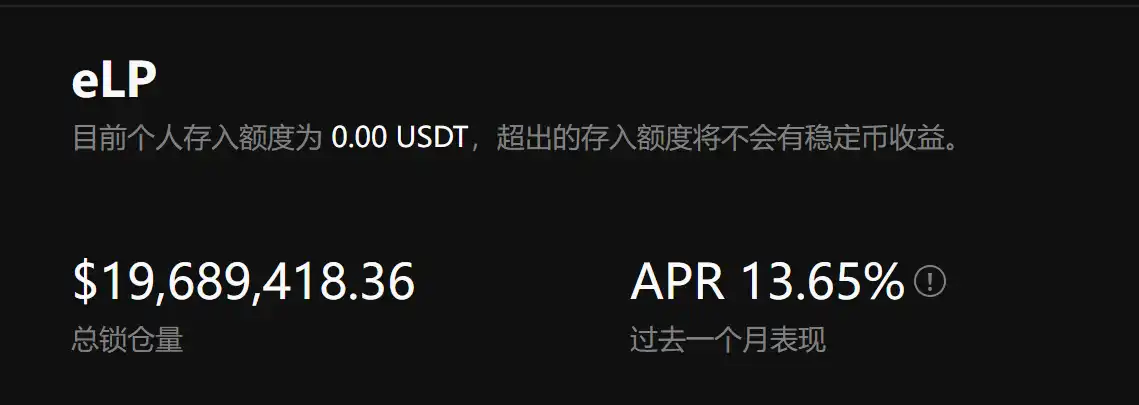
As of the time of posting, the eLP Treasury TVL is $196 million; Source: edgeX
As for the community's much-discussed "Witch Rule," anymose stated that the edgeX team's stance on the Witch is: "As long as you have received the points, there is no Witch."
"This means: if there is a Witch, then you won't receive any points," anymose said.
However, the only thing to note is that in edegX's trading rules, there is a provision that self-trading does not earn points. "Self-trading, which is placing an order to match your own order, is easy to identify," anymose explained. According to information obtained by BlockBeats in the community, the weight of ultra-short round trips (immediate close after opening) will be slightly lower. In the case of equal trading volume, holding the position longer will result in a higher points weight.
Therefore, the most prudent approach is to: first concentrate the fund size to create a boutique account to upgrade the VIP level, prioritize placing limit orders to reduce fees, engage in real trading to avoid self-trading, participate in activities and ambassador rebates, ensure the eLP Treasury is fully funded or gradually increase positions. This way, you can optimize the cost per point, engage in real trading, and achieve stable returns simultaneously.
1 Point for $30 - Overvalued or Undervalued?

Recently, there has been a discussion in the community on social media about the edgeX points' price. Although the off-exchange trading volume is not significant, anymose considers the price of $30 per point to be reasonable.
"I conservatively estimate edgeX's Fully Diluted Valuation (FDV) to be around $2 billion, with an airdrop ratio of 20%, and a total of 6 million points. Therefore, the price of 1 point would be $67. However, considering a valuation range with +/- 50% elasticity, we ultimately calculate the price of 1 point to be in the range of $30 to $50. Thus, the current OTC price is not unreasonable."
According to statistics from BlockBeats, edgeX has issued a total of 2.83 million points, including the points distributed in the first season, Alpha Season, and the points currently being distributed in the second season, Open Season. If for the next 7 weeks, 25,000 points are distributed in full each week, the total points will be 4.83 million.
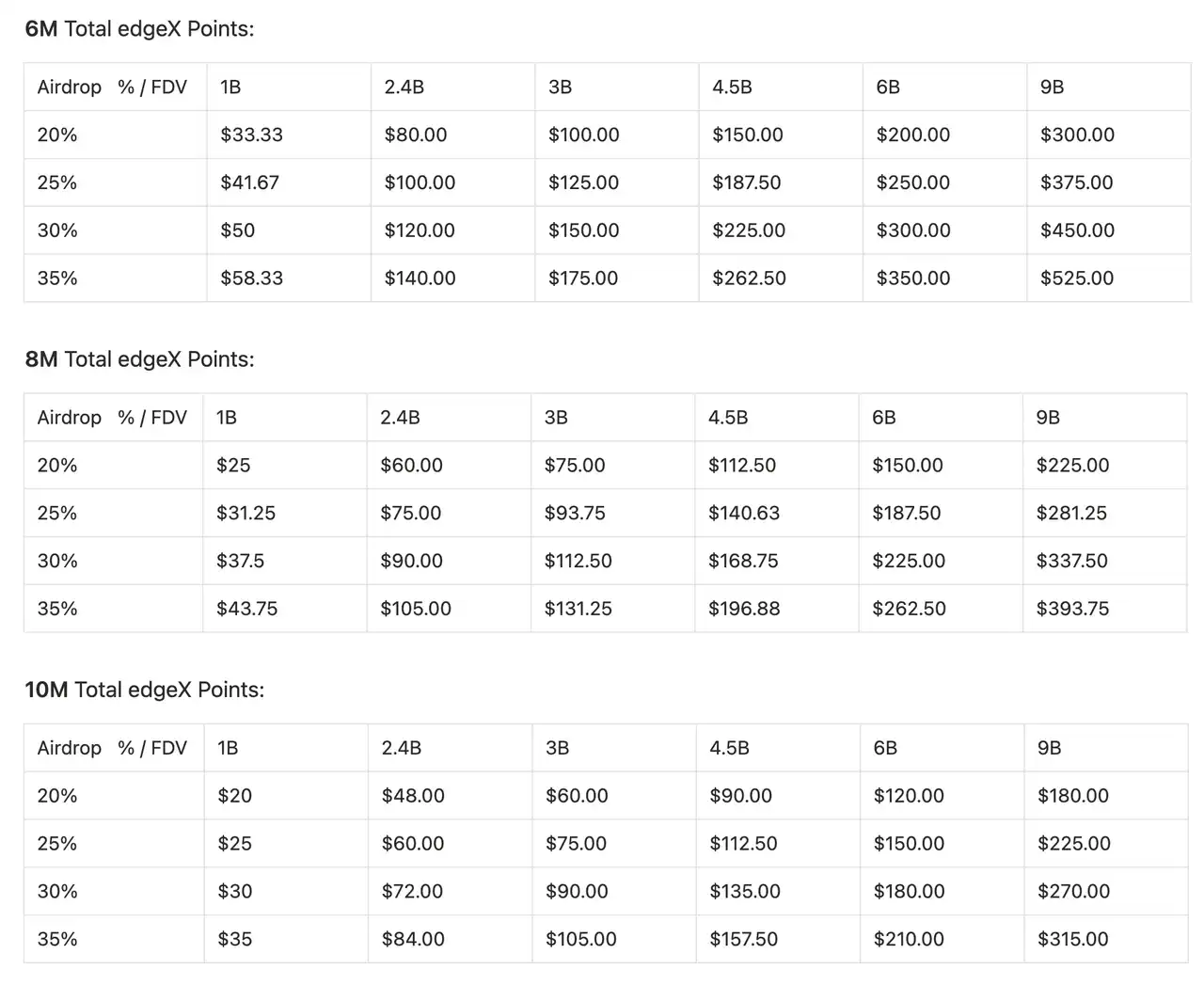
Now, let's refer to another community member akonresearch's calculation model: if at the time edgeX issues coins, the daily trading volume reaches $1.5 billion, the daily trading user count reaches 8,000, and the TVL reaches $500 million, then the FDV can be reasonably estimated at 1/20 of the hype, which is $2.4 billion. In this case, with a total of 6 million points, estimating the airdrop share at 20%-35%, the value of a point could reach $80-$140, which is much higher than anymose's estimate.
Of course, this is based on the assumption that the "second season is also 21 weeks." If the market performance is poor and the event is delayed, the estimated value of points will also be adjusted downwards. However, from another perspective, although the point denominator may continue to increase leading to dilution, the product is maturing, liquidity and user structure are healthier, and the price support after the TGE may be more stable. "After all, edgeX still has many products to polish, and time is needed to further optimize liquidity for non-major pairs and system stability," anymose candidly stated.
In terms of the timeline, the official stance is: if the market and product development progress smoothly, the target is the TGE in the fourth quarter of this year. Anymose provides a more detailed observation point: "So the next key point is 7 weeks away, which is the end of October. The open season is already in the 14th week, and the season may end by the 21st week."
In addition to paying attention to the product status and market environment 7 weeks later, anymose also suggests focusing on several signals approaching the TGE: whether the trading volume will surge again, the entry of partners, and the progress on product features such as the treasury and V2 testnet.
Regarding competitors, anymose bluntly stated that Lighter may take the lead before the TGE: "Lighter's model and pace are faster, possibly with more resources from VCs, and the product is more focused. However, from the perp perspective, it is far behind edgeX. If Lighter launches first, our marginal investment in edgeX will decrease, shifting to a defensive strategy." However, in the long run, anymose still prefers the growth potential of edgeX, "In terms of the team, from my interaction with the people at edgeX, I can feel that they are very focused on the business, not as flamboyant and aggressive."
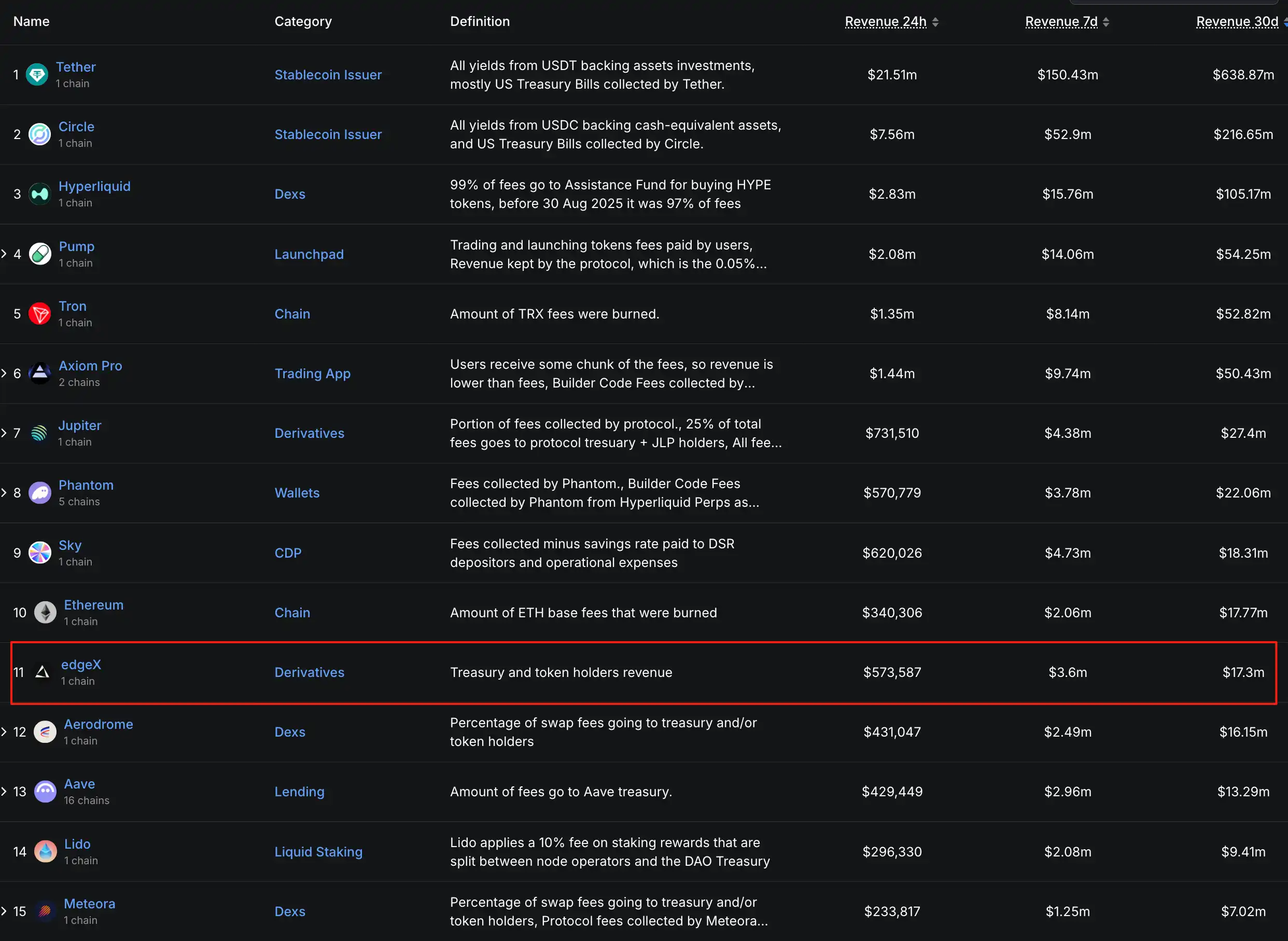
In fact, income data also supports anymose's judgment. As of the time of writing, edgeX's 30-day revenue ranks 11th among all crypto protocols. Among the top 15 protocols (excluding the issuers of the stablecoins USDT and USDC and Axiom, a trading bot that has repeatedly stated it has no token issuance plans), edgeX is the only one left without a token issuance. More about edgeX's revenue can be found in: "This DEX without a token issuance has exceeded Uniswap in revenue."
In terms of liquidity depth, within the 0.01% price difference range, eedgeX's order book can support a maximum BTC order size of approximately $6 million, higher than Hyperliquid (around $5 million), Aster (around $4 million), and Lighter (around $1 million). Although the overall depth is slightly lower than Hyperliquid, on most coins, edgeX has the best depth among all Perpetual DEXs except for Hyperliquid. Considering trading volume, edgeX is also second only to Hyperliquid and Lighter. This means that in terms of both product completeness and various data, edgeX is striving to be in the top three in the Perpetual DEX arena.
So is $30 per minute expensive? The answer depends on your expectations for FDV, airdrop ratio, and integral factor. More importantly, it depends on your mode of participation, as this determines your marginal cost. Concentrate on being a "boutique trader," increase your level to reduce fees, leverage ambassadors/events/invitations and the eLP treasury to dilute the cost per unit, and then wait for the TGE window.
And perhaps the most important of the eightfold path is cost reduction and efficiency enhancement, as simplicity is the ultimate sophistication.
Welcome to join the official BlockBeats community:
Telegram Subscription Group: https://t.me/theblockbeats
Telegram Discussion Group: https://t.me/BlockBeats_App
Official Twitter Account: https://twitter.com/BlockBeatsAsia