Bullish IPO, Why Is Its Valuation Less Than 10% of Coinbase's?


On August 12, following Coinbase, the second cryptocurrency exchange will officially debut on the New York Stock Exchange — Bullish plans to raise approximately $9.9 billion through an initial public offering.
Superficially, this is just another routine entry of the crypto industry. The impressive performances of IPOs of companies like Circle and Figma in the past six months, Coinbase's inclusion in the S&P 500, have already whetted the appetite of the US stock market for crypto companies.
Bullish's appearance seems to continue this trend, and may even be the most ostentatious one. This exchange, with $30 billion in assets, not only received strong support from top investors such as Peter Thiel, Alan Howard, and SoftBank, acquired the crypto media giant CoinDesk, firmly holding the industry's most influential "microphone," with its CEO Tom Farley having previously served as the NYSE president.
The strong background and aura have made investors' demand for Bullish's IPO "particularly strong," causing Bullish to increase its fundraising size from $6.29 billion to $9.9 billion on the eve of the IPO.
However, beneath Bullish's glittering resume lies a story that is enough to stir the memory of the crypto community — the destination of the massive financing, the rift between the community and capital, and an abandoned public chain — EOS.
EOS's "preacher" Li Xiaolai once wrote in his circle of friends on August 10, 2018, "Let's look at EOS again in seven years." Ironically, seven years later the community did not see EOS's growth, but rather the glory of Bullish — a company completely unrelated to EOS.

A $4.2 Billion Betrayal
If Bullish's relationship with EOS were to be described in one sentence, it would probably be — ex and current, mutually tacit understanding, but difficult to sit together again.
After news of Bullish secretly submitting its IPO application leaked, the price of EOS tokens surged by 17%, as if experiencing an illusion of rekindled old love. However, in the eyes of the EOS community, this slight increase seemed more like irony. The former manipulator Block.one had long turned and embraced Bullish, leaving EOS behind — and at the cost of its decline.
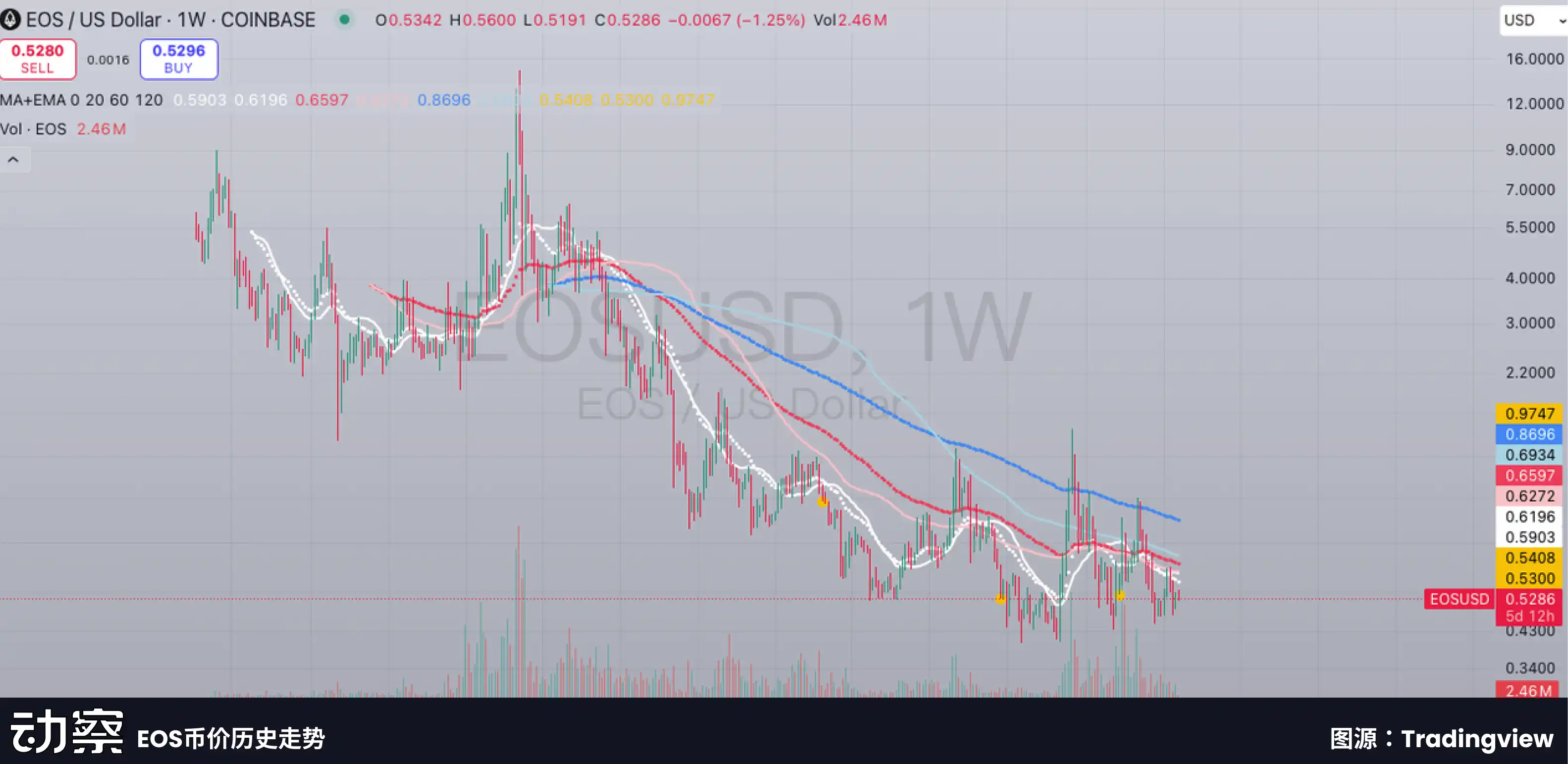
The story begins in 2017. At that time, the public blockchain arena was in its golden age, where a whitepaper could serve as a ticket to entry, and the vision was to create the ultimate fundraising tool. Block.one launched EOS with the bold claims of "millions of TPS, zero fees," which immediately attracted global investors.
In 2018, through an ICO, EOS raised $4.2 billion, setting a new fundraising record in the crypto industry. EOS was also bestowed with the title of "Ethereum Killer."
However, the myth crumbled faster than anticipated. Shortly after the mainnet launch, users discovered a significant gap between reality and the whitepaper: transactions required staking CPU and RAM, making the process cumbersome with high barriers to entry. Node elections did not lead to the expected "decentralized democracy" but quickly devolved into a game of large holders and exchanges.
Technical flaws were just the surface; the deeper crack stemmed from uneven resource distribution.
Despite Block.one's promise to allocate $1 billion to support the EOS ecosystem, out of the $4.2 billion raised, $2.2 billion was ultimately used to purchase US Treasury bonds, along with investments in BTC, the stock market, the acquisition of Silvergate (which went bankrupt in 2023), the purchase of the Voice domain name, and other investment ventures.
The funds that truly reached the EOS developer ecosystem were embarrassingly scarce.
The final straw that broke the EOS community's patience was the emergence of Bullish in 2021. Block.one announced the launch of this brand-new crypto trading platform with a staggering $1 billion in funding, completely unrelated to the EOS technical ecosystem—no EOS chain, no support for EOS tokens, no acknowledgment of any connection to EOS, not even a symbolic thank you.
To the EOS community, this was a blatant betrayal: Block.one raised a huge sum through EOS and then started a new venture in the limelight, leaving EOS behind, stripped of its original resources and spotlight.
Bullish: A $1 Billion Financing New Beginning
Derived from the shattered EOS dream, Bullish initially received $100 million in cash injection support from Block.one.
It also attracted renowned investors such as Peter Thiel, Alan Howard (investors in FTX and Polygon), as well as top-tier venture capital firms like Galaxy Digital, DCG, and SoftBank to join the investment camp, forming a truly impressive lineup.
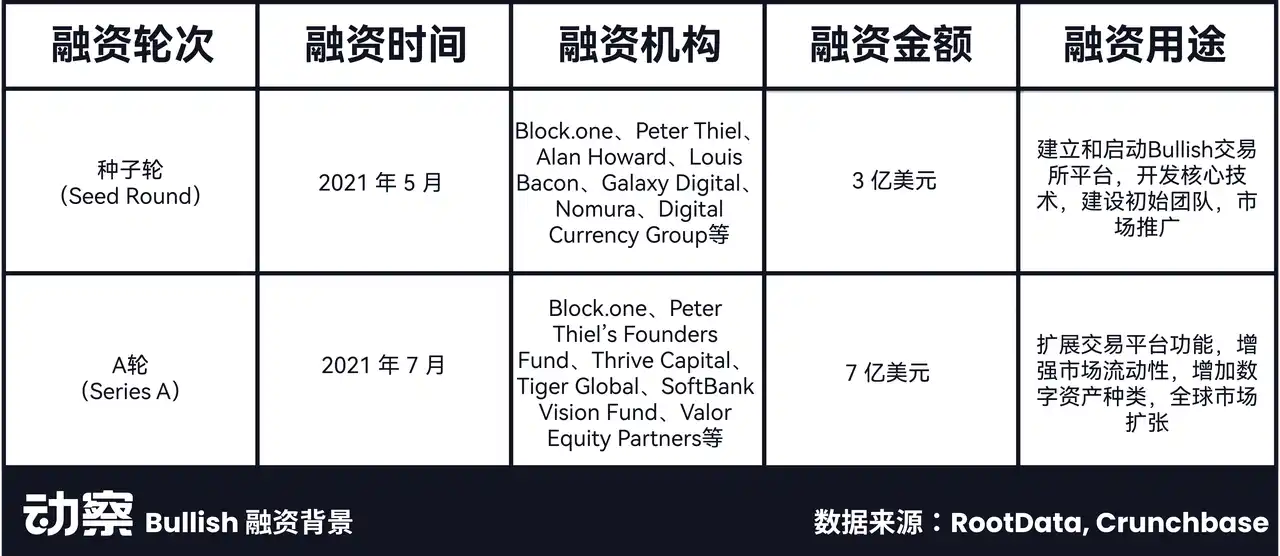
This allowed Bullish to have up to $1 billion in initial capital, far exceeding its competitor Kraken, which only raised $65 million in seed and Series A funding rounds.
Since 2021, Bullish's core business has revolved around its exchange. With an innovative hybrid liquidity model (combining CLOB and AMM), Bullish is able to provide low trading spreads in high liquidity environments and maintain stable market depth in low liquidity environments.
This technological innovation has quickly gained favor with institutional clients, propelling Bullish to become the world's fifth-largest crypto exchange.
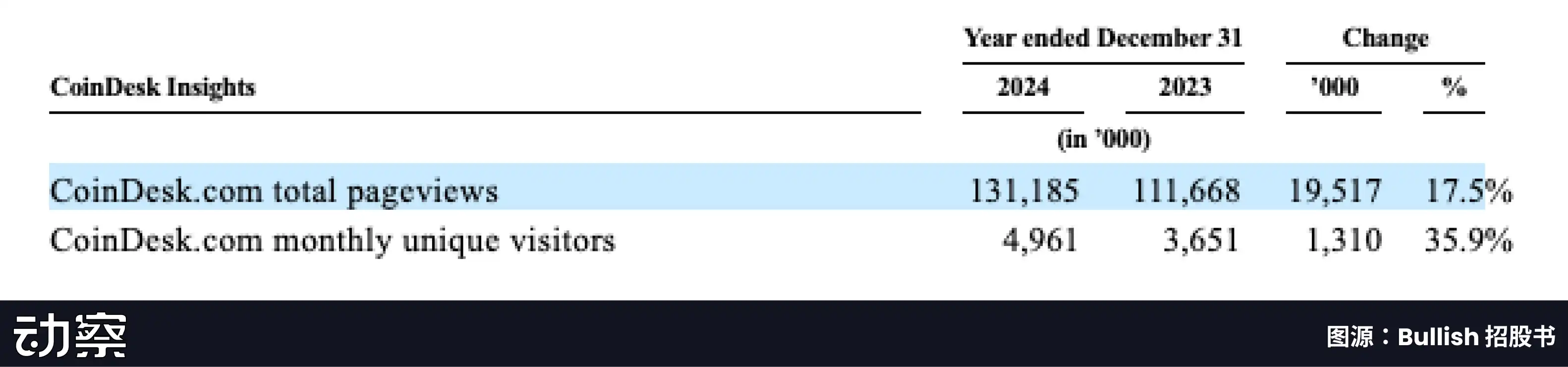
While steadily growing its exchange's core business, Bullish acquired the globally leading crypto media platform CoinDesk in 2023, further strengthening its industry influence. CoinDesk reached 4.96 million monthly unique visitors in 2024.
Bullish also launched CoinDesk Indices and acquired CCData in 2024, leveraging their data services to help institutional clients track digital asset performance and provide market data insights.
Additionally, Bullish established a venture capital arm—Bullish Capital. Through this business, Bullish can invest in crypto innovation projects, bringing potential capital returns to Bullish and helping it maintain its industry-leading position through diversification. Currently, Bullish Capital has invested in several well-known crypto projects including Ether.fi, Babylon, Wingbits, and more.
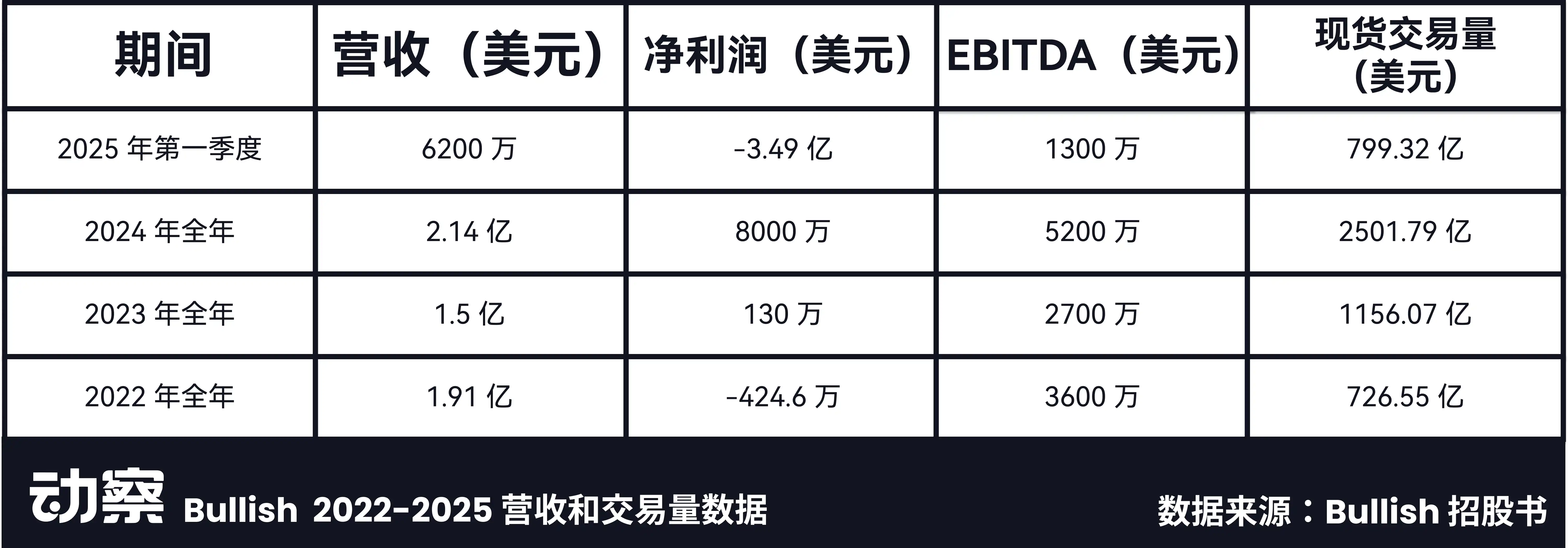
Financially, Bullish's current revenue sources are still relatively concentrated, with its exchange's spot trading revenue accounting for 70% to 80% of total revenue.
According to its prospectus, Bullish reported a net loss of $349 million in the first quarter of 2025, primarily due to significant decreases in the fair value of the company's holdings of cryptocurrencies such as Bitcoin and Ethereum.
On the other revenue front, Coindesk saw significant growth in revenue. In the first quarter of 2025, CoinDesk's subscription revenue reached $20 million, up over 100% from $9 million in the same period of 2024.
This growth was partly fueled by the $9 million sponsorship revenue from the Consensus Hong Kong 2025 conference held in February 2025.
However, compared to its main competitors Coinbase and Kraken, Bullish's revenue and profit seem somewhat lackluster. Starting from 2022, Coinbase's revenue has almost always remained over 20 times that of Bullish. Additionally, Kraken's total revenue of $15 billion in 2024 far exceeded Bullish's $2.14 billion during the same period.
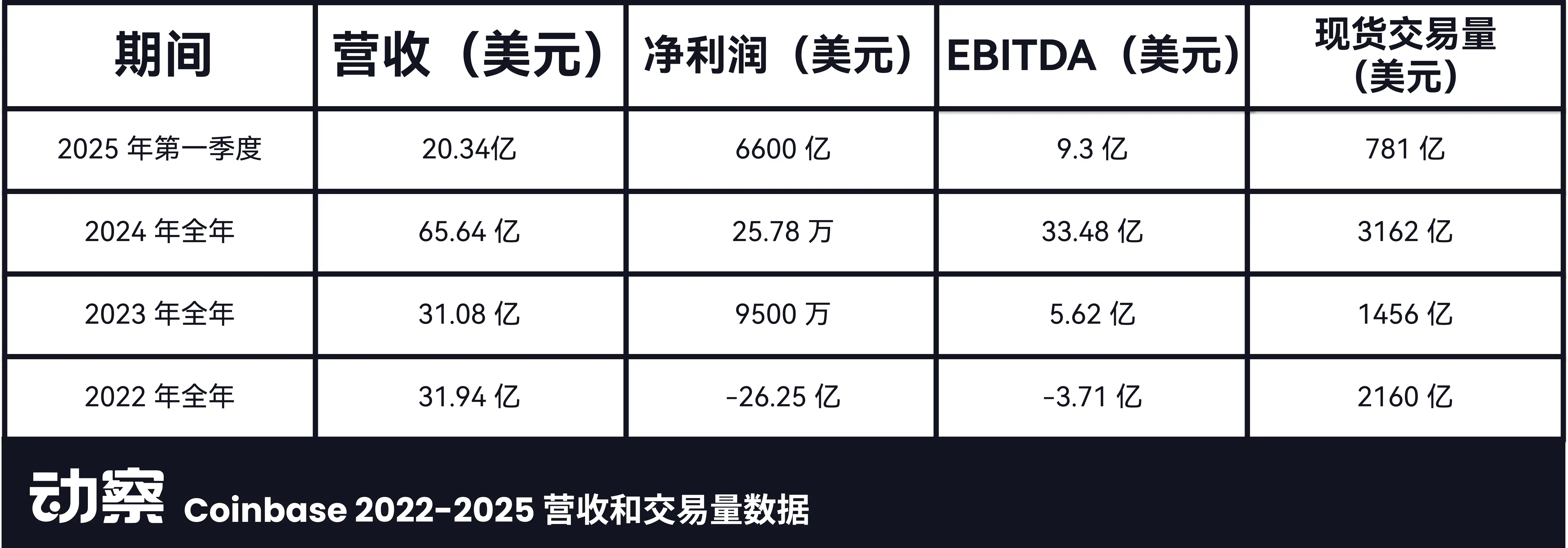
In terms of business data, Bullish's spot trading volume growth is quite remarkable. In the first quarter of 2025, Bullish's $799 billion in trading volume even slightly outpaced Coinbase.
This trading volume matching leading exchanges but significantly lagging in revenue is mainly due to Bullish proactively reducing the trading spread.
“The strategic measure of tightening the spread has enhanced our competitive position and captured a larger market share,” according to the IPO prospectus. In 2024, Bullish's global BTC and ETH spot trading volume market share increased by 10% and 37%, respectively, and in 2023, increased by 31% and 189%, respectively.
However, the strategy of expanding market share by compressing the spread is not optimistic in the long run.
On one hand, as institutional investors gradually enter the market and the market matures, trading is increasingly concentrated on top assets like BTC, leading to reduced volatility.
On the other hand, the launch of ETFs further intensifies the competition among exchanges. These changes will narrow the market's trading spread, thereby affecting Bullish's profitability and competitive advantage.
Facing the increasingly fierce market competition, Bullish's competitive strategy is also similar to top exchanges like Coinbase—expanding into the derivatives market and acquisitions to explore a second growth curve:
“We expect to meet the ongoing demand of stable, high-value institutional clients through expanding products, especially options products, to achieve growth. And continue to leverage our scale, assets, and professional advantages to acquire companies that align with our business lines.”
A $48 Billion Valuation: "Low-Key" or Another Motive?
The confidence behind Bullish's future large-scale acquisitions can be largely attributed to the historic fundraising that took place — Block.one's $4.2 billion USD raised through the 2018 EOS ICO.
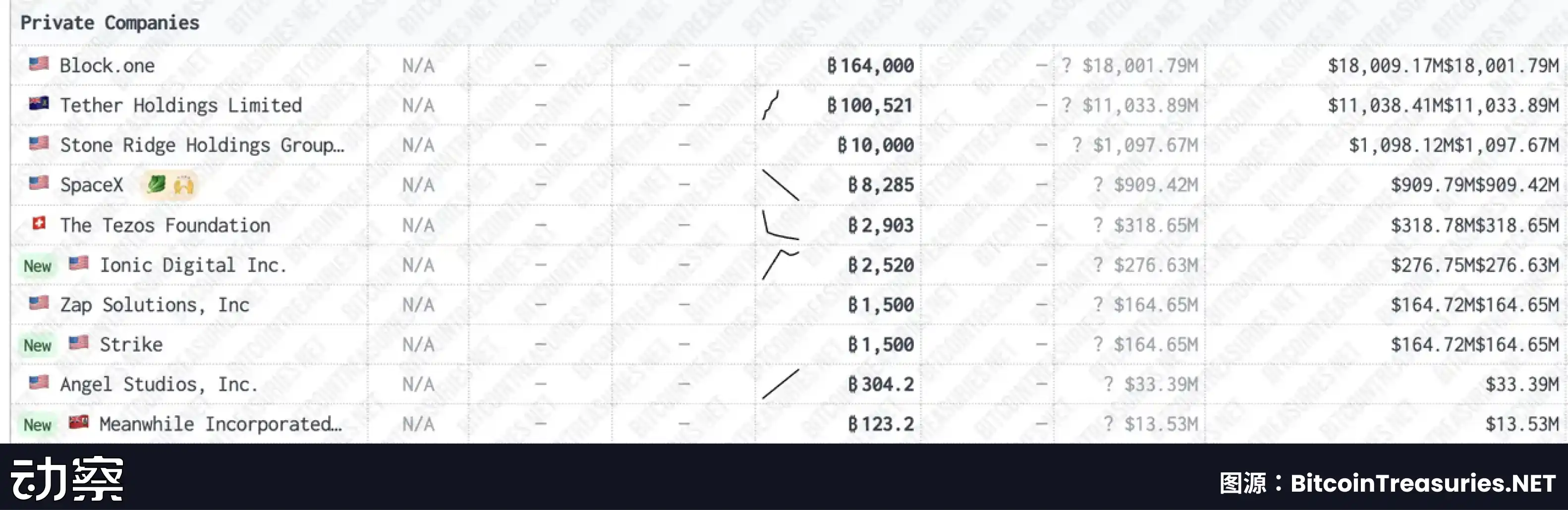
Aside from allocating a significant portion of this fund to secure U.S. Treasury bonds and sporadic equity investments, Block.one also made an early substantial purchase of 160,000 Bitcoins.
This move instantly made it the world's largest privately held company in terms of cryptocurrency holdings, surpassing stablecoin giant Tether by a whopping 40,000 Bitcoins.
Bullish's balance sheet also carries significant weight: with total assets exceeding $3 billion USD, including 24,000 Bitcoins (valued at around $2.8 billion USD), 12,600 Ethereum, and $418 million USD in cash and stablecoins.
For comparison, in the second quarter of the same year, Coinbase held only 11,776 Bitcoins, valued at approximately $1.3 billion USD — meaning that in terms of BTC holdings alone, Bullish is nearly twice the size of Coinbase.
This strong asset base has positioned Bullish as somewhat "low-key" in the face of its $4.8 billion USD IPO valuation, making it more akin to a digital asset reserve company rather than just an exchange.
At the $4.8 billion valuation, the current premium to net asset value (mNAV) of this coin stock is only 1.6. This "low-key valuation" has ignited strong investor demand for this IPO, leading to enthusiastic market sentiment.
On August 11, the company significantly adjusted the issuance plan last minute — raising the per-share price range from $28-31 to $32-33, and expanding the issuance size from 20.3 million shares to 30 million shares. On August 12, the offering price was once again increased to $37.
The prospectus also stated that BlackRock and ARK Investment Management will subscribe to $200 million USD worth of shares at the IPO price, undoubtedly adding to the optimistic sentiment.
However, behind the enthusiasm lies another set of rules. Less than 15% of the shares are in circulation for this IPO, with the vast majority still held tightly by major shareholders and early investors. Low circulation implies scarcity, and scarcity implies potential "rush-to-buy" on the first day, which is enticing for short-term funds.
As Renaissance Capital's Senior Strategy Officer Matt Kennedy commented on Bullish IPO: "Bankers are more willing to leave some room for valuation, to raise on a low valuation basis, rather than start with an overpriced valuation, which would instead dampen market enthusiasm."
However, the flip side of low liquidity is a potential time bomb of selling pressure. When the lock-up period ends, if major shareholders and early investors choose to cash out and exit, the market is prone to a chain reaction of increased liquidity and price decline.
A similar script has been seen too many times in the cryptocurrency market during this cycle.
It is also worth noting that this is not Bullish's first attempt to enter the capital market. Back in the peak of the 2021 crypto bull market, it had planned to go public with a $9 billion valuation through a merger with SPAC company Far Peak Acquisition Corporation. That time, regulatory uncertainty and market volatility dealt a double blow, halting the plan in 2022.
Now, with Bitcoin once again hitting a historical high near $120,000, crypto companies like Circle have successfully tested the waters of the capital market through IPOs. Bullish, with a nearly halved valuation and a more careful strategy, is once again aiming for the NYSE.
Will this combination of "valuation suppression + liquidity crunch + bull market timing" allow Block.one's already substantial book assets to see another impressive appreciation?
However, for investors familiar with the EOS story, there may be a more important lesson – don't love companies like these for too long, lest the final outcome replay the old dream of EOS community destiny.
Go to the Dynamics Beating official account to read the full article
Welcome to join the official BlockBeats community:
Telegram Subscription Group: https://t.me/theblockbeats
Telegram Discussion Group: https://t.me/BlockBeats_App
Official Twitter Account: https://twitter.com/BlockBeatsAsia