6 Valuation Methods Assessment: Can Ethereum Reach $10,000 This Cycle?

Original Title: "Can Ethereum Reach $10,000 in This Cycle? 6 Valuation Methods Calculated"
Original Source: Biteye
ETH has rebounded from its April low and is currently sitting at the $4,500 mark.
If 2024 was the year the Bitcoin ETF ignited the bull market, then 2025 might be Ethereum's turn.
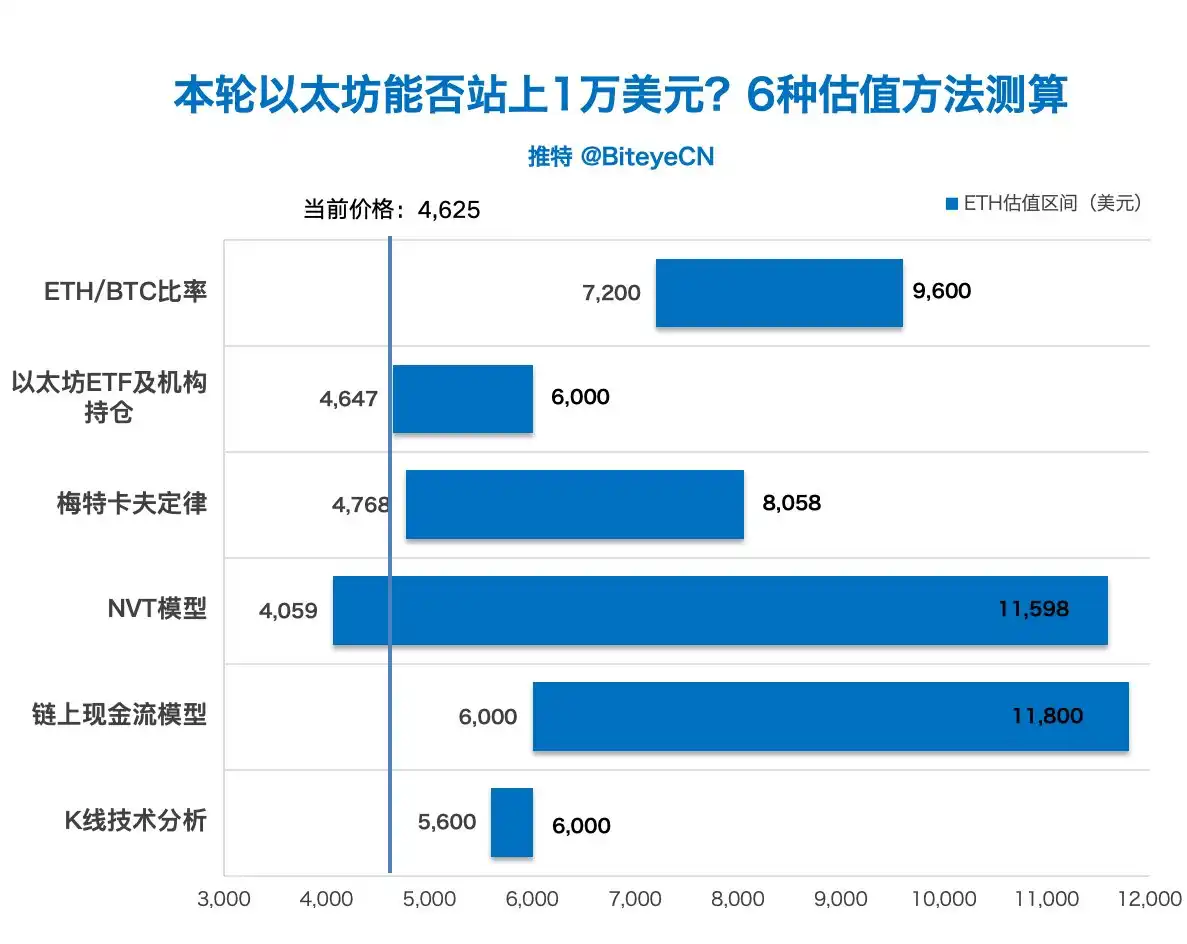
This article uses 6 valuation methods to analyze whether ETH can break through the $10,000 mark!
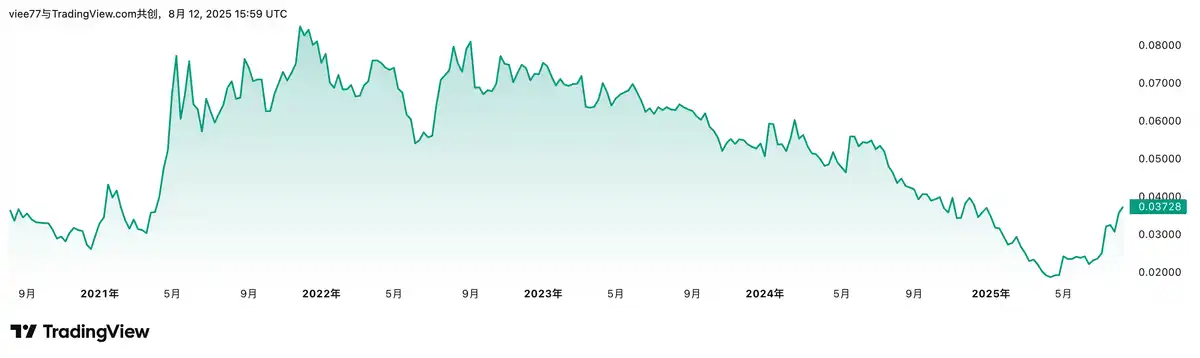
1/8 ETH/BTC Ratio
First, let's compare ETH and BTC using a relative valuation.
The ETH/BTC ratio has been relatively stable in the long term, but the current ratio is only 0.0372, near a historical low in the past 5 years, indicating that ETH may currently be "undervalued."
Calculating based on the past five years' ETH/BTC ratio average of 0.0518, assuming BTC remains around $120,000, the corresponding ETH price would be $6,214.
If we use the ETH/BTC ratio of 0.06-0.08 from the last bull run to calculate, still assuming BTC stays around $120,000, the corresponding ETH price would be $7,200-$9,600.
2/8 Ethereum ETF and Institutional Holdings
With the surge in ETH price, a large amount of off-exchange funds has poured into the Ethereum ETF. Many people have overlooked the actual impact of the Ethereum ETF and institutional buying, which is not only positive sentiment but also significant buying pressure.
According to @SoSoValueCrypto data, Ethereum spot ETF has hit a new all-time high, with a net inflow of $1.019 billion on August 11th EDT, and the current net asset value of the Ethereum spot ETF is $25.712 billion, with holdings of approximately 6 million ETH, accounting for about 4.96% of the current ETH circulating supply,
Comparing to the BTC ETF percentage of 6.48%, there is still room for growth. In addition, 70 Ethereum reserve entities currently hold approximately 3.49 million ETH, accounting for 2.89% of the ETH circulating supply, with BMNR publicly aiming to eventually hold 5% of the global Ethereum circulating supply. After deducting the staked amount of 36.17 million ETH, there are only about 75.10 million ETH in free circulation.
The following price projection is based on a simple assumption: the percentage by which the circulating supply decreases will proportionally increase the price per coin.
In other words, New Price = Current Price × (Target Circulating Supply / Current Circulating Supply)
If we consider ETFs and institutional reserves as a single entity, they currently hold 7.85% of the total supply. Assuming this percentage increases to 10% in the future, with a relatively stable staking ratio, the circulating supply would decrease to approximately 72.52 million coins, leading to a mechanical price increase to around $4647; if it rises to 15%, the price would reach around $5070; if it goes up to 20%, it would approach $6000.
This calculation does not account for the demand-side amplification effect, so the actual price increase could be higher. Additionally, incremental funds from ETFs and institutions typically take some time to be fully deployed, meaning the ETH price would be lifted over the long term in a stable manner, rather than a sudden surge.
3/8 Metcalfe's Law
Many people tend to focus on price fluctuations and market narratives when discussing ETH valuation, overlooking the long-term network value supported by on-chain activity. Metcalfe's Law states that a network's value is proportional to the square of its active users, applied to Ethereum, the network value ≈ k × (Daily Active Addresses)².
Simply put, "the more users, the more valuable the network," as a quadratic increase in user numbers brings exponential growth in market capitalization.
Based on BitInfoCharts data, on August 13, 2025, Ethereum's mainnet had approximately 971,486 Daily Active Addresses (DAA) in the last 24 hours, with ETH priced at around $4500, a total supply of about 120.7 million coins, and a market cap of around $543.1 billion. Substituting these values into the formula yields the current coefficient k ≈ 0.576 (USD/Address²).
With this k value, you can project prices under different activity scenarios:
If DAA increases to 1 million, the price would be around $4768 (+6%)
If DAA increases to 1.1 million, the price would be around $5769 (+28.2%)
If we optimistically reach 1.3 million (close to a historical peak of 90%), the price would be around $8058 (+79.1%)
This projection assumes that the staking amount and circulating supply remain relatively stable, and the increase in activity directly amplifies the network's value, thereby driving up the price per ETH coin. Unlike ETF and institutional buying pressure, the Metcalfe method reflects the organic growth of on-chain usage and economic activity. It does not rely on external capital inflows but is based on the compounding network effects.
Please note that once on-chain activity resonates with the on-chain volume—increased on-chain transactions, rising fees, increasing gas burn—and when combined with the ETF and institutional chip contraction effect, ETH's price will be simultaneously driven by the forces of supply contraction and network expansion. The upward momentum may far exceed predictions based on a single factor.
4/8 NVT Model
NVT is essentially like the "crypto version of PE ratio." Given a reasonable NVT multiple (based on historical ranges) and the future daily on-chain transaction volume, the market cap and price can be inversely derived.
NVT = Market Cap (USD) / Daily On-chain Transaction Volume (USD), calculated as the current NVT = 518B / 14B = 37
ETH's NVT has historically been roughly in the range of 60–110, currently positioned at a historically lower level. Assuming the NVT multiple remains within the reasonable ranges of 60/80/90/100/110 over 6–12 months; the on-chain transaction volume (USD) is expected to range from 7B to 14B/day.
6-month Scenario
· Conservative: NVT 70, daily transaction $7B → Market Cap ≈ $490B → Price ≈ $4,059
· Base: NVT 80, daily transaction $9B → Market Cap ≈ $720B → Price ≈ $5,965
· Optimistic: NVT 90, daily transaction $12B → Market Cap ≈ $1080B → Price ≈ $8,947
12-month Scenario
· Conservative: NVT 75, daily transaction $8B → Market Cap ≈ $600T → Price ≈ $4,971
· Base: NVT 90, daily transaction $10B → Market Cap ≈ $900T → Price ≈ $7,456
· Optimistic: NVT 100, daily transaction $14B → Market Cap ≈ $1400T → Price ≈ $11,598
This means that ETH's network effect is holding up a valuation base of $5,000 to $12,000.
5/8 On-chain Cash Flow Model
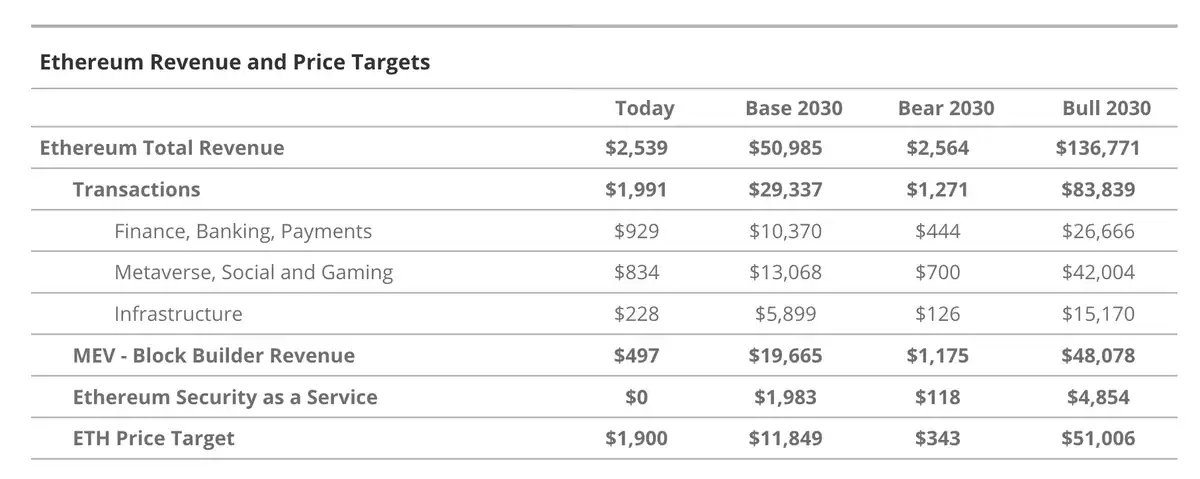
The on-chain "revenue" generated by the Ethereum protocol (fees + MEV, etc.) is considered as cash flow, measuring network value. As the Ethereum application ecosystem expands, the growth in network "revenue" can enhance ETH's valuation.
Asset management company VanEck predicts that by 2025, with the introduction of Ethereum staking rewards ETF and other favorable factors, the price of ETH is expected to approach $6000. In a report as early as 2023, VanEck made a price valuation for ETH, assuming that on-chain fees and usage would continue to rise, projecting that by 2030, ETH could reach around $11,800. Refer to the chart below:
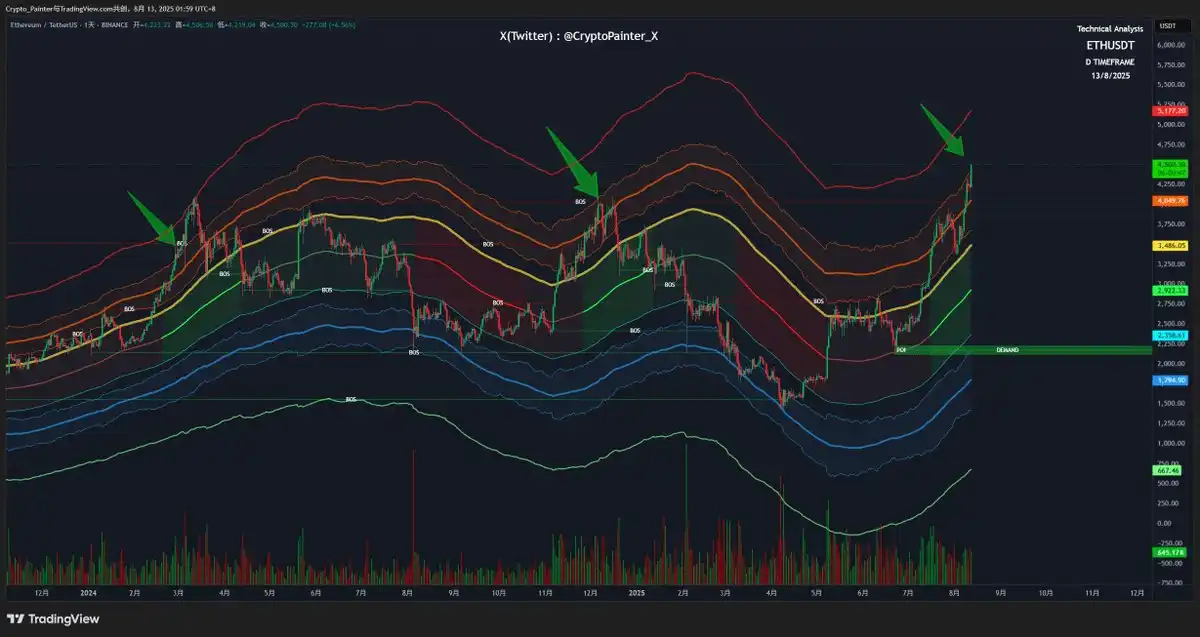
6/8 K-Line Technical Analysis
@CryptoPainter_X believes that although ETH is currently facing some historical selling pressure from the 2021 peak supply zone, the technical structure at the 4-hour level shows that the swing lows are slowly rising, with no significant breakdown.
Observing from the ASR channel, ETH's price is oscillating upwards above the orange average pressure zone, indicating a strong trend, suggesting that market demand is gradually absorbing supply near the historical highs.
There are signs of a daily ASR channel breakout above the average pressure zone. The last similar breakout occurred in early 2024. If this breakout is successful, the daily target may directly hit the daily overbought line (around $5600).
Another possibility is a repeat of the price action at the end of 2024, encountering extreme resistance at the upper edge of the orange channel.
Overall, the current situation still looks positive, with the possibility of ETH price hitting $6000 in the medium term.
7/8 Crypto Analyst Scenario Analysis
Some crypto analysts and media outlets have provided a series of scenario-based predictions for ETH price:
1. Crypto analyst @VirtualBacon0x believes that ETH has entered a new macro bull market phase. In a base-case scenario, by the end of 2025, ETH is expected to rise to the $6000-$7000 range, with a long-term target around $10,000 in mid-2026. In an extremely optimistic scenario, with the market in full frenzy mode, BTC hitting $200,000 and ETH outperforming, Virtual Bacon estimates that ETH could reach as high as $16,000.
2. Wall Street analyst Tom Lee stated in a July Bankless podcast that in the short term, ETH should at least recover to $4000; and by the end of 2025, ETH reaching $7000, even reaching $12,000 or $15,000, is reasonable.
3. Former BitMEX CEO Arthur Hayes has set a target price of around $10,000 for ETH by the end of 2025, representing an optimistic bull market scenario. In his article in July 2025, he emphasized that the US policy shift towards credit expansion will bring a substantial amount of liquidity, coupled with Western institutions rekindling interest in Ethereum. These macro factors will be key catalysts driving ETH's price increase.
4. Crypto media Bankless outlined an extremely bullish scenario in 2025 where ETH could potentially surge to $15,000. In their annual outlook, they stated that new drivers such as the artificial intelligence craze could trigger a new round of crypto market frenzy, providing an opportunity for Ethereum's price to reach the five-digit level in this optimistic scenario. Assumptions behind this include ample market liquidity, narrative-driven rallies (such as AI+Crypto), and Ethereum's continued dominant position in the DeFi space.
8/8 Editor's Summary
Considering seven valuation methods, ETH has a significant chance of reaching the $6,000-$8,000 range in 2025. If market sentiment is highly positive and on-chain activity continues to grow, breaking $10,000 is not out of the question, with a potential range of $12,000-$15,000 in an extremely optimistic scenario.
This is not just "market speculation" but a collective interpretation of on-chain data, fund behavior, and macro liquidity. Whether it ultimately reaches $10,000 or not, ETH, as the infrastructure of the crypto ecosystem, has already established itself in a multi-valued pricing system.
Risk Disclaimer: The content of this article is for informational purposes only and does not constitute any investment advice. ETH's price is influenced by multiple factors such as market sentiment, on-chain activity, and policy changes, resulting in high volatility. Please make decisions based on your own risk tolerance and bear the investment risk.
Welcome to join the official BlockBeats community:
Telegram Subscription Group: https://t.me/theblockbeats
Telegram Discussion Group: https://t.me/BlockBeats_App
Official Twitter Account: https://twitter.com/BlockBeatsAsia

 Related Articles