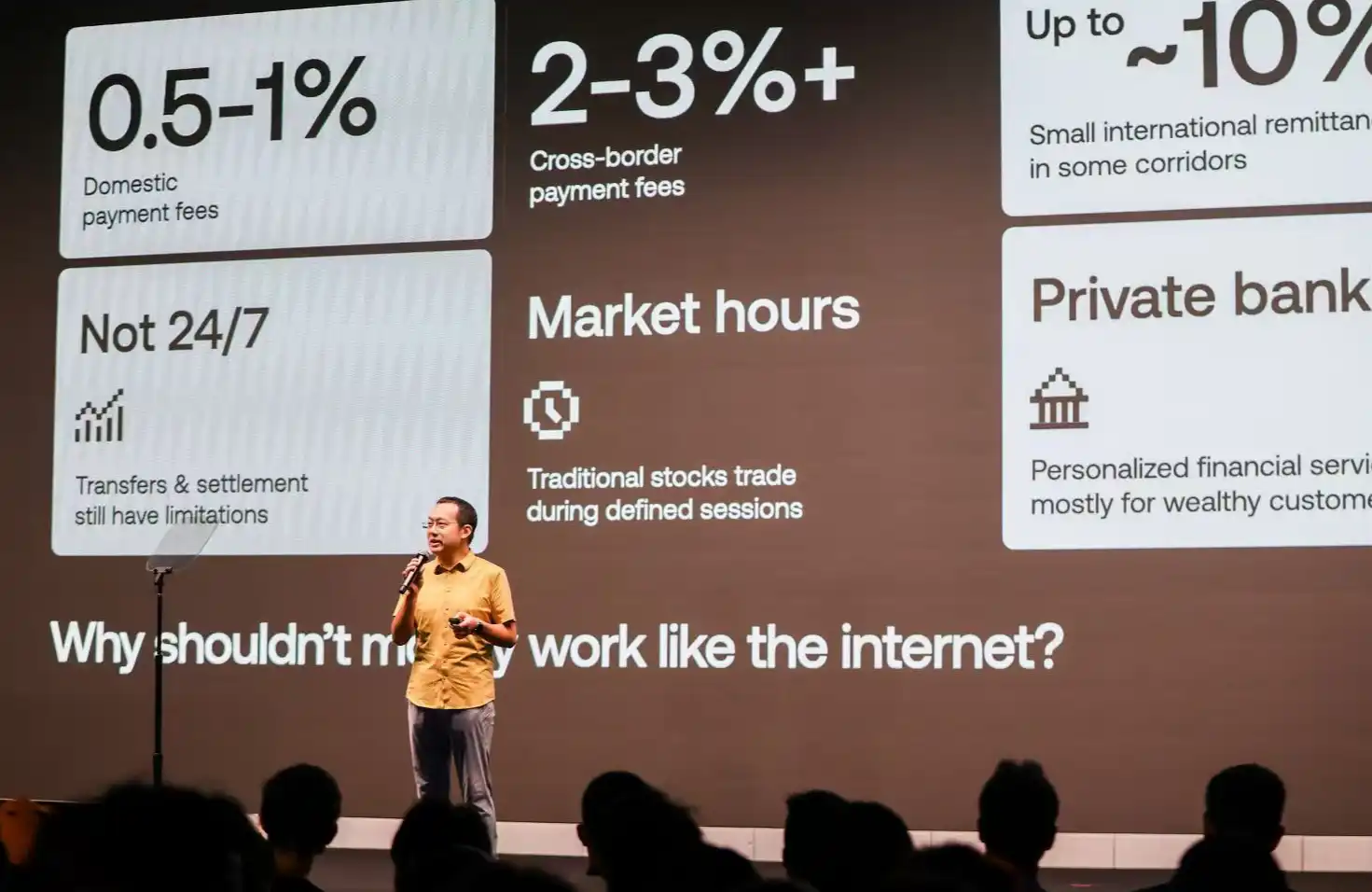
How much does it cost to launch a stablecoin?



Image Source: "The Epoch"
From Wall Street investment banks to Silicon Valley tech companies, and to Asian financial giants and payment platforms, more and more businesses have set their sights on the same venture — stablecoin issuance.
With economies of scale, stablecoin issuers' marginal issuance cost is close to zero, making it look like a risk-free arbitrage game to them. In the current global interest rate environment, the yield spread is incredibly attractive. Stablecoin issuers simply need to deposit users' dollars into short-term U.S. Treasuries, earning a stable 4-5% yield each year, raking in billions of dollars effortlessly.
Tether and Circle have long proven the viability of this path. As stablecoin regulations in different regions are gradually introduced, the compliance route has become clearer. More and more businesses are eager to try it out, with even FinTech giants like PayPal and Stripe swiftly entering the scene. Not to mention that stablecoins inherently possess the ability to integrate with payments, cross-border settlements, and even Web3 scenarios, presenting tremendous possibilities.
Stablecoins have indeed become a battleground for global financial companies.
However, the issue lies here — many only see the seemingly risk-free arbitrage logic of stablecoins but overlook that this is a capital-intensive, high-threshold business.
If a company wants to lawfully and compliantly issue a stablecoin, how much money do they actually need to spend?
This article will break down the true cost behind a stablecoin and tell you whether this seemingly straightforward arbitrage business is truly worth it.
The Costs Behind Stablecoin Issuance
In the minds of many, issuing a stablecoin is merely creating an on-chain asset, seemingly not a high-threshold task from a technical perspective.
However, to legitimately and globally launch a stablecoin, the organizational structure and system requirements behind it are far more complicated than imagined. It involves not only financial licenses and audits but also fund custody, reserve management, system security, and ongoing operations, requiring substantial capital investment across multiple dimensions.
In terms of cost and complexity, the overall construction requirements are no less than those of a medium-sized bank or a compliant trading platform.
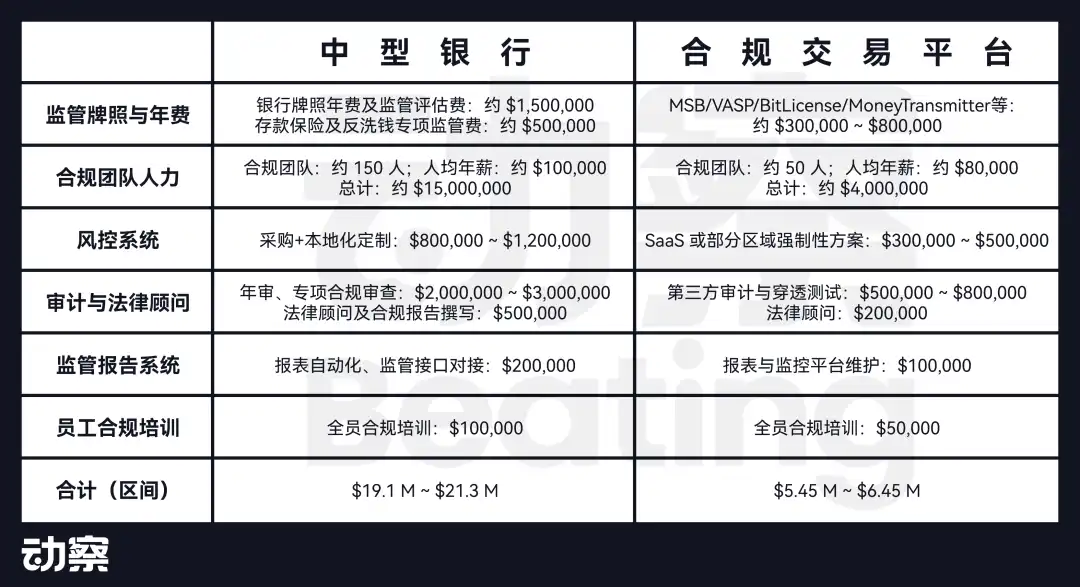
The first hurdle facing stablecoin issuers is the establishment of a compliance framework.
They often need to simultaneously address regulatory requirements from multiple jurisdictions, obtaining key licenses such as the U.S. MSB, New York BitLicense, EU MiCA, Singapore VASP, and others. Behind these licenses lies detailed financial disclosure, anti-money laundering mechanisms, and ongoing monitoring and compliance reporting obligations.
Comparable to a mid-sized bank with cross-border payment capabilities, stablecoin issuers face annual compliance and legal expenses reaching millions of dollars just to meet the basic qualifications for cross-border operations.
In addition to licenses, the establishment of KYC/AML systems is also a mandatory requirement. Project teams typically need to engage mature service providers, compliance advisors, and outsourcing teams to sustain a comprehensive set of mechanisms such as ongoing customer due diligence, on-chain surveillance, address blacklisting management, and more.
In today's increasingly stringent regulatory environment, without a robust KYC and transaction monitoring capability, gaining access to major markets is nearly impossible.
Market analysis indicates that HashKey's application for a Hong Kong VASP license may require a total sum of costs ranging from HK$20-50 million, along with the need for at least 2 responsible officers (RO) and collaboration with the big three accounting firms, resulting in costs several times higher than the traditional industry.
Apart from compliance, reserve management is also a key cost in stablecoin issuance, covering fund custody and liquidity arrangements.
Superficially, the asset-liability structure of stablecoins is not complex—users deposit dollars, and the issuer purchases equivalent short-term U.S. Treasury bonds.
However, once the reserve size surpasses $1 billion, or even $10 billion, the operational costs escalate rapidly. Solely fund custody may incur annual fees in the millions of dollars; and government bond trading, clearing processes, and liquidity management not only bring additional costs but also heavily rely on the collaboration and execution by professional teams and financial institutions.
More importantly, to ensure an "instant redemption" user experience, issuers must maintain sufficient off-chain liquidity positions to address large redemption requests during extreme market conditions.
This configuration logic is very close to the risk reserve mechanism of traditional money market funds or clearing banks, far more complex than a simple "smart contract lockup."
To support this architecture, issuers must also establish highly stable and auditable technical systems covering key financial processes both on-chain and off-chain. This typically includes smart contract deployment, multi-chain minting, cross-chain bridge configuration, wallet whitelisting mechanisms, clearing systems, node operations, security risk management systems, and API integrations, among others.
These systems not only need to support large-scale transaction processing and fund flow monitoring, but also need to have scalability to adapt to regulatory changes and business expansion.
Unlike the "lightweight deployment" of typical DeFi projects, the underlying systems of stablecoins essentially play the role of a "public settlement layer," with technology and operational costs consistently in the multimillion-dollar range.
Compliance, reserves, and system stability are the three major engineering foundations of stablecoin issuance, collectively determining whether a project can sustain long-term development.
Essentially, stablecoins are not a technological product but a financial infrastructure that combines trust, compliance architecture, and payment capabilities.
Only those enterprises that truly possess cross-border financial licenses, institutional-grade clearing systems, on-chain and off-chain technical capabilities, and controllable distribution channels have the potential to operate stablecoins as a platform-level capability.
It is for this reason that before deciding to enter this arena, enterprises must first assess whether they have the capacity to build a complete stablecoin system, including: Can they obtain ongoing recognition from multiple regulatory jurisdictions? Do they have a self-owned or trustable fund custody system? Can they directly control wallet, exchange platform, and other channel resources to truly connect the circulation end?
This is not a lightweight entrepreneurial opportunity but a tough battle that demands high capital, systemic, and long-term capabilities.
Issued a Stablecoin, What's Next?
Completing the issuance of a stablecoin is just the beginning.
Regulatory approvals, technical systems, custody structures—these are just the prerequisites for entry. The real challenge is how to make it circulate.
The core competitiveness of a stablecoin lies in "whether it is being used." Only when a stablecoin is supported by trading platforms, integrated into wallets, accessed by payment gateways and merchants, and ultimately used by users, can it be truly considered to have achieved circulation. And on this road, there are high distribution costs waiting for them.
In the insight into the Stablecoin Industry Chain released by Beating in collaboration with the self-custody service provider SafeHeron, issuing a stablecoin is only the starting point of the entire chain, and for a stablecoin to circulate, attention needs to be paid to the midstream and downstream.
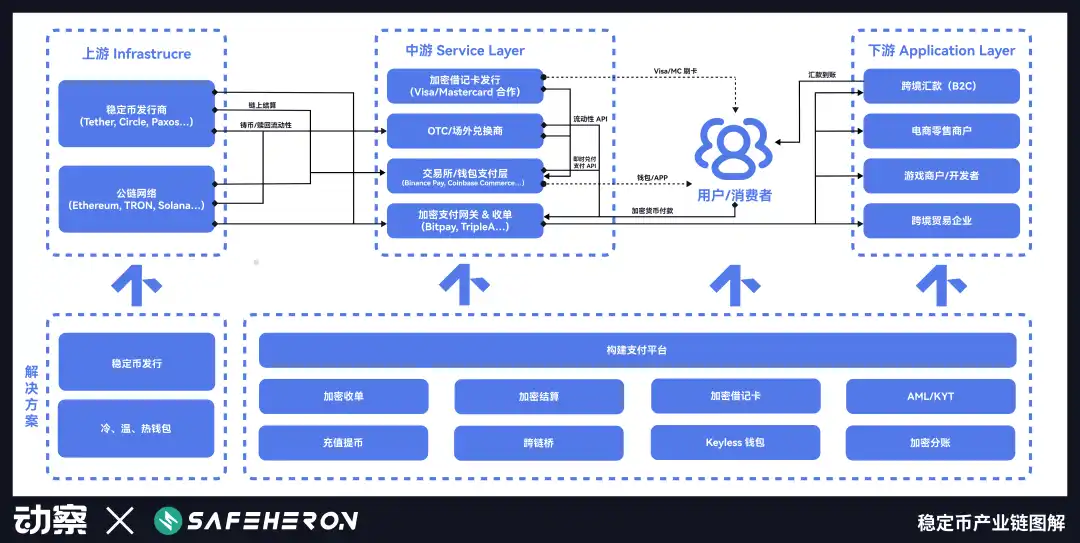
Taking USDT, USDC, and PYUSD as examples, it is clear to see three fundamentally different circulation strategies:
· USDT initially relied on grayscale scenarios to build an irreproducible network effect and, leveraging its first-mover advantage, rapidly established a market standard position;
·USDC primarily relies on channel partnerships within a compliant framework, gradually expanding relying on platforms like Coinbase;
while PYUSD, even with PayPal's backing, needs to rely on incentive mechanisms to drive TVL and has always struggled to penetrate real-world use cases.
Their paths may be different, but they both reveal the same fact—the competition of stablecoins lies not in issuance but in circulation. The key to success lies in their ability to build a distribution network.
1. USDT's Irreplicable First-Mover Structure
The birth of USDT stemmed from the real dilemma faced by cryptocurrency exchanges during that era.
In 2014, the Hong Kong-based cryptocurrency exchange Bitfinex was rapidly expanding globally, and traders wanted to trade with USD, but the platform consistently lacked a stable USD deposit channel.
The cross-border banking system was hostile towards cryptocurrencies, making it difficult for funds to flow between Mainland China, Hong Kong, and Taiwan, with accounts frequently being closed, leaving traders at risk of funds being cut off at any time.
In this context, Tether was born. Initially operating on Bitcoin's Omni protocol, it had a simple and straightforward logic—users wired USD to Tether's bank account, and Tether issued an equivalent amount of USDT on-chain.
This mechanism bypassed the traditional banking clearance system, enabling the "dollar" to circulate borderlessly 24/7 for the first time.
Bitfinex was Tether's first significant distribution node, and more importantly, both were actually operated by the same group of people. This deeply intertwined structure allowed USDT to rapidly gain liquidity and use cases in its early days. Tether provided Bitfinex with a compliant yet efficient USD channel. They colluded, shared information, and aligned interests.
Technically, Tether is not complex, but it addressed the pain points of cryptocurrency traders' fund inflow and outflow, becoming the key factor that initially captured user mindshare.
In 2015, as capital market volatility intensified, USDT's attractiveness grew rapidly. Many non-USD region users began seeking USD alternatives to bypass capital controls, and Tether offered them a "digital dollar" solution that required no account opening, no KYC, and was usable as long as there was an internet connection.
For many users, USDT was not just a tool but also a hedge.
The ICO boom in 2017 was a key moment for Tether to achieve PMF (Product-Market Fit). With the launch of the Ethereum mainnet, ERC-20 projects surged, and exchanges shifted to trading pairs of cryptographic assets, making USDT the "dollar substitute" in the altcoin market. By using USDT, traders could freely move between platforms like Binance and Poloniex to complete trades without the need for repeated fund transfers.
Interestingly, Tether has never actively spent money on promotion.
Unlike other stablecoins that adopted a subsidy strategy in the early stages to expand market share, Tether has never actively subsidized exchanges or users to use its services.
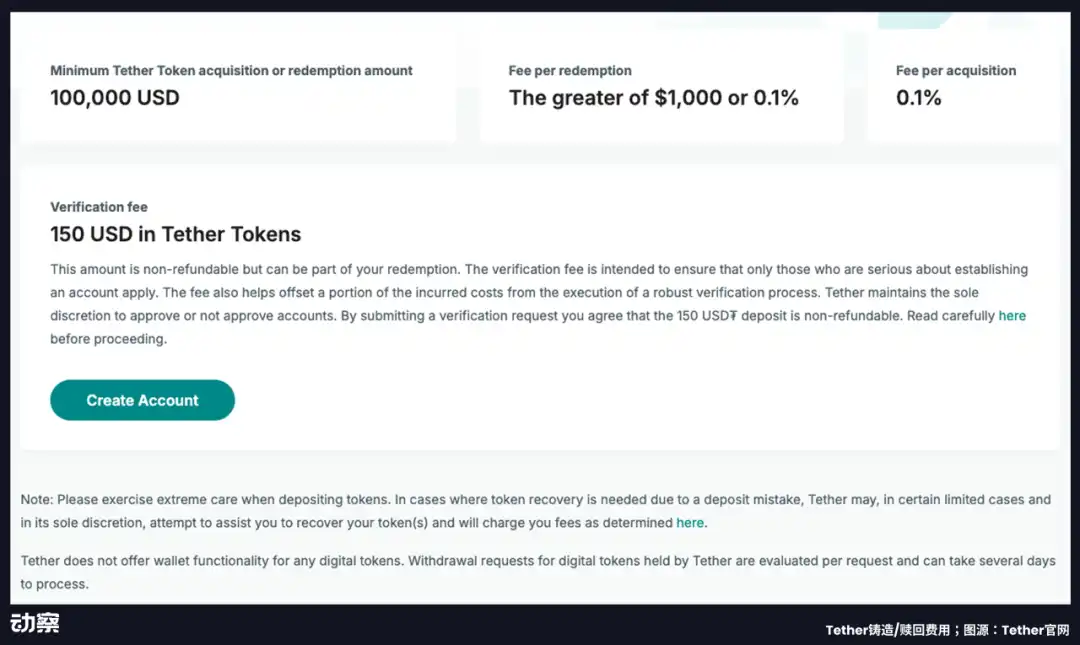
Instead, Tether imposes a 0.1% fee on each minting and redemption transaction, with a minimum redemption threshold of $100,000, and an additional 150 USDT validation fee.
For institutions wishing to directly integrate with its system, this fee structure has almost constituted a kind of "reverse promotion" strategy. It is not promoting the product, but rather setting standards. The cryptocurrency trading network has long been built around USDT, and any participant wishing to access this network must align with it.
By 2019, USDT had almost become synonymous with the "on-chain dollar." Despite repeated regulatory scrutiny, media questioning, and reserve controversies, USDT's market share and circulation continued to rise.
By 2023, USDT had become the most widely used stablecoin in non-dollar markets, especially in global southern countries. Particularly in high inflation areas such as Argentina, Nigeria, Turkey, Ukraine, USDT is used for salary settlements, international remittances, and even to replace local currencies.
The true moat of Tether has never been its code or asset transparency, but the trust path and distribution network it established in the early years within the Chinese-speaking cryptocurrency trading community. This network, starting in Hong Kong and using the Greater China region as a springboard, gradually extended to the entire non-Western world.
And this "first-mover-as-standard" advantage has also made Tether no longer need to prove to users who it is; instead, the market must adapt to the circulation system it has long established.
2. Why Circle Relies on Coinbase
Unlike Tether, which naturally grew in a grayscale scenario, USDC was designed from the beginning as a standardized, institutionalized financial product.
In 2018, Circle partnered with Coinbase to launch USDC, aiming to create a compliance-driven, institutional-grade "on-chain dollar" system for institutions and mainstream users. To ensure governance neutrality and technical collaboration, both parties held a 50% stake, establishing a jointly owned company named Center, responsible for the governance, issuance, and operation of USDC.
However, this governance-based funding model does not address the key question - how will USDC truly circulate?
……
Read the full article on Dynamic Monitoring's Official Account
Welcome to join the official BlockBeats community:
Telegram Subscription Group: https://t.me/theblockbeats
Telegram Discussion Group: https://t.me/BlockBeats_App
Official Twitter Account: https://twitter.com/BlockBeatsAsia