Data is the New Asset: DataFi is Pioneering a New Frontier

Original Article Title: "Data as an Asset: DataFi is Opening a New Blue Ocean"
Original Article Author: anci_hu49074, Biteye Core Contributor
“We are in an era where the world is competitively building the best foundational models. While computing power and model architecture are important, the true moat is the training data.”
—Sandeep Chinchali, Chief AI Officer at Story
Starting from Scale AI, Discussing the Potential of the AI Data Track
When it comes to the biggest gossip in the AI circle this month, nothing beats Meta showcasing its financial prowess, with Zuckerberg actively recruiting talent to build a high-profile Meta AI team primarily composed of Chinese scientific research talents. Leading this team is the 28-year-old Alexander Wang who founded Scale AI. He single-handedly created Scale AI, currently valued at $29 billion, serving not only the U.S. military but also competing AI giants such as OpenAI, Anthropic, Meta, etc., all of which rely on Scale AI's data services. The core business of Scale AI is to provide large amounts of accurate labeled data.
Why Can Scale AI Stand Out from the Crowd of Unicorns?
The reason lies in its early recognition of the importance of data in the AI industry.
Computing power, models, and data are the three main pillars of AI models. If we compare a large model to a person, the model is the body, computing power is the food, and data is the knowledge/information.
In the years since the rapid development of large language models (LLM), the industry's focus has also shifted from models to computing power. Nowadays, most models have established transformer as the model framework, occasionally innovating with techniques like MoE or MoRe. Major players either build super clusters for computing power or sign long-term agreements with powerful cloud services like AWS. Having secured the basics of computing power, the importance of data has gradually become more prominent.
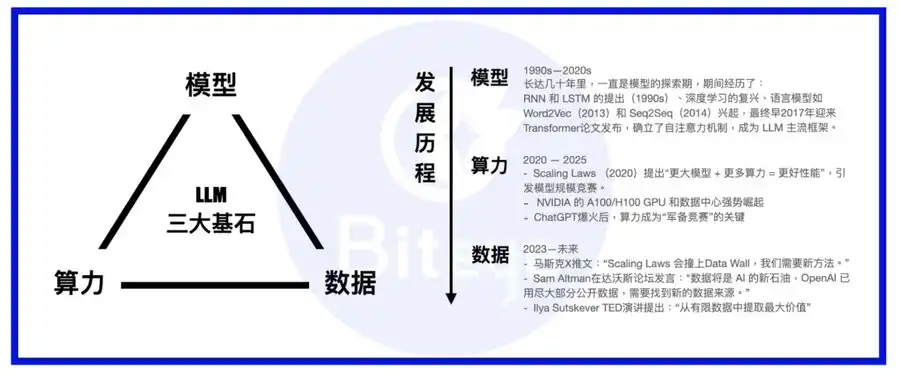
Unlike traditional well-known secondary-market B2B big data companies like Palantir, Scale AI, true to its name, is committed to building a solid data foundation for AI models. Its business goes beyond mining existing data and looks to the more long-term data generation business. It also aims to assemble AI trainer teams composed of experts from different fields to provide higher-quality training data for AI model training.
If you are skeptical about this business, then let's first take a look at how the model is trained.
The training of the model is divided into two parts — pre-training and fine-tuning.
In the pre-training part, it's a bit like the process of a human baby gradually learning to speak. What we usually need to do is feed the AI model a large amount of text, code, and other information obtained from web crawling. The model learns human language (academically known as natural language) through self-learning of this content, acquiring basic communication skills.
The fine-tuning part is like going to school to study, usually with clear rights and wrongs, answers, and directions. Schools will cultivate students into different talents based on their positioning. Similarly, we will train the model to have the desired capabilities through some preprocessed and targeted datasets.

By now, you may have already understood that the data we need is also divided into two parts.
· One part of the data does not need much processing, just an adequate amount, typically coming from sources such as Reddit, Twitter, Github, large UGC platform crawling data, public literature databases, enterprise private databases, etc.
· The other part, like a professional textbook, requires careful design and selection to ensure that it can cultivate specific good qualities of the model. This requires us to do some necessary work such as data cleaning, filtering, labeling, and human feedback.
These two parts of the dataset constitute the main body of the AI Data track. Do not underestimate these seemingly low-tech datasets. Currently, the mainstream view is that, as the advantage of computing power in Scaling laws gradually diminishes, data will become the most important pillar for various large model manufacturers to maintain their competitive edge.
As the model's capabilities continue to improve, various more refined and professional training data will become a key variable influencing the model's capabilities. If we further compare the model training to the development of a martial arts master, then high-quality datasets are like the most superior martial arts secrets (to complete this analogy, we can also say that computing power is a miraculous elixir, and the model itself is innate aptitude).
From a broader perspective, AI Data is also a long-termism track with snowballing capabilities. With the accumulation of early work, data assets will also have the ability to compound interest, becoming more valuable as they age.
Web3 DataFi: The Chosen Soil for AI Data
Compared to Scale AI's remote annotation team of hundreds of thousands in the Philippines, Venezuela, and other places, Web3 has a natural advantage in the AI data field, and a new term, DataFi, has emerged.
Ideally, the advantages of Web3 DataFi are as follows:
1. Data sovereignty, security, and privacy guaranteed by smart contracts
As existing public data is being exhausted for development, exploring undisclosed data, even private data, further is an important direction for expanding data sources. This poses a significant trust choice — whether to opt for a one-size-fits-all contract from a centralized large company, selling off your data, or choose a blockchain approach to continue holding onto your data IP while also being able to clearly and transparently understand through smart contracts: who, when, and for what purpose your data is being used.
Additionally, for sensitive information, there are methods such as zk, TEE, etc., to ensure that your private data is only handled by trustworthy machines and will not be leaked.
2. Natural geographic arbitrage advantage: A freely distributed architecture that attracts the most suitable labor force
Perhaps it's time to challenge traditional labor production relationships. Instead of searching worldwide for low-cost labor like Scale AI, it's better to leverage the distributed nature of blockchain and, through open and transparent incentive measures secured by smart contracts, allow a globally dispersed workforce to participate in data contribution.
For labor-intensive tasks such as data labeling, model evaluation, etc., compared to the centralized approach of establishing data factories, using the Web3 DataFi method also benefits from participant diversity, which has long-term significance in avoiding data bias.
3. Clear incentives and settlement advantages on the blockchain
How to avoid a "Riverside Leather Factory" tragedy? Naturally, it is to use a smart contract's clearly defined incentive system to replace the darkness of human nature.
In an inevitable deglobalization context, how to continue achieving low-cost geographic arbitrage? Setting up companies all over the world is evidently more challenging now, so why not bypass the barriers of the old world and embrace on-chain settlement methods.
4. Facilitates building a more efficient, open "one-stop" data market
"Middlemen profiting from the price difference" is a perpetual pain for both supply and demand sides. Instead of allowing a centralized data company to act as an intermediary, it is better to create a platform on the chain and, like an open-marketplace such as Taobao, enable more transparent and efficient connection of data supply and demand sides.
As the on-chain AI ecosystem develops, the on-chain data demand will become more vigorous, segmented, and diverse. Only decentralized markets can efficiently satisfy this demand and transform it into ecosystem prosperity.
For retail investors, DataFi is also the most favorable decentralized AI project for ordinary retail investor participation.
Although the emergence of AI tools has somewhat lowered the learning curve, the original intention of decentralized AI is to break the current giant's monopoly on the AI business. However, it must be admitted that many current projects are not very participatory for retail investors with no technical background—participation in decentralized computing power networks often comes with expensive upfront hardware investment, and the technical barriers in the model market easily deter ordinary participants.
In contrast, one of the few opportunities for ordinary users to seize in the AI revolution is that with Web3, you don't need to sign a contract with a data sweatshop; you just need to click your mouse to log in to your wallet and participate by completing various simple tasks, including: providing data, intuitively and instinctively labeling models, evaluating simple tasks, or further using AI tools for some simple creations, participating in data transactions, etc. For experienced users, the difficulty is close to zero.
Web3 DataFi Potential Projects
Where the money flows, the direction is there. In addition to the Scale AI receiving a $14.3 billion investment from Meta and Palantir's stock skyrocketing more than 5 times in a year in the Web2 world, in Web3 financing, the DataFi track has also performed exceptionally well. Here we will give a brief introduction to these projects.
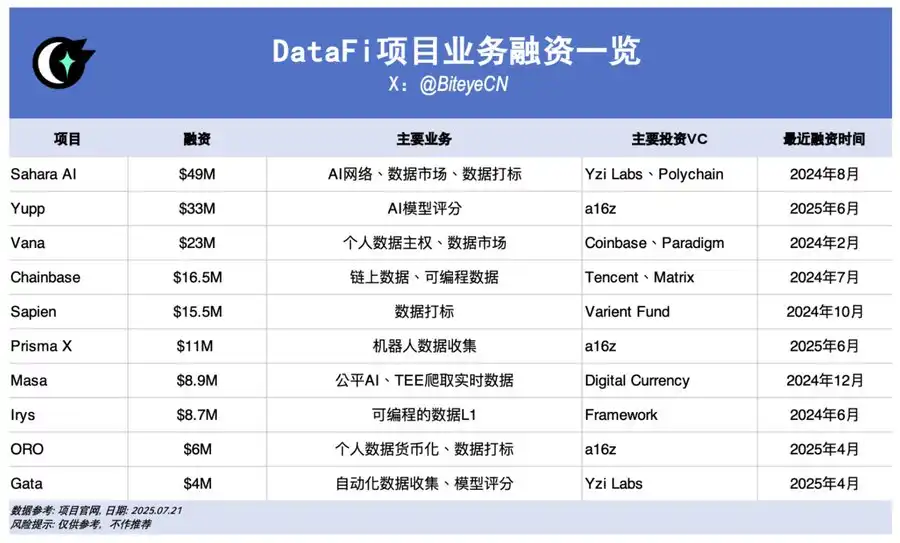
Sahara AI, @SaharaLabsAI, $49 million raised
The ultimate goal of Sahara AI is to build a decentralized AI super infrastructure and trading market, with the first pilot being AI Data. Its Data Services Platform (DSP) beta will go live on July 22, where users can earn token rewards by contributing data and participating in data labeling tasks.
Link: app.saharaai.com
Yupp, @yupp_ai, $33 million raised
Yupp is a platform for AI model feedback, primarily collecting user feedback on model outputs. The main task currently is for users to compare outputs from different models on the same prompt and then select which one they personally believe is better. Completing tasks can earn Yupp points, which can be further exchanged for USDC and other fiat-pegged stablecoins.
Link: https://yupp.ai/
Vana, @vana, Raised $23M
Vana's focus is on converting users' personal data (such as social media activity, browsing history, etc.) into monetizable digital assets. Users can authorize the upload of their personal data to the corresponding DataDAOs' Data Liquidity Pools (DLPs), where this data will be aggregated for tasks like AI model training, and users will receive token rewards.
Link: https://www.vana.org/collectives
Chainbase, @ChainbaseHQ, Raised $16.5M
Chainbase's business revolves around on-chain data, currently covering 200+ blockchains, transforming on-chain activities into structured, verifiable, and monetizable data assets for dApp development. Chainbase's business is mainly obtained through methods like multi-chain indexing, and the data is processed through its Manuscript system and Theia AI model, with low current user involvement.
Sapien, @JoinSapien, Raised $15.5M
Sapien aims to massively convert human knowledge into high-quality AI training data. Anyone can perform data annotation work on the platform, and through peer validation, ensure the data's quality. At the same time, users are encouraged to build long-term reputations or make commitments through staking to earn more rewards.
Link: https://earn.sapien.io/#hiw
Prisma X, @PrismaXai, Raised $11M
Prisma X aims to be an open coordination layer for robots, where physical data collection is key. This project is currently in its early stages, and based on a recently released whitepaper, participation may involve investing in robot data collection and remotely operating robot data. There is currently an open quiz activity based on the whitepaper where you can participate to earn points.
Link: https://app.prismax.ai/whitepaper
Masa, @getmasafi, Raised $8.9M
Masa is one of the flagship subnetwork projects in the Bittensor ecosystem, currently operating the 42nd Data Subnet and the 59th Agent Subnet. The Data Subnet aims to provide real-time access data, mainly where miners crawl real-time X/Twitter data via TEE hardware. For ordinary users, participation is challenging both in terms of difficulty and cost.
Irys, @irys_xyz, $8.7M Funding
Irys focuses on programmable data storage and computation, aiming to provide efficient and low-cost solutions for AI, decentralized applications (dApps), and other data-intensive applications. Regarding data contribution, currently, there are not many opportunities for regular users to participate, but there are multiple activities available to participate in during the current testnet phase.
Link: https://bitomokx.irys.xyz/
ORO, @getoro_xyz, $6M Funding
ORO's goal is to empower ordinary people to contribute to AI. Supported methods include: 1. Linking personal accounts to contribute personal data, including social accounts, health data, e-commerce, and financial accounts; 2. Completing data tasks. The current testnet is live and participation is possible.
Link: app.getoro.xyz
Gata, @Gata_xyz, $4M Funding
Positioned as a decentralized data layer, Gata has launched three key products to participate in: 1. Data Agent: a series of AI Agents that automatically run to process data as long as the user opens the webpage; 2. AII-in-one Chat: a mechanism similar to Yupp's model evaluation to earn rewards; 3. GPT-to-Earn: a browser plugin that collects user conversation data on ChatGPT.
Link: https://app.gata.xyz/dataAgent
https://chromewebstore.google.com/detail/hhibbomloleicghkgmldapmghagagfao?utm_source=item-share-cb
How to view these projects at present?
Currently, the barriers to entry for these projects are generally not high. However, it must be recognized that once user accumulation and ecosystem stickiness are achieved, platform advantages will accumulate rapidly. Therefore, early-stage efforts should focus on incentive measures and user experience. Only by attracting a sufficient number of users can these platforms succeed in the data business.
However, as labor-intensive projects, these data platforms, while attracting manpower, must also consider how to manage human resources and ensure the quality of data output. After all, a common problem with many Web3 projects is that most users on the platform are just ruthless free riders. In pursuit of short-term gains, they often sacrifice quality. If allowed to become the main user base of the platform, it will inevitably result in bad money driving out good, ultimately jeopardizing data quality and failing to attract buyers. Currently, we see projects like Sahara and Sapien emphasizing data quality, striving to establish long-term healthy partnerships with labor on the platform.
Furthermore, lack of transparency is another issue with current on-chain projects. Admittedly, the blockchain trilemma has forced many projects in their early stages to take a path of "centralization driving decentralization." However, an increasing number of on-chain projects now give the impression of being more like "Web2 projects disguised in Web3 clothing" — with scarce publicly available on-chain traceable data, and even the roadmap does not clearly show a public, transparent long-term commitment. This opacity is undoubtedly detrimental to the long-term healthy development of Web3 DataFi, and we also look forward to more projects staying true to their original intentions and accelerating their open, transparent pace.
Lastly, the path to mass adoption of DataFi must be viewed in two parts: one is to attract a sufficient number of ToC participants to join this network, forming the backbone of data collection/generation engineering and the consumers of the AI economy, creating an ecosystem loop; the other part is to gain recognition from current mainstream ToB corporations, as in the short term, their deep pockets are the main source of large data contracts. In this regard, we have also seen good progress from Sahara AI, Vana, and others.
Conclusion
From a deterministic standpoint, DataFi nurtures machine intelligence with human intelligence in the long term, while using smart contracts as a covenant to ensure that human intelligence's labor is rewarded and ultimately benefits from machine intelligence.
If you are anxious about the uncertainty of the AI era, if you still hold blockchain ideals amidst the fluctuations of the crypto world, then following in the footsteps of many capital giants and joining DataFi is undoubtedly a timely and wise choice.
This article is contributed content and does not represent the views of BlockBeats.
Welcome to join the official BlockBeats community:
Telegram Subscription Group: https://t.me/theblockbeats
Telegram Discussion Group: https://t.me/BlockBeats_App
Official Twitter Account: https://twitter.com/BlockBeatsAsia

 Related Articles