



What are the key components of the "Build Back Better Act" that infuriated Musk?

Original Article Title: "US$3.3 Trillion Tax Cut, US$5 Trillion Debt Limit, Musk Furious: Analyzing Trump's 'Big and Beautiful Bill Act'"
Original Source: TechFlow by DeepWave
Editor's Note: On July 2, US President Trump's proposed "Beautiful Big Bill Act" passed in the Senate, but the bill failed to include key tax amendment provisions that could have benefited cryptocurrency users. In the final hours of negotiations, senators and industry policy leaders supporting cryptocurrency raced against the clock to try to include an amendment for cryptocurrency tax benefits in the bill, benefiting stakeholders such as stakers, miners, large holders of crypto assets, and ordinary digital asset users. However, it ultimately failed due to lack of time. A cryptocurrency policy leader expressed regret over this outcome, calling it a "missed opportunity" for the industry. The following is a detailed analysis of this bill:
US$3.3 trillion tax cut, US$1.13 trillion spending cut, 1118-page bill text... A super bill known as the "Big and Beautiful Bill Act 2025" (OBBBA) is reshaping the US economic landscape, sparking a new bipartisan dispute and even leaving Musk "furious." On July 1, Musk posted on the social platform X, stating that if the current "crazy spending bill" is passed ("Big and Beautiful Bill Act"), he will establish the "America Party" the next day to protest against this bill.
As a hallmark policy of Trump's second term, this bill can be described as "all-encompassing." It carries the ambitions of the Republican Party and ignites intense social controversy. This article will delve into the core content of the "Big and Beautiful Bill Act," the discussions it has sparked, and its potential impact on the cryptocurrency industry, uncovering the full picture of this legislative storm.
Big Bill
The "Big and Beautiful Bill Act" is a large-scale tax and spending bill promoted by US President Donald Trump in 2025, covering six major areas including tax reform, healthcare reform, immigration policy, defense budget, energy policy, and education and welfare reform.
As a landmark legislation in Trump's second term, it seeks to stimulate the economy through large-scale tax cuts, increased spending, and policy adjustments while addressing fiscal, immigration, and national security issues. The bill text spans 1118 pages, containing 237,327 words, and involves multiple complex provisions. During Senate deliberation of the bill, reading the text verbatim took 16 hours. According to a BBC report summarized on June 28, the core aspects of the "Big and Beautiful Bill Act" include the following nine areas:

According to the Tax Foundation's calculation, the "Big and Beautiful Act" is expected to reduce federal tax revenue by approximately $3.3 trillion through tax cuts from 2025 to 2034 (dynamically estimated), while increasing defense spending by about $150 billion, mainly for missile defense, ammunition, and shipbuilding. At the same time, the act will also significantly cut spending by about $1.13 trillion, including an $800 billion cut to Medicaid and $330 billion in savings from student loan program reforms.
On the economic front, the act is projected to increase long-term GDP growth by 0.6%, but capital stock and pre-tax wages are expected to decrease by 0.2% and 0.1%, respectively, with employment increasing by approximately 794,000 full-time positions. Ultimately, the act is expected to increase the deficit by $3.3 trillion from 2025 to 2034, potentially posing fiscal sustainability risks in the long run due to high interest rates and crowding out effects on private investment.
Furthermore, the Congressional Budget Office (CBO) estimates that if the act is implemented in the House version, U.S. debt would increase by $2.4 trillion, and the purchasing power of the bottom 10% of households would decrease by 4% from 2026 to 2034, while the purchasing power of the top 10% of households would increase by nearly 3%, sparking controversy over "robbing the poor to benefit the rich."
But the controversy goes far beyond that.
Major Controversy
The "Big and Beautiful Act" was first unveiled by the U.S. House Ways and Means Committee on May 12, 2025, passed the House by a slim margin of 215 to 214 on May 22, and passed the Senate by a procedural vote of 51 to 49 on June 28, entering formal deliberation, with an expected signing into law by Trump on July 4, before the U.S. Independence Day holiday. Due to its large scale, complex content, and profound impact, it has become a focal point of American politics and public opinion, sparking widespread controversy and intense debate.
Supporters of the act see it as a core agenda of the Trump administration. They believe that through tax cuts and increased defense spending, the act will stimulate economic growth and enhance national security, especially with some voters supporting the tough immigration and border policies.
However, there is a clear division within the Republican Party, with some hardliners calling for further cuts to social welfare spending, while moderates hope to retain programs like healthcare subsidies, expressing concerns that the act may lead to increased deficits and impact low-income groups. In the two votes on May 22 and June 28, the act passed by a narrow margin, demonstrating the split in party opinions.
Beyond just intra-party divisions, what is more widely known is actually the strong opposition to this bill from the former head of the Department of Government Efficiency (DOGE) and Tesla founder, Elon Musk. Based on this bill, Musk's public feud with President Trump is seen as a landmark event marking a clear rupture between the two. Since June 3, he has referred to it as "vast in scale, absurdly ridiculous, and extremely distasteful," and even after the most recent procedural vote on June 28, he still firmly believes it is a "political suicide" for the Republican Party.
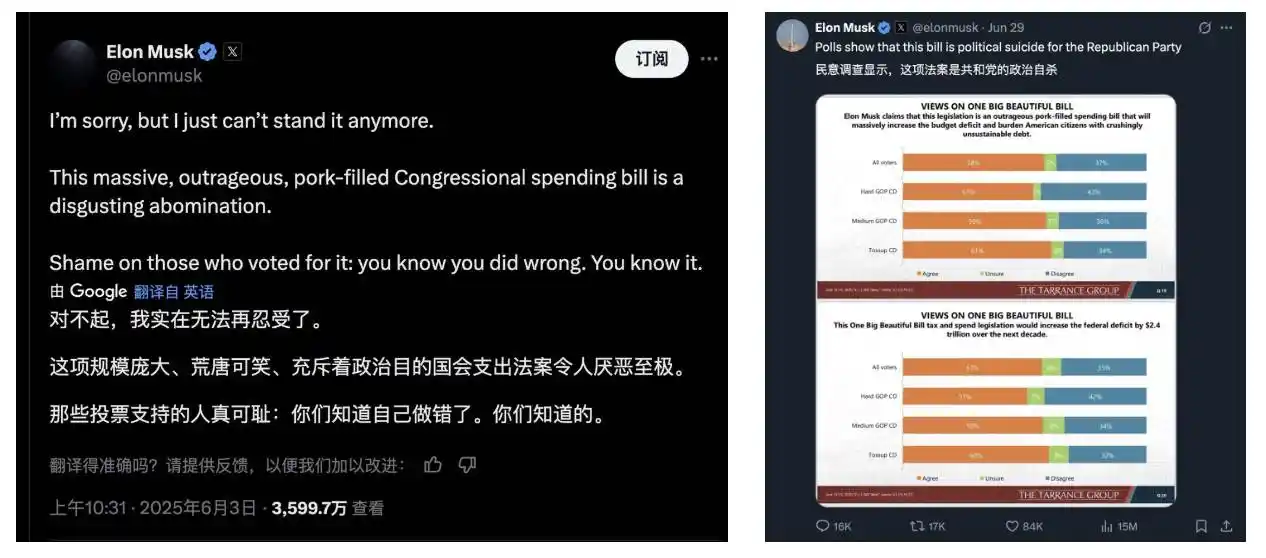
Musk criticizes the bill for leading to a significant increase in the budget deficit, with an expected increase of $600 billion in the next fiscal year and a potential cumulative total of $2.5 trillion over the next decade, contradicting the Trump administration's previous goal of reducing government spending.
Furthermore, the provision in the bill to gradually phase out the electric vehicle tax credit could have a negative impact on Tesla, exacerbating Musk's dissatisfaction. He also proposed to transfer the Federal Aviation Administration's (FAA) air traffic control system to his "Starlink" operation, but this proposal was not adopted, further fueling controversy. Musk even threatened to fund primary challenges against Republican lawmakers who support the bill, highlighting his disagreement with Trump.
The Democratic Party is united in opposition to the bill, arguing that by cutting healthcare and welfare support for low-income groups to give tax breaks to the rich, it is a typical case of "robbing the poor to feed the rich." Senate Democratic leader Schumer requested a verbatim reading of the bill in the Senate to delay the vote, demonstrating a strong resistance. Nobel laureate in economics, Paul Krugman, also criticized the bill as an unprecedented case of robbing the poor to feed the rich, and pointed out that in conjunction with Trump's tariff policy, it would further harm the interests of the bottom 80% of households.
Public and media reactions have been polarized. Supporters believe the bill fulfills Trump's campaign promises, such as tax cuts and a tough immigration policy, while opponents are concerned that it may exacerbate social inequality and debt burden. Some users are also concerned about the potential issues of digital identity and big data surveillance that may arise after the bill is passed, sparking worries about privacy protection.
From an international perspective, foreign capital is cautiously optimistic about the bill, believing that its stimulus measures may partly offset the negative impact of the tariff policy on GDP, estimated at about 1%. However, the provision in the bill's Section 899 regarding "enforcement of remedies against unfair foreign taxation" involves retaliatory taxation, raising concerns about foreign investment motives and dollar stability.
Overall, the passage of the "Big and Beautiful Bill" has not only sparked widespread political and social controversy domestically in the United States but also had a profound impact on the international economic environment and investment confidence. Although the White House has issued a rumor versus fact article addressing most of the current controversies, the future implementation effects remain to be seen.
What's Cryptocurrency Got to Do with It?
Literally speaking, the widely known provision of the current massive and beautiful bill may weaken federal court power, devastate the healthcare system, increase debt burden, intensify immigration enforcement, restrict foreign investment, worsen air pollution, and boost defense budget, although the impact is extensive, it really has nothing to do with cryptocurrency.
However, the reality may be different. The passage of the "massive and beautiful" bill (OBBBA) is likely to have a profound impact on the cryptocurrency and financial industry. The 2024 Republican Party platform in the United States has explicitly included clauses supporting cryptocurrency, opposing excessive regulation, supporting the right of citizens to self-manage digital assets, reflecting the government's positive attitude towards the crypto industry. At the same time, the government's executive order establishing a "Strategic Bitcoin Reserve" and including Bitcoin in the national strategic reserve asset signify a fundamental elevation in Bitcoin's status.
The bill is expected to result in an additional $5 trillion deficit for the U.S. government, and this scale of fiscal expansion may weaken market trust in the U.S. dollar and U.S. bonds. Foreign selling of U.S. bonds has become a structural trend, with funds flowing into Asian stock markets, gold, and Bitcoin (BTC) after outflows, further enhancing Bitcoin's position as a global store of value asset, especially against the backdrop of Bitcoin being included in the U.S. strategic reserve asset.
Meanwhile, the tax reduction policies and fiscal stimulus measures in the bill have created a more favorable macro environment for crypto assets. Capital gains tax incentives encourage investors to hold digital assets long-term, injecting long-term funds into the cryptocurrency market and further solidifying the U.S.'s position as a global cryptocurrency hub.
On June 11, 2025, Cahill released an analysis report on the upcoming cryptocurrency asset legislative amendment. The report stated that this "expected amendment to be proposed by Republican Senator Cynthia Lummis of Wyoming," "an unreleased digital asset legislative proposal," is "planned to be included as an amendment to the massive and beautiful bill."
This bill involves specific provisions in subfields such as mining, staking, airdrops, cross-border transactions, as well as the formulation of inclusive policies such as the $600 minimum limit and taxation of foreign investors, reflecting the regulator's cautious stance in balancing industry development and tax management.
Market trends show that since May, over 100,000 BTC have flowed out from platforms like Coinbase, and the continued accumulation by whales indicates a strong long-term bullish sentiment in the Bitcoin market. Whether it's the balance between tax cuts and deficits, the toughening of immigration policies, or the potential impact on cryptocurrency and financial markets, they will continue to shape the economic and social landscape of the United States in the coming years.
The past is already visible, but the beauty is yet to be revealed.
Welcome to join the official BlockBeats community:
Telegram Subscription Group: https://t.me/theblockbeats
Telegram Discussion Group: https://t.me/BlockBeats_App
Official Twitter Account: https://twitter.com/BlockBeatsAsia







