《The New York Times》: In ‘Big Beautiful Wall’ Bill, Trump Imposes Voting Authority With Presidential Might

Original Title: Why a Bill Nobody Loves Feels Inevitable
Original Authors: Jess Bidgood, Catie Edmondson, The New York Times
Translated by: DeepTech TechFlow
Trump has referred to his signature domestic legislation as the "One Big Beautiful Bill," but its path to enactment has been anything but smooth.
The bill aims to extend the 2017 tax cuts and pay for those cuts by cutting funds to the social safety net. In the House, the bill almost didn't pass; in the Senate, it was heavily amended. In recent days, a key Senate official vetoed multiple provisions in the bill, whose role is to ensure lawmakers comply with budget rules, forcing senators to scramble to reintroduce parts of it.
Furthermore, as my colleagues Carl Hulse and Catie Edmondson wrote today, no one really likes this bill.
But this is Trump's Washington. Here, not knowing the specifics of a bill or lacking enthusiasm for it — such "minor issues" — may not be enough to deter Senate Republicans from voting in favor of it, possibly as soon as this weekend.
I consulted with Catie on the bill's convoluted journey — how it became a policy "hodgepodge," why it has unsettled many Republicans, and why these issues may not greatly affect its prospects of becoming law.
Republicans are working to salvage parts of the bill that Senate parliamentarian deemed to violate budget reconciliation rules. You've covered Congress since the early days of the Trump administration and witnessed many legislative "sausage-making" processes. Is this kind of chaos normal?
To some extent, this is indeed a familiar sight in the legislative process, with both parties having faced similar challenges in the past. For example, when Democrats used budget reconciliation to pass President Biden's "Lowering Inflation Act" and pandemic relief package, lawmakers also struck down key provisions, including a proposal to raise the federal minimum wage.
However, on the other hand, I do think this back-and-forth illustrates how this legislation has morphed into a "policy hodgepodge," where some elements have little to do with the budget. The bill includes tax cuts, cuts to Medicaid and nutrition assistance programs, but also provisions banning states from regulating artificial intelligence, relaxing certain gun laws, and selling off public lands.
What Role is Trump Playing? Have His Actions — or Lack Thereof — Exacerbated the Chaos?
Yesterday, President Trump worked the phones from the White House in support of the bill, but so far we haven’t seen him get deeply involved in the lobbying effort. The “game plan” on the Hill is usually to have him swoop in at the last minute of a key vote to try to persuade those final holdouts.
At the same time, there’s a recurring dynamic at play here: Lawmakers who are on the fence about the bill call the president seeking his backing for their stance. Trump typically tells them he agrees with them. This has made it harder for lawmakers to pin down what he truly wants, as his position can shift with these conversations.
Right now, this is especially playing out on the issue of Medicaid. Some senators feel the Senate plan goes too far in cutting Medicaid. That includes Missouri Senator Josh Hawley, who along with others brought this concern to the president. Hawley came back saying Trump told them he prefers the House plan because it preserves more Medicaid projects.
The Medicaid debate is just one of several intraparty struggles playing out around this bill. What other rifts within the party have been exposed?
The Medicaid debate is part of a broader discussion about the extent of federal spending cuts. Early on in the process, some fiscal conservatives in both the House and the Senate said they wouldn’t vote for anything that increased the deficit, hoping to offset the revenue loss from tax cuts with new spending cuts. However, that didn’t happen in either chamber. Both bills would add trillions to the deficit. That’s clearly not the policy path these fiscal conservatives hoped to take with control of both Congress and the White House.
Does Anyone Really Like This Bill?
Republicans feel they need to pass this legislation because if they don’t extend the 2017 tax cuts, everyone’s taxes go up. The bill also includes new tax breaks for tips and overtime, something Trump promised to do during his campaign. But beyond that, they are essentially building on the status quo — the 2017 tax cuts — while making deep cuts to some very popular social welfare programs.
If you’re preparing to run for re-election in a politically moderate state or district, you know Democrats will hammer you on the cuts to Medicaid and food assistance in this bill. Many Republican lawmakers have already heard these concerns from constituents at town hall meetings.
So, will all of this discussion we've had—the various reasons why Republicans dislike this bill and the challenges they face in keeping the bill intact—truly threaten its chances of passage?
I don't think so, although it may make their timeline more complex and could alter the specifics of the final bill. Since the House passed its version, this bill has seemed inevitable.
They may end up passing a politically risky and universally disliked bill. Why?
This is a vote that carries political risk, but it's not in service of some grand political vision, making it different from some tough votes both parties have faced in the past. But this is what Trump has asked for.
I think there is a widespread sense within the Republican Party that they could lose the House majority in the midterm elections—a very real possibility based on historical trends—meaning their time to pass major legislation is limited. And they do feel an ideological urgency to continue the 2017 tax cuts. All of these factors, plus the fact that this bill is fundamentally a simple vote of support or opposition to the president's agenda, make the chances of this bill outright failing very slim.

How much will the "big and beautiful" bill actually cost? That depends on how you count—and where you start counting. I consulted my colleague Andrew Duehren, who covers tax policy, about this, and he swears that digging into these details is actually quite fun. He explained to us the budget "tricks" the Republicans are trying to use to make the numbers look better on paper.
Any budget requires assumptions about the future. For example, how much will I spend on groceries next month? Will I get a raise at work? The answers to these questions can help you answer other questions, like, Can I afford this vacation?
The way Washington works is similar, just on a much larger scale. Over time, Republicans and Democrats have agreed on a set of assumptions about the future national budget—assuming no additional policy changes. They use this as a baseline to determine if they can afford certain policies, like tax cuts.
Senate Republicans want to change how Washington makes these assumptions about the future. For decades, temporary tax policies have been seen as a kind of special expenditure; the usual assumption is that over the long term, these tax policies will expire, taxes will revert to their original level, and government revenue will increase as a result.
But Senate Republicans believe this assumption is wrong. They argue for incorporating the temporary tax policies passed in 2017 into the long-term budget assumptions. If these tax policies are redefined in this way, then extending them (as they hope to do with this bill) doesn't look like new spending.
This is like when you initially thought renting a luxury car was just a short-term splurge, but when the lease was up, you didn't opt for a cheaper option. Instead, you told yourself: I always planned to pay a higher car fee, so I can totally rent another luxury car.
Haiyun Jiang/The New York Times
Arrival and Departure
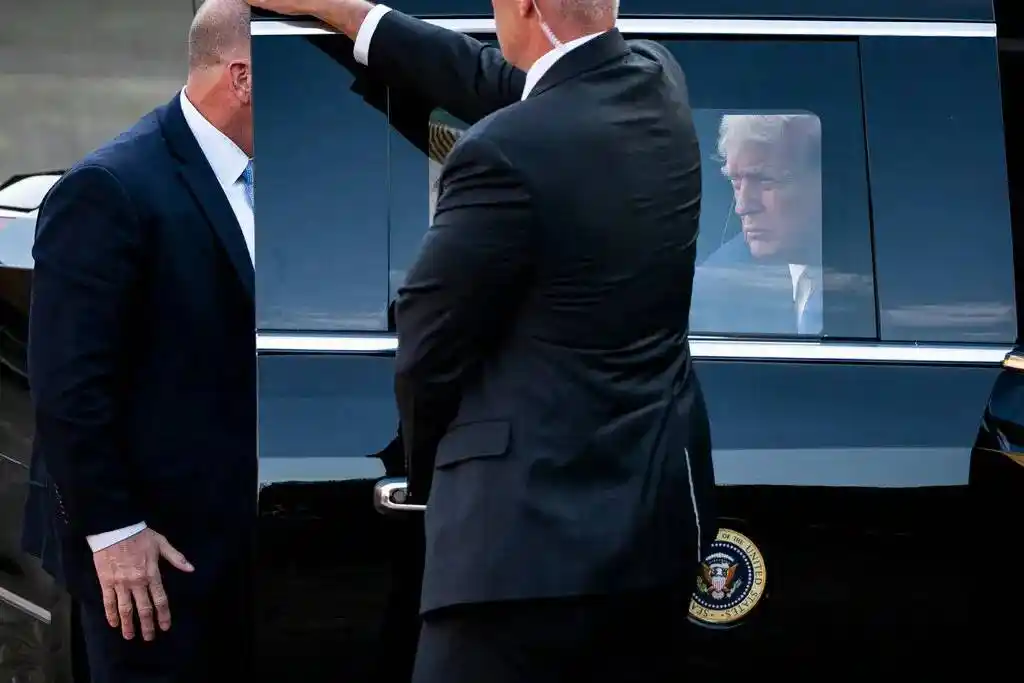
The New York Times's latest photojournalist, Haiyun Jiang, has a special affinity for photos that can tell a story of power. This week, traveling with former President Trump to The Hague, she captured such a moment.
On Tuesday night, Haiyun, along with other photojournalists, waited for Trump to arrive at Huis ten Bosch Palace, a Dutch royal palace where Trump would meet the King and Queen of the Netherlands and spend the night. These highly ceremonial, grandiose, and royal-related events are just the kind of occasions Trump relishes.
As Trump arrived in an armored luxury car, Haiyun saw a prime opportunity to capture the presidential authority.
“I tried to frame his figure with the car window because I knew the Secret Service agents would open the door for him. I felt this was a way to capture power,” Haiyun told me.
Later, she seized another opportunity. As Haiyun and the other photojournalists were hurriedly escorted away from the scene, she noticed the palace guards had already begun clearing away the symbols of power.

Haiyun Jiang/The New York Times
Welcome to join the official BlockBeats community:
Telegram Subscription Group: https://t.me/theblockbeats
Telegram Discussion Group: https://t.me/BlockBeats_App
Official Twitter Account: https://twitter.com/BlockBeatsAsia

 Related Articles